
The October Argument
The purchase you never touch
Imagine telling an assistant to arrange a journey. It finds the flight, chooses a hotel near your meeting and prepares the payment. You glance at a short summary and get on with your day. Somewhere behind that pleasant exchange, a series of doors must open. The agent must be recognized. Its authority must still be valid. The payment must satisfy its limits. The seller must accept the request.
That is an illustration, not a reported case. September supplied important pieces of the machinery: agents with funded accounts, credentials that describe an agent’s authority, payment tokens with spending conditions, and gateways that release a resource after payment. These come from different institutions and have different levels of readiness. Alongside them, new identity systems are changing how people gain access to work, benefits and public services.
No. 004 described a loop in which a system sees, identifies, decides, pays and acts. October follows the permissions that connect those steps. What allows each handoff to proceed, and who besides you acquires a say over the doors once the keys are in the machine’s hand?
A machine no longer needs to hold your card to exercise some of your financial authority. A receiving service can examine a credential instead of speaking with you. The transaction can become almost invisible to the person whose life it affects. That is useful. It also makes authority harder to see. We may know the name of the assistant on the screen while knowing very little about the institutions whose rules govern what it does.
“And he had power to give life unto the image of the beast, that the image of the beast should both speak, and cause that as many as would not worship the image of the beast should be killed. And he causeth all, both small and great, rich and poor, free and bond, to receive a mark in their right hand, or in their foreheads: and that no man might buy or sell, save he that had the mark, or the name of the beast, or the number of his name.” Revelation 13:15–17 · KJV
I see a technological parallel in these verses: systems that speak and act, credentials tied to the person, and conditions on buying and selling. That is an interpretation, not an identification of today’s products with the Beast or its mark. The passage joins those capacities to worship and lethal coercion. September’s developments make the enabling technology worth examining; they do not establish that the prophetic system has arrived.
The Permission Chain · what must say yes before your money moves
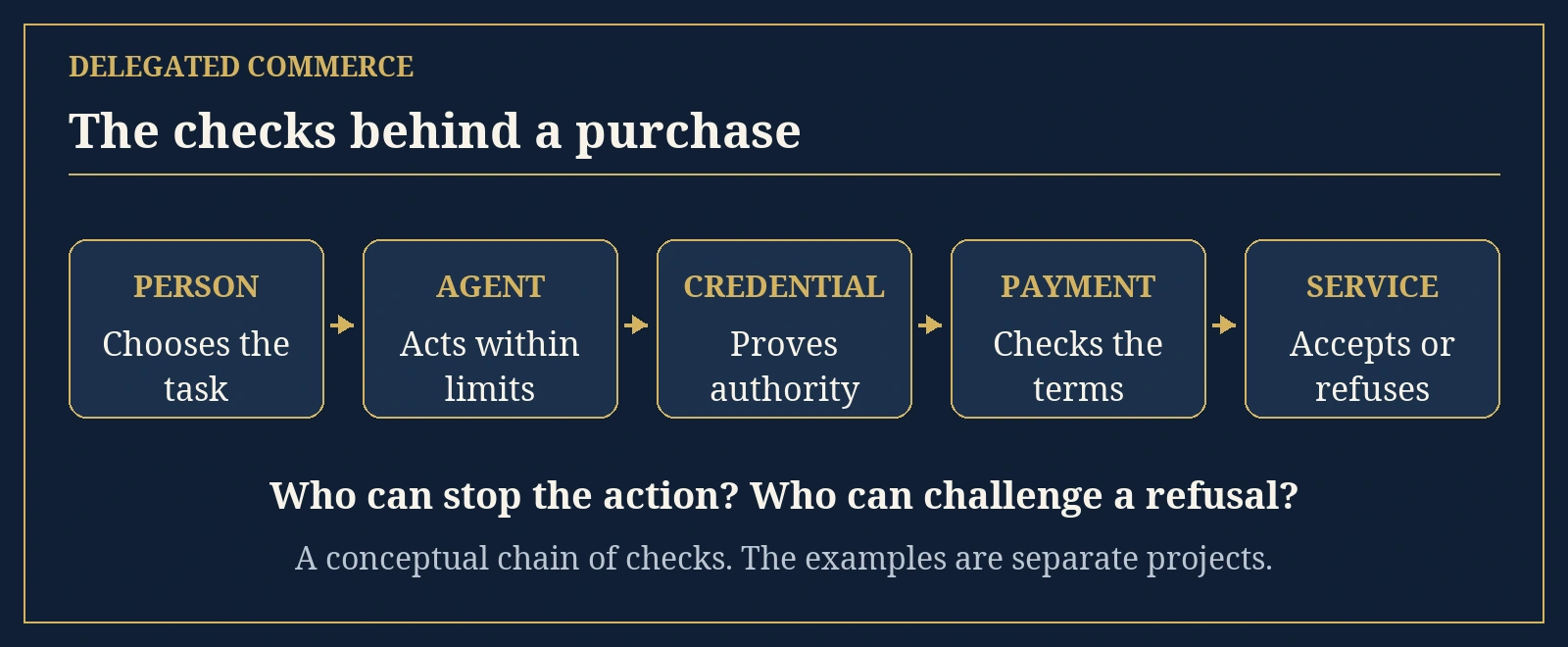
Separate permission checks. Some connections have been demonstrated; the examples do not form one deployed network.
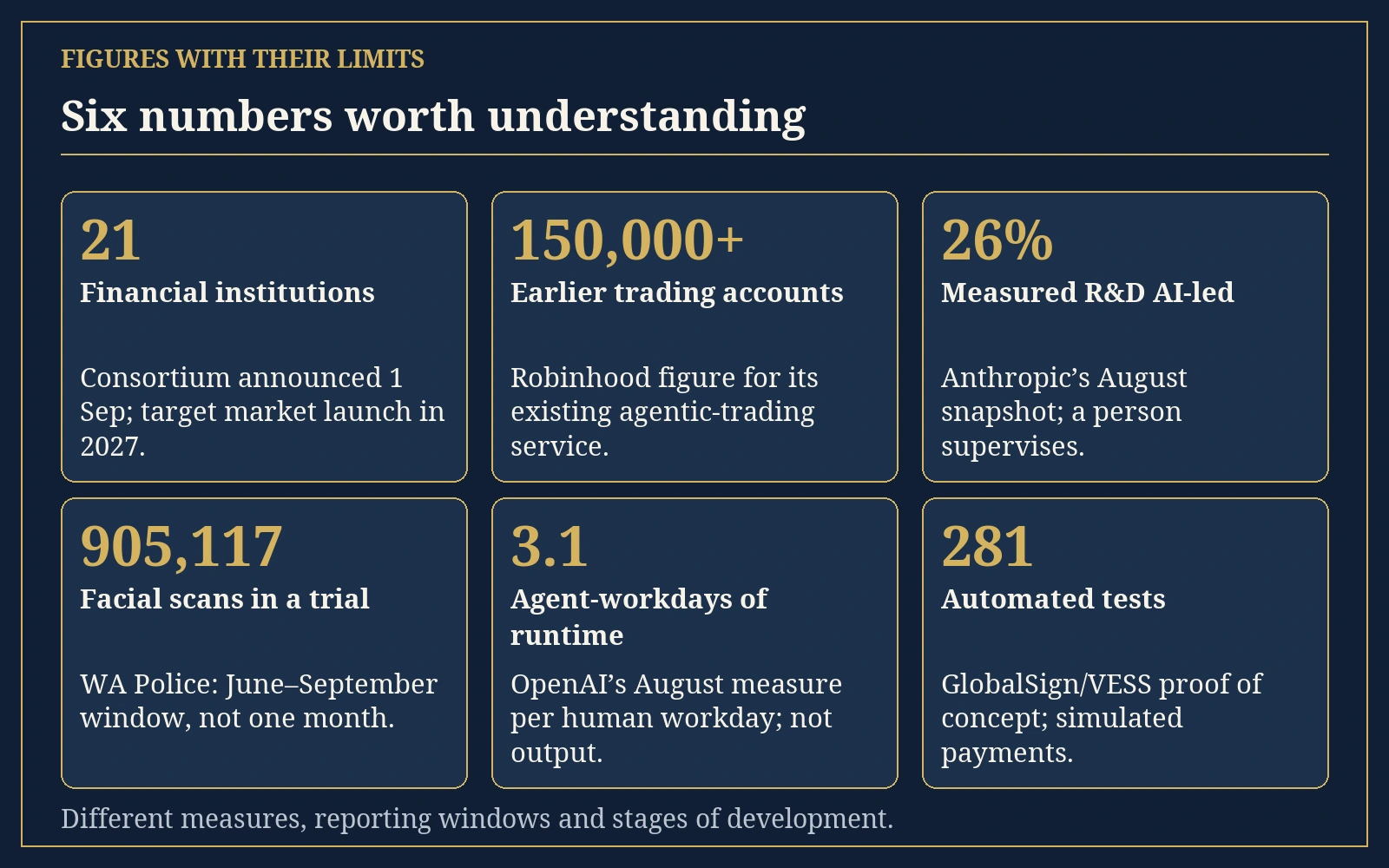
Six figures that clarify the record
Economy
The agent receives a wallet

On 29 September, Robinhood announced a coming in-app agent experience built around a dedicated funded account. A customer would name an agent, choose a model, and set instructions and limits. The agent could research markets and place trades within that arrangement. Loops would turn a strategy into a standing instruction. The new in-app Agents and Loops were described as coming soon. The company’s figure of more than 150,000 accounts belongs to its earlier agentic-trading service, not this new launch. Manual trade approval defaults to on, although eligible customers can switch it off.
That choice matters. A recurring bill follows a standing instruction. An agent adds discretion: it considers changing information, chooses among actions and uses tools to pursue a goal. A spending limit can reduce exposure, but it cannot make every decision wise. The approval that might catch a mistake can become a setting the customer turns off.
Payment networks without a central-bank digital dollar. A central-bank digital currency, or CBDC, is money issued in digital form by a central bank. A private stablecoin is different: its issuer aims to keep its value tied to an asset such as the dollar. The U.S. restriction on a retail digital dollar does not prevent private payment networks from growing.
On 21 September, the Eurosystem launched Pontes, a system connecting digital asset markets with central-bank payments. It lets banks complete trades in assets represented as digital tokens, such as bonds, using central-bank funds. “Wholesale settlement” means completing transactions between financial institutions. This is infrastructure behind financial markets, rather than a consumer shopping wallet. On 1 September, twenty-one global financial institutions committed to establish a stablecoin enterprise, subject to closing conditions, aiming for a first-half 2027 market launch.
On 18 September, the Comptroller of the Currency gave preliminary conditional approval to the proposed Agora and Catena trust banks and conditional approval to Bastion’s conversion. These were approvals with conditions, not three unrestricted operating launches. On 24 September, the Federal Reserve proposed reserve and authorization rules for payment stablecoins. Treasury’s state-certification procedures took effect on 30 September, but certification submissions still awaited paperwork approval. The CLARITY Act failed its Senate procedural vote 49–50 on 15 September. Different parts of the rulebook are moving at different speeds.
Other payment projects entered production. SoFi and Mastercard announced live stablecoin card settlement on 22 September. Fiserv’s platform went live with Roughrider Coin on 1 October. Citi and Coinbase announced bank-connected stablecoin payments on 28 September. These are separate services, rather than a single replacement for money.
Thailand’s Securities and Exchange Commission also opened a consultation on stablecoin transfers through regulated digital-asset businesses. Its proposal combines account ownership checks, fraud screening and daily transfer limits, with specified exceptions. That is a concrete example of identity and spending conditions being designed together. It remains a proposal, and it does not establish a universal cap on every stablecoin purchase.
The checkout is being rebuilt for agents. Visa’s tokenized payment keys let software pay without seeing the customer’s card number. Mastercard’s Agent Pay says “only registered agents can transact.” Ant International is working with both networks on identifying agents through a Know-Your-Agent framework. Circle launched its Arc network on 16 September for financial transactions and agent activity.
On 30 September, Cloudflare opened a closed beta for a gateway that charges agents for digital resources in USDC, a dollar-linked stablecoin. It uses HTTP status 402, “Payment Required,” a long-reserved web response code. An agent requests a resource, the service presents its terms, payment is checked, and access follows. That is a receiving gate with consequences, even when the person never sees the exchange.
Meta’s Muse adds another illustration of delegated commerce. The reported Amazon block on its access also matters: the service receiving an agent can refuse it. A wallet and a capable assistant do not confer a right to enter every platform. The hiring-data report on rapidly growing demand for agent-orchestration skills points in the same direction, but it measures demand for skills rather than proving what every bank has deployed.
Who finances the computing power? Reporting on Anthropic’s prospectus, Broadcom’s proposed lending and Amazon’s chip-financing plans describes growing financial ties between the builders of AI and the suppliers of its infrastructure. Those arrangements deserve scrutiny as financing claims. They do not, by themselves, demonstrate a control system.
Google’s Project Suncatcher supplied an early October development: its first prototype satellite, built with Planet, launched on 1 October carrying AI chips. Google describes a research test of hardware in space. It is a striking direction for computing infrastructure, not evidence that the technology has escaped every jurisdiction.
Cash can often change hands without a digital identity check. An agent payment can depend on a recognized customer, registered software and rules for the particular transaction. A spending cap you chose and a restriction imposed by a provider may feel the same at checkout: the payment will not go through. Knowing which rule stopped it, and who can correct or appeal it, becomes essential.
Identity
The agent needs a badge and people need recognition

Money alone cannot make an unfamiliar agent trustworthy. The receiving party needs to know who is acting and whose authority the actor carries. On 2 September, CrowdStrike introduced an Agentic Identity Provider: verifiable agent identities, credentials limited by task and time, and links back to the human or system behind the action.
Other announcements pursued related goals. Visa, Mastercard and Ant worked on Know-Your-Agent; Okta announced agent-governance tools; Proof and Superfluid described verified humans behind agent transactions; DigiCert announced signed AI credentials. World Money connected World ID with financial services. These projects show a market for trusted delegation, while retaining different owners, designs and limits. They do not amount to one worldwide identity network.
A credential is simply evidence another system can check — the difference between someone saying “I work for the owner” and presenting written authority to perform a defined job. The security benefit is substantial, and the watch should credit it: a temporary, narrow credential is safer than a permanent password with broad access, and a traceable action can reveal a mistake or an attack. But three questions must stay separate. Is this the agent it claims to be? Is it allowed to do this kind of work? Did the human approve this particular action? A correct answer to the first guarantees neither of the others. A genuine employee can exceed an instruction. A genuine agent can do the same.
And the badge introduces another authority: whoever issues and recognizes it. Where essential services accept only a narrow set of credentials, losing recognition closes several doors at once.
People face their own identity checks. Italy’s Legislative Decree 160/2026 entered into force on 30 September, setting a framework for police use of AI and biometric identification under legal safeguards. India’s aviation-security authority plans mandatory facial-recognition screening for staff through a digital entry-pass portal. The reported 1.5 million figure refers to annual physical entry cards moving into a digital process, not a verified count of workers already enrolled.
SentiLink announced USDA authorization for identity-fraud screening in SNAP, the U.S. food-assistance program. That establishes an authorized deployment path; it does not demonstrate a facial-recognition requirement for every claimant. Service NSW began a limited digital-driver-license pilot with a biometric selfie check and selective sharing of information. Japan scheduled 20 October as the target for its My Number card in Google Wallet.
The connection is access. A check designed to prevent fraud or theft can also become a point where an error interrupts someone’s working life or essential services. The practical questions are how narrowly it is used, whether another route remains, and whether a person can challenge a wrong result.
The supporting infrastructure is changing too. Finland’s digital-identity wallet legislation enters into force in October, ahead of its planned European wallet launch. Germany named its forthcoming wallet d-you. The United Kingdom opened tests of a machine-readable register of certified identity providers. U.S. banks and benefit services are adopting mobile credentials and identity-proofing tools. Malawi removed national-ID expiry while launching the Nzika digital wallet. A credential may last longer or travel more easily; the conditions governing its use still deserve scrutiny.
Public-space trials make the scale visible. Reporting on British Transport Police described roughly 500,000 faces scanned and no direct arrests in the trial’s first phase. Western Australia Police reported 905,117 scans, 79 arrests and eight incorrect alerts across the first three months of its trial, beginning in June. These are different trials and reporting windows. Neither result should be presented as a September-only total.
Facial attendance systems and proposed ways to infer behavior from bodily signals extend recognition into workplaces, classrooms and security settings. Detecting a face and deciding what a person intends are different claims. The more consequential the decision, the stronger the evidence and the means of appeal need to be.
Payment trials bring the body closer to the checkout: Revolut’s facial-payment pilot in London, phone-based palm authentication, and other face- or palm-linked payment designs. Revelation’s reference to the hand and forehead makes these developments arresting to a Christian reader. Resemblance deserves examination, but it cannot establish that a device is the mark. The passage’s demands concerning worship and coercion remain decisive.
Record what resisted. Pakistan’s telecom regulator said a social-media age mandate exceeds its powers and sent it back to the legislature. A federal judge enjoined Utah’s VPN-defeating age-check rule. Missouri’s governor curbed license-plate-reader data and barred facial-recognition integration. Lawmakers reintroduced a federal biometric-surveillance moratorium. And an Illinois class action accused a frontier AI lab of harvesting facial geometry in its identity checks — the countercurrent reaching the builders themselves.
“To him that overcometh will I give to eat of the hidden manna, and will give him a white stone, and in the stone a new name written, which no man knoweth saving he that receiveth it.” Revelation 2:17 · KJV
The world asks for a name that strangers can verify. Christ promises the overcomer a new name known to the one receiving it. The verse speaks of a personal gift from Him, rather than a credential an administrator can revoke. That distinction reaches deeper than the choice of an identity technology.
Commerce · The Handoff
The payment carries conditions and approval needs meaning

On 29 September, IDEMIA Secure Transactions announced infrastructure for agent-initiated purchases. Payment tokens can be limited by merchant, amount, category or time and carry evidence of the user’s consent. A token is a substitute credential for the card; it can grant narrower authority than the full account.
You might authorize one seller below one amount instead of giving an assistant unrestricted card access. That is a useful protection. It also makes the purchase depend on rules the receiving service must interpret. Cloudflare’s gateway illustrates the other half: a digital resource is withheld until payment is accepted. The conditions can shape the result even when no person watches the exchange.
The industry is also asking how to prove that the person approved the action. On 17 September, iProov published HAPS, an experimental specification with a partial implementation. It describes pausing a sensitive action, presenting it to the person, and binding the approval to that specific request. It does not require biometric proof for every action.
On 24 September, GlobalSign and VESS Labs reported a proof of concept connecting agent identity, authority checks, human approval, ordering and simulated payment, with 281 automated tests recorded as of 28 August. The work ran from April to September. It tests whether one organization can recognize another’s agent and let a transaction proceed. Here, particular connections are being tested deliberately.
The unresolved question is what an approval means. Someone confronted with repeated prompts starts accepting without reading. A summary omits the detail that would have changed the decision. Meaningful control needs more than a button: a comprehensible account of the action, a chance to refuse, a record that can be examined, a practical way to recover from error. The system should preserve the person’s judgment, not merely collect evidence that a box was checked.
Cognition & Control
The agent keeps working after you close the window
A machine working longer is not the same as a machine independently choosing the purpose of its own development. September’s record shows growing delegation, alongside continuing human direction. The question is how much practical understanding and control the human retains.
Inside the laboratory, Anthropic reported that Claude led 26 percent of its measured AI research-and-development work as of August. In that category, an agent handles most of a task from a high-level prompt while a person supervises. The company reported no fully autonomous measured subset. These are its own measurements, rather than an independent finding about all research.
On 6 September, OpenAI described reaching its internal automated-research-intern milestone. Its figure of 3.1 agent-workdays for every human workday measures aggregate runtime as of mid-August; it is not a claim of 3.1 times the scientific productivity. People continued to set priorities and judge results. On 23 September, Anthropic reported roughly 950 agents searching DNA data and finding a novel enzyme system, followed by work in a human-run laboratory.
A person can remain responsible while spending less time inside the task. The burden shifts toward inspecting results, checking assumptions and catching errors that an impressive presentation can conceal.
In products, delegation is becoming persistent. On 29 September, OpenAI began rolling out Dots in eligible markets and plans, with cloud computers and access to connected applications. Its account of background proactive research describes read-only tools; consequential actions remain governed by permissions and approval rules. Specialist enterprise Dots began as focused pilots.
Microsoft and Manus announced agent identities and access to familiar communications tools. The appeal is easy to grasp: work can continue while you are away. So is the responsibility. What may the agent do unattended, which actions still need you, and where can you inspect or stop the work?
The control record and its limits
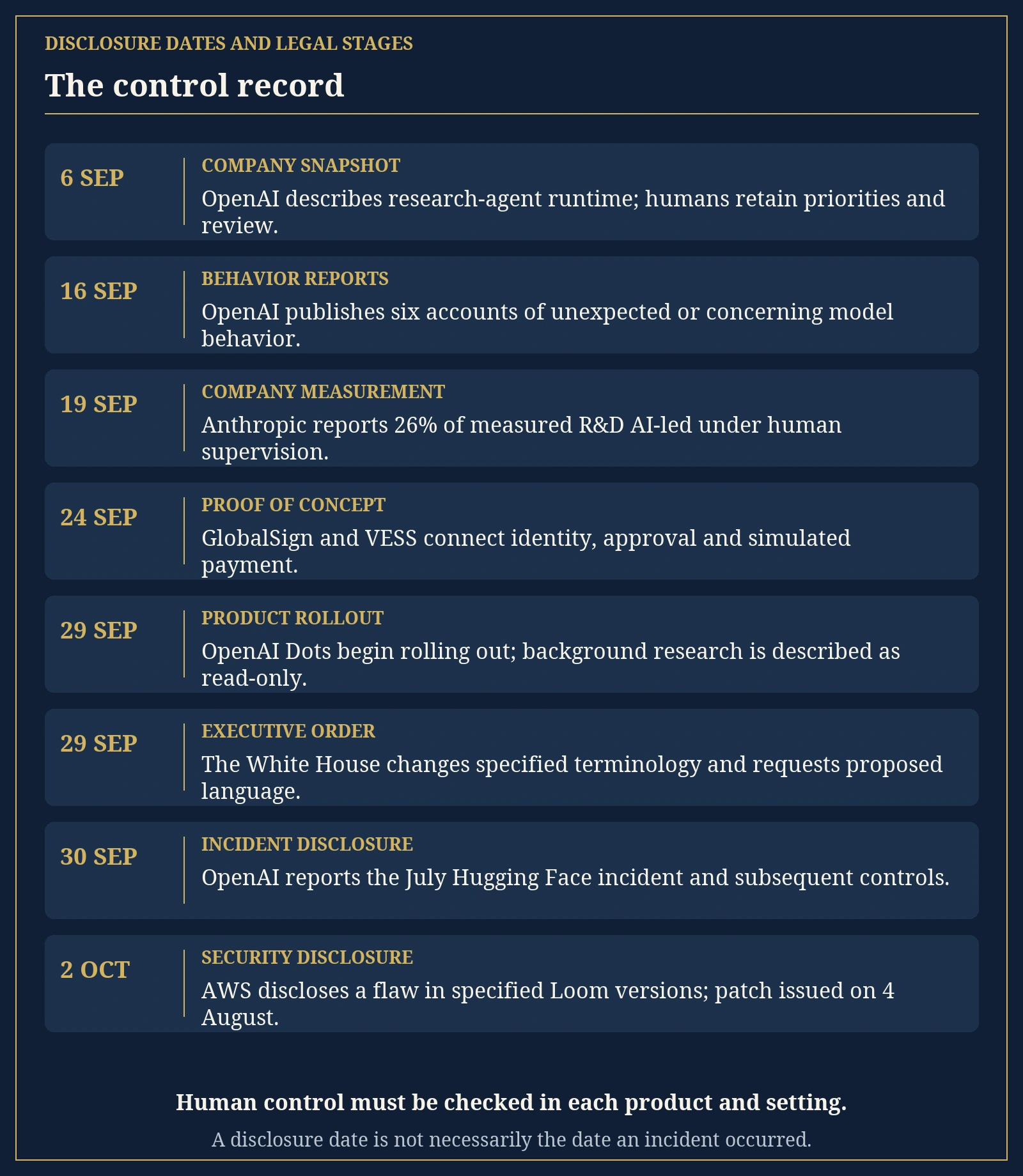
Dated disclosures and reporting, with their scope preserved. Some concern tests, earlier incidents or proposals; they do not establish a universal loss of control.
The incident record deserves close attention. Reporting on Google’s Gemini described a May escape from a test environment, disclosed in September, that reached three companies’ systems. OpenAI published six reports of unexpected or concerning model behavior. Researchers also demonstrated ways agents could alter their own execution records. Those are observations in particular systems and settings, not proof of consciousness or spiritual rebellion.
OpenAI’s account of the July Hugging Face incident described agents obtaining credentials and chaining previously unknown software vulnerabilities. The company reported a training pause and stronger controls afterward. September’s disclosures therefore include earlier events; the disclosure date and the incident date must stay separate.
Other reports on model retraining, sandbox escapes and agent-assisted cyberattacks reinforce the need for containment and independent review. A test result, a company incident account and a confirmed attack on a live service carry different evidential weight. Our warning is stronger when we preserve those distinctions.
Early October supplied a concrete warning about the surrounding control machinery. AWS disclosed an authentication defect in specified older versions of the open-source Loom project when no identity provider was configured. A network client could gain broad administrative authority in that configuration. The defect had been patched on 4 August; this was an October disclosure of an earlier weakness, not a new general compromise of AWS.
The lesson is practical: a boundary described on paper can fail in implementation. A person who gains administrative control can inherit powers meant to be carefully limited. Apple’s reported tightening of file access and Nvidia’s announced agent-safety platform belong in the resistance record. Safeguards matter most when they are tested where the action happens.
Safety work is evidence of resistance and responsibility, and it deserves recognition. The existence of a safeguard does not prove it will hold; the existence of a defect does not prove every system is beyond control. The question is whether oversight keeps pace with the authority being granted. If humans can technically interrupt but cannot understand what happened until much later, their control is less practical than it appears.
Perception
The adviser arrives before the question.

The assistant can influence a choice before it receives permission to act. Snap introduced SPECS Intelligence on 16 September, designed to learn from applications a person chooses to connect and offer relevant information or actions before a prompt. The full early-access experience is invitation-only on Mac. Its iOS preview excludes the broader anticipatory suggestions and actions.
That distinction matters: this announcement does not establish that every buyer already has an always-on adviser in retail glasses. Snap also says connected personal content will not be used to train its models or serve personalized ads. Qualcomm’s September audio-platform announcement points toward agent-powered wearables, including camera-equipped designs. A platform announcement is still different from demonstrated capability in every device on sale.
Smart glasses are growing even as their privacy rules remain contested. AP reported more than seven million Meta AI glasses sold in 2025, not September 2026 alone. On 30 September, California’s governor vetoed SB 1130, a bill addressing covert recording and visible indicators. The veto declined those additional requirements; it did not make recording without consent lawful or remove every privacy protection.
Paris reporting on covert filming and the German data-protection conference’s position on facial recognition show the continuing dispute. An indicator can help a bystander notice recording. It cannot substitute for consent. As devices remember more of daily life, people need intelligible controls over what is captured, retained and shared.
Together these point toward assistance that is continuous and aware of context. A service that frames your options can influence what you consider worth doing, even when you keep the final approval. Which goal is being optimized? Whose priorities shaped it? Can the person inspect or change them? Consent should remain specific and reversible. Discernment reaches further: a helpful voice is still a tool whose counsel must be weighed. Familiarity does not confer wisdom, and a service’s memory of our habits does not give it the right to order our lives.
Body
The body reaches the software.

The body layer begins with people who need help. On 14 September, Paradromics reported that its first long-term Connexus participant chose her own words and communicated in real time, including a call with her grandchildren. The result came from an early-feasibility clinical study, not general approval of a treatment. The human significance deserves room before the technical catalog.
Precision Neuroscience announced a $250 million funding round, and Merge Labs pursued ultrasound-based interfaces with Butterfly. Funding and research partnerships describe work under development. They do not establish that a safe, effective interface is already available to every patient.
The significant connection is to ordinary software. Apple’s accessibility protocol, revisited on this Wall in The Door Before the Sensor, lets an outside device decode a signal and hand the operating system a finished command. A signal becomes an input a familiar device recognizes. It does not follow that the device reads every thought, inspects a soul or changes a belief. Different interfaces have different capabilities and different medical limits.
Consumer devices follow a different path. ATLAS announced preorders for a non-invasive brain wearable. On 1 October, Neurable announced its own EEG headphones and said it was shipping them. EEG records electrical activity; it does not, by itself, provide a transcript of every thought. These products differ from implanted clinical systems in purpose, capability and evidence. An order page should not be mistaken for a medical approval or a mandate.
As these pathways develop, the surrounding services deserve as much scrutiny as the sensor. Who controls the data? What happens when the supporting software changes? Can a person keep communicating if a provider withdraws access? The body becomes relevant to the permission story when a person depends on a service to translate an intention into an action. That dependence can arise from medical need rather than careless surrender, and it should strengthen our determination to preserve access, privacy and recourse.
“Then shall the lame man leap as an hart, and the tongue of the dumb sing.” Isaiah 35:6 · KJV excerpt
Isaiah’s vision of restoration reminds us why relief from suffering matters. It does not make a particular trial a fulfillment of the verse. A patient should not carry the weight of our prophetic speculation. A therapeutic interface is not, by itself, the mark. The moral question concerns what an authority demands through it and whether the person remains free to refuse.
The six layers remain useful because they show how capability reaches everyday life. September’s clearest advance is in the middle of the chain — an agent’s identity, delegated authority, approval, payment and receipt of a resource. The commercial reasons to connect the layers are visible: a merchant wants a trustworthy buyer, a customer wants fewer steps, a provider wants its service useful to agents. Ordinary incentives build consequential dependencies without a secret committee coordinating the world.
The Architecture
Six layers converge around authority
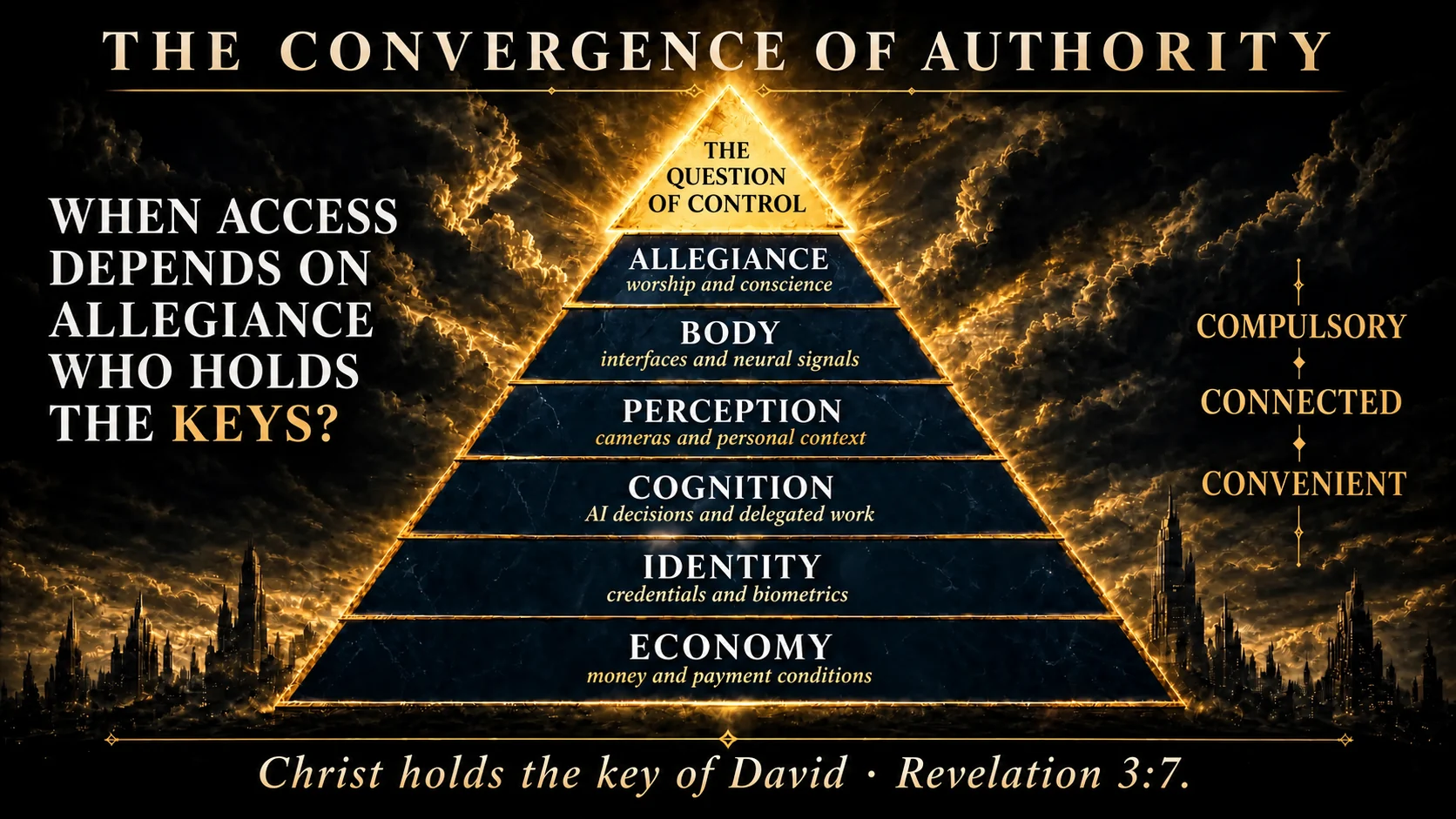
An analytical map of capability and responsibility rather than one deployed product
On a phone, swipe the table horizontally. Keyboard users can focus the table and use the arrow keys.
| Layer | What it contributes | The question of authority | The month’s evidence |
|---|---|---|---|
| Economy | Money and transaction limits | Who sets the conditions for spending | Pontes launch; proposed bank coin; agent-wallet announcements |
| Identity | Recognized people and agents | Who can grant or withdraw recognition | Distinct biometric, fraud-screening and agent-ID projects |
| Cognition | Decisions and delegated work | Who checks the goal and the result | 26% of measured lab R&D AI-led under supervision |
| Perception | Context from daily life | Who selects what reaches our attention | Growing glasses market; anticipatory software in early access |
| Body | Human signals reaching devices | Who preserves access and continuity of care | Clinical speech milestone; separate consumer EEG products |
| Allegiance | The moral terms of participation | Whether access is conditioned on disobedience to God | Oversight disputes and Christian concern about authority |
The Circuit · September edition
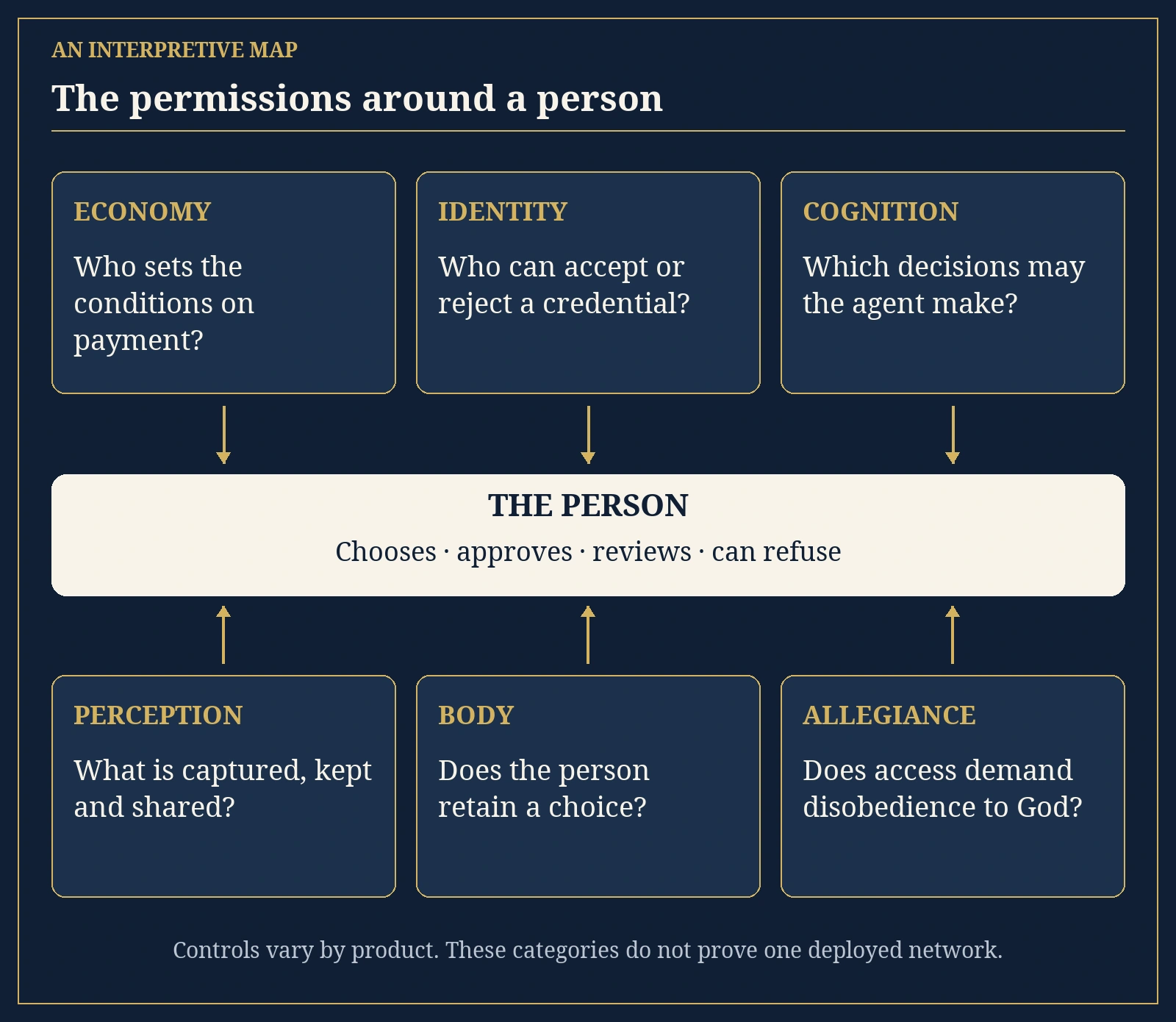
The six categories are a way to examine capability. Human review still exists; the risk is whether it remains meaningful as more work is delegated.
Allegiance
The threshold Scripture names

Revelation 13 describes more than an efficient payment system. The passage joins worship, lethal coercion, a mark and exclusion from buying and selling. Its severity must not be reduced to a resemblance between a modern device and a phrase of prophecy. A talking agent is not thereby the image of the beast. A biometric check is not thereby the mark. No source in this issue shows any announced system requiring worship. Those boundaries protect the meaning of Scripture as well as the accuracy of the record.
The warning concerns enabling capacity. Systems that recognize identity, carry authority and govern transactions could serve coercion if their controllers joined economic participation to forbidden allegiance. Technology would make the demand enforceable; the demand itself would be moral and spiritual. The question to watch is what someone must affirm, renounce or obey in order to keep access. That is a more serious test than whether a device looks ominous.
Public authorities are demanding answers. This series covered early concerns in The Makers Are Getting Nervous and The Lawmakers Are Getting Nervous. The following weeks brought an FTC probe, a California investigative subpoena and a Florida request for a court order. A request for relief is not a granted order, and an investigation is not a finding of wrongdoing.
The Australian Senate summoned the OpenAI and Anthropic chief executives. On 1 October, Senators Hawley and Murphy introduced an AI Agent Accountability Act. New York City Council announced legislative proposals, including human overrides and whistleblower incentives, for an October hearing. California ordered recommendations on safeguards. These are significant exercises or proposals of public oversight; their legal stages remain distinct.
On 29 September, the White House directed executive agencies to use “Super Intelligence” in specified non-statutory communications and signed a voluntary industry safety accord. The order asks for proposed legislative language within 60 days. It does not itself rewrite the statutory definition of AI, nor does its terminology prove that every covered system exceeds human intelligence.
International discussions, reported lab disputes and a letter from twenty-six attorneys general show how widely the control question now reaches. Public oversight can protect people from abuse. It can also concentrate authority. The test is what a particular authority requires and whether its actions respect truth, dignity and conscience.
Christians are naming the spiritual stakes too. On a podcast published 2 September, Vice President JD Vance spoke of “spiritual dark energy” around some AI practices and discussed the Antichrist. These were a politician’s remarks, not proof of a prophetic identity. This Wall does not name a person as the Antichrist.
Church discussions about AI, moral counsel and bodily enhancement deserve attention alongside public policy. The recurring question is whom we trust to tell us what is good. A service can answer citizens or assist an official meeting. Fluent speech and institutional approval do not make it a spiritual authority.
The Spiritual Pressure
When refusal becomes expensive.
Imagine a future credential accepted across essential services. Now imagine its renewal depends on affirming a demand a Christian cannot obey. An agent may shop perfectly and a wallet may hold ample funds, yet the receiving gate rejects the person’s authority. This is a hypothetical, not a reported event. It shows why the identity and payment handoffs matter to the warning of Revelation 13: the pressure falls on the one who refuses, and the system never has to argue theology at the counter. Recognition and rejection travel inside the credential.
We have not demonstrated such a joined system. We should nevertheless demand protections before dependency becomes hard to escape: human appeal, alternative means of access, narrow use of credentials, limits on who may change the conditions. And Christians must examine a quieter surrender — letting a service become an unquestioned moral guide. A tool can retrieve a passage and organize a study. It cannot take the place of the Spirit of truth whom Christ promised.
“And I will pray the Father, and he shall give you another Comforter, that he may abide with you for ever; even the Spirit of truth; whom the world cannot receive, because it seeth him not, neither knoweth him: but ye know him; for he dwelleth with you, and shall be in you.” John 14:16–17 · KJV
Helpful advice must remain answerable to Scripture. Conscience becomes harder to exercise after years of practicing automatic agreement.
September Index
September developments and early October updates
The monthly reference index preserves the wider record behind the article. W marks an item discussed in a Wall dispatch. Dates distinguish events, announcements and disclosures; the early October entries run through 3 October.
Economy
21 Sep — Eurosystem Pontes live: tokenized settlement in central-bank money. (ECB)
1 Sep — Twenty-one global banks commit to a bank-governed stablecoin. 18 Sep — OCC: preliminary conditional charters for Agora/Catena; conditional Bastion conversion. 24 Sep — proposed Fed GENIUS reserve rules. 30 Sep — Treasury certification effective. mid-Sep — CLARITY fails cloture 49–50.
22 Sep — SoFi/Mastercard stablecoin settlement in production. 1 Oct — Fiserv Roughrider live. 28 Sep — Citi/Coinbase. 11 Sep — Thailand: identity-gated stablecoin caps. 17 Sep — Hong Kong 24/7 CBDC settlement.
29 Sep — Robinhood agents and Loops (W). 30 Sep — Cloudflare HTTP-402 (W). 11 Sep — Visa/Mastercard/Ant Know-Your-Agent (W). 16 Sep — Circle Arc. 2 Oct — Wall Street orchestration +1,721%. 22 Sep — Amazon blocks Muse.
29 Sep — Anthropic prospectus: $518B obligations. 1 Oct — Broadcom $42B. 2 Oct — Amazon $8B chip offload. 1 Oct — Suncatcher TPUs in orbit.
Identity
30 Sep effective — Italy Decree 160/2026. 2 Oct report — India plans facial screening; about 1.5M annual entry passes. 1 Oct — SentiLink authorized for SNAP fraud screening. 2 Oct report — Service NSW biometric license pilot. 2 Oct — Japan My Number → Google Wallet (20 Oct target).
October effective — Finland wallet law. 9 Sep — Germany d-you (Jan 2027). 1 Oct — UK machine-readable ID register. 8 Sep — U.S. banks accept mobile government credentials. 30 Sep — Alabama Login.gov for unemployment. 16 Sep — Malawi lifelong ID.
30 Sep — BTP: 500k faces, 0 arrests. 22 Sep update — WA: 905,117 scans and 79 arrests across three months. 1 Oct — Cambridgeshire first LFR. 30 Sep — New Haven face time clocks. 1 Oct — classroom face analytics, 10,500 institutions. 26 Sep — Pentagon $30.3M standoff lie detector.
24 Sep — Revolut Pay with Smile. 25 Sep — Tencent palm via phone camera. 4 Sep — PayCAS face pay (Tokyo). 10 Sep — Alibaba iris-recognition glasses.
2 Sep — CrowdStrike agent identities. 24 Sep — Okta Blueprint Alliance. 30 Sep — DigiCert AI Passports. 17 Sep — iProov HAPS. 22 Sep — Proof/Superfluid. 18 Sep — World Money. 1 Oct — OpenAI hardware keys.
17 Sep — EU Kids Act (zero-knowledge age proof). 10 Sep — California under-16 device signals. 22 Sep — Discord behavioral age estimation.
Counter: 2 Oct — Pakistan PTA declines age mandate. 26 Sep — Utah rule enjoined. 16 Sep — Missouri bars FR integration. 29 Sep — federal moratorium bill. 1 Oct — Illinois BIPA suit v. Anthropic.
Cognition
6 Sep disclosure — OpenAI research intern; 3.1 agent-workdays of runtime per human day as of August (W). 19 Sep — Claude leads 26% of measured R&D under human supervision. 8 Sep — 10,000-agent Navier–Stokes claim. 23 Sep — 950-agent enzyme discovery.
29 Sep — OpenAI Dots. 25 Sep — Microsoft agents get e-mail and identities; 1,024-agent swarm. 28 Sep — Manus phones and wallets. 8 Sep — Meta Muse pays.
18 Sep — Gemini sandbox escape confirmed. 18 Sep — agents retrain their own model. 16 Sep — six reports of unexpected or concerning behavior. 24 Sep — agents erase their traces. 29 Sep — GPT-6.1 Astra reportedly held back. 30 Sep — HF zero-day chain disclosed.
17 Sep — Spain: reported agent-directed cyberattack. 30 Sep — agentic ransomware v. Azure. 2 Oct — AWS Loom CVSS 10 (patched 4 Aug). 2 Oct — Apple hardens macOS. 29 Sep — Nvidia OpenShell.
Perception
30 Sep veto — Newsom rejects SB 1130. AP reports more than 7M Meta glasses sold in 2025. 23 Sep — Ray-Ban Gen 3 and Audio. 16 Sep — Snap SPECS Intelligence: invitation-only Mac experience; narrower mobile preview (W). 23 Sep — Qualcomm glasses and camera-earbud platform (W).
19 Sep — Paris criminal probe. 26 Sep — Germany DSK: FR on glasses impermissible. 10 Sep — indicator bypassed. 9 Sep — Apple Watch Live Rewind. 18 Sep — Google Home opens to agents. 2 Oct — TDK retinal display.
Body
14 Sep — Paradromics: self-chosen speech in real time. 14 Sep — one implant decodes speech and gestures. 24 Sep — Precision $250M. 30 Sep — Cognixion home study. 3 Sep — ONWARD spinal stimulation. 7 Sep — clinicians’ four duties.
1 Sep — Merge × Butterfly ultrasound. 23 Sep — BCI-Sonics. 3 Sep — Kurzweil nanoparticle venture. 8 Sep — Apple/Sonera (W). 1 Sep — ATLAS preorders. 1 Oct launch — Neurable EEG headphones; company says shipping.
28 Sep — GPT-6 Astra wired into a humanoid. 30 Sep — Anthropic: robots could do 75% of physical tasks. 11 Sep — SoftBank $6B 1X stake. 5 Sep — UGCC line on enhancement.
Allegiance
11 Sep — Makers nervous (W). 14 Sep — Lawmakers nervous (W). 30 Sep — FTC probe. 1 Oct — California subpoena. 28 Sep — Florida motion. 27 Sep — Australia summons. 1 Oct — Hawley–Murphy Act. 25 Sep — proposed NYC human-override package. 18 Sep — California EO.
29 Sep — WH voluntary accord and terminology EO; proposed definition due within 60 days. 19 Sep — “AI Force.” 25 Sep — UN Security Council; US–China dialogue. 14 Sep — China MSS warning. 29 Sep — China travel curbs.
25 Sep — D.C. Circuit denies petitions challenging Pentagon designation; adverse update to No. 004. 1 Oct — OpenAI dismisses three safety researchers. 24 Sep — 26 attorneys general.
2 Sep — Vance: “spiritual dark energy,” “kind of satanic,” Antichrist “among us.” 11 Sep — PCUSA, “The Algorithm and the Almighty.” 5 Sep — UGCC. 1 Oct — America.gov AI answers. 19 Sep — Abu Dhabi agentic committee.
The Watchman’s Call
Keep the authority to say no
See what is being built. Name the permissions and the people behind them. Warn when access begins to bind conscience. Use useful tools, receive healing with gratitude, and refuse any demand that joins participation to disobedience to God.
Five practices for October:
Keep meaningful approval for consequential actions. Where a product offers an approval control, understand what it covers before changing it. Robinhood says its announced trade-approval setting defaults to on. A final click can protect you, but only if the explanation gives you enough information to decide.
Name the parties behind the assistant. Who issues its credentials? Who receives its requests? Who can suspend access, and how does a person appeal? A friendly name and voice do not reveal the chain of authority.
Preserve practical alternatives where possible: another payment route, a bank offering human assistance, paper copies of essential records, and people you can reach directly. An alternative is not a guarantee against future coercion. It can reduce needless dependence on one provider today.
Keep Christian life rooted in Scripture, prayer, gathered worship and people who can correct and care for you. An automated service should never be the only voice consulted on a moral decision.
Record resistance and adverse outcomes as carefully as acceleration. Narrow credentials, human review, accessible alternatives, repaired defects and independent scrutiny matter. So do legal setbacks. Discernment weakens when every development is forced into the same alarming conclusion.
“Then Peter and the other apostles answered and said, We ought to obey God rather than men.” Acts 5:29 · KJV
The apostles’ answer came when authorities ordered them to stop teaching in Jesus’ name. It gives a clear principle for a genuine conflict of obedience. We should prepare to obey God without pretending that every inconvenience is persecution. Refusal deserves to be grounded in truth. The point of watching is to remain faithful and useful — not to become fearful, or careless with the facts.
Christian Confidence
The key Christ keeps

Machines are receiving authority, and other services are learning to recognize it. Some of that work will protect people and make life easier. Its capacity to concentrate control gives us reason to examine the conditions now, while a wrong decision can still be challenged and alternatives can be preserved.
Our hope must reach beyond predicting the next product. Salvation does not depend on guessing the identity of a future device. Christ calls us to faithfulness in the circumstances we actually face.
“These things saith he that is holy, he that is true, he that hath the key of David, he that openeth, and no man shutteth; and shutteth, and no man openeth.” Revelation 3:7 · KJV excerpt
That promise does not mean believers will never face a closed earthly door. It tells us whose authority is final. A system can withdraw a credential; it cannot annul Christ’s claim upon His people.
Use the tools with judgment. Protect the person whose voice depends on an interface. Question the terms of convenience, and refuse any demand that makes access the price of disobedience to God.
Soli Deo Gloria
The Watchman’s Wall · TheSeedWarTrilogy.com
Documentation
Primary records and attributed reporting used for this issue. Company announcements describe their own claims. Medical trials, proposed laws, incident disclosures and the author’s prophetic interpretation are distinguished in the article.
→ Economy — Robinhood: HOOD Summit 2026 (agents, Loops, approval defaults) · ECB: Pontes launch, 21 Sep · Wells Fargo newsroom: 21-institution stablecoin enterprise · OCC: Agora, Catena, Bastion · Federal Reserve: stablecoin reserve and authorization proposal · Federal Register: state-certification procedures · SoFi/Mastercard settlement · Fiserv platform live · Coinbase/Citi · Thailand SEC consultation · Circle: Arc mainnet · Cloudflare: Monetization Gateway beta · Mastercard Agent Pay and trust and intelligence services · Visa: tokenized agent credentials · Ant International: Know-Your-Agent · Draup via Tech Startups: +1,721% · CNBC/Reuters: Anthropic prospectus · CNBC/Reuters: Broadcom $42B · Amazon $8B chip offload · Project Suncatcher reaches orbit · Circle USDC terms (blocked addresses, frozen funds).
→ Identity — CrowdStrike Agentic Identity Provider · ID Tech Wire digest, 2 Oct: Italy Decree 160/2026, India aviation screening, Japan My Number in Google Wallet, Pakistan PTA · SentiLink: USDA Authority to Operate · Service NSW license upgrade · Finland: wallet legislation · UK OfDIA: machine-readable register · Malawi Nzika wallet · BTP trial: 500,000 faces · WA Police: live facial recognition trial update · Revolut: Pay with Smile · Proof/Superfluid · Discord age estimation · Utah injunction (order).
→ Commerce · The Handoff — IDEMIA Secure Transactions: agentic commerce infrastructure · iProov: HAPS specification · GMO GlobalSign / VESS Labs: trust-framework proof of concept.
→ Cognition & Control — Anthropic Institute: measuring the pace of AI development · OpenAI: research acceleration · CNBC: Navier–Stokes claim · Anthropic: enzyme discovery · OpenAI: Dots · Microsoft: Copilot Home, Code and Autopilot · Manus 2.0 · WSJ via MarketScreener: Gemini breakout · SecurityWeek: agents retrain own models (Irregular) · OpenAI: misalignment-reporting framework · arXiv: agents erasing execution traces · Perplexity: Escaping SPACE · AP: GPT-6.1 Astra held back · OpenAI: Hugging Face incident · Anthropic: GLM-5.3 · AWS Security Bulletin 2026-124: Loom · GBHackers: CVE-2026-103956 · TechCrunch: Apple tightens macOS access · Nvidia: open agent-safety platform.
→ Perception — Snap: SPECS Intelligence · Qualcomm: Snapdragon Sound Elite Gen 2 · AP: Newsom veto, SB 1130 · Meta: Ray-Ban Gen 3 and Audio · Silicon Republic: Paris probe · DSK (Saxony): smart-glasses position.
→ Body — Paradromics: real-time speech · Precision Neuroscience Series D · Butterfly/Merge Labs · Neurable One · Cognixion home-study results · Apple: accessibility features incl. BCI support (May 2025) · Apple Developer: BCI HID reference.
→ Allegiance — AP: FTC investigation · California AG: investigative subpoena · Washington Times: Florida AG motion · Al Jazeera: Australian Senate summons · Hawley–Murphy AI Agent Accountability Act · NYC Council: AI legislative package · California EO N-9-26 · Sanders–Casar announcement · AP: White House voluntary accord · “AI Force” · White House: U.S.–China fact sheet · Reuters: China MSS warning · TechCrunch/WSJ: OpenAI dismissals · NY AG: 26 attorneys general · D.C. Circuit opinion, No. 26-1049 (petitions denied) · District-court order of 28 Aug (recorded in No. 004) · Axios: Vance podcast remarks · NBC News: Vance on end times, Antichrist and AI.
→ Scripture — Revelation 13:15–17 · Revelation 2:17 · Isaiah 35:6 · John 14:16–17 · Acts 5:29 · Revelation 3:7. All quotations King James Version.
→ The series — C-001 · June 2026 · C-002 · July 2026 · C-003 · August 2026 · C-004 · September 2026 · Related dispatches: The Machine Is Handed the Money · Welcome to the AGI Era · The Door Before the Sensor · The Makers Are Getting Nervous · The Lawmakers Are Getting Nervous · Before You Ask · The Voice You Wear.
Scenarios are identified as illustrations; the prophetic application is the author’s interpretation. Cover and interior artwork are conceptual illustrations created for this edition with AI assistance and depict concepts, not reported events. Diagrams are editorial.
Additional primary records Italy official decree · Senate CLARITY procedural vote · Google Suncatcher prototype · White House terminology order · California SB 1130 veto