

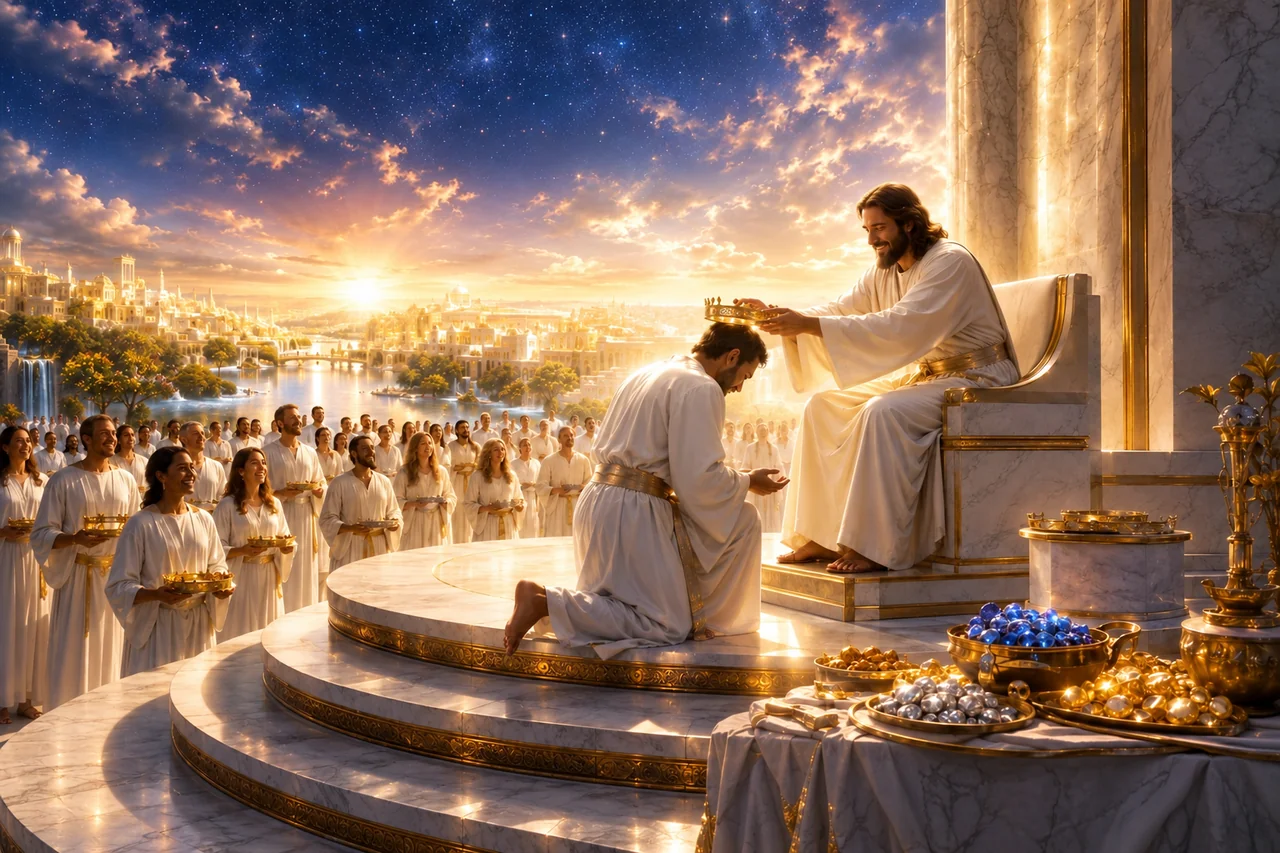
Before you beginThe study’s perspectiveContext, vocabulary, grace, and the road to the Kingdom
BEFORE YOU BEGIN
About This Study
Illustrated Study Edition · September 28, 2026
This is a study about the happy ending of the world. Not the ending Hollywood imagines — a dying sun, a silent cosmos, humanity’s candle guttering out in the dark — but the ending God wrote down in advance and sealed with the blood of His Son: a King on a throne in Jerusalem, a planet healed and singing, a thousand years of peace, and beyond it a city so beautiful that God Himself will move into it and wipe every tear from every face.
You do not need a seminary degree to read this book. You need a Bible, an honest heart, and about an hour of quiet at a time. Every technical word is explained the first time it appears and again in the glossary at the back. Every claim is anchored to a Scripture reference you can look up and weigh for yourself, like the Bereans, who “searched the scriptures daily, whether those things were so” (Acts 17:11).
A word about approach. Faithful students of the Bible have arranged the prophetic furniture in different ways, and godly people disagree on the timing of some events. This study takes the Scriptures about the end plainly and literally wherever they will bear it: a real seven-year tribulation, a real catching away of the church at its midpoint, a real return of Christ to a real Mount of Olives, a real thousand-year kingdom on this real earth. Where the study makes a judgment call, it tells you so, and it tells you why. Take everything back to the Book. And expect no dates in these pages: this study follows the order of events, never a calendar — “of that day and hour knoweth no man” (Matthew 24:36).
Each section closes with a few questions under the heading Consider. Use them alone with a journal, or around a table with friends. Prophecy was never given to make us clever. It was given to make us ready.
How This Study Reads Prophecy
The promises, the framework, and the pictures
Read with your Bible open. Our aim is to know Christ, understand the hope of His kingdom, and live faithfully now. The sequence below expresses this study’s reading of the prophetic passages. Christians who trust the same Savior differ about parts of that sequence.
Begin with the text. We read prophecy in its context, attending to history, poetry, symbolism, and the links between biblical books. A promise may describe a real future while using a vivid image. A passage’s direct statement carries more weight than a conclusion assembled from several passages.
The adopted timetable. We understand Daniel’s final “week” as a future seven-year period and place the church’s rapture at its midpoint. The connection between Paul’s “last trump” and Revelation’s seventh trumpet is part of this interpretation; neither passage explicitly identifies the two (Daniel 9:27; 1 Corinthians 15:51–52; Revelation 11:15).
The kingdom in view. We read Revelation 20 as Christ’s future thousand-year reign following His visible return. Glorified saints serve with Him alongside mortal survivors and their descendants. We understand the David promises to include the resurrected David serving under Christ, while acknowledging the messianic reading and the unresolved identity of Ezekiel’s prince.
The temple and the cross. We read Ezekiel’s sanctuary vision within this future kingdom and understand its offerings in relation to Christ’s completed sacrifice. This interpretation must account for Ezekiel’s language of cleansing; no future offering can add to Jesus’ once-for-all atonement (Ezekiel 45:15–22; Hebrews 10:10–18).
The final horizon. After the millennium, the study follows Satan’s final rebellion, the Great White Throne, and the new heaven and new earth. It distinguishes the renewed earthly kingdom from the final state in which death is gone (Revelation 20–22).
Read with discernment. Treat exact schedules, governmental arrangements, and joined river courses as interpretations where no single passage supplies the whole picture. The illustrations, clothing, buildings, and imagined scenes of daily life help us picture the hope; they do not predict every detail. Test the argument with charity. Agreement with this timetable is not a condition of salvation.
Grace, Faithfulness, and Assurance
How salvation, service, accountability, and reward belong together
The hope in this study begins with what Jesus has done for us. His death and bodily resurrection are the foundation of our salvation. Our faithful service matters because we belong to Him.
Salvation is God’s gift. We are saved by God’s grace through faith in Christ. Forgiveness and new life cannot be purchased by good deeds, religious achievement, or a correct prophecy chart. The Savior’s mercy gives us a standing we could never earn (Ephesians 2:8–9; Titus 3:4–7).
Grace bears fruit in service. The same passage that excludes works as the price of salvation says we are created in Christ for good works. Love, generosity, endurance, and mercy are responses to His grace. They give practical expression to faith and bless our neighbors (Ephesians 2:10; Titus 3:8).
Accountability is real. Believers will give account to Christ. He knows our actions and motives, including quiet faithfulness that others overlook. In 1 Corinthians 3, Paul first addresses the work of building the church; this study applies its warning to Christian service more broadly. Work can receive reward or be lost, while the person described in verse 15 is saved (2 Corinthians 5:9–10; Romans 14:10–12; 1 Corinthians 3:10–15; 4:5).
Assurance rests in the Savior. Our assurance rests in Christ’s promise and saving work. He gives His people eternal life and holds them securely; there is no condemnation for those in Him. Within this study’s understanding, the evaluation of believers’ service does not reopen the question of whether Christ’s sacrifice was sufficient (John 5:24; 10:27–29; Romans 8:1).
Rewards honor faithfulness. Belonging to Christ and the measure of reward should not be confused. The study’s promises of life with Him do not guarantee an identical reward or assignment for every believer. Christ judges wisely, and the joy of serving Him matters more than comparisons with another person’s role (1 Corinthians 3:8, 14–15).
Live with confidence and care. Serve from gratitude. Confess sin, receive God’s forgiveness, and return to the work He has given you. In the Sheep and Goat discussion, read acts of mercy as evidence of allegiance within the study’s interpretation, never as a payment for salvation. The grace that gives assurance also calls us to love, repentance, and faithful care for others (1 John 1:9; Matthew 25:31–46).
THE STORY SO FAR
A War Older Than History
Every war has a first shot. This one was fired in a garden.
When our first parents fell, God turned to the serpent — that ancient dragon, the devil wearing a borrowed body — and declared war on him in a single verse. Theologians call it the protoevangelium, the first gospel. It is also the first battle order of the longest war ever fought:
And I will put enmity between thee and the woman, and between thy seed and her seed; it shall bruise thy head, and thou shalt bruise his heel.
GENESIS 3:15
King James Version
Two seeds. Two lines. One long war. From that morning forward, all of history has been the story of the serpent’s seed trying to corrupt, counterfeit, or kill the Seed of the woman — and failing. Cain rises against Abel. Pharaoh drowns the sons of Israel. Athaliah butchers the royal line down to one hidden baby. Herod empties Bethlehem of its infant boys. And when the Seed Himself finally stands up in Galilee, the serpent arranges a cross for Him — and discovers, three days later, that the bruising of the Seed’s heel was the crushing of his own skull.
But when the fulness of the time was come, God sent forth his Son, made of a woman, made under the law, to redeem them that were under the law, that we might receive the adoption of sons.
GALATIANS 4:4–5
King James Version
But the war did not end at the empty tomb. The sentence was passed there; it has not yet been carried out. For two thousand years the risen King has been gathering a people out of every nation — a family of new-born sons and daughters carrying His life, His Spirit, His seed within them. And the serpent, knowing his time is short, has spent those same centuries building something: a system. A web of money and power and marvels and lies designed to do what brute force never could — to make the whole world choose him.
That system gets seven years to show what it is. Then the sky opens.
This study begins at the moment the last seven years begin, and it does not stop until the war is over, the rebel is in the lake of fire, and the Seed of the woman reigns from a city with no night in it. If you have read Battle of the Seed, you know the terrain. If you have not, no matter — everything you need is in these pages and in your own Bible.
THE MAP
The Road to the Kingdom
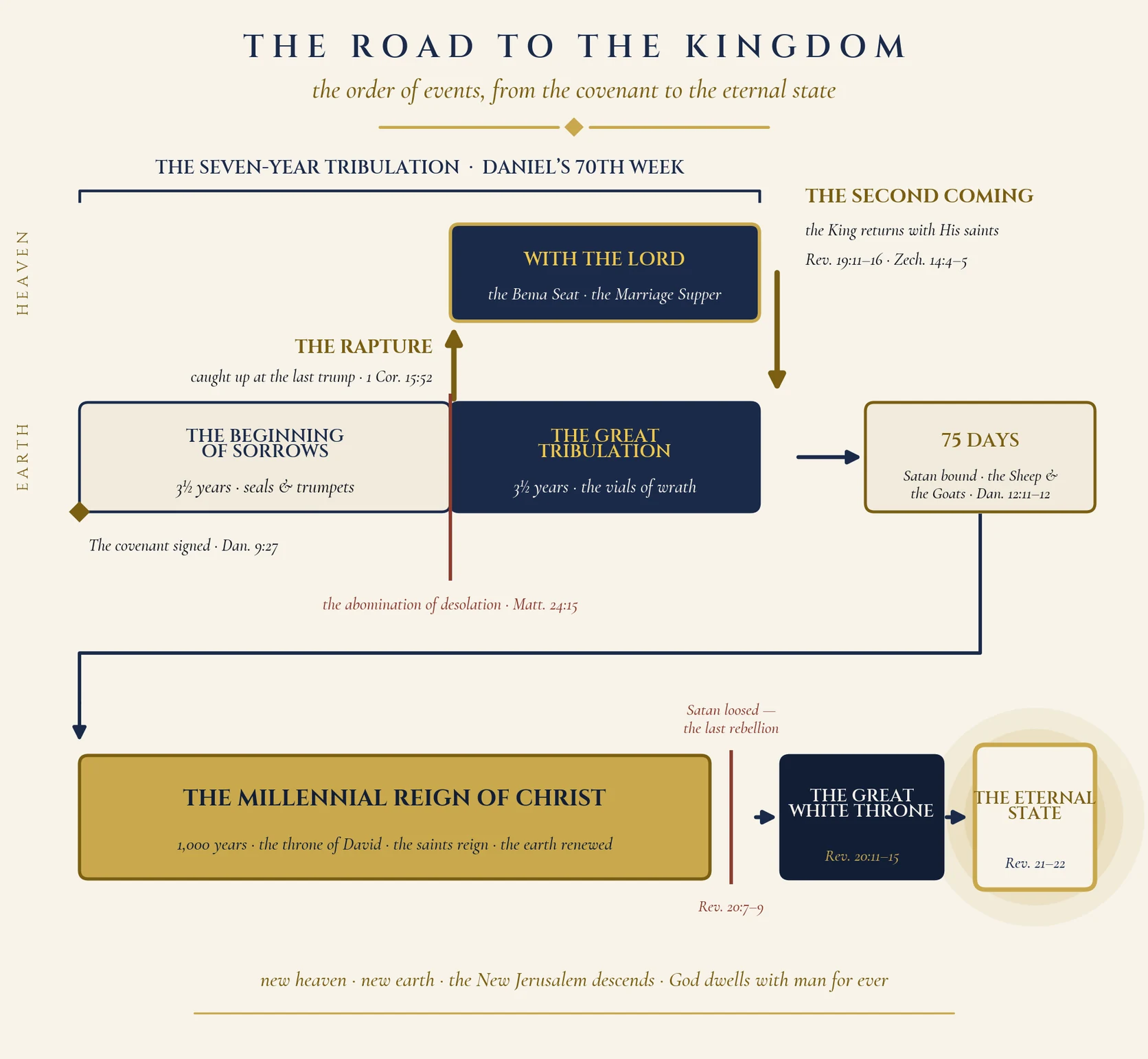
Here is the whole journey on one page. Every section of this study walks one stretch of this road. When the sequence gets rich and detailed — and it will — return to this map and find your footing again.
 Open artwork at full size in a new tab
The order of events as this study understands them: the seven-year tribulation of Daniel 9:27, divided at its midpoint by the rapture of the church; the Second Coming at its close; a brief interval of judgment; the thousand-year reign; the last rebellion; the Great White Throne; and the eternal state.
SECTION IThe Covenant and the Clock
the seven-year tribulation begins
——— ◆ ———
The last seven years of this age will not begin with fire. They will begin with a handshake.
Five centuries before Christ, the prophet Daniel was given a timetable for his people Israel — seventy “weeks” of years, four hundred ninety years in all, decreed “to finish the transgression, and to make an end of sins … and to anoint the most Holy” (Daniel 9:24). Sixty-nine of those weeks ran their course with astonishing precision, from the decree to rebuild Jerusalem right up to the week Messiah rode into the city and was “cut off, but not for himself” (Daniel 9:26). Then the clock stopped. One week — seven years — remains on God’s stopwatch for Israel. Between week sixty-nine and week seventy falls the whole church age, a great parenthesis of grace in which we now live.
What starts the clock again? Daniel tells us exactly:
And he shall confirm the covenant with many for one week: and in the midst of the week he shall cause the sacrifice and the oblation to cease, and for the overspreading of abominations he shall make it desolate.
DANIEL 9:27
King James Version
A ruler — the “prince that shall come” of the previous verse, the man the New Testament will call the beast and popular language calls the Antichrist — confirms a covenant with “many,” with Israel and her neighbors, for one seven-year week. That signature is the starting gun. The moment his pen lifts from that treaty, the world has exactly seven years left of business as usual, and heaven knows it to the day.
A False Golden Age
Do not picture the opening of the tribulation as a horror film. Picture it as a relief. The first rider of Revelation 6 carries a bow with no arrow mentioned, and “a crown was given unto him: and he went forth conquering, and to conquer” (Revelation 6:2) — a conqueror on a white horse, wearing peace like a costume. The man of sin will not seize the world at gunpoint; he will be handed it by acclamation, because he will appear to have solved the unsolvable: war in the Middle East, a groaning economy, a fractured world order. Paul says it plainly — “when they shall say, Peace and safety; then sudden destruction cometh upon them” (1 Thessalonians 5:3).
Under the covenant, Israel dwells in confidence. The temple rises again in Jerusalem — Revelation 11 assumes it standing, for John is told to measure it. Sacrifice and oblation resume, which is precisely what the midpoint treachery will “cause to cease.” The world congratulates itself on its new architect of peace. And all the while, the seals are opening.
Sorrows, Like a Woman with Child
Jesus called the first half of the week “the beginning of sorrows” (Matthew 24:8) — literally, birth pangs. War follows the false peace; the red horse takes peace from the earth. Famine follows war; the black horse weighs bread against silver. Death follows famine on a pale horse, and hell follows with him. Earthquakes, pestilences, fearful sights. The pangs come faster and harder, as birth pangs do — because something is trying to be born: a kingdom, and before it, a counterfeit.
And ye shall hear of wars and rumours of wars: see that ye be not troubled: for all these things must come to pass, but the end is not yet. For nation shall rise against nation, and kingdom against kingdom: and there shall be famines, and pestilences, and earthquakes, in divers places. All these are the beginning of sorrows.
MATTHEW 24:6–8
King James Version
Yet the first half of the week belongs to grace as much as to judgment. God seals a hundred and forty-four thousand servants out of the tribes of Israel — an unkillable band of Jewish evangelists loosed on a collapsing world. And in Jerusalem, two witnesses in sackcloth stand up with fire in their mouths:
And I will give power unto my two witnesses, and they shall prophesy a thousand two hundred and threescore days, clothed in sackcloth.
REVELATION 11:3
King James Version
Twelve hundred sixty days — three and a half years to the day. God is precise with His calendar in this week: “time, and times, and half a time,” “forty and two months,” “a thousand two hundred and threescore days” (Daniel 7:25; Revelation 11:2–3; 12:6). The tribulation is not an open-ended nightmare. It is a measured week, cut in half by design, ticking toward a trumpet.
SECTION IICaught Up
the rapture of the church at the last trump
——— ◆ ———
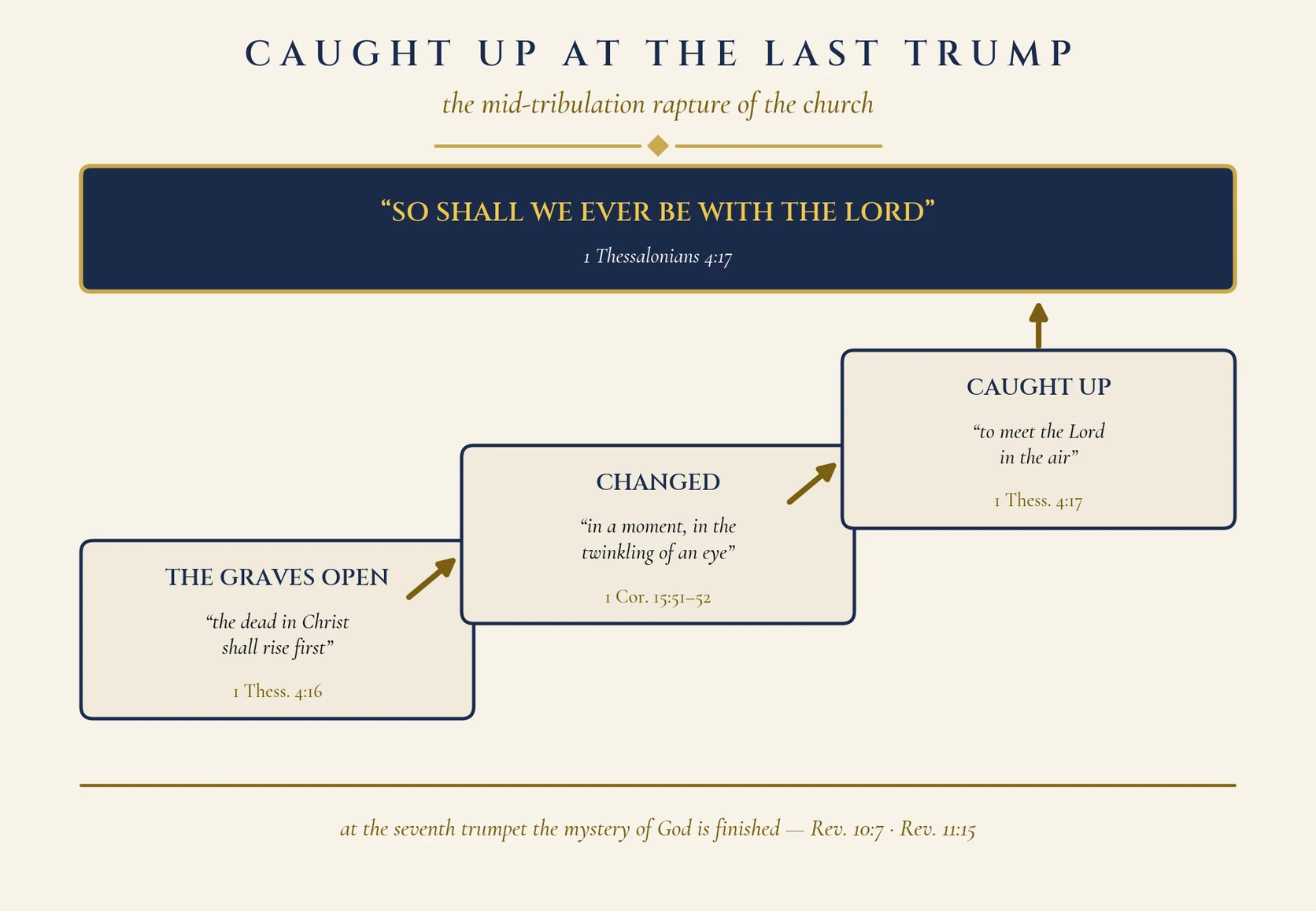
Halfway through the seven years, on an ordinary day the world will never forget, a trumpet will sound that only some will hear — and in less time than it takes to blink, every genuine believer in Jesus Christ, living and dead, will vanish from the face of the earth.
Paul calls it a mystery — a secret now told:
Behold, I shew you a mystery; We shall not all sleep, but we shall all be changed, in a moment, in the twinkling of an eye, at the last trump: for the trumpet shall sound, and the dead shall be raised incorruptible, and we shall be changed.
1 CORINTHIANS 15:51–52
King James Version
For the Lord himself shall descend from heaven with a shout, with the voice of the archangel, and with the trump of God: and the dead in Christ shall rise first: then we which are alive and remain shall be caught up together with them in the clouds, to meet the Lord in the air: and so shall we ever be with the Lord.
1 THESSALONIANS 4:16–17
King James Version
“Caught up” — in Latin, rapturo, from which we get the word rapture. The order of that split second: the Lord descends into the atmosphere of His own world; the graves of believers open first, from sea-beds and catacombs and country churchyards; then the living are changed — mortality swallowed up of life — and the whole redeemed family rises together to meet the Lord in the air. Not a secret doctrine invented last century, but the plain reading of two apostolic letters written before most of the New Testament existed.
Why the Midpoint?
Here this study makes its position plain. Some place this catching-away before the seven years begin; some place it at the end. This study places it in the midst of the week, and for reasons you can check with your own Bible open.
First, Paul anchors the rapture to “the last trump.” Revelation is a book of numbered trumpets, and when the seventh and last of them sounds, listen to what heaven shouts:
And the seventh angel sounded; and there were great voices in heaven, saying, The kingdoms of this world are become the kingdoms of our Lord, and of his Christ; and he shall reign for ever and ever.
REVELATION 11:15
King James Version
That seventh trumpet sounds at the middle of the book and the middle of the week — after the two witnesses finish their 1,260 days, and before the vials of wrath are poured. In the days of its voice, “the mystery of God should be finished” (Revelation 10:7) — the same word Paul uses for the rapture. Second, the church is promised exemption from God’s wrath — “God hath not appointed us to wrath” (1 Thessalonians 5:9) — and in Revelation the technical vocabulary of divine wrath belongs to the second half of the week, the vials, not the first-half birth pangs, which are the wrath of men and of the dragon. The church sails through tribulation, as she always has; she is lifted out before the wrath. Third, the pattern is acted out in miniature before your eyes in Revelation 11: God’s two witnesses lie dead, breath returns, a great voice says “Come up hither,” and “they ascended up to heaven in a cloud; and their enemies beheld them” (Revelation 11:12). Resurrection, then ascension, at the midpoint — the church’s own story in a two-man parable. And fourth, Revelation 12 shows a man child “caught up unto God, and to his throne” — the same Greek word as “caught up” in Thessalonians — immediately before the dragon is cast down in fury, “because he knoweth that he hath but a short time” (Revelation 12:12): three and a half years, to be exact.
And behind all four reasons stands a promise the risen Lord made to the church He loves:
Because thou hast kept the word of my patience, I also will keep thee from the hour of temptation, which shall come upon all the world, to try them that dwell upon the earth.
REVELATION 3:10
King James Version
Hold the position with charity — pre-tribulationists and post-tribulationists love the same Lord and read the same Book, and no one’s salvation hangs on the timing. But this study will proceed on the mid-week reckoning: three and a half years of sorrows, then the trumpet.
 Open artwork at full size in a new tab
That Day
Try to stand inside the moment. A shout — the same voice that called Lazarus out of a four-day grave, now calling a whole planet’s worth of graves at once. An archangel’s cry. A trumpet blast that human physics cannot account for. And then — before a camera can focus — gone. The pilot from the cockpit, the surgeon from the table, the mother from the school pickup line, the body from the casket mid-funeral. Empty clothes, stopped cars, and a world suddenly, deafeningly without the salt and light it never knew was preserving it.
For the believer, no event in your future is more practical. You will be there. If the trumpet waits another lifetime, you will simply arrive by the older road, through the grave — and rise first, ahead of the living, at that same trumpet. Either way, “so shall we ever be with the Lord. Wherefore comfort one another with these words” (1 Thessalonians 4:17–18). Paul gave the doctrine as a comfort, not a curiosity.
And behind Paul’s trumpet stands Jesus’ own farewell promise, made in an upper room the night before the cross — the oldest rapture text in the Bible:
In my Father’s house are many mansions: if it were not so, I would have told you. I go to prepare a place for you. And if I go and prepare a place for you, I will come again, and receive you unto myself; that where I am, there ye may be also.
JOHN 14:2–3
King James Version
For the world left behind, the midpoint is midnight. The restraining presence is removed, “and then shall that Wicked be revealed” (2 Thessalonians 2:8). Within days, the covenant-maker stands in the new temple, ends the sacrifices, and demands the worship of mankind — “the abomination of desolation, spoken of by Daniel the prophet, stand[ing] in the holy place” (Matthew 24:15). The Great Tribulation begins. And yet — mark this well, for we will meet these people again at the Sheep and Goats — multitudes will be saved after the rapture. The 144,000 remain. An angel flies in mid-heaven “having the everlasting gospel to preach unto them that dwell on the earth” (Revelation 14:6). A “great multitude, which no man could number,” comes “out of great tribulation” (Revelation 7:9, 14). The rapture ends the church age; it does not end the reach of grace.
Looking for that blessed hope, and the glorious appearing of the great God and our Saviour Jesus Christ.
TITUS 2:13
King James Version
SECTION IIIThe Bema Seat
the judgment of reward — and the wedding that follows
——— ◆ ———
 Open artwork at full size in a new tab
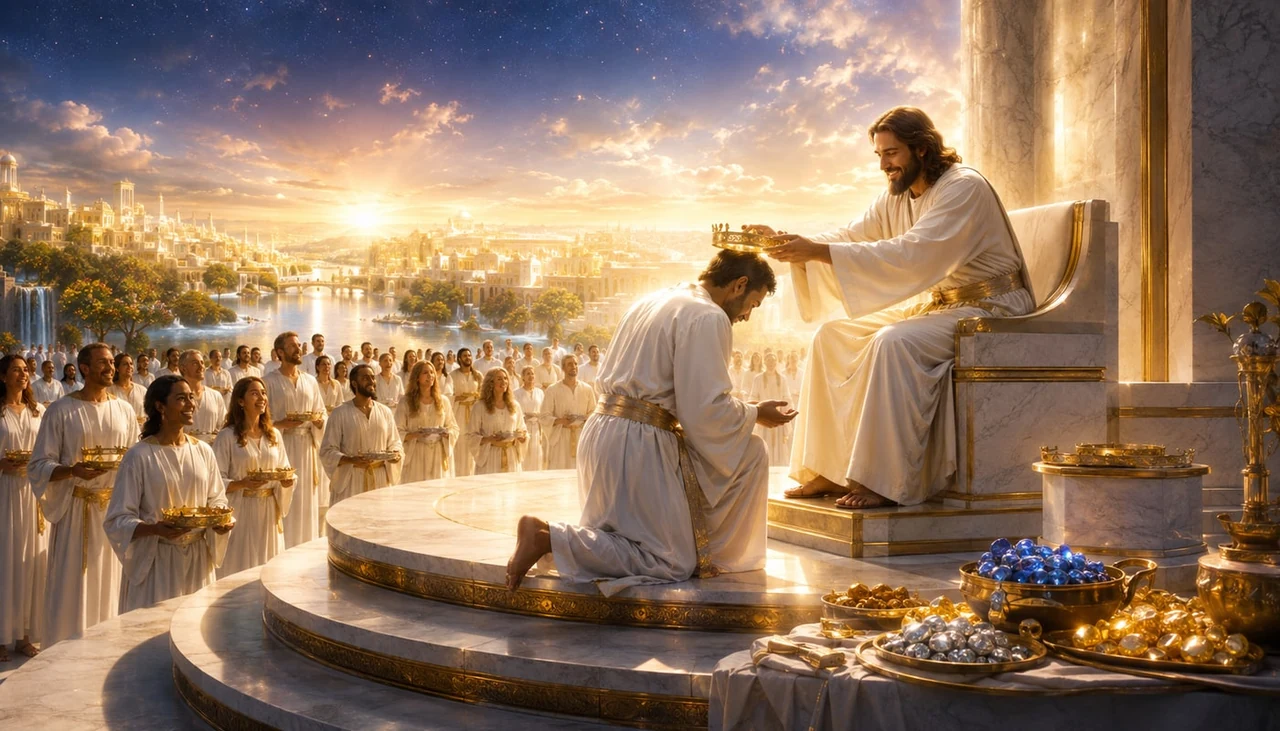
Faithfulness brought into the light — the believer before the judgment seat of Christ. From The Medal Ceremony of Eternity. Artistic visualization of reward and accountability (2 Corinthians 5:10; 1 Corinthians 3:12–15).
The moment after the trumpet, every believer of the church age is in the presence of the King — and the first item on heaven’s agenda is not a feast. It is an evaluation.
For we must all appear before the judgment seat of Christ; that every one may receive the things done in his body, according to that he hath done, whether it be good or bad.
2 CORINTHIANS 5:10
King James Version
The Greek word for “judgment seat” is bema — and it is worth the trouble of learning, because it rescues this event from a misunderstanding that has robbed many believers of both their peace and their urgency. The bema was not the criminal dock. It was the raised platform at the Isthmian games near Corinth where the judge of the contest stood — the place where finishers were crowned. Paul’s readers had watched athletes strain toward that platform all their lives. No athlete at the bema was on trial for his life; he was there for the verdict on his race.
Settle this first, then: the Bema is a judgment of believers only, and salvation is not the question on the table. The question of your sin was settled at the cross — “There is therefore now no condemnation to them which are in Christ Jesus” (Romans 8:1). What comes to the Bema is not your guilt but your works: what you built on the foundation, with the one life you were given.
…for we shall all stand before the judgment seat of Christ. … So then every one of us shall give account of himself to God.
ROMANS 14:10, 12
King James Version
Now if any man build upon this foundation gold, silver, precious stones, wood, hay, stubble; every man’s work shall be made manifest: for the day shall declare it, because it shall be revealed by fire; and the fire shall try every man’s work of what sort it is.
1 CORINTHIANS 3:12–13
King James Version
Two kinds of building material, and the difference between them is not visible from the street. Wood can be carved handsomely; hay stacks high and fast; stubble covers ground cheaply. A ministry can be large and combustible. A quiet life can be full of gold. The fire of that day is not the fire of punishment — it is the fire of disclosure. It burns off everything done for applause, everything done in the flesh, everything done for self under a painted label of service, and it leaves gleaming whatever was done in love, by faith, for Him. “And the fire shall try every man’s work of what sort it is” — of what sort, not of what size.
Paul adds a sobering line: “If any man’s work shall be burned, he shall suffer loss: but he himself shall be saved; yet so as by fire” (1 Corinthians 3:15). It is possible, then, to be genuinely saved and arrive at the Bema with a life’s work that goes up in a moment — saved, as it were, escaping through the smoke of your own burned barn. The Bema holds no condemnation, but it does hold the possibility of profound regret; the same apostle who wrote “no condemnation” also disciplined himself daily “lest … I myself should be a castaway” — disqualified for the prize, not the family (1 Corinthians 9:27). Motives are weighed there, too: the Lord “will make manifest the counsels of the hearts: and then shall every man have praise of God” (1 Corinthians 4:5).
That is why Paul kept talking about the Bema in an athlete’s vocabulary — and kept training:
Know ye not that they which run in a race run all, but one receiveth the prize? So run, that ye may obtain. And every man that striveth for the mastery is temperate in all things. Now they do it to obtain a corruptible crown; but we an incorruptible.
1 CORINTHIANS 9:24–25
King James Version
The Crowns
Scripture names five crowns — think of them less as five literal hats than as five categories of reward the King delights to give:
On a small screen, swipe the table or use the arrow keys.
THE CROWN | GIVEN FOR | SCRIPTURE |
|---|---|---|
The Incorruptible Crown | mastery over self — the disciplined life | 1 Cor. 9:25–27 |
The Crown of Rejoicing | soul-winning — the people you led to Christ | 1 Thess. 2:19–20 |
The Crown of Righteousness | loving His appearing — the watching life | 2 Tim. 4:8 |
The Crown of Life | faithfulness under trial and persecution | James 1:12 · Rev. 2:10 |
The Crown of Glory | shepherding God’s flock willingly | 1 Pet. 5:2–4 |
What do the crowned do with their crowns? The twenty-four elders show us: they “cast their crowns before the throne, saying, Thou art worthy, O Lord” (Revelation 4:10–11). Reward in heaven is not a trophy shelf; it is capacity — capacity to honor Him, and, as we shall see when the Kingdom opens, capacity to serve Him. The Bema is where your assignment in the Millennium is fitted to you.
The Wedding
The Bema ends, and the mood in heaven turns to music. While the vials of wrath empty on the beast’s kingdom below, heaven prepares a wedding:
Let us be glad and rejoice, and give honour to him: for the marriage of the Lamb is come, and his wife hath made herself ready. And to her was granted that she should be arrayed in fine linen, clean and white: for the fine linen is the righteousness of saints.
REVELATION 19:7–8
King James Version
Look closely at the bride’s gown. The fine linen is “the righteousness of saints” — literally the righteous acts of the saints. Here is the tender logic of heaven: the Bema is where the Bride’s wedding dress is woven. Every cup of cold water, every midnight prayer, every hidden faithfulness comes back from the fire as thread — and she walks to her Bridegroom dressed in the story of her own love for Him. Then comes the announcement that includes you by name: “Blessed are they which are called unto the marriage supper of the Lamb” (Revelation 19:9).
And, behold, I come quickly; and my reward is with me, to give every man according as his work shall be.
REVELATION 22:12
King James Version
SECTION IVEarth’s Midnight
the Great Tribulation below
——— ◆ ———
While heaven holds a coronation review and a wedding, the earth passes through the darkest forty-two months in its history. Jesus did not soften it:
For then shall be great tribulation, such as was not since the beginning of the world to this time, no, nor ever shall be. And except those days should be shortened, there should no flesh be saved: but for the elect’s sake those days shall be shortened.
MATTHEW 24:21–22
King James Version
Worse than the Flood’s eve. Worse than any century of plague or total war. And the only mercy in the sentence is that the days are numbered — 1,260 of them — and the number is a kindness.
The Beast Unmasked
With the church gone and the Restrainer’s hand lifted, the covenant-maker drops the mask. He stands in the temple he permitted, stops the sacrifices he authorized, and seats himself where only God belongs — “so that he as God sitteth in the temple of God, shewing himself that he is God” (2 Thessalonians 2:4). His partner, the false prophet, animates an image of the beast and organizes the worship of the world. And then comes the masterstroke the dragon has been building toward since Eden — not an army, but a market:
And he causeth all, both small and great, rich and poor, free and bond, to receive a mark in their right hand, or in their foreheads: and that no man might buy or sell, save he that had the mark, or the name of the beast, or the number of his name.
REVELATION 13:16–17
King James Version
Understand what the mark is, beneath whatever technology carries it. It is not a tattoo problem or a chip problem; it is a worship problem. The Greek word is charagma — a brand, an etched sign of ownership. God seals His servants in their foreheads (Revelation 7:3); the dragon counterfeits the seal with a brand. One mark says this one belongs to the Lamb; the other says this one belongs to the system. And the system’s genius is that it never asks you to hate God — only to comply with the economy. No mark, no bread. Every purchase becomes a small act of allegiance, every meal a sacrament of surrender. It is allegiance made cash-flow, worship with a checkout lane.
Wrath and Witness
Now the vials of God’s wrath — the third and final series of judgments, reserved for the second half of the week — are poured out in rapid succession on the beast’s kingdom: sores on the marked, seas and rivers to blood, scorching sun, darkness on the throne of the beast, the Euphrates dried for the kings of the east, and a shaking of the planet that levels the cities of the nations (Revelation 16). These are not random disasters; they are targeted, Exodus-style plagues on a rival Pharaoh, and heaven announces the justice of each one.
Israel, meanwhile, passes through the fire that finally refines her. It is “the time of Jacob’s trouble; but he shall be saved out of it” (Jeremiah 30:7). At the abomination, Jesus’ counsel to Judea is blunt: run — “then let them which be in Judaea flee into the mountains” (Matthew 24:16). The woman of Revelation 12 is carried to a wilderness refuge “for a time, and times, and half a time, from the face of the serpent” (Revelation 12:14), while the dragon, furious, turns to make war on “the remnant of her seed” (Revelation 12:17). Two-thirds of the land falls, says Zechariah, “but the third shall be left therein: and I will bring the third part through the fire, and will refine them as silver is refined … they shall call on my name, and I will hear them” (Zechariah 13:8–9).
And still grace works. The great multitude of Revelation 7 — “of all nations, and kindreds, and people, and tongues” — stands before the throne in white robes, and the answer to the elder’s question is the tribulation’s hidden glory: “These are they which came out of great tribulation, and have washed their robes, and made them white in the blood of the Lamb” (Revelation 7:14). Many seal their new faith with their lives, “beheaded for the witness of Jesus” (Revelation 20:4); we will meet them again, alive and enthroned. Others — hear this carefully, for the whole next act of the story depends on it — believe and survive: hiding, sheltering the hunted, refusing the mark, feeding the Lord’s brethren at the risk of their own ration cards. These survivors in mortal bodies are the raw material of the coming Kingdom.
Heaven’s own verdict over the tribulation church — hunted, outlawed, and utterly victorious — is already written:
And they overcame him by the blood of the Lamb, and by the word of their testimony; and they loved not their lives unto the death.
REVELATION 12:11
King James Version
Hold both honors together. Survival is not proof of stronger faith, and martyrdom is not evidence that God abandoned anyone — some of the Kingdom’s most decorated servants will be those who came home early. One gospel saves in every age: there is no “grace for us now, endurance for them then.” The Lamb remains the only Redeemer of the tribulation’s believers, and their faithfulness is the fruit of belonging to Him, never the price of it.
As the seventh vial empties, three unclean spirits like frogs go out from the mouths of the false trinity “unto the kings of the earth and of the whole world, to gather them to the battle of that great day of God Almighty … into a place called in the Hebrew tongue Armageddon” (Revelation 16:14, 16). The serpent, sensing the end, does the only thing left in his playbook: he masses every army he owns around Jerusalem, to make the Seed’s promised landing zone a kill box. It is the oldest strategy in his war — exterminate the line, hold the ground — and it is about to fail for the last time.
SECTION VThe King Returns
the Second Coming — Christ with His saints
——— ◆ ———
Every event we have studied so far has been preparation. This is the event itself — the hinge of history, the moment every prophet leaned toward, the answer to two thousand years of “Thy kingdom come.” And John was allowed to watch it:
And I saw heaven opened, and behold a white horse; and he that sat upon him was called Faithful and True, and in righteousness he doth judge and make war. His eyes were as a flame of fire, and on his head were many crowns … And he was clothed with a vesture dipped in blood: and his name is called The Word of God.
REVELATION 19:11–13
King James Version
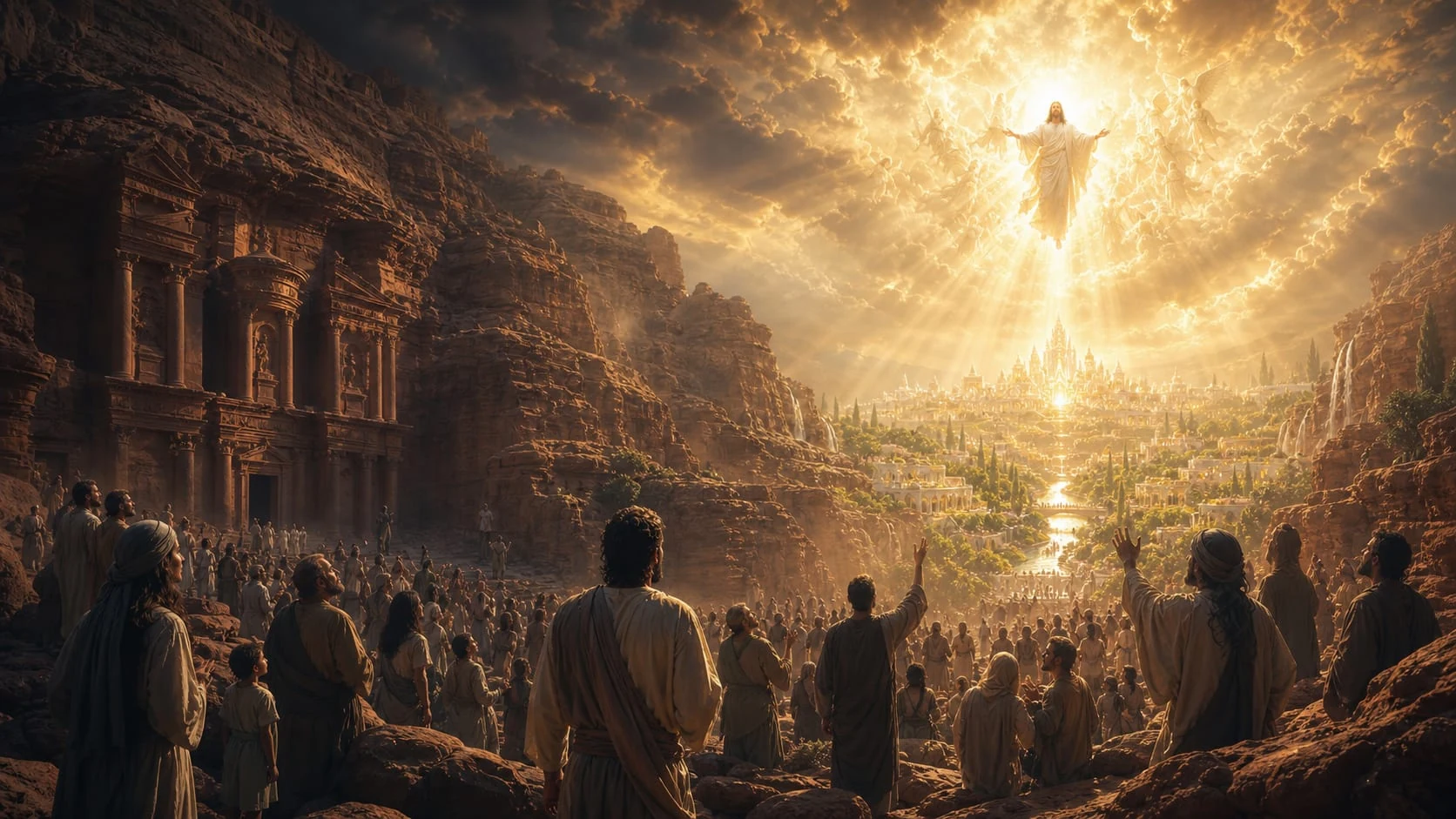 Open artwork at full size in a new tab
The King Returns — the website’s cinematic vision of Christ’s appearing above a sandstone canyon. The setting and composition are artistic interpretation; Scripture supplies the promise of His visible return (Revelation 1:7; 19:11–16).
Look at Him. The last time earth saw this face, it wore spittle and a crown of thorns. Now the eyes that wept over Jerusalem are flames; the head that bore one mocking crown bears “many crowns” — every diadem of every realm, gathered onto one brow; the mouth that stayed silent before Pilate now carries a sharp sword, “that with it he should smite the nations.” On His vesture and on His thigh a name is written: “KING OF KINGS, AND LORD OF LORDS” (Revelation 19:16). This is no longer the Lamb in humiliation. This is the Seed of the woman come to bruise the serpent’s head in open field.
And You Are in This Picture
Read the next verse slowly, because it is about you:
And the armies which were in heaven followed him upon white horses, clothed in fine linen, white and clean.
REVELATION 19:14
King James Version
Fine linen, white and clean — we have seen that uniform before. It is the Bride’s wedding dress, woven at the Bema from the righteous acts of the saints (Revelation 19:8). The armies of heaven are not merely angels; they are the raptured, rewarded, married-to-the-Lamb church, riding down with her King. Zechariah saw it five centuries early: “and the Lord my God shall come, and all the saints with thee” (Zechariah 14:5). Enoch preached it before the Flood: “Behold, the Lord cometh with ten thousands of his saints, to execute judgment upon all” (Jude 14–15). At the midpoint you went up to meet Him in the air; at the end of the week you come back with Him. The rapture and the Return are the two halves of one promise.
There will be nothing hidden about this arrival. “As the lightning cometh out of the east, and shineth even unto the west; so shall also the coming of the Son of man be” (Matthew 24:27). “Behold, he cometh with clouds; and every eye shall see him, and they also which pierced him” (Revelation 1:7). The sign of the Son of man blazes across a darkened sky; the tribes of the earth mourn; and His feet — the pierced feet — touch down exactly where the angels said they would, on the ridge He ascended from:
And his feet shall stand in that day upon the mount of Olives, which is before Jerusalem on the east, and the mount of Olives shall cleave in the midst thereof toward the east and toward the west, and there shall be a very great valley.
ZECHARIAH 14:4
King James Version
The mountain splits at His footfall like the Red Sea standing up on end, opening a valley of escape for the besieged remnant of Jerusalem. Creation itself recognizes its Maker’s weight.
The Shortest Battle Ever Fought
Armageddon is remembered as a battle. It reads more like a sentence being carried out. The assembled kings and their armies — the largest concentration of military power in human history, gathered by demonic persuasion into one valley — manage no recorded resistance at all. “And then shall that Wicked be revealed, whom the Lord shall consume with the spirit of his mouth, and shall destroy with the brightness of his coming” (2 Thessalonians 2:8). The sword that smites the nations proceeds “out of his mouth” (Revelation 19:15) — He speaks, as He spoke to storms and demons and dead men, and it is over. The birds of the air are summoned to the field before the fighting starts, so certain is the outcome (Revelation 19:17–18).
Then three swift acts of justice close the war’s active phase. The beast and the false prophet are “taken” and “cast alive into a lake of fire burning with brimstone” (Revelation 19:20) — the first two occupants of the final prison, arriving a thousand years ahead of their master. The armies are slain by the word of the King. And the dragon himself:
And he laid hold on the dragon, that old serpent, which is the Devil, and Satan, and bound him a thousand years, and cast him into the bottomless pit, and shut him up, and set a seal upon him, that he should deceive the nations no more, till the thousand years should be fulfilled.
REVELATION 20:2–3
King James Version
Chained, cast down, shut up, sealed over. Four verbs of total custody. For the first time since Eden, planet earth will conduct its affairs with no serpent whispering in it. Notice, too, what the binding is for: “that he should deceive the nations no more.” Deception has been his whole trade since the garden — “he is a liar, and the father of it” (John 8:44). Remove the liar, and mankind is about to receive something it has never once had: a thousand years of truth, under a King who is the Truth.
The First Resurrection Completed
One more company must be gathered before the Kingdom opens. John watches thrones fill:
And I saw thrones, and they sat upon them, and judgment was given unto them: and I saw the souls of them that were beheaded for the witness of Jesus, and for the word of God … and they lived and reigned with Christ a thousand years.
REVELATION 20:4
King James Version
The tribulation martyrs are raised. With them, the sleeping saints of the older covenant awake — at this very juncture, Daniel is told, when Michael stands up for Israel at the tribulation’s end:
And many of them that sleep in the dust of the earth shall awake, some to everlasting life, and some to shame and everlasting contempt.
DANIEL 12:2
King James Version
“Thy dead men shall live … awake and sing, ye that dwell in dust” (Isaiah 26:19). Abraham, Sarah, Moses, Ruth, David, Daniel himself — “blessed and holy is he that hath part in the first resurrection: on such the second death hath no power, but they shall be priests of God and of Christ, and shall reign with him a thousand years” (Revelation 20:6).
The “first resurrection,” then, is not a single moment but a single harvest gathered in stages, as Paul says: “Christ the firstfruits; afterward they that are Christ’s at his coming” (1 Corinthians 15:23) — the Lord Himself on Easter morning, the church at the rapture-trumpet, Israel’s saints and the tribulation martyrs at the Return. One harvest, three sheaves, and every sheaf rises before the thousand years begin. The rest of the dead — the unbelieving dead — stay in the grave until the thousand years are finished, and we will stand at their judgment in Section XII.
SECTION VIThe Sheep and the Goats
the judgment of the living nations
——— ◆ ———
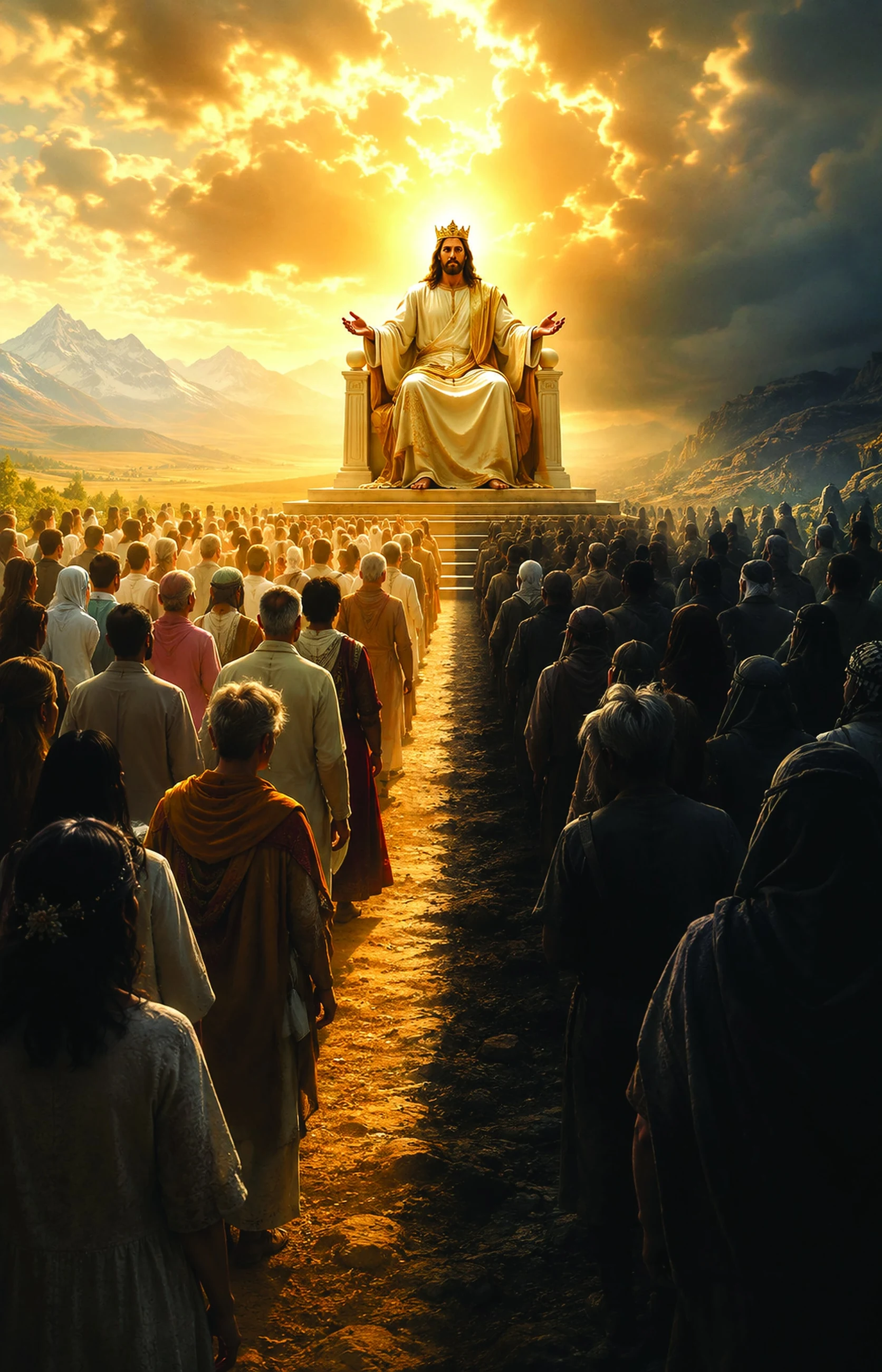 Open artwork at full size in a new tab
Before Him are gathered all nations. The King separates the sheep from the goats (Matthew 25:31–46). Original website artwork; the composition is an artistic visualization.
The war is won; the Kingdom has not yet convened. Daniel’s calendar marks a short, busy interval here: the tribulation proper runs 1,260 days from the abomination, but Daniel is told of blessing for the one who waits to the 1,335th day (Daniel 12:11–12) — some seventy-five days between the King’s touchdown and the Kingdom’s full inauguration. Thrones are set. The battlefield of a global war is cleared. And the surviving population of planet earth is summoned to the valley of decision, because a question must be answered before the thousand years can begin: who enters?
When the Son of man shall come in his glory, and all the holy angels with him, then shall he sit upon the throne of his glory: and before him shall be gathered all nations: and he shall separate them one from another, as a shepherd divideth his sheep from the goats.
MATTHEW 25:31–32
King James Version
Be clear about who stands in this crowd. Not the raptured church — she is already glorified and riding in the King’s train. Not the resurrected martyrs — they are already enthroned. Not the dead of the ages — their day comes a thousand years later, at a white throne. This is the judgment of the living: every mortal man, woman, and child who came through the Great Tribulation alive. They have just watched the sky open. And the Shepherd-King, who never needed a jury, begins to separate them with perfect knowledge, one from another.
The Evidence of the Ration Card
Then shall the King say unto them on his right hand, Come, ye blessed of my Father, inherit the kingdom prepared for you from the foundation of the world: for I was an hungred, and ye gave me meat: I was thirsty, and ye gave me drink: I was a stranger, and ye took me in: naked, and ye clothed me: I was sick, and ye visited me: I was in prison, and ye came unto me.
MATTHEW 25:34–36
King James Version
The verdict evidence the King cites is startlingly concrete — bread, water, shelter, clothing, a bedside, a prison visit. “Inasmuch as ye have done it unto one of the least of these my brethren, ye have done it unto me” (Matthew 25:40).
Who are “my brethren”? In the tribulation context, the King’s brethren are His hunted ones — the Jewish remnant fleeing the dragon, and the outlawed preachers of the everlasting gospel. Now weigh what it cost to feed such a person in the beast’s economy. Every loaf was traceable. Every kindness to the unmarked was a confession. No one sheltered a hunted Jew or fed an unregistered evangelist by accident, out of vague niceness; you did it because you believed the message they carried, and you defied the system’s brand to do it. The works the King cites are not a substitute for faith — they are the forensics of faith, mercy that could only have grown from belief, exactly as James says: “I will shew thee my faith by my works” (James 2:18). The sheep are not saved by their kindness; their kindness is the fingerprint of their salvation.
Then the two sentences, and heaven and earth hold still between them. To the sheep: “Come, ye blessed of my Father, inherit the kingdom prepared for you from the foundation of the world” (Matthew 25:34) — enter, alive, in your mortal bodies, into the thousand years; marry, plant, build, fill the renewed earth. To the goats — the marked, the compliant, the informers, those who watched the brethren starve: “Depart from me, ye cursed” (Matthew 25:41). They are removed from the earth and will answer again at the last throne. And so the Millennium opens with something no era of history has ever seen: a world whose entire citizenry, on day one, knows and loves the King.
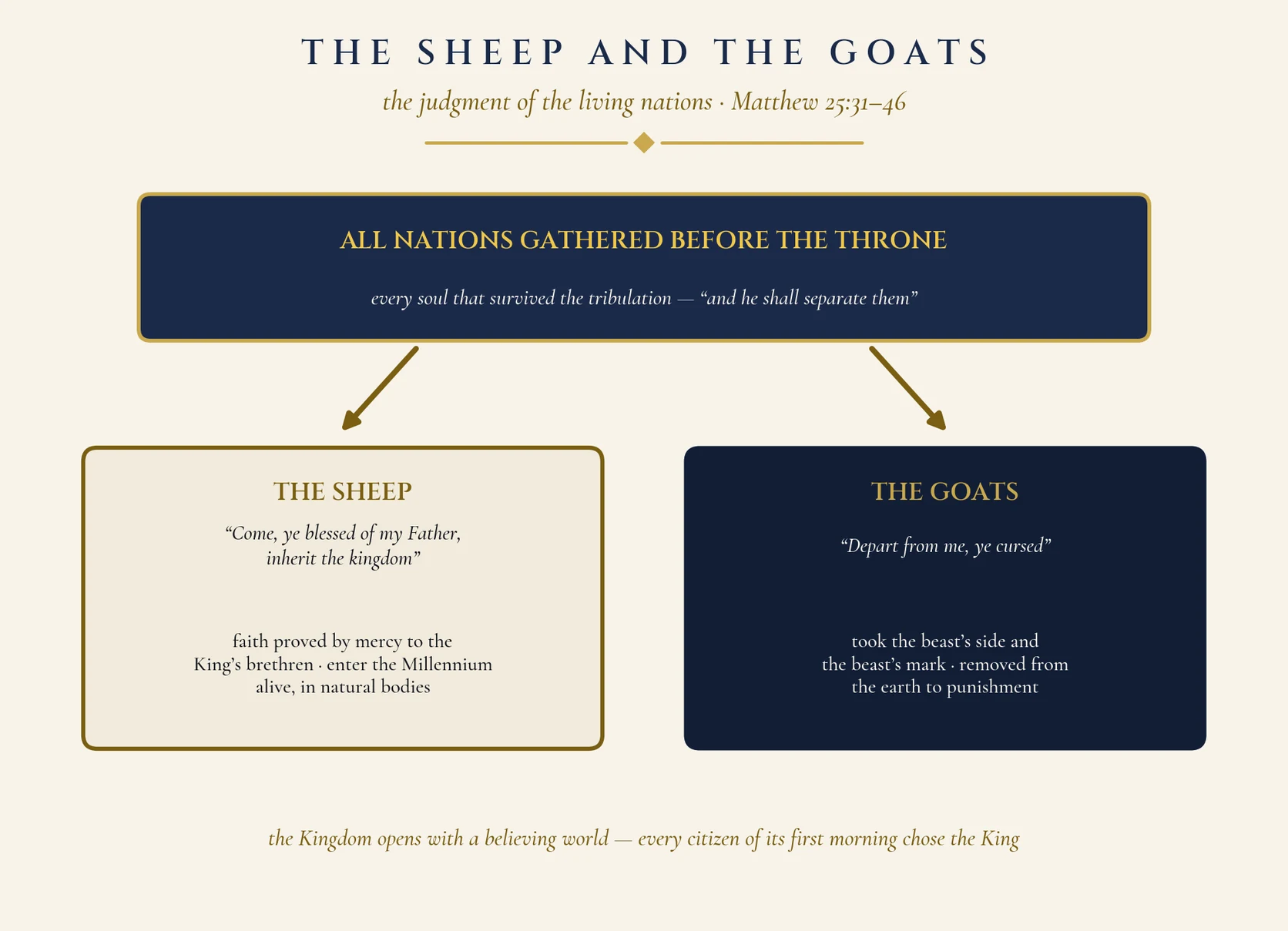 Open artwork at full size in a new tab
Israel Comes Home
The nations are not the only ones gathered. “And he shall send his angels with a great sound of a trumpet, and they shall gather together his elect from the four winds” (Matthew 24:31) — the scattered remnant of Israel, airlifted home by angels from every country of their long exile. Ezekiel foresaw a purging in transit: “I will bring you out from the people … and I will bring you into the wilderness of the people, and there will I plead with you face to face … and I will purge out from among you the rebels” (Ezekiel 20:34–38). Israel, too, is sifted; only the believing remnant crosses into the land of the Kingdom.
And they do believe — this is the wonder of the age. The nation that missed the hour of her visitation looks up at her returning King and sees the scars:
And I will pour upon the house of David, and upon the inhabitants of Jerusalem, the spirit of grace and of supplications: and they shall look upon me whom they have pierced, and they shall mourn for him, as one mourneth for his only son.
ZECHARIAH 12:10
King James Version
A fountain is opened “for sin and for uncleanness” (Zechariah 13:1); a nation is born at once (Isaiah 66:8); “and so all Israel shall be saved” (Romans 11:26). And God does in them what centuries of law and exile could not do:
A new heart also will I give you, and a new spirit will I put within you: and I will take away the stony heart out of your flesh, and I will give you an heart of flesh.
EZEKIEL 36:26
King James Version
The family quarrel that runs the whole length of the Bible ends in tears on a father’s neck — and the stage is set, at last, for the promises made to Abraham, Moses, and David to be kept to the letter.
Three Judgments, Never Confused
Much confusion about the end dissolves the moment three courtrooms are kept apart. No one stands in more than one of them, and no one is missed by all three:
On a small screen, swipe the table or use the arrow keys.
JUDGMENT | WHO STANDS THERE | WHEN — AND WHAT IS DECIDED |
|---|---|---|
The Bema Seat | believers only — the raptured and risen church | after the rapture, in heaven · service weighed for reward, never for salvation (2 Cor. 5:10) |
The Sheep & the Goats | the living nations — every soul that survived the tribulation | at the Return · allegiance revealed by mercy; the sheep enter the Kingdom (Matt. 25:31–46) |
The Great White Throne | the unbelieving dead of every age | after the 1,000 years · judged by the books; the Book of Life decides (Rev. 20:11–15) |
Why do works appear in all three? Because judgment is truthful, and deeds disclose the life that was actually lived. But watch what the works do in each courtroom. At the Bema they measure a believer’s service, for reward. At the Sheep and Goats they reveal the allegiance of the living, for admission. At the Great White Throne they demonstrate the justice of the sentence — while the Book of Life alone decides belonging. Works are evidence everywhere, and currency nowhere.
SECTION VIIA World Made New
the renewed earth of the thousand years
——— ◆ ———
What kind of world do the sheep inherit? Begin with Jesus’ own word for the era. He called it “the regeneration” — “in the regeneration when the Son of man shall sit in the throne of his glory” (Matthew 19:28) — the same word used for a soul born again, applied to a planet. Peter preached it as “the times of restitution of all things, which God hath spoken by the mouth of all his holy prophets since the world began” (Acts 3:21). Not evacuation to somewhere else: restitution — creation put back, and put right.
Paul says the creation has been waiting for this precise moment like a prisoner listening for keys in the lock: “For the earnest expectation of the creature waiteth for the manifestation of the sons of God … because the creature itself also shall be delivered from the bondage of corruption into the glorious liberty of the children of God” (Romans 8:19–21). When the sons of God are revealed — glorified, returned, reigning — the ground itself gets its parole. The thorns of Eden’s curse begin to release their grip.
New Geography
The renovation begins violently, at the King’s landing. The Mount of Olives splits east to west (Zechariah 14:4). The great earthquake of the seventh vial has already rearranged the plates — “every island fled away, and the mountains were not found” (Revelation 16:20). When the dust settles, the land around Jerusalem is flattened into a vast plain, and the city herself is “lifted up, and inhabited in her place” (Zechariah 14:10) — a raised capital, visible like a lamp on a lampstand. Isaiah saw it from a distance: “the mountain of the Lord’s house shall be established in the top of the mountains … and all nations shall flow unto it” (Isaiah 2:2).
And out from under the raised city, water. “Living waters shall go out from Jerusalem; half of them toward the former sea, and half of them toward the hinder sea” (Zechariah 14:8) — twin rivers flowing east to the Dead Sea and west to the Mediterranean. Ezekiel wades into the eastern branch in one of prophecy’s most beautiful scenes: ankle-deep at the temple threshold, then knee-deep, then waist-deep, then “waters to swim in, a river that could not be passed over” (Ezekiel 47:5). Where it flows, everything lives. The Dead Sea — the saltiest grave on earth — is healed; fishermen spread their nets at En-gedi over waters teeming “as the fish of the great sea, exceeding many” (Ezekiel 47:9–10). Along both banks grow trees whose fruit comes monthly and whose “leaf shall be for medicine” (Ezekiel 47:12). Take the picture at face value: the Millennium is an age in which a river out of God’s house makes dead things live, and the map itself preaches.
The Land Restored
An imagined panorama of the renewed land around Jerusalem
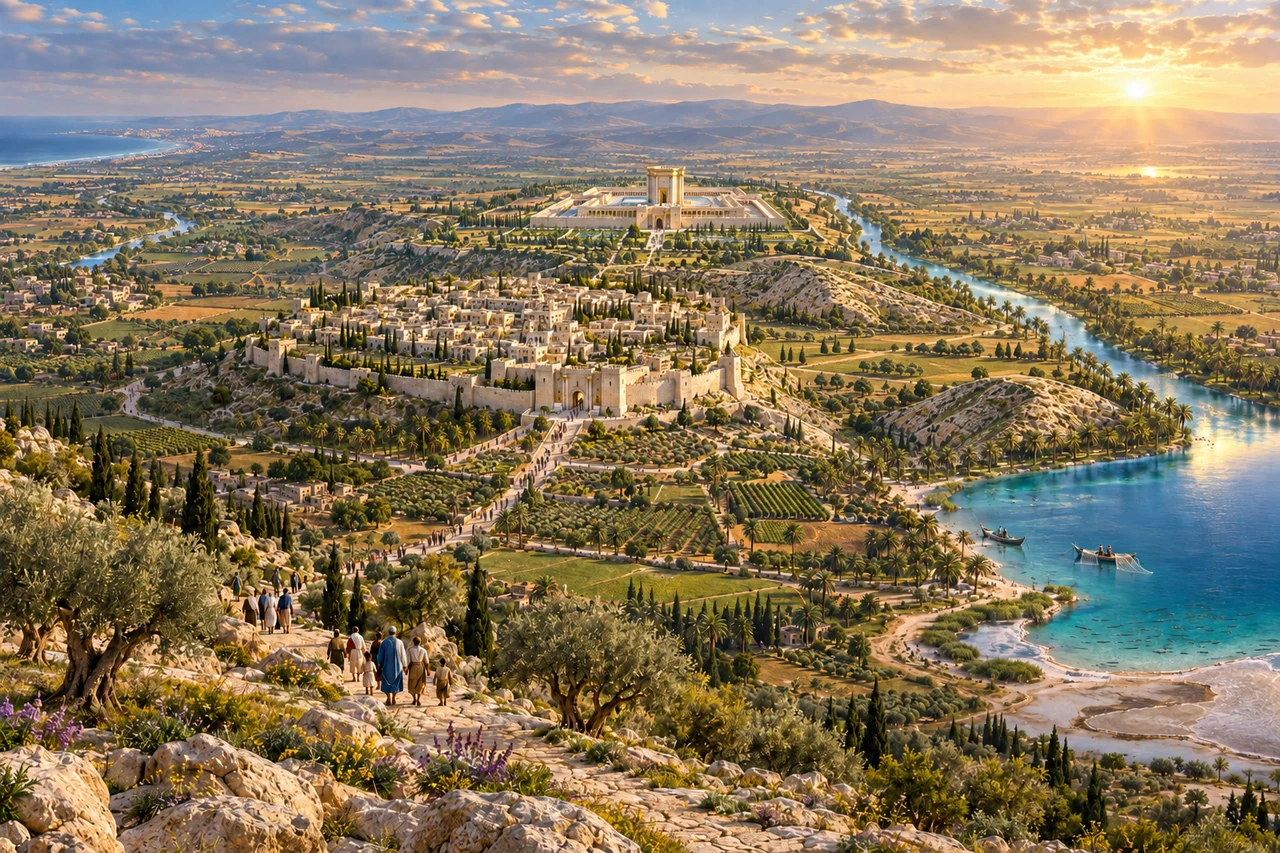 Open artwork at full size in a new tab
A composite illustration within this study’s millennial reading of Ezekiel 40–48, Isaiah 2 and 35, and Zechariah 14. Distances, elevations, architecture, and river courses are compressed artistic choices.
The raised capital. The city rises above a broad cultivated plain. Zechariah names the region from Geba to Rimmon; Isaiah sees the Lord’s mountain exalted and the nations coming to learn His ways (Zechariah 14:10–11; Isaiah 2:2–4).
The opened land. East of the city, separated ridges recall the Mount of Olives opening into an east–west valley. The two watercourses recall year-round living waters going toward the eastern and western seas (Zechariah 14:4, 8).
The land made fruitful. The sanctuary, green riverbanks, restored waters, fishing nets, and pale salt marsh draw on Ezekiel’s detailed vision. Fields and flowering land echo Isaiah’s promise of a wilderness transformed (Ezekiel 47:1–12; Isaiah 35:1–7).
Reading the Renewed Land
These prophets give us complementary views of restoration. This study brings them together within its premillennial framework. The passages do not themselves provide one surveyed map or a day-by-day reconstruction schedule. Their shared center is the Lord’s presence among His people.
Uplift and an opened valley. Zechariah places the Lord’s feet on the Mount of Olives and describes an east–west valley as the two halves move north and south. Jerusalem remains inhabited in its place while the surrounding land becomes like a plain. The named limits are Geba and Rimmon south of Jerusalem; the verse does not say the whole planet becomes flat (Zechariah 14:4–5, 10–11).
The sanctuary and the city. Ezekiel is set on a very high mountain and sees a measured sanctuary. His later allotments distinguish the sanctuary’s holy portion from the city’s residential and agricultural portion. The panorama therefore separates them; it does not reproduce their dimensions or claim an exact future site plan (Ezekiel 40:2; 43:1–7; 48:8–22).
Water that changes the land. Zechariah’s waters flow toward both seas in summer and winter. Ezekiel follows water issuing eastward from beneath the sanctuary threshold, south of the altar. Its depth increases at successive thousand-cubit measurements: ankles, knees, waist, then a river too deep to ford. Joining these visions into one river system is a synthesis; neither passage traces every channel (Zechariah 14:8; Ezekiel 47:1–5).
A healed sea and living banks. The eastern river reaches the sea, brings abundant fish, and sustains fishermen from En-gedi to En-eglaim. Some marshes remain saline. Trees on both banks bear fresh fruit each month and leaves for healing. The painting includes the salt margin because restoration does not erase every distinction in Ezekiel’s landscape (Ezekiel 47:8–12).
A habitable and fruitful earth. Isaiah pictures desert flowers, pools, springs, and a safe road to Zion. Cultivated land, houses, vineyards, and peace among creatures describe a world lived in and tended. Ezekiel also pictures ruined cities rebuilt and desolate ground becoming like Eden (Isaiah 35:1–10; 65:21–25; Ezekiel 36:33–36).
Geology and light. Revelation’s final bowl brings a vast earthquake and the disappearance of islands and mountains from view. The text does not name tectonic plates, uplift rates, or a mechanism. Isaiah’s brighter sun and moon and Zechariah’s unusual evening light belong to the prophets’ language of restoration; the artwork’s dawn is an imaginative rendering, not a climate calculation (Revelation 16:18–20; Isaiah 30:23–26; Zechariah 14:6–7).
Beyond the frame. Isaiah also describes changed crossings and a highway for the returning remnant beyond this local scene. Ezekiel orders tribal land and a holy district; Zechariah describes nations traveling to worship. Their wider geography exceeds one picture. This illustration shows the renewed earthly kingdom as understood here; the New Jerusalem of Revelation 21–22 belongs to the study’s later horizon (Isaiah 11:15–16; Ezekiel 48; Zechariah 14:16).
Read Zechariah 14 · Ezekiel 47–48 · Isaiah 35
The Curse in Retreat
Isaiah is the great landscape painter of the Kingdom, and he uses every color he has. The deserts first: “The wilderness and the solitary place shall be glad for them; and the desert shall rejoice, and blossom as the rose … for in the wilderness shall waters break out, and streams in the desert” (Isaiah 35:1, 6). Then the farms: “Then shall he give the rain of thy seed … and bread of the increase of the earth, and it shall be fat and plenteous” (Isaiah 30:23); the plowman overtakes the reaper, and the mountains drip sweet wine (Amos 9:13). Even the light changes: “the light of the moon shall be as the light of the sun, and the light of the sun shall be sevenfold … in the day that the Lord bindeth up the breach of his people” (Isaiah 30:26).
Behold, the days come, saith the Lord, that the plowman shall overtake the reaper, and the treader of grapes him that soweth seed; and the mountains shall drop sweet wine, and all the hills shall melt.
AMOS 9:13
King James Version
Then the animals — and here the prophet writes the verses every child instinctively loves, because children have not yet been taught to shrink the promises:
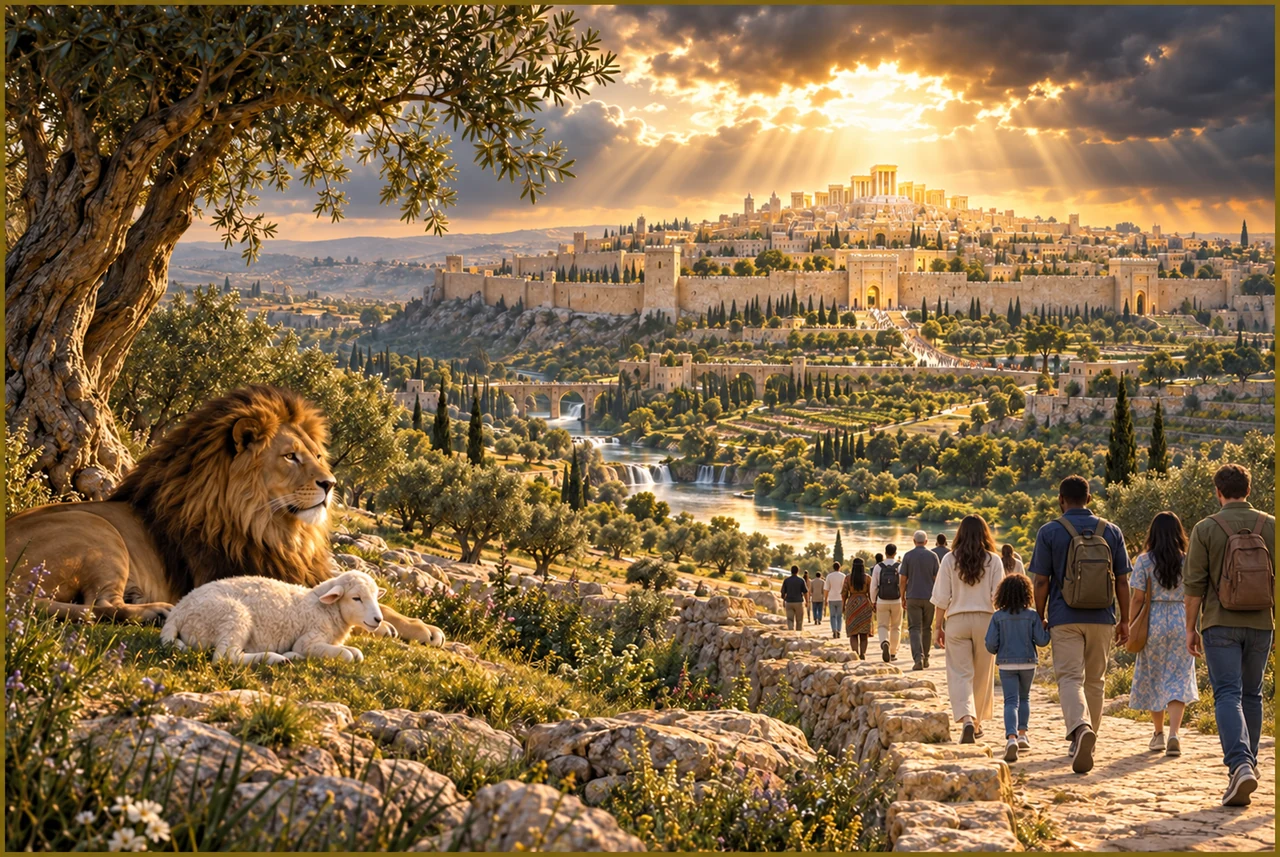
The wolf also shall dwell with the lamb, and the leopard shall lie down with the kid; and the calf and the young lion and the fatling together; and a little child shall lead them … and the sucking child shall play on the hole of the asp … They shall not hurt nor destroy in all my holy mountain: for the earth shall be full of the knowledge of the Lord, as the waters cover the sea.
ISAIAH 11:6–9
King James Version
The food chain itself stands down: “the lion shall eat straw like the bullock” (Isaiah 65:25). Predation, the emblem of a world where survival requires someone else’s death, is retired. A toddler with a stick leads the wolf and the leopard home for supper. This is not sentimentality; it is the curse of Genesis 3 being rolled up like an old carpet, room by room.
 Open artwork at full size in a new tab
The Kingdom in one frame — peace among the creatures and the nations going up to the King (Isaiah 11:6–9; 2:2–3). Contemporary clothing and walking shoes invite us to imagine inhabiting this future; Scripture does not prescribe its fashions.
Human life stretches out again to Genesis proportions. “There shall be no more thence an infant of days, nor an old man that hath not filled his days: for the child shall die an hundred years old” (Isaiah 65:20) — a century qualifies you as a child; a death at one hundred is read as a judgment, not a lifespan. “As the days of a tree are the days of my people” (Isaiah 65:22) — oaks and olives, centuries deep. Sickness loosens its grip: “the inhabitant shall not say, I am sick” (Isaiah 33:24); “then the eyes of the blind shall be opened, and the ears of the deaf shall be unstopped. Then shall the lame man leap as an hart” (Isaiah 35:5–6). And the oldest human industry of all is shuttered for lack of demand: “they shall beat their swords into plowshares … nation shall not lift up sword against nation, neither shall they learn war any more” (Isaiah 2:4). Not merely no wars — no military science. No academies teach it; no budgets fund it; no mother anywhere rehearses the knock at the door. Instead, “they shall sit every man under his vine and under his fig tree; and none shall make them afraid” (Micah 4:4).
And he shall judge among the nations, and shall rebuke many people: and they shall beat their swords into plowshares, and their spears into pruninghooks: nation shall not lift up sword against nation, neither shall they learn war any more.
ISAIAH 2:4
King James Version
The Crown Jewel: A Temple by the River
At the center of the renewed land, Ezekiel is shown a temple in measurements so exact — nine chapters of them (Ezekiel 40–48) — that they read like an architect’s handoff package, which is precisely what they are. From it flows the river; around it the tribes of Israel are resettled in new allotments; in it the glory of the Lord, which Ezekiel once watched depart to the east, comes back the same way: “and, behold, the glory of the God of Israel came from the way of the east … and the glory of the Lord filled the house” (Ezekiel 43:2, 5). Sacrifices are offered there — and before that troubles you, remember what sacrifices always were: not payment, which the cross alone accomplished once for all, but proclamation. As the Lord’s Supper looks back to a finished cross from within the church age, the Kingdom’s offerings look back to it from within the Millennium — object lessons in blood for generations who will be born into a peaceful world and must still learn what their peace cost.
SECTION VIIIThe Throne of David
the government of the King — and the king under the King
——— ◆ ———
Every kingdom is finally about its throne. And the throne at the center of the Millennium is not a new invention; it is the keeping of the oldest royal promise in the Bible. A thousand years before Christ, God swore to a shepherd-king: “And thine house and thy kingdom shall be established for ever before thee: thy throne shall be established for ever” (2 Samuel 7:16). David believed it. The prophets staked everything on it. And when the angel Gabriel came to a virgin in Nazareth, he quoted it as the birth announcement:
He shall be great, and shall be called the Son of the Highest: and the Lord God shall give unto him the throne of his father David: and he shall reign over the house of Jacob for ever; and of his kingdom there shall be no end.
LUKE 1:32–33
King James Version
Read that the way Mary heard it. Every clause of the first half came literally true — He was great; He was called the Son of the Highest; Mary bore a son and called His name Jesus. By what rule of reading does the second half dissolve into metaphor? The throne of David is a real throne over a real house of Jacob in a real Jerusalem — “Then the moon shall be confounded, and the sun ashamed, when the Lord of hosts shall reign in mount Zion, and in Jerusalem, and before his ancients gloriously” (Isaiah 24:23). At the name of Jesus every knee now bows in heaven; in the Millennium, the reign becomes visible on earth, from the city that once crucified Him. “At that time they shall call Jerusalem the throne of the Lord; and all the nations shall be gathered unto it” (Jeremiah 3:17).
Behold, the days come, saith the Lord, that I will raise unto David a righteous Branch, and a King shall reign and prosper, and shall execute judgment and justice in the earth. In his days Judah shall be saved, and Israel shall dwell safely: and this is his name whereby he shall be called, THE LORD OUR RIGHTEOUSNESS.
JEREMIAH 23:5–6
King James Version
What Government Under Christ Is Like
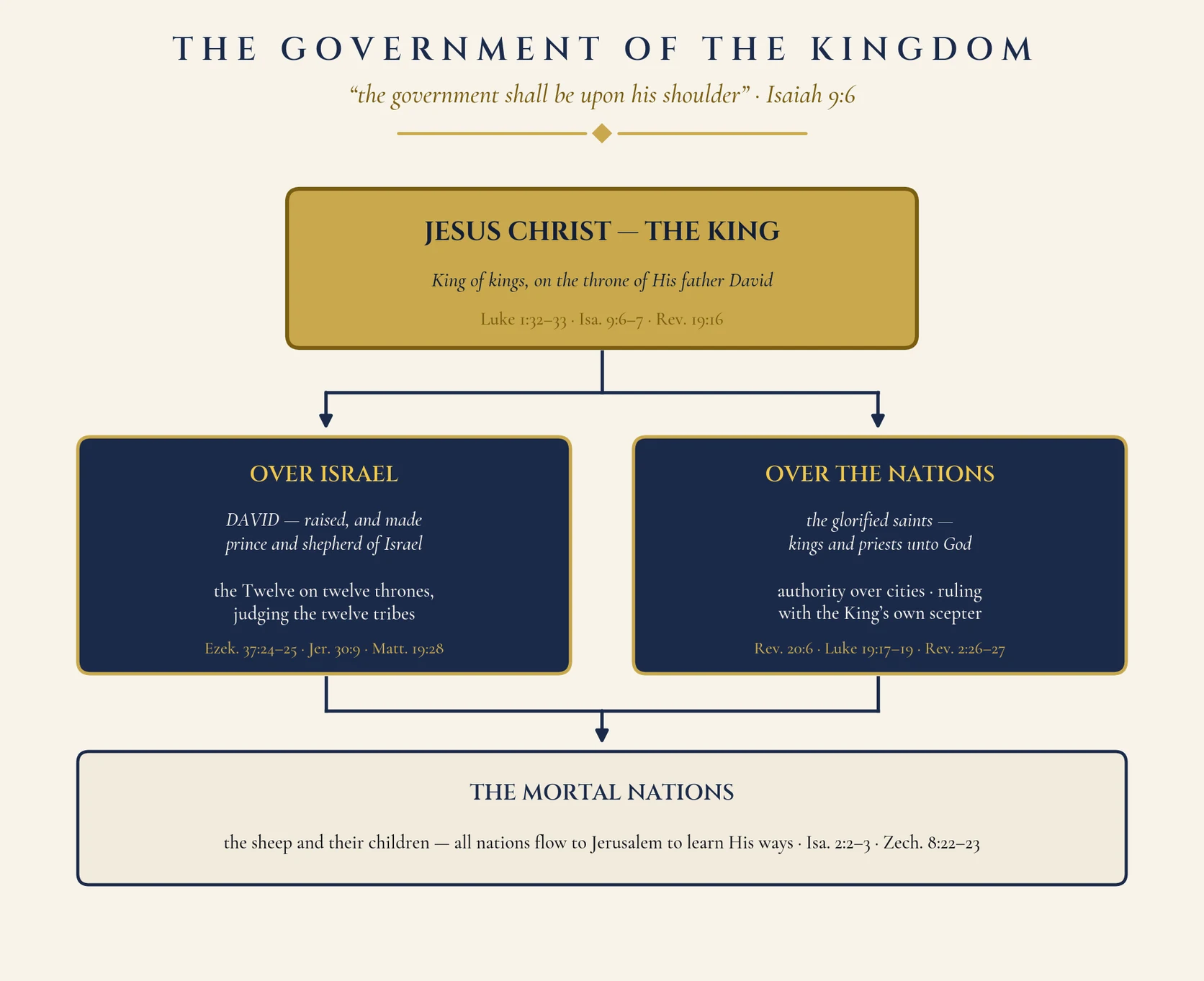
For unto us a child is born, unto us a son is given: and the government shall be upon his shoulder: and his name shall be called Wonderful, Counsellor, The mighty God, The everlasting Father, The Prince of Peace. Of the increase of his government and peace there shall be no end, upon the throne of David, and upon his kingdom, to order it, and to establish it with judgment and with justice from henceforth even for ever.
ISAIAH 9:6–7
King James Version
He judges “not after the sight of his eyes, neither reprove[s] after the hearing of his ears: but with righteousness shall he judge the poor” (Isaiah 11:3–4) — a Judge who needs no testimony because He reads hearts directly. No case backlog, no bribed court, no unsolved crime, no spin. And Psalm 2 supplies the instrument of enforcement — authority that cannot be lobbied, corrupted, or overthrown:
Yet have I set my king upon my holy hill of Zion. … Ask of me, and I shall give thee the heathen for thine inheritance, and the uttermost parts of the earth for thy possession. Thou shalt break them with a rod of iron; thou shalt dash them in pieces like a potter’s vessel.
PSALM 2:6–9
King James Version
For everyone who loves righteousness, the rod of iron is the safest object in the universe; it only falls on the wolf at the door.
And the nations, remarkably, cannot get enough of this government: “many people shall go and say, Come ye, and let us go up to the mountain of the Lord … and he will teach us of his ways, and we will walk in his paths: for out of Zion shall go forth the law” (Isaiah 2:3). Ten men grab the sleeve of one Jew, “saying, We will go with you: for we have heard that God is with you” (Zechariah 8:23). History’s longest resentment — mankind chafing at rule — dissolves, because for the first time the One ruling is worthy of it.
David, Prince of Israel
Now for one of Scripture’s most staggering appointments — recorded not once but four times, across three prophets:
And I will set up one shepherd over them, and he shall feed them, even my servant David; he shall feed them, and he shall be their shepherd. And I the Lord will be their God, and my servant David a prince among them; I the Lord have spoken it.
EZEKIEL 34:23–24
King James Version
“And David my servant shall be king over them … and my servant David shall be their prince for ever” (Ezekiel 37:24–25). “But they shall serve the Lord their God, and David their king, whom I will raise up unto them” (Jeremiah 30:9). “Afterward shall the children of Israel return, and seek the Lord their God, and David their king … in the latter days” (Hosea 3:5).
Some readers take “David” here as simply a title for the Messiah, great David’s greater Son — and the Messiah is certainly the fountain of all this authority. But notice how the text itself keeps two persons distinct: “I the Lord will be their God, and my servant David a prince among them.” The Lord is God over the arrangement; David is prince within it — and Jeremiah’s word settles the identity: David their king, “whom I will raise up unto them.” This study takes the promise at face value: the resurrected David — the shepherd who wrote the Shepherd Psalm, the king after God’s own heart, sinner, psalmist, and friend of God — raised in the first resurrection at the Return, and installed as regent-prince over Israel, serving under the Son of David on the throne above him. The man who once refused to seize Saul’s crown before God’s time receives a better one in God’s time — a servant-prince over the beloved nation, for ever second, and for ever satisfied to be.
Beneath the King and His prince, the structure fills in. To the Twelve, Jesus made a cabinet appointment at a supper table: “in the regeneration when the Son of man shall sit in the throne of his glory, ye also shall sit upon twelve thrones, judging the twelve tribes of Israel” (Matthew 19:28). Judges and counselors are restored “as at the first” (Isaiah 1:26); “a king shall reign in righteousness, and princes shall rule in judgment” (Isaiah 32:1). And over the wider world of the nations — that is the saints’ own story, and it deserves its own section.
 Open artwork at full size in a new tab
SECTION IXReigning with the King
what the glorified saints do for a thousand years
——— ◆ ———
Ask the average believer what Christians do after this life and you will hear something about clouds, harps, and an endless church service — a picture with more Renaissance painting in it than Bible. Now hear Scripture’s answer, and notice the verbs:
Blessed and holy is he that hath part in the first resurrection: on such the second death hath no power, but they shall be priests of God and of Christ, and shall reign with him a thousand years.
REVELATION 20:6
King James Version
Priests. Kings. Two offices, one glorified person. Heaven’s own new song, sung to the Lamb, says it plainly:
…for thou wast slain, and hast redeemed us to God by thy blood out of every kindred, and tongue, and people, and nation; and hast made us unto our God kings and priests: and we shall reign on the earth.
REVELATION 5:9–10
King James Version
Not float in the clouds: reign on the earth. The Millennium is not retirement; it is deployment. Everything the Bema fitted you for now unfolds into a thousand years of glorious, consequential work.
Real Thrones, Real Portfolios
Jesus described the mechanics in a parable He told, Luke notes, precisely “because they thought that the kingdom of God should immediately appear” (Luke 19:11). A nobleman travels to a far country to receive a kingdom; his servants trade with his money while he is away; he returns, audits the books — a Bema in miniature — and then makes the appointments: “Well, thou good servant: because thou hast been faithful in a very little, have thou authority over ten cities. … Be thou also over five cities” (Luke 19:17, 19).
Cities. Not metaphors — municipalities of the renewed earth, with mortal citizens who farm and build and raise children, needing wise government. The faithful in small things are made governors of great ones; the reward for work, wonderfully, is more work — with more joy in it: “enter thou into the joy of thy lord” (Matthew 25:21). Paul states it as a flat principle: “Do ye not know that the saints shall judge the world? … Know ye not that we shall judge angels?” (1 Corinthians 6:2–3). And the risen Lord promises the overcomer a share in His own scepter: “And he that overcometh, and keepeth my works unto the end, to him will I give power over the nations: and he shall rule them with a rod of iron … even as I received of my Father” (Revelation 2:26–27). “If we suffer, we shall also reign with him” (2 Timothy 2:12). The throne you occupy then is being carved now, in the unseen faithfulness of this present life.
Daniel saw the same transfer of power from his side of the ages, and wrote it down as settled fact:
And the kingdom and dominion, and the greatness of the kingdom under the whole heaven, shall be given to the people of the saints of the most High, whose kingdom is an everlasting kingdom, and all dominions shall serve and obey him.
DANIEL 7:27
King James Version
A Body Like His
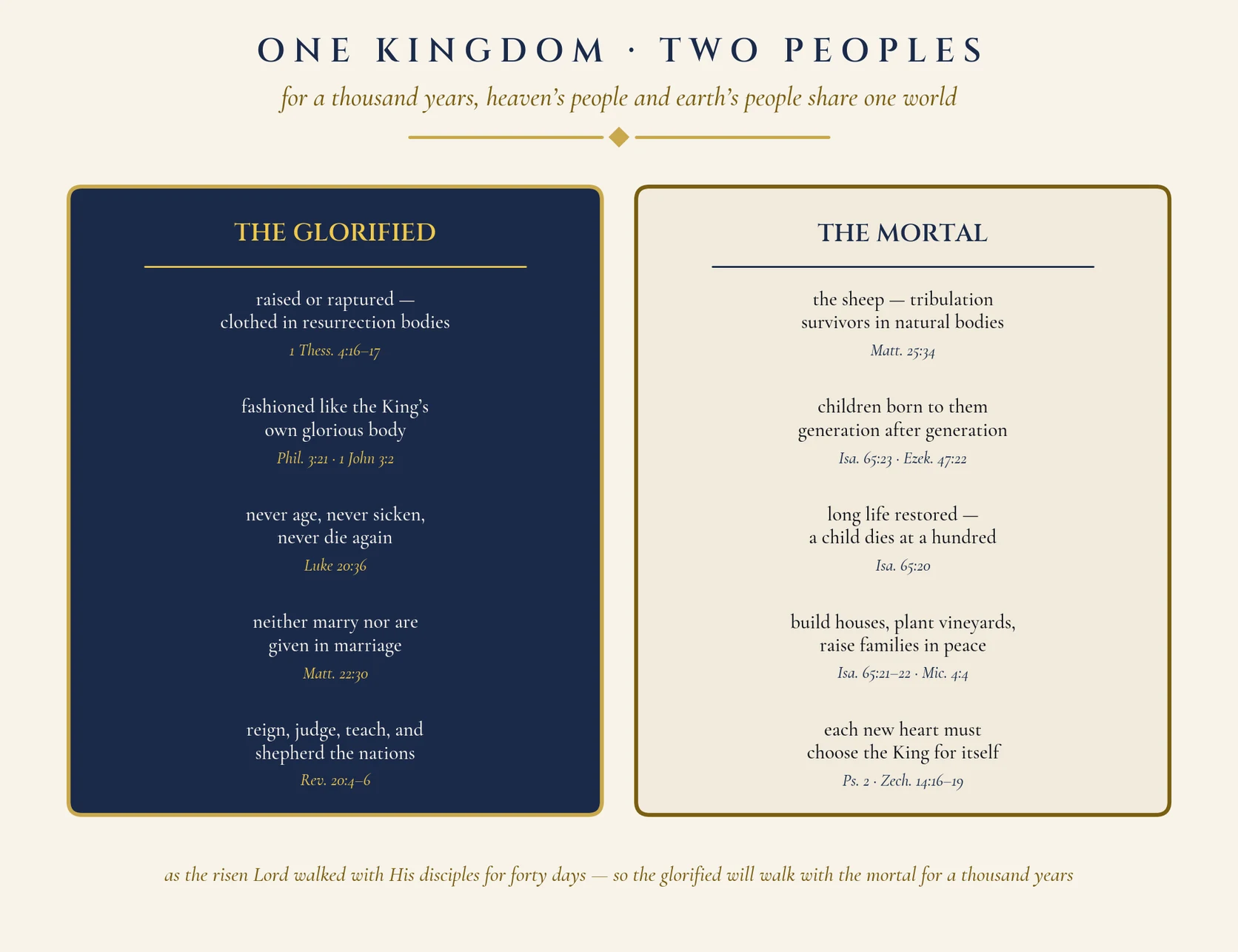
What kind of being does such work? “Beloved, now are we the sons of God, and it doth not yet appear what we shall be: but we know that, when he shall appear, we shall be like him; for we shall see him as he is” (1 John 3:2). The Lord “shall change our vile body, that it may be fashioned like unto his glorious body” (Philippians 3:21). Your preview, then, is the risen Christ of the forty days: a body of “flesh and bones” that could be touched and could broil fish for breakfast on a beach (Luke 24:39; John 21:9–13) — and could also appear inside a locked room, vanish at Emmaus, and ascend through the air. Recognizably Himself, scars included; gloriously beyond Himself, gravity optional.
So will the glorified be: incorruptible — “neither can they die any more: for they are equal unto the angels; and are the children of God, being the children of the resurrection” (Luke 20:36); unmarried — “in the resurrection they neither marry, nor are given in marriage” (Matthew 22:30), every lesser union outshone by the marriage to the Lamb it always pointed to; unbounded — at home in the heavenly Jerusalem and on the renewed earth alike, as their Lord was at home in both throughout the forty days; and knowing — “then shall I know even as also I am known” (1 Corinthians 13:12). Picture the fellowship such beings enjoy: sitting down “with Abraham, and Isaac, and Jacob, in the kingdom of heaven” (Matthew 8:11); a thousand years of conversations with Moses about the wilderness, with Ruth about the harvest field, with Paul about the shipwrecks — and with the King Himself about everything.
 Open artwork at full size in a new tab
The Work of the Age
Gather the strands and a portrait of the saints’ millennial vocation emerges. They govern: cities, regions, and nations, under the King, with the incorruptible justice of beings who cannot be bribed because they cannot want. They judge: courts without error, verdicts without appeal-worthy flaws, angels themselves within their jurisdiction. They teach: Isaiah promises the mortal world, “thine eyes shall see thy teachers: and thine ears shall hear a word behind thee, saying, This is the way, walk ye in it” (Isaiah 30:20–21) — and who better to teach the way than those who walked it in weakness and now know it in glory? Every mortal generation must learn the King’s ways; the glorified are the faculty of the age. They minister as priests: standing between the visible King and His mortal subjects, carrying the knowledge of God outward “as the waters cover the sea” (Isaiah 11:9), leading a planet’s worship up to Zion, feast by feast. And they worship and learn: for the ages to come exist, Paul says, “that in the ages to come he might shew the exceeding riches of his grace in his kindness toward us” (Ephesians 2:7) — a thousand years is merely the first installment of the showing.
And through all of it runs the deepest reward, the one Jesus attached to the faithful servant not as wages but as welcome: “enter thou into the joy of thy lord.” The Millennium is work without weariness, authority without anxiety, service without self — the thing your best day of meaningful labor was a rumor of.
And the style of that authority never changes hands. “Whosoever will be great among you, shall be your minister” (Mark 10:43) was not a rule for the church age only; it is the constitution of the Kingdom, modeled by a King who reigns with towel-marks on His hands. Glorification perfects the servant character of leadership — it never repeals it. No glorified saint will envy another’s assignment or lord it over the mortals in his care; whoever finds the thought of future authority stirring an appetite to dominate has not yet understood the King.
SECTION XLife in the Kingdom
a year in the Millennium — the mortal world under the King
——— ◆ ———
Now change vantage points. Set aside the glorified saint’s view and stand in the sandals of a mortal citizen — a grandchild, say, of two tribulation survivors, born in the Kingdom’s second century. What is life actually like?
You wake in a stone farmhouse your great-grandfather built — build once, and a house outlasts empires now — under your own vine and fig tree, and “none shall make them afraid” (Micah 4:4) is not poetry to you; it is the reason your village has no wall, no lock, and no word for burglary. The morning is bright — sunlight sevenfold, moonlight like day (Isaiah 30:26) — and the land answers labor the way it answered Adam’s before the thorns: “they shall not plant, and another eat: for as the days of a tree are the days of my people, and mine elect shall long enjoy the work of their hands” (Isaiah 65:22). Your body knows no sickness — “the inhabitant shall not say, I am sick” (Isaiah 33:24). Your great-grandfather, at three hundred, is still called a young man.
Thus saith the Lord of hosts; There shall yet old men and old women dwell in the streets of Jerusalem, and every man with his staff in his hand for very age. And the streets of the city shall be full of boys and girls playing in the streets thereof.
ZECHARIAH 8:4–5
King James Version
Justice, when it is needed, is immediate and exact — a word from the throne, or from the glorified governor whose district includes your valley. War is a museum subject; your children study it the way ours study the plague, amazed such a thing was ever allowed. And God is not a debate topic anywhere on earth: “the earth shall be full of the knowledge of the Lord, as the waters cover the sea” (Isaiah 11:9). The King is not believed in; He is known — a real Person on a real throne, whom your own grandmother has seen.
In his days shall the righteous flourish; and abundance of peace so long as the moon endureth. He shall have dominion also from sea to sea, and from the river unto the ends of the earth.
PSALM 72:7–8
King James Version
The Feast of the King
Once a year, your family joins the river of pilgrims flowing up to the raised city:
And it shall come to pass, that every one that is left of all the nations which came against Jerusalem shall even go up from year to year to worship the King, the Lord of hosts, and to keep the feast of tabernacles.
ZECHARIAH 14:16
King James Version
Of all Israel’s feasts, Tabernacles — the harvest-home festival of God dwelling with His people in booths — is the one the whole earth keeps, because it is the one the whole earth is finally living. “From the rising of the sun even unto the going down of the same my name shall be great among the Gentiles” (Malachi 1:11). Nations that skip the pilgrimage find their rain withheld (Zechariah 14:17) — a discipline worth pausing over, because of what it reveals: even in a perfect world, worship must still be commanded for some, and enforced with sanctions. File that away. It is the crack under the wallpaper.
The Crack Under the Wallpaper
For here is the sobering genius of the millennial arrangement: the world is perfect, and the people in it are not. The Kingdom’s first generation — the sheep — were believers all. But their children are born the way all children of Adam are born: mortal, and fallen, needing to be born again like every generation before them. Many will love the King truly. Some will not. Isaiah’s hundred-year-old “child” who dies is a “sinner … accursed” (Isaiah 65:20) — open rebellion is answered swiftly, and it is answered, which means it occurs. The Psalmist foresaw a class of subjects who “submit themselves” to the King — the Hebrew margin says yield feigned obedience (Psalm 18:44; 66:3) — hearts that keep the feast, mind the rain, obey the iron rod, and inwardly wish the throne were empty.
Sit with that until it astonishes you properly. These people will have everything every utopian scheme ever promised: perfect government, perfect justice, perfect environment, universal prosperity, no devil to tempt them — he is sealed in the pit — and a visibly present, demonstrably good King. And still, some hearts will withhold themselves. The Millennium is God’s thousand-year public demonstration of a truth the human race has resisted since Eden: our problem was never the environment. Not poverty, not ignorance, not bad government, not even the devil — remove every one of them for ten centuries, and sin still grows wild wherever a heart remains unregenerate. “Ye must be born again” (John 3:7) is as true in the golden age as it was in Nicodemus’s dark garden. The stage is now set — tragically, perfectly — for what happens when the pit is unsealed.
SECTION XIThe Last Rebellion
Satan loosed — and the final proof
——— ◆ ———
The strangest verse in the Revelation may be this one: “And when the thousand years are expired, Satan shall be loosed out of his prison” (Revelation 20:7). Loosed? After ten centuries of planetary peace, with the war won and the King enthroned — why would God unchain the serpent on purpose? He is not careless, and heaven has no accidents. The verse before the binding told us the release was planned from the start: “he must be loosed a little season” (Revelation 20:3). Must. There is one more thing that must be demonstrated before the books of history close.
And shall go out to deceive the nations which are in the four quarters of the earth, Gog and Magog, to gather them together to battle: the number of whom is as the sand of the sea.
REVELATION 20:8
King James Version
Watch how fast it happens. No centuries of patient corruption this time; a “little season” suffices. The deceiver steps out of the pit into a perfect world and finds his constituency waiting — the feigned-obedience class, generations deep by now, spread across “the four quarters of the earth.” He tells them the oldest lie in his inventory, the Eden original: the King is withholding something from you; the throne could be yours. And they believe him — “the number of whom is as the sand of the sea.” From a standing start, in a world without poverty, injustice, or grievance, he raises the largest army in ten centuries and marches it against “the camp of the saints about, and the beloved city” (Revelation 20:9). Jerusalem again. The Seed’s city, one last time.
Why God Signed Off on This
Now the purpose of the release comes clear. For a thousand years, an objector could still have argued: of course they obey — the devil is locked up; mankind never got a fair test in a fair world. Very well. Here is the fair test, run under laboratory conditions: perfect environment, perfect government, no tempter for a thousand years — then one tempter, briefly readmitted, with no army, no wealth, and no weapon but a lie. The result: sand-of-the-sea multitudes rallying to dethrone the King who healed their world. The verdict of the experiment is final and universal: sin is not made by circumstances; it is chosen by hearts. Every alternative explanation for human evil — bad environments, bad institutions, bad influences — is eliminated in one motion. What remains is Jeremiah’s old diagnosis, now proven before all worlds:
The heart is deceitful above all things, and desperately wicked: who can know it? I the Lord search the heart, I try the reins, even to give every man according to his ways, and according to the fruit of his doings.
JEREMIAH 17:9–10
King James Version
And only a new heart — God’s gift through the new birth — ever made anyone safe to be free.
The battle itself is not a battle. There is no siege, no campaign, no exchange: “and fire came down from God out of heaven, and devoured them” (Revelation 20:9). One verse. The war that began with a whisper in a garden ends with fire on a plain — the serpent’s final assault on the Seed dying before it strikes a single blow. And then the sentence deferred since Eden is executed in full:
And the devil that deceived them was cast into the lake of fire and brimstone, where the beast and the false prophet are, and shall be tormented day and night for ever and ever.
REVELATION 20:10
King James Version
Mark the small, terrible word are. The beast and false prophet were cast in a thousand years earlier — and they are there still. The lake of fire does not annihilate its occupants; a millennium has passed and its first two prisoners remain. Now their master joins them, for ever. He is not hell’s king, whatever the cartoons taught you; he is its most notorious inmate. The Seed War is over. There is no Act Three for the serpent, no sequel, no last twist. The head, bruised judicially at the cross, is now crushed finally and for ever.
SECTION XIIThe Great White Throne
the last judgment — and the second death
——— ◆ ———
After the fire, a silence. And then John sees the single most solemn sight in the Bible:
And I saw a great white throne, and him that sat on it, from whose face the earth and the heaven fled away; and there was found no place for them.
REVELATION 20:11
King James Version
Great — beyond appeal. White — beyond corruption. A throne — beyond resistance. So absolute is the holiness of the One seated there that the physical universe itself bolts from His face like a guilty thing; the old heaven and earth, their long service complete, are dismissed to make way for the new. There is no scenery left, no horizon, no place to look except at the throne. And before it stands everyone who never stood anywhere else:
And I saw the dead, small and great, stand before God; and the books were opened: and another book was opened, which is the book of life: and the dead were judged out of those things which were written in the books, according to their works.
REVELATION 20:12
King James Version
Be precise about who is in this crowd, because the gospel hangs on the precision. No believer stands here. The church was judged at the Bema; Israel’s saints and the martyrs rose in the first resurrection; the sheep entered the Kingdom; “blessed and holy is he that hath part in the first resurrection: on such the second death hath no power” (Revelation 20:6). This is the second resurrection — “the rest of the dead” (Revelation 20:5) — the unbelieving of every age, summoned bodily from wherever death filed them: “the sea gave up the dead which were in it; and death and hell delivered up the dead which were in them” (Revelation 20:13). The emperor and the informer, the marked worshippers of the beast and the polite unbelievers of quiet centuries, the small and the great — with no rank left but the one that never mattered.
The Books, and the Book
Two kinds of records lie open. The books — plural — contain works: “the dead were judged … according to their works.” Here is perfect, individualized justice: every deed weighed, every secret sifted — “God shall bring every work into judgment, with every secret thing” (Ecclesiastes 12:14); “every idle word that men shall speak, they shall give account thereof in the day of judgment” (Matthew 12:36). Judgment by works is scrupulously fair — and that is precisely its terror, for “by the works of the law shall no flesh be justified” (Galatians 2:16). The books can establish degrees of guilt — Jesus spoke plainly of “few stripes” and “many stripes,” of it being “more tolerable for Sodom” than for cities that refused greater light (Luke 12:47–48; Matthew 11:24) — but the books cannot acquit. No ledger of mixed deeds ever added up to the righteousness God’s presence requires.
That is why the other Book is there. “And another book was opened, which is the book of life.” One Book holds no deeds at all — only names: the register of everyone who ever took refuge in the Lamb. At the last assize the verdict turns on a single question, and it is not how bad were you? but whose are you? — “And whosoever was not found written in the book of life was cast into the lake of fire” (Revelation 20:15). Grace or works: every human being is judged out of one Book or the others. The saved are judged in Christ at the Bema, works weighed for reward. The lost are judged in themselves at the White Throne, works weighed for sentence. No one is judged twice, and no one is missed.
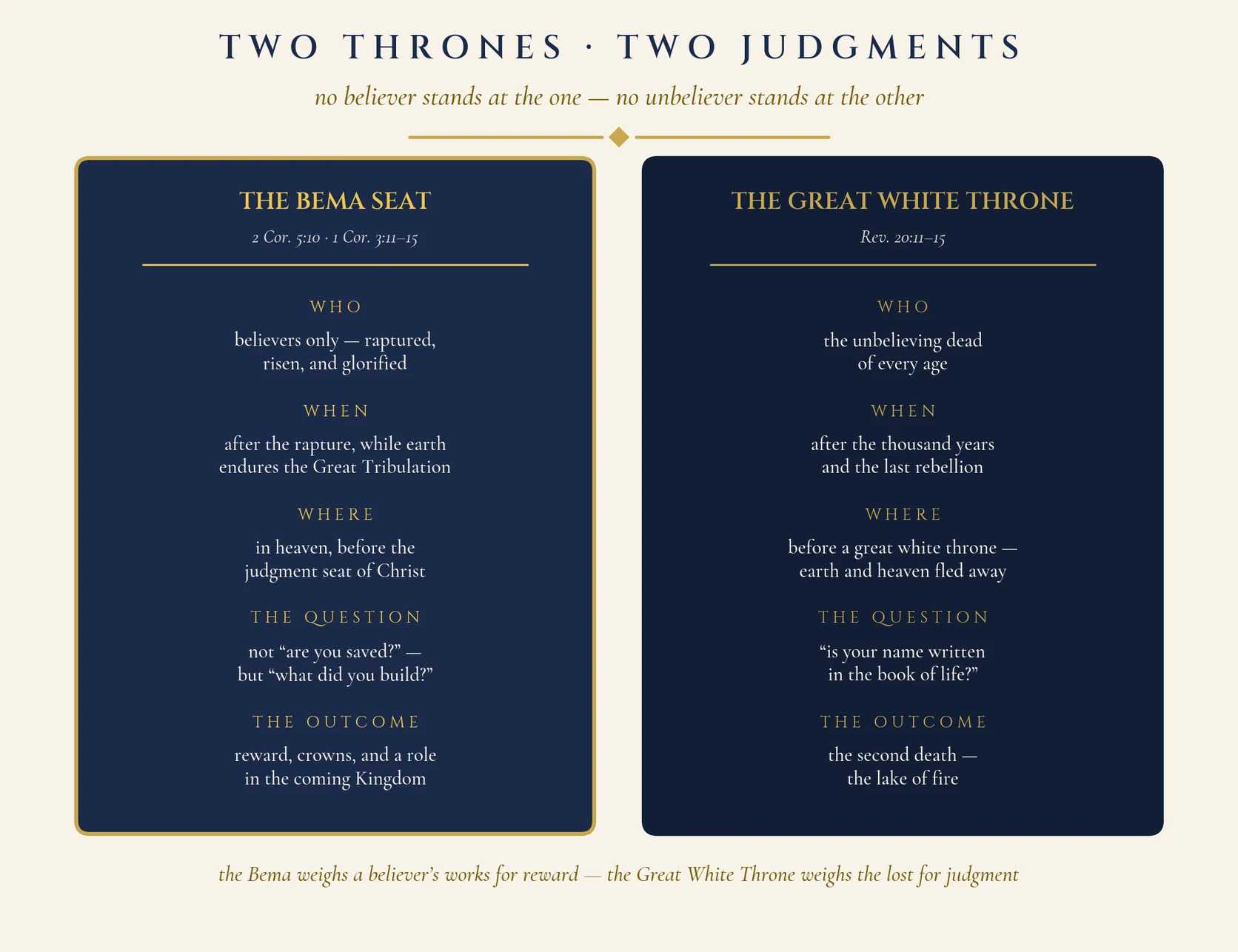 Open artwork at full size in a new tab
The Second Death
And death and hell were cast into the lake of fire. This is the second death. And whosoever was not found written in the book of life was cast into the lake of fire.
REVELATION 20:14–15
King James Version
Even death dies — the last enemy destroyed, exactly as promised (1 Corinthians 15:26). Hades, the intermediate prison where the unbelieving dead awaited trial — the “county jail” of the unseen world — is emptied and abolished; the lake of fire is the final penitentiary, and the difference matters: no one is in the lake of fire yet but the unholy trinity; after this day, no one goes anywhere else.
Of hell itself, this study will say neither less nor more than the Bible says. It is real: the most sobering descriptions of it in Scripture come from the gentlest lips in Scripture — Jesus spoke of hell more often than any prophet or apostle, precisely because He alone knew fully what He was warning against and what it would cost Him to save us from it. It is conscious: the rich man of Luke 16 remembers, feels, sees, and pleads. It is shut out, not shut in: “outer darkness,” “punished with everlasting destruction from the presence of the Lord, and from the glory of his power” (2 Thessalonians 1:9) — the final Apousia, distance made permanent, every good gift withdrawn with the Giver, for every good gift came only ever from Him. And it is everlasting: the same Greek word measures both destinies in a single verse — “these shall go away into everlasting punishment: but the righteous into life eternal” (Matthew 25:46). The one lasts exactly as long as the other.
And it was never meant for you. Jesus said the fire was “prepared for the devil and his angels” (Matthew 25:41) — mankind enters it only over the barricade of the cross, past a Savior who died precisely so that no name need be missing from the Book. If the White Throne teaches one thing, it is the infinite seriousness of the question you can still settle today, on this side of it, where the Book is still open and “whosoever will” may yet be written in (Revelation 22:17).
Jesus put the escape from that throne in a single sentence — one verse, and the White Throne can never summon you:
Verily, verily, I say unto you, He that heareth my word, and believeth on him that sent me, hath everlasting life, and shall not come into condemnation; but is passed from death unto life.
JOHN 5:24
King James Version
SECTION XIIIAll Things New
the New Jerusalem and the eternal reign
——— ◆ ———
The judgments are finished. The old universe has served its purpose and stepped aside. And now John hears the Architect speak from the throne for almost the first time in the whole Revelation — and what He says is the gospel of the entire Bible in five words: “Behold, I make all things new” (Revelation 21:5).
And I saw a new heaven and a new earth: for the first heaven and the first earth were passed away; and there was no more sea. And I John saw the holy city, new Jerusalem, coming down from God out of heaven, prepared as a bride adorned for her husband.
REVELATION 21:1–2
King James Version
The Millennium was the old creation renewed; this is creation replaced — “new heavens and a new earth, wherein dwelleth righteousness” (2 Peter 3:13), a universe with no fault lines of any kind, physical or moral. And onto that new earth descends the capital of eternity: a city “prepared as a bride” — because it is the Bride’s city, the place Jesus meant on the night He was betrayed: “I go to prepare a place for you” (John 14:2). He has been preparing it ever since. Now, at last, He delivers it.
The City Foursquare
John’s angel-guide measures it, and the numbers alone are a sermon. “The city lieth foursquare … twelve thousand furlongs. The length and the breadth and the height of it are equal” (Revelation 21:16). Twelve thousand furlongs is roughly fifteen hundred miles — call it 1,380 by modern reckoning of the stadion — in every direction. Every direction. A city as long as the distance from Atlanta to the Rockies, as wide — and as high. Its upper terraces stand five times higher than the Space Station’s orbit. If its footprint were set down on America it would fill most of the map; its volume could house every human being who ever lived with room to spare, “and yet there is room” (Luke 14:22).
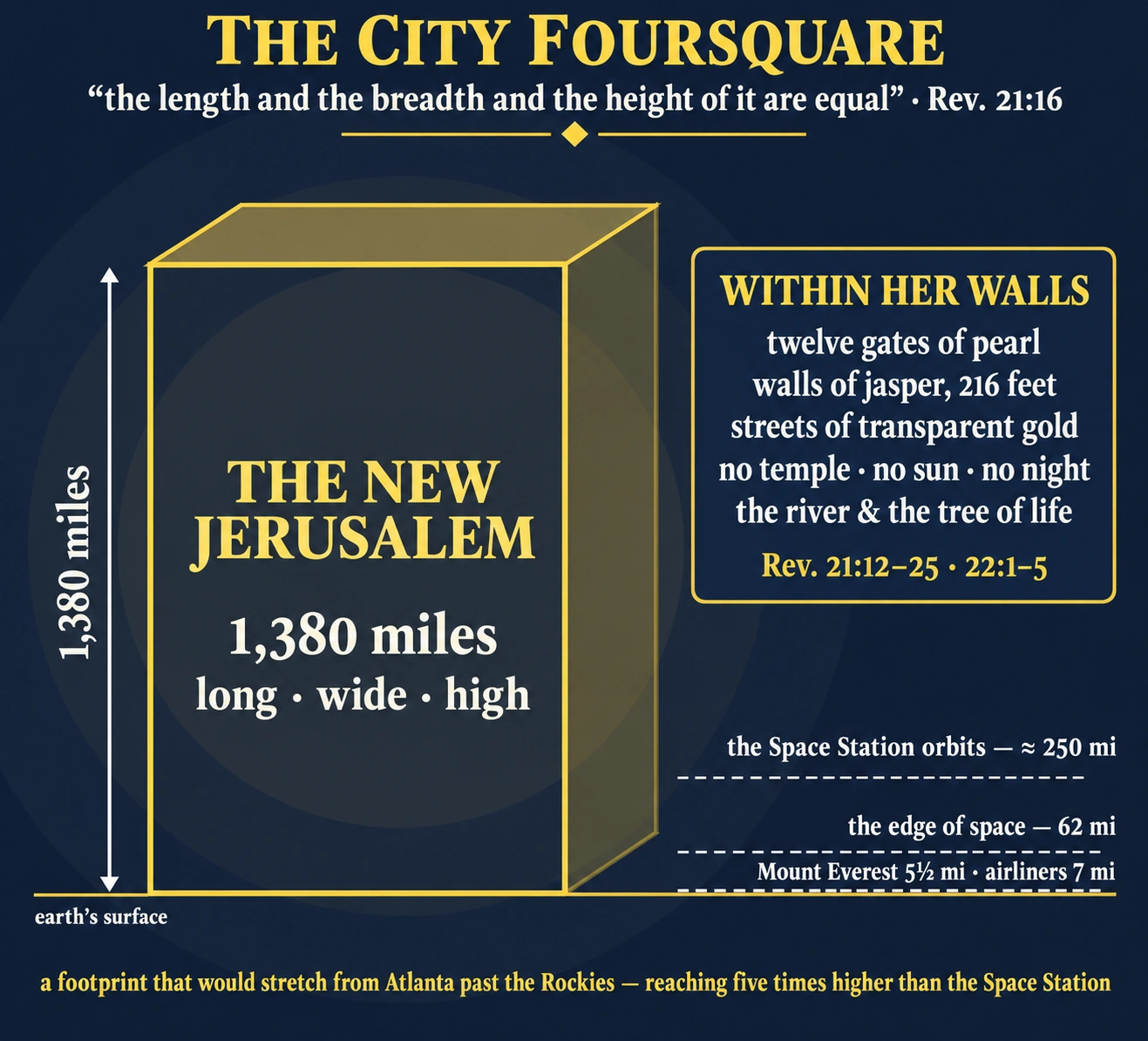 Open artwork at full size in a new tab
And the shape — why a cube? Because Scripture has shown us exactly one cube before. The Holy of Holies in Solomon’s temple, the innermost chamber where the glory dwelt above the mercy seat, measured twenty cubits by twenty by twenty: “the length … and the breadth … and the height thereof” equal (1 Kings 6:20). One room in one building in one city, entered by one man on one day a year — that was the old creation’s allowance of the immediate presence of God. The New Jerusalem is that room, scaled to fifteen hundred miles: the entire city is the Holy of Holies, and everyone in it lives where only the high priest could stand. That is why “I saw no temple therein: for the Lord God Almighty and the Lamb are the temple of it” (Revelation 21:22). There is no sanctuary in the city because the city is the sanctuary; nothing is “sacred” inside it because nothing is secular anywhere, for ever.
The materials are the treasure-room of creation turned inside out: a wall of jasper, clear as crystal, on twelve foundations garnished with every precious stone, each foundation bearing an apostle’s name; twelve gates, each a single pearl, each bearing a tribe’s name — Israel and the church built into the same architecture, the whole family of the Seed in one structure. “And the street of the city was pure gold, as it were transparent glass” (Revelation 21:21) — gold so refined it has become window, wealth so purified it exists only to let light through. The city “had no need of the sun, neither of the moon, to shine in it: for the glory of God did lighten it, and the Lamb is the light thereof” (Revelation 21:23). And the gates “shall not be shut at all by day: for there shall be no night there” (Revelation 21:25) — unlocked doors on the treasury of God, for ever, because nothing that defiles can enter and nothing that enters wants to leave. The nations of the new earth “walk in the light of it: and the kings of the earth do bring their glory and honour into it” (Revelation 21:24) — commerce, culture, craft, everything Babel tried to build without God, now flowing gladly toward Him.
The River, the Tree, and the Face
And he shewed me a pure river of water of life, clear as crystal, proceeding out of the throne of God and of the Lamb. In the midst of the street of it, and on either side of the river, was there the tree of life … and the leaves of the tree were for the healing of the nations. And there shall be no more curse.
REVELATION 22:1–3
King James Version
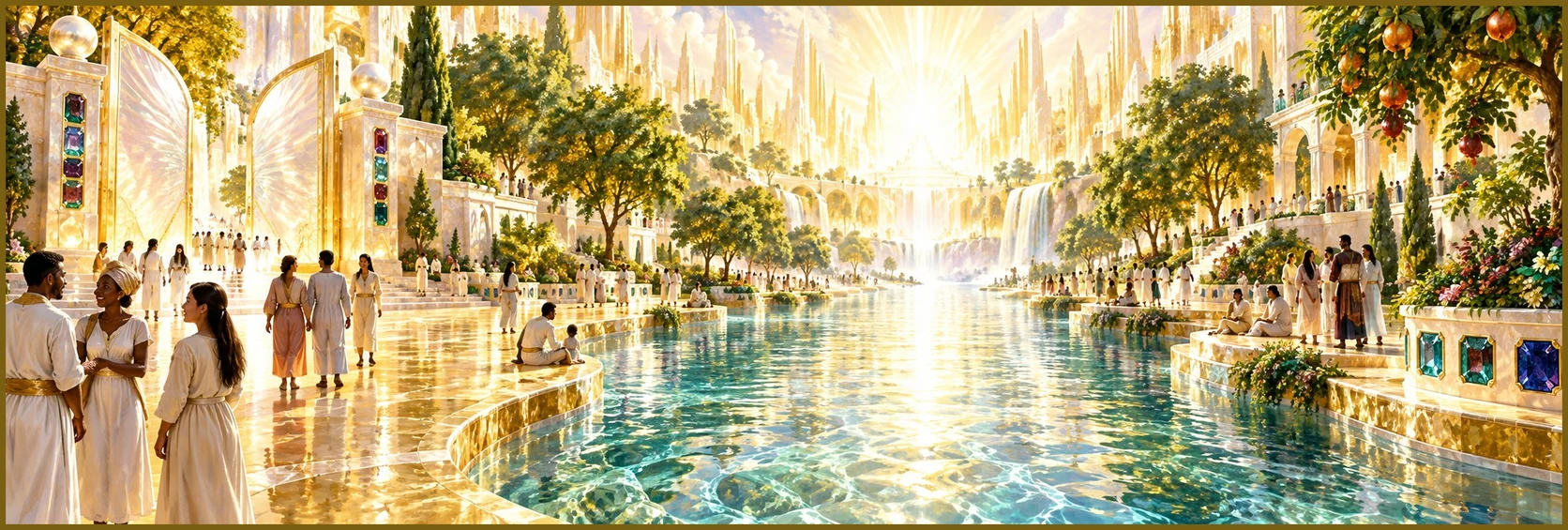 Open artwork at full size in a new tab
Inside the city of God — the river of life, the tree-lined street of gold, and light with no sun behind it (Revelation 22:1–5). An artistic visualization; the reality will out-glory the art.
The Bible ends where it began, with every loss of Eden reversed and bettered. A river again — but from the throne now, not merely through a garden. The tree of life again — the very tree mankind was barred from at sword-point “lest he … eat, and live for ever” — now lining both banks of Main Street, its fruit monthly, its leaves for health, the cherubim’s flaming sword nowhere in sight because the flaming sword fell on the Seed at Calvary. No more curse: the sentence of Genesis 3 formally, finally repealed. And then John writes the two shortest, deepest promises in the Book:
And they shall see his face; and his name shall be in their foreheads.
REVELATION 22:4
King James Version
They shall see His face — the thing Moses begged for and was refused, “for there shall no man see me, and live” (Exodus 33:20), granted now as the ordinary birthright of every servant, because life itself has been made unkillable. The Parousia — presence, nearness, communion — is no longer a hope or a season; it is the permanent atmosphere. And His name in their foreheads: the seal, the sphragis, the exact opposite of the mark of the beast. The serpent’s brand said owned by the system, for its use. The Lamb’s name says known by the Father, at home for ever. Not one in that city will ever again wonder who they are or whose they are; identity, the thing mankind chased through every idol and empire, is written on their faces by hands that were pierced procuring it.
And then the summit of every promise in the Book — a great voice from the throne itself, explaining what the city means:
Behold, the tabernacle of God is with men, and he will dwell with them, and they shall be his people, and God himself shall be with them, and be their God. And God shall wipe away all tears from their eyes; and there shall be no more death, neither sorrow, nor crying, neither shall there be any more pain: for the former things are passed away.
REVELATION 21:3–4
King James Version
Himself. The wiping of tears is not delegated.
The Eternal Reign
And what do the redeemed do in that city, for ever? The last page of the Bible answers with the same royal vocabulary as the Millennium — but removes the time limit: “and his servants shall serve him … and they shall reign for ever and ever” (Revelation 22:3, 5). The thousand years, it turns out, were the apprenticeship. The eternal state is the career. Serving and reigning, worshipping and working, exploring “the exceeding riches of his grace” down corridors of ages without number (Ephesians 2:7) — sons and daughters of God, at home with Him, in a city with no night, no lock, no tear, no curse, and no end. The war of the seeds began with two exiles walking out of a garden under sentence of death. It ends with an innumerable family walking into a city under promise of life — and the King in the midst of it, whose face is the light they read each other by.
SECTION XIVCome Home
the door is still open
——— ◆ ———
We have walked the whole road now — from a signature on a seven-year covenant to a city with no night in it. One question remains, and it is not a prophecy question. The last chapter of the Bible, having shown all this, turns from vision to invitation, and the Book’s final word to mankind is not a warning but a welcome:
And the Spirit and the bride say, Come. And let him that heareth say, Come. And let him that is athirst come. And whosoever will, let him take the water of life freely.
REVELATION 22:17
King James Version
Everything in this study sorts every reader into one of two futures, and the difference is not morality, church attendance, or prophecy expertise. It is a Person, received or refused. If you have never done so, do it now, in your own words, in this chair: acknowledge that you have sinned and cannot balance your own books; believe that Jesus, the Seed of the woman, died in your place and rose bodily from the grave; and receive Him — “as many as received him, to them gave he power to become the sons of God, even to them that believe on his name” (John 1:12). No ritual, no waiting period, no fine print. The moment you do, your name stands in the Book of Life, the second death loses all claim on you, and every promise in these pages — the trumpet, the Bema’s reward, the returning King’s train, the thousand years, the city, the face — is yours by birthright.
The whole offer has stood in one verse since the night Nicodemus came asking:
For God so loved the world, that he gave his only begotten Son, that whosoever believeth in him should not perish, but have everlasting life.
JOHN 3:16
King James Version
And if you are already His? Then this study ends as every true word about the future must end: not with a chart but with a charge. Watch — “for ye know not what hour your Lord doth come” (Matthew 24:42). Build with gold, not stubble; the fire is friendly to gold. Hold your possessions, your grievances, and your plans loosely; the trumpet does not check calendars. Tell someone — the Book is still open, and “whosoever will” has your neighbors’ names in it, waiting to be claimed. And keep your eyes on the eastern sky with the church of every age, praying the oldest prayer in the family: “Even so, come, Lord Jesus” (Revelation 22:20).
Behold, I stand at the door, and knock: if any man hear my voice, and open the door, I will come in to him, and will sup with him, and he with me.
REVELATION 3:20
King James Version
For in the end, prophecy is not a calendar to decode. It is a Person to welcome. We do not wait for events. We wait for Him.
The serpent’s war is lost. The Seed reigns. The city is prepared. The door is open.
Come home.
——— ◆ ———
SOLI DEO GLORIA
to God alone be the glory
QUICK REFERENCE
ReferenceThe Order of Events at a Glance
On a small screen, swipe the table or use the arrow keys.
EVENT | WHEN | SCRIPTURE |
|---|---|---|
The covenant signed — the seventieth week begins | Day one | Dan. 9:27 |
The beginning of sorrows — seals and trumpets; the two witnesses; the 144,000 | Years 1–3½ | Matt. 24:8 · Rev. 6–11 |
THE RAPTURE — the church caught up at the last trump | The midpoint | 1 Cor. 15:52 · 1 Thess. 4:16–17 |
The abomination of desolation — the beast enthroned; the mark | The midpoint | Matt. 24:15 · Rev. 13 |
The Bema Seat and the Marriage Supper — in heaven | Years 3½–7 | 2 Cor. 5:10 · Rev. 19:7–9 |
The Great Tribulation — the vials of wrath; Babylon falls | Years 3½–7 | Matt. 24:21 · Rev. 16–18 |
THE SECOND COMING — Christ returns with His saints; Armageddon; Satan bound; the first resurrection completed | End of the week | Rev. 19:11–20:6 · Zech. 14:4–5 |
The Sheep and the Goats — the living nations judged; Israel regathered and saved | 75-day interval | Matt. 25:31–46 · Dan. 12:11–12 |
THE MILLENNIAL REIGN — the throne of David; the earth renewed; the saints reign | 1,000 years | Rev. 20:4–6 · Isa. 2; 11; 35; 65 |
Satan loosed — the rebellion of Gog and Magog; fire from heaven | A little season | Rev. 20:7–10 |
THE GREAT WHITE THRONE — the second resurrection and the second death | After the 1,000 years | Rev. 20:11–15 |
All things new — the New Jerusalem descends; the eternal reign | For ever | Rev. 21–22 |
QUESTIONS READERS ASKHonest Questions, Brief Answers
Is the “thousand years” literal?
Revelation 20 repeats it six times in seven verses — a strange emphasis for a symbol. The events tied to it (Satan bound then loosed, resurrections before and after) require a real duration with real endpoints. This study takes it as a literal millennium: the seventh “day” of history, the Sabbath of the ages.
Will I know my family and friends in glory?
Yes. The disciples knew the risen Jesus; Moses and Elijah were recognizable on the mount of transfiguration centuries after their departure; Jesus promises we will sit down “with Abraham, and Isaac, and Jacob” (Matthew 8:11) — identifiable persons, not anonymous spirits. Glorification perfects identity; it does not erase it. You will be more yourself then, not less — and so will they.
Is my marriage over in the resurrection?
“In the resurrection they neither marry, nor are given in marriage” (Matthew 22:30). Marriage as an institution belongs to this mortal age — but the love, the history, and the person are not lost. Earthly marriage was always a portrait of a greater union (Ephesians 5:32); at the Marriage Supper you exchange the portrait for the Person. No one in glory will feel demoted.
Who populates the Millennium, if the saved were raptured and glorified?
The sheep of Matthew 25 — tribulation survivors who believed and were still alive at the Return — enter the Kingdom in natural, mortal bodies, and their children fill the earth for a thousand years (Isaiah 65:23). The glorified saints reign over and among them. Two peoples, one Kingdom — see Sections VI and IX.
Can people sin — and be lost — during the Millennium?
Yes. Children born in the Kingdom inherit Adam’s fallen nature and must be born again like every generation before them. Open sin is judged swiftly (Isaiah 65:20), and some render only feigned obedience (Psalm 66:3) — as the final rebellion tragically proves. Perfect conditions never regenerated a single heart; only the new birth does.
What about children and those unable to believe, at the rapture and the judgments?
Scripture gives us principles rather than a verse: the Judge of all the earth does right (Genesis 18:25); Jesus said of little children, “of such is the kingdom of heaven” (Matthew 19:14); David expected to go to his infant son (2 Samuel 12:23). This study is content to leave the little ones in the hands that were laid on them in blessing — the safest place in the universe.
Where do the glorified saints live — the New Jerusalem or the earth?
Both, as their King does. The pattern is the risen Christ of the forty days, at home in two realms. During the Millennium the saints administer the renewed earth while belonging to the heavenly city; in the eternal state the city descends to the new earth and the two realms become one address (Revelation 21:2–3).
Do Old Testament believers go up in the rapture?
The rapture resurrection is specifically “the dead in Christ” (1 Thessalonians 4:16) — the church. Daniel is told Israel’s saints awake at the tribulation’s end, when Michael stands up (Daniel 12:1–2), joining the tribulation martyrs in the completion of the first resurrection at the Return (Revelation 20:4–6). Same harvest, later sheaf — and not one saint of any age misses the Kingdom.
Is the mark of the beast a technology I should be watching for?
Watch the direction, not the gadget. The mark, when it comes, will be an instrument of WORSHIP — allegiance to the beast enforced through the economy (Revelation 13:15–17) — and it belongs to the seventieth week, after the covenant and the abomination. No one takes it by accident. But every system that trains mankind to trade conscience for access is rehearsing its logic, and the wise are paying attention now (see the Watchman’s Wall at theseedwartrilogy.com).
What happens to the faithful mortal believers when the thousand years end?
Scripture states the outcome without describing the mechanism: “flesh and blood cannot inherit the kingdom of God; neither doth corruption inherit incorruption” (1 Corinthians 15:50), and in the eternal city death is gone entirely (Revelation 21:4). The faithful of the Millennium will certainly be fitted for eternity — but the Bible never narrates the moment they are changed, and this study will not invent one. God has told us enough to establish the hope, and has kept the logistics to Himself. Speak confidently where He has spoken, and modestly where He has not.
Does Christ stop reigning when He delivers the kingdom to the Father (1 Corinthians 15:24–28)?
No. Paul is describing the completion of the Son’s mediatorial conquest — every enemy subdued, death destroyed last of all — and the presentation of the finished work to the Father, “that God may be all in all.” It is a victory report, not a resignation. Gabriel’s word stands for ever: “of his kingdom there shall be no end” (Luke 1:33); eternity’s throne is “the throne of God and of the Lamb” (Revelation 22:3); and the saints “shall reign for ever and ever” — under a King who does the same.
Won’t a thousand years — let alone eternity — get boring?
Boredom is a disease of the fallen condition: weariness, restlessness, and desire out of order. Glorified people have none of the three. And the revealed future is purposeful through and through — reigning, judging, teaching, priestly service, feasting, fellowship across every age of the family, and the endless exploration of “the exceeding riches of his grace” (Ephesians 2:7). The God who invented joy, and built your capacity for it, is not planning to bore you with Himself.
GLOSSARY
ReferenceTerms Used in This Study
Abomination of Desolation — The midpoint event of the seven years: the beast ends the temple sacrifices and enthrones himself as God in the holy place (Daniel 9:27; Matthew 24:15; 2 Thessalonians 2:4).
Abyss (Bottomless Pit) — The place of Satan’s confinement during the thousand years (Revelation 20:1–3) — a holding cell, kept carefully distinct from the lake of fire, which is his final destiny (Revelation 20:10).
Apousia — Distance, absence, separation — the opposite of Parousia. Used in this study for the soul’s separation from God, and ultimately for the second death: distance made permanent.
Armageddon — The gathering place (Hebrew har-Megiddo) of the world’s armies at the close of the tribulation — ended not by battle but by the word of the returning King (Revelation 16:16; 19:15).
Bema — Greek: the judge’s platform where race-finishers were crowned. The judgment seat of Christ, in heaven, where believers’ works — never their salvation — are tested for reward (2 Corinthians 5:10).
Charagma — Greek: a brand or etched mark of ownership — the “mark” of the beast, the serpent’s counterfeit of God’s seal (Revelation 13:16–17).
Daniel’s Seventieth Week — The final seven years of Daniel’s 490-year prophecy for Israel (Daniel 9:24–27), beginning with the beast’s covenant and ending at the Second Coming.
First Resurrection — The resurrection of the righteous, gathered in stages — Christ the firstfruits, the church at the rapture, Israel’s saints and the tribulation martyrs at the Return — all before the thousand years (1 Corinthians 15:23; Revelation 20:4–6).
Gog and Magog — The name Revelation borrows from Ezekiel’s ancient northern enemies for the final rebellion at the Millennium’s end (Revelation 20:8).
Great Tribulation — The second half of the seventieth week — forty-two months of the beast’s enthronement and God’s vials of wrath (Matthew 24:21; Revelation 13–16).
Great White Throne — The final judgment of the unbelieving dead of all ages, after the Millennium, issuing in the second death (Revelation 20:11–15).
Hades — The intermediate holding place of the unbelieving dead between death and the last judgment; emptied into the lake of fire at the end (Revelation 20:13–14).
Marriage Supper of the Lamb — The wedding celebration of Christ and His church in heaven, following the Bema, before the Return (Revelation 19:7–9).
Millennium — Latin mille annum, “a thousand years” — the earthly reign of Christ from David’s throne, described six times in Revelation 20:2–7 and by all the prophets.
Parousia — Greek: presence, arrival, nearness — the New Testament word for the Lord’s coming, and the destiny-word of the redeemed: for ever with the Lord.
Rapture — From the Latin rapturo, “caught up” (1 Thessalonians 4:17): the resurrection of the church-age dead and the instant transformation of living believers, placed by this study at the seventh trumpet, mid-week.
Second Death — The lake of fire — final, conscious, eternal separation from God, over which the first-resurrection saints have absolute immunity (Revelation 20:6, 14).
Seed War — This study’s name for the long conflict declared in Genesis 3:15 between the Seed of the woman (Christ, and His family) and the seed of the serpent — the thread on which all prophecy is strung.
Sheep and Goats — The judgment of the living nations after the Return (Matthew 25:31–46), determining who enters the Kingdom in mortal bodies.
Sphragis — Greek: a seal of ownership and protection — God’s mark on His servants (Revelation 7:3), consummated as the Lamb’s name on the foreheads of the redeemed (Revelation 22:4).
Times of the Gentiles — The long era of Gentile dominion over Jerusalem, running from Babylon to the Second Coming (Luke 21:24).
FOR FURTHER STUDY
ReferenceScriptures by Section
I — THE COVENANT AND THE CLOCK
Daniel 9:24–27 · Matthew 24:4–14 · Revelation 6 · Revelation 11:1–6 · 1 Thessalonians 5:1–9
II — CAUGHT UP
1 Corinthians 15:51–58 · 1 Thessalonians 4:13–18 · Revelation 10:7; 11:11–15 · Revelation 12:1–12 · 2 Thessalonians 2:1–12
III — THE BEMA SEAT
2 Corinthians 5:9–10 · Romans 14:10–12 · 1 Corinthians 3:9–15; 4:5; 9:24–27 · Revelation 4:10–11; 19:6–9
IV — EARTH’S MIDNIGHT
Matthew 24:15–28 · Revelation 12–13; 16 · Jeremiah 30:4–11 · Zechariah 13:8–9 · Revelation 7:9–17
V — THE KING RETURNS
Revelation 19:11–21; 20:1–6 · Zechariah 14:1–9 · Jude 14–15 · Matthew 24:27–31 · Daniel 12:1–3 · Isaiah 26:19–21
VI — THE SHEEP AND THE GOATS
Matthew 25:31–46 · Daniel 12:11–12 · Ezekiel 20:33–44 · Zechariah 12:10–13:1 · Romans 11:25–29
VII — A WORLD MADE NEW
Isaiah 2:1–4; 11:1–10; 30:23–26; 35; 65:17–25 · Ezekiel 47:1–12 · Zechariah 14:8–11 · Amos 9:13–15 · Romans 8:18–25
VIII — THE THRONE OF DAVID
2 Samuel 7:12–16 · Luke 1:31–33 · Isaiah 9:6–7; 24:23 · Ezekiel 34:23–24; 37:21–28 · Jeremiah 30:9 · Hosea 3:4–5 · Matthew 19:28
IX — REIGNING WITH THE KING
Revelation 5:9–10; 20:4–6 · Luke 19:11–27 · 1 Corinthians 6:2–3 · Revelation 2:26–27 · 1 John 3:1–3 · Philippians 3:20–21 · Luke 24:36–43
X — LIFE IN THE KINGDOM
Zechariah 14:16–19 · Micah 4:1–5 · Isaiah 33:24; 65:20–25 · Malachi 1:11 · Psalm 2 · Psalm 72
XI — THE LAST REBELLION
Revelation 20:3, 7–10 · Jeremiah 17:9 · John 3:1–8
XII — THE GREAT WHITE THRONE
Revelation 20:11–15 · Ecclesiastes 12:13–14 · Matthew 25:41–46 · Luke 16:19–31 · 2 Thessalonians 1:7–10 · John 5:24–29
XIII — ALL THINGS NEW
Revelation 21–22 · Isaiah 65:17; 66:22 · 2 Peter 3:10–13 · 1 Kings 6:20 · John 14:1–3 · Ephesians 2:4–7
XIV — COME HOME
Revelation 22:16–21 · John 1:11–13; 3:14–18; 5:24 · Romans 10:9–13 · 2 Peter 3:9
——— ◆ ———
THE SEED ENTHRONED
Illustrated Study Edition · September 28, 2026
A Battle of the Seed Bible Study
MICHAEL KENDRICK · PROVIDENCE TEACHING MINISTRY
THESEEDWARTRILOGY.COM
Battle of the Seed — book one of The Seed War Trilogy — is available now.
Scripture quotations are from the Holy Bible, King James Version (public domain).
© 2026 Providence Teaching Ministry. Freely share this study in its complete, unaltered form.