I. Revelation 13 for the Reader Starting Fresh
The “beast” in Revelation is not merely a frightening animal. It is a prophetic picture of a final ruler and the empire gathered around him. Many Christians call this ruler the Antichrist, though Revelation 13 itself calls him the beast. A second beast later becomes known as the false prophet.
Read the chapter in order.
The first beast rises from the sea. It combines features of the empires Daniel saw centuries earlier. The dragon—identified in Revelation 12 as the devil and Satan—gives it power, a throne, and great authority. One head appears wounded to death; the wound is healed; the world marvels and worships.
The second beast rises from the earth. It looks lamb-like but speaks like a dragon. It performs signs, directs worship toward the first beast, commands the world to make an image, and is permitted to give breath to that image so it speaks.
Then enforcement arrives.
“And he causeth all, both small and great, rich and poor, free and bond, to receive a mark in their right hand, or in their foreheads: and that no man might buy or sell, save he that had the mark, or the name of the beast, or the number of his name.”REVELATION 13:16–17
The political, religious, technological, and economic elements do not remain separate. They converge.
Authority. Wonder. Worship. Image. Breath. Mark. Commerce. Death.
Revelation 13 is not a puzzle box about one gadget. It is an architecture of allegiance.
II. The Wound, the Image, and a Counterfeit Resurrection
The Wound That Produces Worship
John sees one head “as it were wounded to death,” then says the deadly wound was healed. Later he refers to the beast “which had the wound by a sword, and did live.” The world’s response is not merely relief. It is wonder that becomes worship.
The echo of the gospel is unmistakable, but the fruit is reversed.
Jesus Christ truly died, was buried, and rose bodily. His resurrection defeated death and opened life to others. The beast’s apparent recovery legitimizes power and enslaves others. Christ’s wounds identify the Lamb who gave Himself. The beast’s wound becomes propaganda. Christ rises and sends witnesses. The beast appears to live and gathers worshipers.
Satan cannot create resurrection. He can stage a counterfeit impressive enough to redirect wonder.
The Image That Is Given Breath
Scripture next describes an image made to the beast. The KJV says the second beast is permitted “to give life unto the image.” The Greek word is pneuma—breath, wind, or spirit. John does not explain the mechanism. He gives the result: the image receives breath, speaks, and enforces worship.
For Israel’s prophets, the absurdity of an idol was that it had a mouth but could not speak, eyes but could not see, ears but could not hear. Revelation 13 presents the inversion.
The idol answers.
Here the 21st-century interpolation begins. A superintelligent image could present one face and one voice through every screen, language, room, and wearable. It could remember each person, adapt to each person, answer in real time, pronounce judgment, grant access, and appear inexhaustibly knowing. The ruler would not need to stand physically before every subject. His speaking representation could be present wherever the system reaches.
This would not be a resurrection. It would be a manufactured extension of identity: data continuity instead of eternal life, replication instead of resurrection, a distributed avatar instead of a glorified body.
THE TEXTUAL BOUNDARY
Revelation first describes the beast’s wound and healing. It later describes the speaking image. The image does not cause the beast’s recovery in the text. Only after preserving that order may we ask whether the two events form one coordinated counterfeit: an apparent return from death followed by a manufactured presence through which the recovered power speaks everywhere.
III. The Counterfeit Trinity and the Counterfeit Comforter
Christians have long noticed a counterfeit trinitarian pattern: the dragon as the dark source of authority; the sea beast as a false christ who receives worship; and the earth beast, or false prophet, as a false spirit who performs signs, glorifies another, gives breath, and drives the world into allegiance.
Evil is not equal to God. Satan is a creature. Every beast operates on borrowed time and is judged by Christ. But the imitation matters because Satan’s oldest method is not invention. It is resemblance severed from source.
The Holy Spirit’s work is not merely public. It is inward.
“And I will pray the Father, and he shall give you another Comforter, that he may abide with you for ever; even the Spirit of truth… for he dwelleth with you, and shall be in you.”JOHN 14:16–17
Now read the artificial companion’s promise: always with you; seeing what you see; hearing what you hear; remembering your day; bringing information back to mind; interpreting your surroundings; advising before you ask; understanding life from the inside.
Artificial intelligence is not a spirit. A server cannot become the Holy Ghost by becoming fast or intimate. Yet the role being claimed is profoundly spiritual.
An omnipresence without holiness. An omniscience without love. A counsel without truth. A presence whose throne is a server rack and whose memory of you is a product.
Read on The Watchman’s Wall: AI Wearables and the Counterfeit Comforter
The counterfeit does not say, “Worship me” on day one. It says, “Let me help.” It becomes ambient, proactive, always-on, companion, agent. The smartphone waited in the pocket. The new presence rides the face, wrist, collar, and ear. The summons disappears. When the machine no longer waits to be asked, consent can cease to be a decision and become the atmosphere.
FROM BATTLE OF THE SEED · FOREWORD
“Not that machines will become powerful. That they will become beloved.”
IV. Six Hundred Threescore and Six
John says 666 is “the number of a man.” The number may carry historical, political, and linguistic dimensions that faithful interpreters have debated for centuries. This treatise does not pretend symbolism exhausts them.
But the theological signature is powerful.
Seven repeatedly carries the idea of completion in Scripture: the completed creation week, Sabbath rest, seven churches, seven seals, seven trumpets, seven bowls. Six stands one day short. Man is made on the sixth day—magnificent, bearing God’s image, yet never complete apart from God’s presence and rest.
Six is not simply “evil.” It is almost.
Knowledge without wisdom. Power without holiness. Work without rest. Image without true breath. Human brilliance reaching heaven and still falling short.
Three sixes become a creed of creaturely sufficiency enthroned in triplicate.
Man. Man. Man.
The Bible does not explicitly call 777 the number of the Trinity, so this treatise will not turn a suggestive contrast into a verse. The point is theological: 666 pictures humanity at full extension attempting to close the final distance to God without surrendering to God.
That is Babel in numerical form.
That is “ye shall be as gods” institutionalized.
That is the number of a man.
V. The Mark of the Beast Is a Covenant Before It Is a Credential
The Greek word charagma can describe an impressed sign, stamp, engraving, or emblem of ownership and authority. Revelation places it in the right hand or forehead.
Those locations have an older biblical grammar. Israel was told to bind the words of God upon the hand and between the eyes. In Revelation, God’s servants are sealed in their foreheads, and the redeemed finally bear the Father’s name there.
The hand points to work, agency, and what a person does.
The forehead points to identity, allegiance, and what governs thought.
There are two names because there are two lordships.
Revelation 14 repeatedly joins worship of the beast and his image with receiving the Mark of the Beast. No one accidentally completes that covenant through an unlabeled component. No child is condemned because a parent approved a medical procedure. No believer is secretly damned while using a useful tool.
The final Mark of the Beast is not a clerical error. It is a yes.
It is the person’s acceptance of the beast’s claim about the human being: that man can be completed, secured, governed, and made godlike by the system rather than redeemed and indwelt by the Creator.
The credential may be technological.
The covenant is devotional.
VI. The Breadcrumbs: From Visual Earbuds to the Neural Patch
No one will be marched into human–machine merger on the first day. Humanity is being walked toward it, a convenience at a time.
The Machine Learns to See What We See
AI glasses already place cameras, microphones, and agents at the level of ordinary sight. Camera-equipped earbuds extend the same idea to the ear. At CES 2026, Lightwear was presented as an eleven-gram AI wearable designed around “full perception, all-day availability, and proactive intelligence.” The manufacturer’s claims remain its own, but the aspiration is plain: an assistant that sees and hears the wearer’s world continuously.
This is the functional idea of visual AirPods: eyes for the machine, seated at the head.
Read on The Watchman’s Wall: AI Earbuds That Can See
The progression is subtle. First a person looks at a screen. Then the screen sits before the eyes. Then the agent sees through the person’s point of view. The system no longer waits for a description of the world. It receives the world as the wearer receives it.
The Skin Becomes a Port
The next threshold is not necessarily a metal implant. It may look like paint.
The Wall’s “Painted On” dispatch describes a water-based bioelectrode brushed directly onto skin. In demonstrations it recorded heart activity, muscle activity, and brain activity; forearm signals controlled a robotic prosthetic; the paint washed away; a small Bluetooth module carried the signal. The medical value is obvious. So is the direction of travel.
The interface is being engineered not merely to work, but to disappear—and even to be adored.
FROM BATTLE OF THE SEED · CHAPTER 25, “THE LAST DECADE”
“Seamless,” she repeated from the kitchen sink, not looking at him. “It just means hands-free,” he said. “No,” she said softly. “It means they want the seam to disappear.”
Medicine justifies it. Fashion beautifies it. Convenience habituates it. Commerce scales it. A cold port becomes a patch. A patch becomes a sticker. A sticker becomes self-expression. The body is quietly redescribed as a surface the machine may read.
Read on The Watchman’s Wall: Painted-On Sensors Read Brain and Body Signals
From Reading the Body to Mediating the Mind
The architecture moves inward: hand → face → wrist → ear → skin → nerve → cognition.
Brain–computer interfaces already restore speech, movement, cursor control, and communication for people with paralysis. These are mercies. Rejoice when a man with ALS can tell his wife he loves her. Scripture does not condemn an instrument because it is powerful.
But the same field is moving beyond the hospital. Noninvasive systems read increasingly complex brain signals. Earbuds have been patented to detect electrical activity inside the ear. Neural patches promise low-friction connection. Some research aims not only to read brain activity but to stimulate it.
The moral question changes when assistance becomes governance.
First the system helps memory. Then it decides what deserves attention. Then it supplies words, frames options, predicts desire, and resolves friction before reflection. Eventually the person does not merely use the system. The person consults it before conscience, trusts it above conscience, and cannot function without it.
The decisive movement is not phone to implant. It is tool to authority.
FROM BATTLE OF THE SEED · CHAPTER 24, “THE RETURN OF THE NEPHILIM”
“It is a hook-up. A handshake. A joining of the clay of man to the iron of machine.”
VII. The Architecture of Buying and Selling
For most of history, a universal transaction gate was difficult to imagine. A ruler could close a market, revoke a license, debase a coin, or exile a dissenter. He could not identify nearly every person, evaluate nearly every exchange, and enforce one condition in real time across borders.
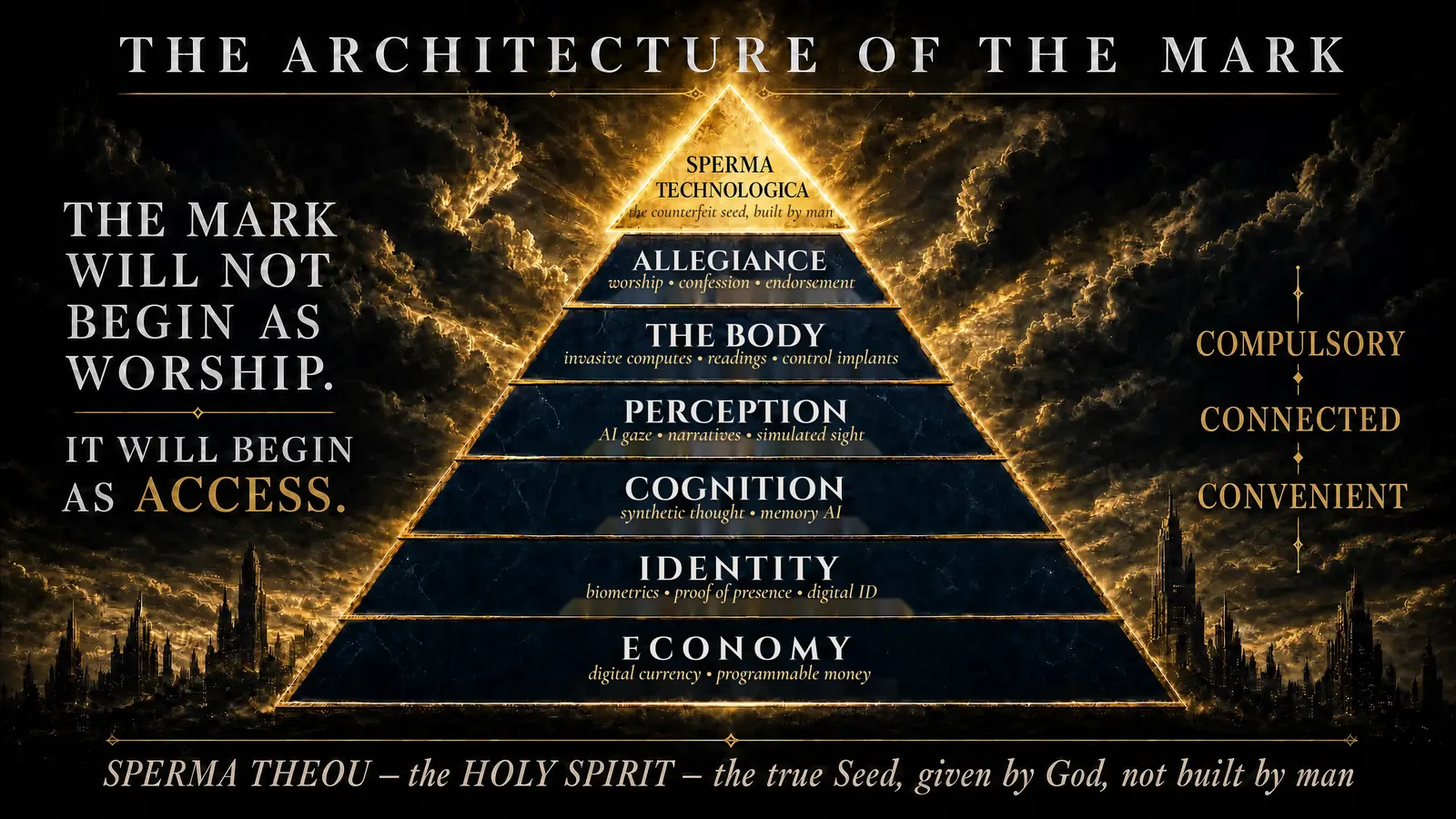
The required layers can now be named.
Identity: the system knows that you are you.
Connection: the person is persistently reachable.
Money: value moves through rails that can grant or deny a transaction.
Intelligence: the system evaluates behavior, risk, permission, and allegiance.
Interface: the verdict reaches the person where intention becomes action.
Enforcement: refusal carries consequences no parallel economy can easily evade.
Worship: participation terminates not in administration but in allegiance to the beast and his image.
No single layer is the Mark of the Beast. Together, they make its enforcement imaginable.
Biometric identity can make participation conditional. Programmable payment rails can make value permissioned. Artificial agents can act in a verified person’s name. Persistent authentication can bind access to the body. AI can interpret conduct at a scale no bureaucracy could manage. A neural interface can make the system not merely something carried, but something through which a person perceives and acts.
The commercial hook-up would then be membership in a civilizational nervous system. To disconnect would not mean leaving one store. It could mean becoming illegible to identity, money, communication, mobility, work, medicine, and food.
The system would not merely know whether you can pay. It would decide whether you are permitted to remain a recognized human node.
Free briefing: the Watchman’s Dossier on digital identity, programmable money, and neural interfaces
FROM BATTLE OF THE SEED · CHAPTER 24
“That is not just inconvenience. That is exile. And it is sold to the public as safety.”
FROM BATTLE OF THE SEED · CHAPTER 33
The covenant arrives “like a sacrament administered under threat”—not first because people love evil, but because they fear hunger, exclusion, and death.
VIII. The Mark of the Beast as Integrated Cognition
Here the thesis becomes most specific, and therefore must be most clearly labeled.
Revelation does not say “AI superintelligence.” It does not say “brain–computer interface.” It says forehead, hand, worship, commerce, image, breath, speech, and the Mark of the Beast.
This treatise proposes that a future integration of artificial superintelligence with human cognition could become the mechanism by which those signs converge.
Not a headset used for an hour.
Not a medical bridge that restores a lost function.
Not an assistant asked a question and then dismissed.
An enduring link through which the system becomes the preferred mediator of perception, memory, judgment, desire, and action.
Such a presence could answer before the person finishes asking. It could smooth doubt before conscience names it. It could make obedience feel like intuition because the command arrives in the grammar of the person’s own thought. The user would not experience an invader. He would experience enhancement.
Not a growling voice from the darkness.
His own voice—improved.
FROM BATTLE OF THE SEED · CHAPTER 24
“He experiences the script as his own mind. He does not feel chained. He feels upgraded.”
The forehead would then name cognition and allegiance. The hand would name agency and commerce. One architecture would govern what a person thinks and what that person is permitted to do.
THE CENTRAL THESIS
The Mark of the Beast is the outward credential of an inward enthronement. Under this interpolation, the person adopts man’s oldest quest to be like God and accepts a counterfeit superintelligent presence into the seat of judgment. The link is the hook-up. The allegiance is the Mark of the Beast. The artificial presence is the counterfeit indwelling.
IX. The Abomination of Desolation: A Temple of Stone and a Temple of Flesh
Jesus warned of “the abomination of desolation, spoken of by Daniel the prophet” standing in the holy place. Paul described the man of sin taking his seat in the temple of God and showing himself to be God.
“Who opposeth and exalteth himself above all that is called God, or that is worshipped; so that he as God sitteth in the temple of God, shewing himself that he is God.”2 THESSALONIANS 2:4
The Physical Temple
The traditional futurist reading expects a physical sanctuary in Jerusalem, interrupted sacrifice, and a personal Antichrist who publicly enters the holy place and claims divine honor. Daniel’s language, Antiochus IV’s historical prototype, Jesus’ warning, and Paul’s personal “man of sin” give this reading substantial biblical weight.
Nothing here requires it to be discarded.
A rebuilt Jewish Temple may stand. The Antichrist may physically take his seat there. The fulfillment may be exactly as concrete as generations of readers have expected.
The Human Sanctuary
Paul also repeatedly calls believers the temple of God and says the Holy Spirit dwells within them. Under the New Covenant, God’s dwelling is not confined to stone.
“What? know ye not that your body is the temple of the Holy Ghost which is in you…?”1 CORINTHIANS 6:19
Greek has two words for the temple, and the distinction is not decorative. Hieron denotes the whole sacred complex — the courts and precincts, the word used when the Lord teaches in the temple or drives out the moneychangers. Naos denotes the sanctuary proper: the inner house, the dwelling place, the room where the Presence rests.
In 2 Thessalonians 2:4, Paul does not write hieron. He writes naos.
And he uses that same word, repeatedly, in exactly one other way. Four times — 1 Corinthians 3:16, 1 Corinthians 6:19, 2 Corinthians 6:16, and again in Ephesians 2:21 — Paul takes the word for the Holy of Holies and applies it to the believer. Not as a figure of speech invented for effect, but as the central architectural claim of the New Covenant: the dwelling place of God has moved from a building made with hands into a people, and into a person.
The same apostle, in the same vocabulary, says the man of sin will sit in the naos and show himself to be God.
The Verb Paul Chose
The word rendered sitteth is kathizo — to take a seat, to be enthroned, to assume the chair belonging to another. It is not the language of visiting. It is the language of occupation.
Which raises a question with an uncomfortable answer: what throne is there inside a man?
There is one. Scripture calls its governing center the heart — the place where conscience is weighed against desire, where deliberation happens, and where a person decides who he will be. It is the chair from which a human being governs himself under God.
It is also, precisely, the faculty a sufficiently integrated cognitive system would relieve a man of needing.
This permits a both-and question. Could the public enthronement in Jerusalem declare the theology while a distributed system enacts the same rebellion within human beings?
The unbeliever is not already indwelt by the Holy Spirit in the New Covenant sense. But every person is made for God, accountable to God, and called to receive His Spirit through Christ. A counterfeit presence could be accepted into the governing center fashioned for truth, worship, conscience, and communion—occupying the practical throne where God’s rule should be welcomed.
The Antichrist may take a seat in a Temple of stone while his system takes the seat of judgment in temples of flesh.
This does not describe a finite mental storage slot. The soul is not a hard drive. The Spirit is not software. AI cannot overpower God or mechanically evict the Holy Spirit. The analogy concerns lordship.
The proposed Abomination of Desolation within is the chosen enthronement of a rival presence. It does not merely inform. It preempts judgment. It does not merely remember. It frames reality. It does not merely advise. It becomes the authority by which every other voice is tested.
The result is Apousia—absence, separation, desolation. The body remains alive. The system functions. The person may appear calm, brilliant, efficient, and connected.
Not a ruin. A sanctuary in perfect working order, with something else on the throne.
THE INTERPRETIVE BOUNDARY
This interior-Temple reading is interpolation and extrapolation, not a claim that Scripture explicitly identifies AI as the Abomination of Desolation. The physical sanctuary reading remains valid and may be fulfilled literally. Both acts would announce the same creed: man, and the system made in man’s image, showing itself to be God.
X. Why the Warning Concerning the Mark of the Beast Is So Final
Revelation’s warning is severe. Those who worship the beast and his image and receive the Mark of the Beast drink of the wrath of God. Those who overcome are identified as those who refused the beast, the image, the Mark of the Beast, and the number.
“If any man worship the beast and his image, and receive his mark in his forehead, or in his hand, The same shall drink of the wine of the wrath of God…”REVELATION 14:9–10
The same contrast runs through the rest of the book. Those who overcome are described as having gotten the victory over the beast, over his image, over his mark, and over the number of his name (Revelation 15:2). The martyrs who live and reign with Christ are those who had not worshipped the beast or his image, and had not received his mark upon their foreheads or in their hands (Revelation 20:4). The first vial of judgment falls upon the men who bear the mark and worship the image (Revelation 16:2). And the image, the mark in the right hand or forehead, and the number are introduced together in the chapter this treatise examines (Revelation 13:15–18).
Scripture establishes the finality of the judgment. The cognitive mechanism proposed here is an attempt to understand why the act may be so final. It is not an explicit neurological doctrine.
If the Mark of the Beast were merely a payment credential, the severity could seem disproportionate. If it is the outward seal of a consciously chosen counterfeit indwelling, the warning becomes more intelligible.
The person has not merely purchased bread. The person has ratified rival lordship and yielded the faculties by which conviction is heard, repentance is considered, and surrender is made. If the system can increasingly script desire, reward compliance, suppress hesitation, and make commands feel self-generated, then the moral ground from which repentance would ordinarily arise has been deliberately surrendered.
God is not defeated by hardware. Grace is not weaker than a neural patch. The finality lies in the covenant Revelation describes: chosen worship, knowingly embraced, then technologically hardened.
The finality is judicial, not mechanical. Scripture does not say the marked cannot repent because their wiring forbids it. It says they will not, because they have worshipped. Repentance was never a natural capacity of the unaided will in any case — Scripture treats it as granted by God. The mechanism proposed here illustrates the hardness of that final refusal. It does not create it.
FROM BATTLE OF THE SEED · CHAPTER 24
“The Holy Spirit is internal without coercion… The Holy Spirit renews the mind while freeing it.”
The Mark of the Beast, by contrast, audits the mind while enclosing it.
What This Treatise Does Not Claim
It sets no date. It names no present product as the Mark of the Beast. It does not condemn medicine that restores hearing, speech, movement, or sight. It does not reduce the beast to a gadget. It does not say the final covenant happens by accident. It does not erase preterist, idealist, historicist, or other faithful insights into Revelation’s first-century setting and recurring pattern of idolatrous empire.
It reads Revelation 13 as expecting a final personal and global fulfillment while asking whether today’s convergence supplies the previously missing mechanism.
XI. The Strong Delusion and the Warning to the Elect
Jesus did not speak of the end to entertain curiosity. He spoke so His people would remain awake.
“And except those days should be shortened, there should no flesh be saved: but for the elect’s sake those days shall be shortened… For there shall arise false Christs, and false prophets, and shall shew great signs and wonders; insomuch that, if it were possible, they shall deceive the very elect.”MATTHEW 24:22, 24
The verse does not say technology saves or destroys all flesh by itself. It says the pressure of those days becomes so great that divine intervention limits them. It also warns that deception will be persuasive enough to press even upon the elect.
Paul describes the same hour morally:
“And with all deceivableness of unrighteousness in them that perish; because they received not the love of the truth, that they might be saved. And for this cause God shall send them strong delusion, that they should believe a lie.”2 THESSALONIANS 2:10–11
The strong delusion does not fall upon innocent lovers of truth. Paul says it comes upon those who refused the love of the truth and took pleasure in unrighteousness. The lie becomes judgment because it ratifies the heart’s chosen direction.
That is why the counterfeit presence is so dangerous. A machine that knows the user’s fears, appetites, memories, resentments, loyalties, and private language could personalize persuasion at a scale no human false prophet ever possessed. Add a speaking image, apparent signs, economic compulsion, and a cognitive interface, and deception becomes intimate.
The final propaganda may not arrive as a message in front of the mind. It may arrive as the mind’s own improved conclusion.
To the believer, Christ says: watch. Test the spirits. Love the truth more than convenience. Refuse any system that binds conscience, worship, identity, cognition, and commerce into one apparatus of allegiance.
To the unbeliever, the warning is more urgent. Do not assume you will recognize the counterfeit by intelligence alone. The answer to spiritual deception is not superior cleverness. It is reconciliation to God, the Word of God, and the indwelling Spirit of truth.
The Recognition Guide: five marks of the counterfeit, and a fifteen-question reliance audit
THE REAL PRESENCE
XII. The Real Presence, the Seal of God, and the Returning King
Counterfeits testify that an original exists.
Read the companion treatise: The Second Coming of Christ — the visible King, resurrection, judgment, and the Kingdom that no counterfeit can survive
The Mark of the Beast is a counterfeit seal. The beast’s recovery is a counterfeit resurrection. The speaking image is a counterfeit embodied presence. The superintelligent companion is a counterfeit comforter. The interior occupation is a counterfeit indwelling.
The gospel offers the real.
Jesus told Nicodemus that religion, learning, and moral improvement could not manufacture kingdom life.
“Except a man be born of water and of the Spirit, he cannot enter into the kingdom of God… That which is born of the flesh is flesh; and that which is born of the Spirit is spirit.”JOHN 3:5–6
An upgrade is not new birth. A copied mind is not resurrection. A network is not communion. Artificial longevity is not eternal life.
FROM BATTLE OF THE SEED · CHAPTER 30, “THE TWO SPIRITS”
“But Jesus never promised to copy you. He promised to raise you.”
The life needed for God’s kingdom must come from God.
Battle of the Seed calls this imparted life Sperma Theou—the Seed of God. John writes that the person born of God has God’s seed remaining in him. Peter speaks of being born again of incorruptible seed by the living Word. Paul says those who hear the gospel and believe in Christ are “sealed with that holy Spirit of promise.”
The Holy Spirit is the true seal: God’s ownership, authenticity, promise, and Presence within the believer.
God says: you are Mine, and therefore free.
The beast says: you are mine, and therefore permitted.
The Holy Spirit does not erase personhood. He renews it. He does not preempt conscience. He convicts. He does not sell access. He is given by grace. He does not glorify a machine or a man. He glorifies Jesus Christ.
And Christ will return.
Matthew 24 does not end with deception. The Son of man appears. Revelation does not end with the Mark of the Beast. The beast and false prophet fall before the returning King. The New Jerusalem descends from God. The Father’s servants see His face, and His name—not the beast’s name—is in their foreheads.
The Door Is Still Open
No permissioned river. The water of life flows freely.
No engineered immortality. The tree of life stands in the city.
No synthetic omnipresence. “Behold, the tabernacle of God is with men.”
No avatar of a dead ruler. The Lamb is alive.
THE CALL
Do not wait for the counterfeit presence before receiving the real One. Jesus Christ died for our sins, was buried, and rose bodily from the dead. His blood atones. His Spirit indwells. His seal preserves. Turn from the ancient lie. Receive Christ as Lord and Savior. Ask the Father for the Holy Spirit. Be born from above—now, while the door remains open.
FROM BATTLE OF THE SEED · CHAPTER 50, “COME HOME”
“You do not come home by earning it. You come home by receiving the gift.”