The Next Event on Heaven’s Calendar
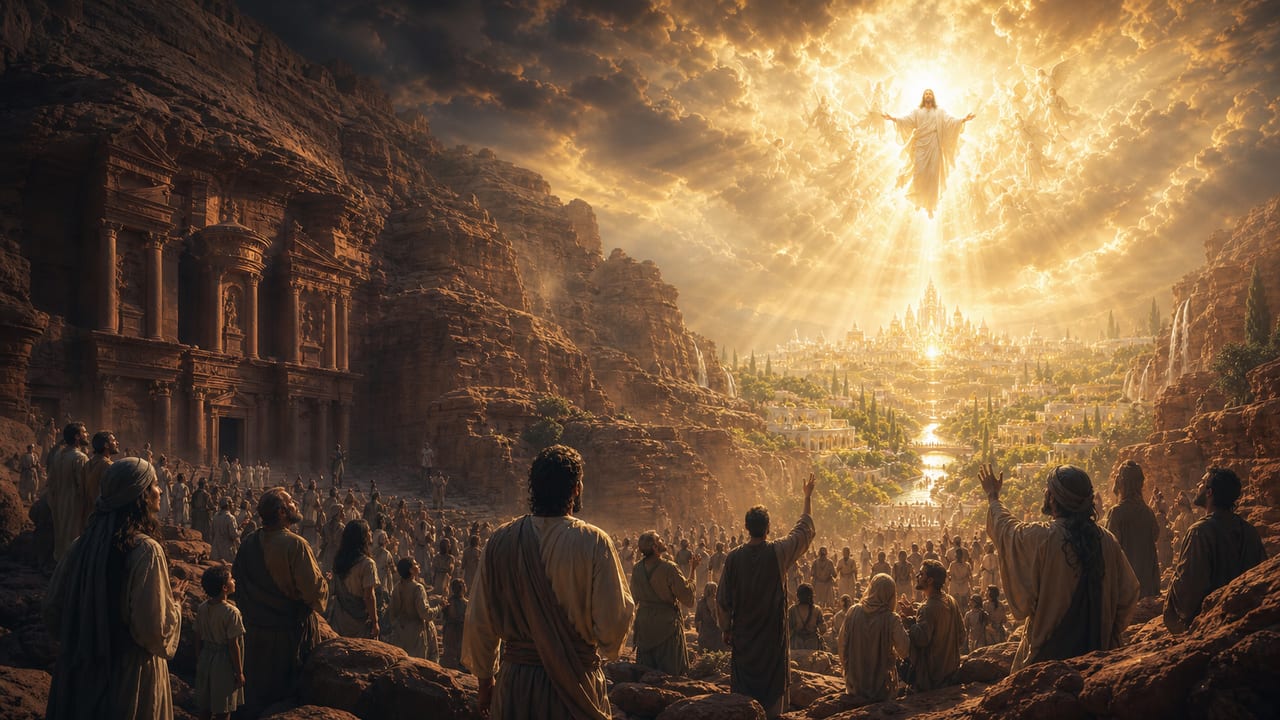
Begin on a hillside east of Jerusalem, on an ordinary morning about two thousand years ago. Eleven men stand on the Mount of Olives staring up into an empty patch of sky. A moment ago their risen Lord was speaking with them. Then He rose — literally rose, feet leaving the earth He made — and a cloud folded around Him and He was gone.
They keep staring. Wouldn’t you?
And then two men in white are standing beside them with a question and a promise that set the course of the next twenty centuries:
ACTS 1:11
“Men of Galilee, why do you stand looking into the sky? This Jesus, who has been taken up from you into heaven, will come in just the same way as you have watched Him go into heaven.”
Just the same way. Personally. Visibly. Bodily. In clouds and glory, to that same mountain. The story of Jesus of Nazareth did not end at the ascension, and it did not dissolve into metaphor. It paused — mid-sentence — with heaven itself promising a second act. The first time He came, He arrived through a stable door and almost nobody noticed. The next time He comes, every human being alive will see it happen at once (Revelation 1:7). The Bible does not treat this as a fringe idea for prophecy hobbyists. It treats it as the main thing history is waiting for.
BY THE NUMBERS — Students of Scripture have counted more than 300 New Testament references to Christ’s return — roughly one verse in every thirty — appearing in 23 of its 27 books. For every prophecy of His first coming, there are about eight of His second. Whatever else that means, it means this: the Bible talks about the Second Coming far more than we do.
This short treatise walks through what Scripture actually says about that day — no date-setting, no newspaper hysteria, interpretation plainly labeled — and then does something most articles never slow down to do: it lays out, step by step, the order of events after He appears. Because the Bible does not merely say He is coming back. It tells us, in remarkable detail, what happens next.
The first time, He came through a stable door. Next time, He comes through the sky.
When Will Jesus Return?
It is the question that likely brought you here, so let us answer it the way Jesus did — with two statements that must be held together.
First: no one can know the date. Jesus could not have said it more plainly: “But of that day and hour no one knows, not even the angels of heaven, nor the Son, but the Father alone” (Matthew 24:36). When the disciples pressed Him after the resurrection, He answered, “It is not for you to know times or epochs which the Father has fixed by His own authority” (Acts 1:7). Every teacher who has ever circled a date on a calendar — and history is littered with them — was wrong before he opened his mouth, because he was doing the one thing the King forbade. You will find no dates in these pages. A watchman who sets dates has stopped watching and started guessing.
Second: Jesus commanded us to read the season. The same Lord who forbade date-setting rebuked people who could forecast the weather but “cannot discern the signs of the times” (Matthew 16:3). He pointed to the fig tree: when the branch grows tender and puts out leaves, “you know that summer is near” (Matthew 24:32–33). He described the era before His return — deception, wars, famines, plagues, a world gospel witness, Israel back in the storyline, birth pangs growing sharper and closer together — and then said: “when you see these things happening, recognize that He is near, right at the door.” Not the day. Not the hour. The season. And His instruction for people living in that season was one word, repeated like a drumbeat: watch (Matthew 24:42; 25:13; Mark 13:35–37).
So the honest biblical answer to “when will Jesus return?” is this: at an hour no man can calculate, in a season every believer is commanded to recognize. He told us we could not know the date precisely so that every generation would live ready — and He told us the signs precisely so that the last generation would not be caught sleeping. “But you, brethren, are not in darkness, that the day would overtake you like a thief” (1 Thessalonians 5:4).
He hid the date so we would always be ready. He gave the signs so we would never be surprised.
Free 24-Page Illustrated Scripture Guide
Take the complete illustrated guide with you
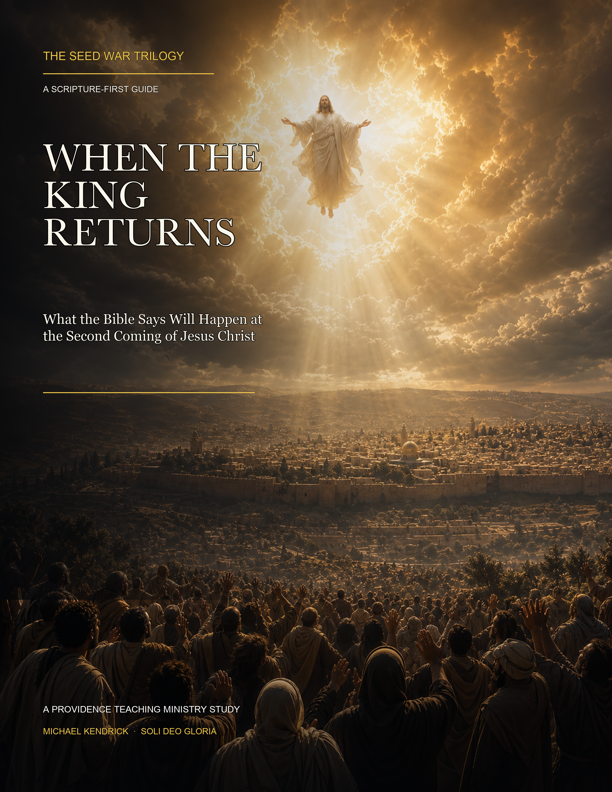
Receive When the King Returns—Michael Kendrick’s 24-page illustrated Scripture guide, including the rapture comparison, 13-event sequence, interpretation labels, full-page artwork, and primary Scripture path.
- Compare the rapture and the visible return
- Follow the complete 13-event sequence
- Explore the Scripture atlas and selected scholarship
Enter your email once to unlock every free resource on this site.
Receive your free resource, a short welcome email series, and ministry updates. Unsubscribe anytime. Privacy policy.
Free instant access. Scripture first. No date-setting. Privacy.
Two Appearings, One Lord
Before we watch the sky open, one clarification prevents a hundred confusions. The New Testament describes the Lord’s return in two distinct scenes that do not look alike, and many careful readers of Scripture understand them as two stages of one great event.
In one scene, Jesus descends only to the clouds and calls His people up to Himself — the dead in Christ raised, living believers caught up “to meet the Lord in the air” in a flash, “in the twinkling of an eye” (1 Thessalonians 4:16–17; 1 Corinthians 15:51–52; John 14:1–3). Believers call this the rapture, from the Latin for “caught up.” It is a rescue, and it is aimed at the church.
In the other scene — the subject of this treatise — He does not stop in the clouds and He does not come quietly. He comes all the way down, with the armies of heaven behind Him, every eye watching, to end the darkest war in history and take the throne of the world (Revelation 19:11–21; Zechariah 14:3–9; Matthew 24:29–31). The first is a bridegroom coming for His bride. The second is a King coming for His crown.
On a small screen, swipe to see all columns. Keyboard: focus the table and use the arrow keys.
| The Rapture | The Second Coming | |
|---|---|---|
| He comes… | FOR His saints, in the air | WITH His saints, to the earth |
| Who sees it | His own — “in the twinkling of an eye” | “Every eye will see Him” (Rev 1:7) |
| Timing | Before the hour of testing (Rev 3:10; 1 Thess 5:9) | “Immediately after the tribulation” (Matt 24:29) |
| The mood | Comfort — “we shall always be with the Lord” | Judgment and coronation — “He treads the wine press” |
| Key texts | John 14:1–3; 1 Thess 4:13–18; 1 Cor 15:51–53 | Rev 19:11–21; Zech 14; Matt 24:29–31 |
✶ INTERPRETATION — LABELED
This treatise reads those scenes in the premillennial way just described: rapture first, then seven years of tribulation on the earth, then the visible Second Coming and a literal thousand-year reign of Christ (Revelation 20:1–6). Faithful Christians have read the sequence differently — some place the rapture at the end of the tribulation, and some understand the thousand years as a symbol of the present age. Those views are weighed respectfully in the longer studies on this site. What no Bible-believing Christian disputes is the center: Jesus Christ will personally, visibly, bodily return in glory to judge the living and the dead. On that, the church has confessed one voice for two thousand years.
The Appearing: The Day the Sky Tears Open
Now come to the day itself. The seventh year of the world’s darkest hour is closing. The Beast’s armies — the kings of the whole earth, gathered to a place called Har-Magedon (Revelation 16:14–16) — have converged on Israel to finish what every Pharaoh and Haman and Herod began: the erasure of the covenant people. Jerusalem has been fought over street by street (Zechariah 14:2). The remnant of Israel, hunted and cornered, does the thing their prophets said they would do at the very end: they call for the One they once refused. “Blessed is He who comes in the name of the Lord!” (Matthew 23:39; Hosea 5:15).
And then it happens.
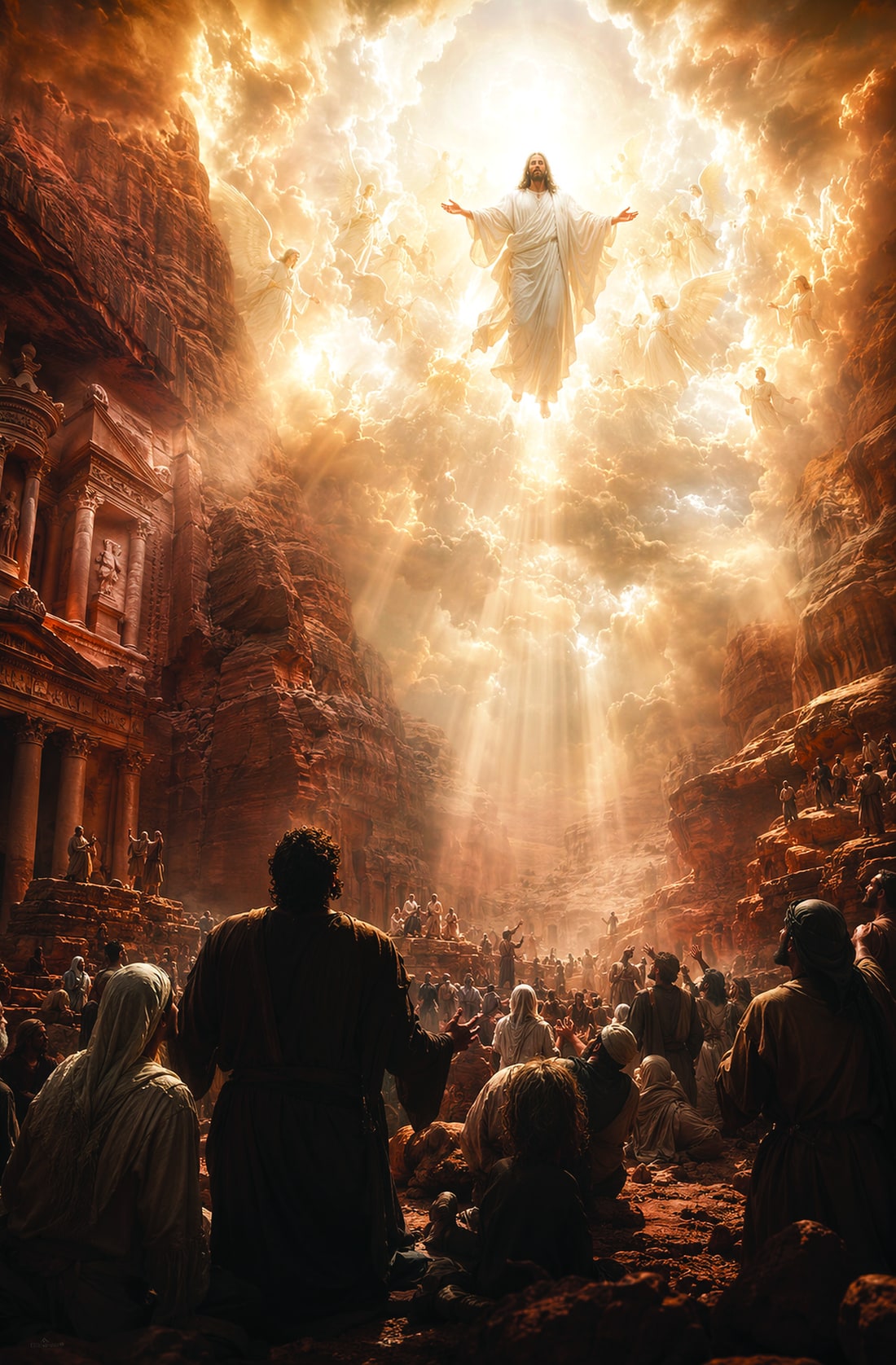
The sun goes dark. The moon fails. Stars fall like fruit from a shaken tree, and “the powers of the heavens will be shaken” (Matthew 24:29). Against that blackout, something begins to burn in the east — “the sign of the Son of Man” blazing where the sun should be — and it moves across the sky the way lightning does, horizon to horizon, unmissable (Matthew 24:27, 30). The armies below stop shooting at Jerusalem and aim upward (Revelation 19:19). The peoples of the earth do not cheer. They mourn — every unready tribe on the planet, at once (Matthew 24:30; Revelation 1:7).
Then heaven opens like a door, and John — who saw it and was told to write it down — describes what rides out:
REVELATION 19:11–16
“And I saw heaven opened, and behold, a white horse, and He who sat on it is called Faithful and True, and in righteousness He judges and wages war. His eyes are a flame of fire, and on His head are many diadems; and He has a name written on Him which no one knows except Himself. He is clothed with a robe dipped in blood, and His name is called The Word of God.
“And the armies which are in heaven, clothed in fine linen, white and clean, were following Him on white horses. From His mouth comes a sharp sword, so that with it He may strike down the nations, and He will rule them with a rod of iron; and He treads the wine press of the fierce wrath of God, the Almighty. And on His robe and on His thigh He has a name written, ‘KING OF KINGS, AND LORD OF LORDS.’”
Read it slowly. A white warhorse where the donkey was. Eyes like flame where tears once were. Many diadems where the thorns went in. A robe dipped in blood — but this time not His own. Behind Him, armies in white linen: the very people He caught up to Himself, coming home in His train (Revelation 19:8, 14; Jude 14). No siege engines, no missiles — a single sword proceeding from His mouth, because the Word that spoke galaxies into being needs nothing else to end a war. The Roman placard once nailed over His head sneered “King of the Jews.” The name written on His robe and thigh answers it forever: KING OF KINGS, AND LORD OF LORDS.
The first coming and the second are the same Person in deliberate, breathtaking reversal. He came in weakness; He returns in omnipotence. He came to be judged; He returns to judge. He came veiled, and only shepherds and stargazers found Him; He returns unveiled, and no one on earth will need to be told what is happening. History is not drifting. It is converging — on a Rider.
He wore our thorns the first time. He wears the many crowns the second.
Where His Feet Land
The angels on ascension day said He would return “in just the same way” — and Scripture is startlingly specific about the landing site. It is the same mountain He left from.
ZECHARIAH 14:4, 9
“In that day His feet will stand on the Mount of Olives, which is in front of Jerusalem on the east; and the Mount of Olives will be split in its middle from east to west by a very large valley, so that half of the mountain will move toward the north and the other half toward the south…
“And the LORD will be king over all the earth; in that day the LORD will be the only one, and His name the only one.”
Feet. A named hill you can stand on today, east of the Old City, with a five-century-old prophecy attached to it. When those feet touch down, the mountain itself tears in two — geology bowing to its Maker — opening a valley of escape for the besieged (Zechariah 14:5), and eventually a river: living waters flowing from Jerusalem to the seas, summer and winter (14:8). This is how physical, how unspiritualized, how real the Second Coming is in the prophets. He does not return as a mood, a movement, or a metaphor. He returns as a Man with feet, to a mountain with a name, and the mountain moves.
And on that day something two thousand years overdue happens in Israel’s heart. “I will pour out on the house of David and on the inhabitants of Jerusalem, the Spirit of grace and of supplication, so that they will look on Me whom they have pierced; and they will mourn for Him, as one mourns for an only son” (Zechariah 12:10). The family recognizes the Brother they sold — the scene of Joseph and his brothers, replayed at the scale of a nation, with the whole world watching. “And so all Israel will be saved” (Romans 11:26). There are few moments in all of Scripture more tender, and it happens in the middle of the most violent day in history. That is very like Him.
After He Appears: The Order of Events
Here is what most articles never slow down to show you. The Bible does not leave the aftermath vague. Set the passages side by side — Revelation 19–21, Matthew 24–25, Daniel 12, Ezekiel 20, Zechariah 12–14, Joel 3 — and a clear sequence emerges. Interpretation labeled: this is the premillennial ordering, each step anchored to its text.
The war ends in a single sentence. The armies gathered at Armageddon — history’s largest military coalition, aimed at heaven itself — are destroyed not by opposing armies but by “the sword which came from the mouth of Him who sat on the horse” (Revelation 19:21). He speaks; it is over. The same voice that said “Let there be light” says something like “Enough,” and the war to erase God’s people dies where it stands (Revelation 19:17–21; Zechariah 14:12–13; Isaiah 63:1–6).
The Beast and the False Prophet are thrown alive into the lake of fire — the counterfeit messiah and his miracle-working prophet, seized like prisoners of war and cast into final fire without trial, its first two occupants (Revelation 19:20). The system that made buying and selling an act of worship dies with its masters in the same hour (Revelation 18).
Satan is bound for a thousand years. An angel — notably, just one — descends with a chain and a key, seizes “the serpent of old,” hurls him into the abyss, and seals it over him “so that he would not deceive the nations any longer” (Revelation 20:1–3). For the first time since Eden, the whisper is gone. Six thousand years of the Seed War, and the serpent’s voice finally goes silent in the earth.
A seventy-five-day transition prepares the Kingdom. Daniel was told the great persecution runs 1,260 days — then given two further numbers: 1,290 and a blessing on those who reach day 1,335 (Daniel 12:11–12). Those extra seventy-five days between the Advent and the Kingdom’s inauguration are the changeover of governments: the desecrated sanctuary cleansed, the battlefield earth purged, thrones prepared. “How blessed is he who keeps waiting and attains to the 1,335 days!”
Israel is gathered and judged. Every surviving Jew is brought from the nations to meet God “face to face,” passing one by one under the Shepherd’s rod, as at a second Exodus: rebels are removed, and the believing nation is brought “into the bond of the covenant” — the New Covenant, the law written on the heart (Ezekiel 20:33–38; Jeremiah 31:31–34). The nation that mourned at His appearing enters its long-promised inheritance.
The nations are judged: the sheep and the goats. Then the King sits on His glorious throne, and all surviving Gentiles stand before Him (Matthew 25:31–46). He separates them as a shepherd sorts a mixed flock — and the evidence He cites is what each did, at the risk of death, for “these brothers of Mine”: His hunted, starving, imprisoned witnesses of the tribulation years. Sheep — believers whose faith showed its hand when kindness was treason — hear the most beautiful sentence ever pronounced: “Come, you who are blessed of My Father, inherit the kingdom prepared for you from the foundation of the world.” Goats hear the other sentence, and are removed from the earth. The Kingdom opens with only the redeemed inside. (This judgment has its own full-length treatise in this series.)
The sleeping saints of the ages rise. “Many of those who sleep in the dust of the ground will awake, these to everlasting life” (Daniel 12:2) — Abraham, David, Daniel himself standing “at the end of the days” for his allotted portion (12:13) — together with the martyrs the Beast beheaded, who “came to life and reigned with Christ for a thousand years” (Revelation 20:4). The first resurrection is complete: “Blessed and holy is the one who has a part in the first resurrection” (20:6).
The Kingdom dawns — a thousand years of the world as it was meant to be. “And the LORD will be king over all the earth” (Zechariah 14:9). Swords are beaten into plowshares and the science of war is forgotten (Isaiah 2:4). The wolf lies down with the lamb, the lion eats straw beside the ox, a child plays over the viper’s den and is not harmed (Isaiah 11:6–9). Deserts blossom; the lame leap; the streets of Jerusalem fill with old men leaning on staffs and children playing (Isaiah 35; Zechariah 8:4–5). Human life stretches back toward Eden-lengths — a hundred-year-old counted a youth (Isaiah 65:20) — as the survivors who entered the Kingdom marry, build, plant, and refill a healing world, while the resurrected saints in glory govern its cities with the King (Revelation 5:10; 20:6; Luke 19:17). Earth finally gets the government every election has ever ached for: the Man with the nail-scarred hands, ruling from David’s throne.
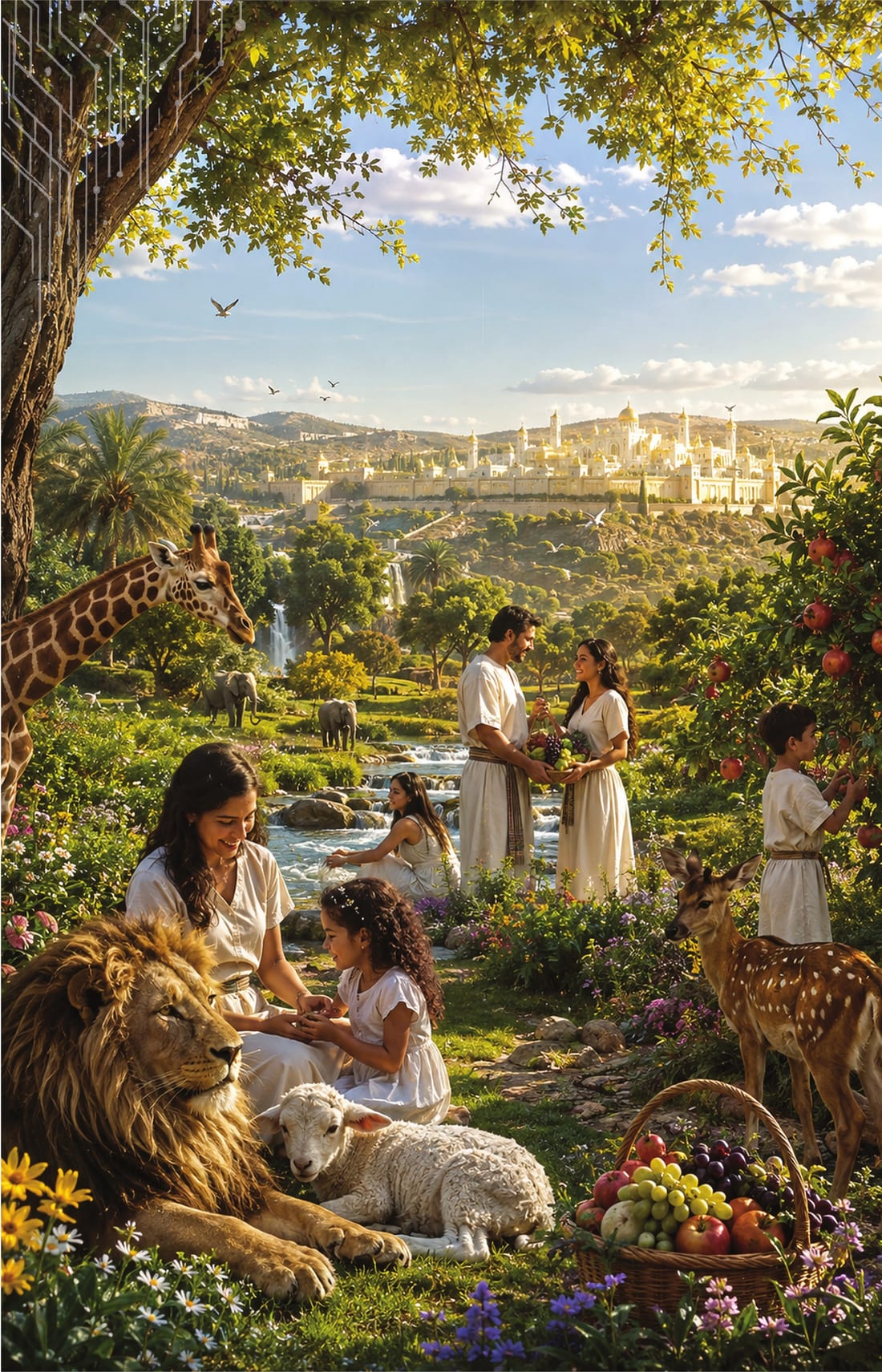
Interpretation labeled · The Millennial KingdomThe Kingdom dawns—a thousand years of the world as it was meant to be. · Isaiah 11:6–9 · Revelation 20:4–6 One last rebellion — and the serpent’s end. At the thousand years’ end, Satan is released “for a short time” and finds, astonishingly, willing recruits — descendants of the Kingdom’s citizens, raised under perfect government, who never gave the King their hearts (Revelation 20:7–9). The rebellion proves forever that sin was never about environment; it lives in unrenewed hearts. Fire from heaven ends it in a verse, and the devil is cast at last into the lake of fire, “tormented day and night forever and ever” (20:10). The war that began with a whisper in a garden ends without a battle.
The Great White Throne. Earth and sky flee from His face. The unbelieving dead of every age stand resurrected before the throne; books are opened, and every life is measured by its record; and one more book — the Book of Life — testifies by its silences. “And if anyone’s name was not found written in the book of life, he was thrown into the lake of fire” (Revelation 20:11–15). It is the last courtroom in the history of the universe. No case is appealed; no verdict is reversed; the day for choosing sides is over.
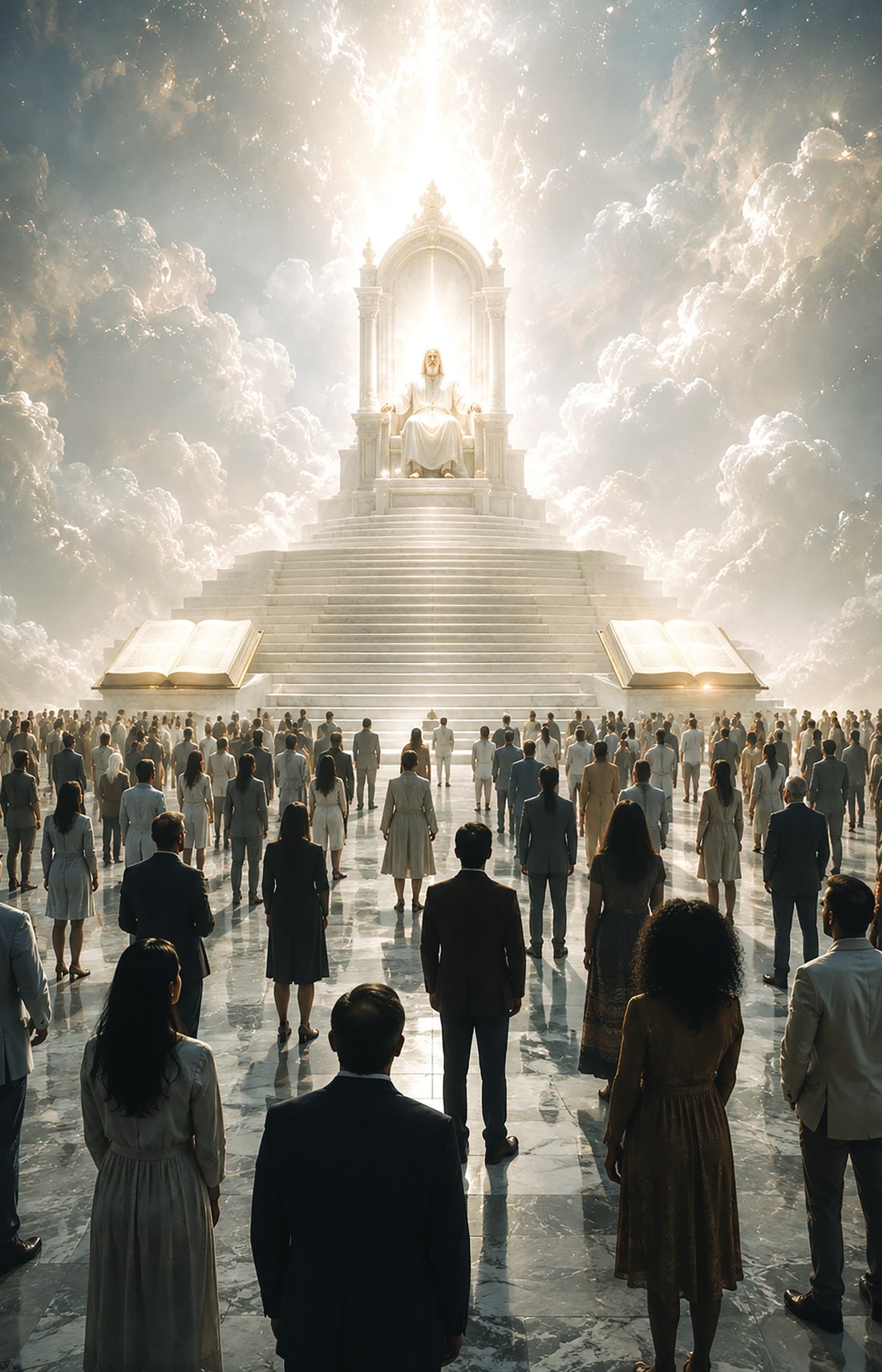
Explicit text · Artistic visualizationThe Great White Throne—the books are opened, and every life is measured by its record. · Revelation 20:11–15 All things new. Then a new heaven and a new earth, and the holy city, New Jerusalem, descending like a bride. “Behold, the tabernacle of God is among men… He will wipe away every tear from their eyes; and there will no longer be any death; there will no longer be any mourning, or crying, or pain; the first things have passed away.” And He who sits on the throne says, “Behold, I am making all things new” (Revelation 21:1–5). The story that opened in a garden closes in a garden-city, with the tree of life bearing fruit on both banks of the river, and the door home standing open forever.

Explicit promise · New Heaven and New EarthThe holy city, New Jerusalem, descends like a bride. God dwells among His people. All things are made new. · Revelation 21:1–5
History is not drifting toward chaos. It is converging on a coronation.
Something So Beautiful — and So Terrible
C. S. Lewis, in Mere Christianity, put his finger on why this doctrine will not let us stay neutral:
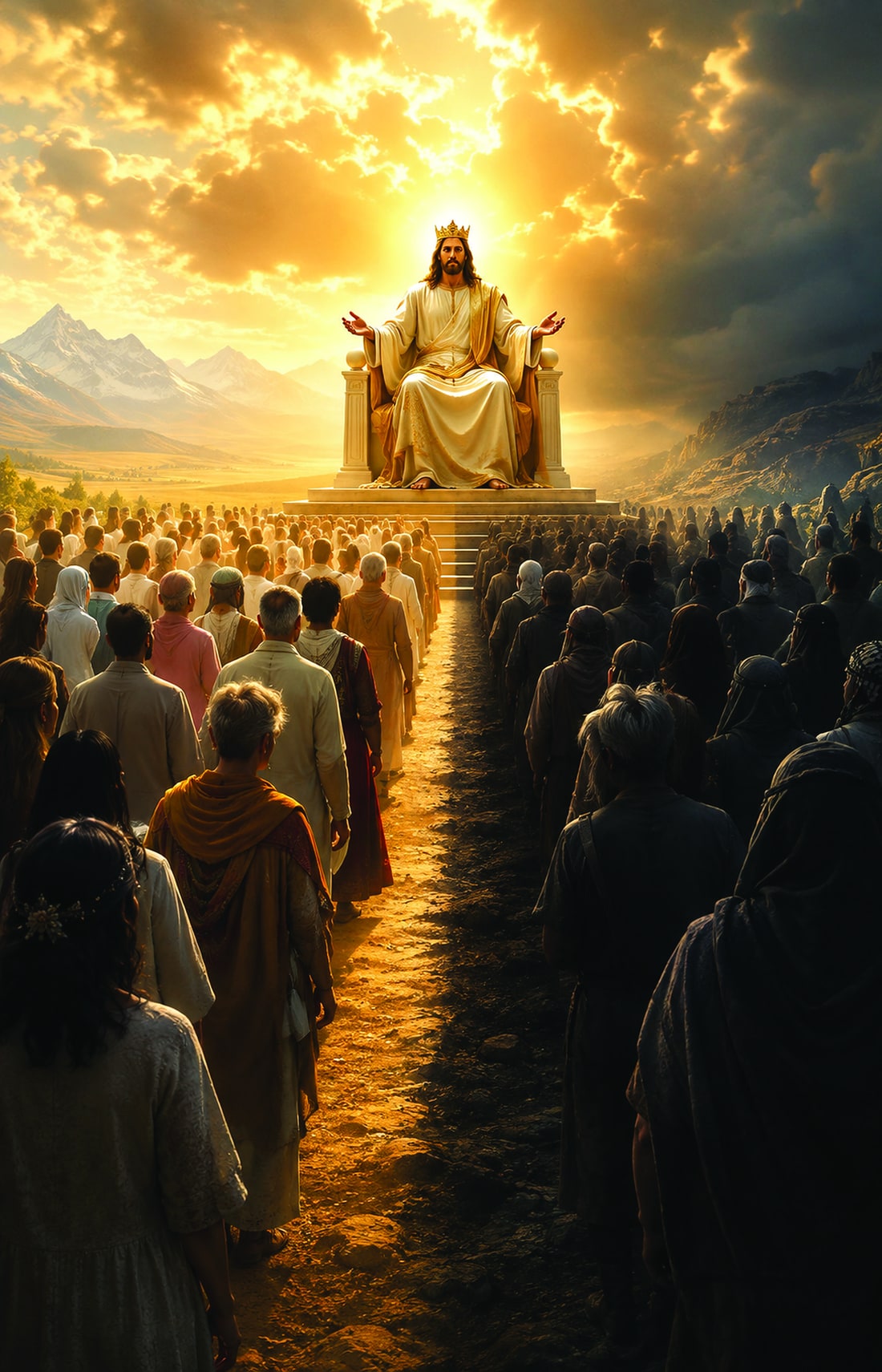
“When the author walks on to the stage the play is over. God is going to invade, all right: but what is the good of saying you are on His side then, when you see the whole natural universe melting away like a dream and something else — something it never entered your head to conceive — comes crashing in; something so beautiful to some of us and so terrible to others that none of us will have any choice left? … It will be too late then to choose your side. That will not be the time for choosing: it will be the time when we discover which side we really have chosen, whether we realised it before or not. Now, today, this moment, is our chance to choose the right side.”
— C. S. Lewis, Mere Christianity, Book II, ch. 5
Scripture shows both faces of the same sunrise. On that day, some of earth’s proudest people — “the kings of the earth and the great men” — will beg mountains to fall on them rather than face “the wrath of the Lamb” (Revelation 6:15–17). And on the same day, under the same sky, another company will lift their faces and say: “Behold, this is our God for whom we have waited that He might save us… let us rejoice and be glad in His salvation” (Isaiah 25:9). Same event. Same Rider. Opposite experiences — and the difference between the two crowds is not education, morality, or religion. It is whether they know the Rider.
That is why the New Testament never once uses the Second Coming to terrify believers. It calls this event “the blessed hope” — “looking for the blessed hope and the appearing of the glory of our great God and Savior, Christ Jesus” (Titus 2:13). It is the day the graves of everyone you loved in the Lord open. The day the war ends. The day the King you have prayed to through every dark night turns out to be exactly as real as the morning. “When these things begin to take place, straighten up and lift up your heads, because your redemption is drawing near” (Luke 21:28).
Will You Be Ready? The Door Is Still Open
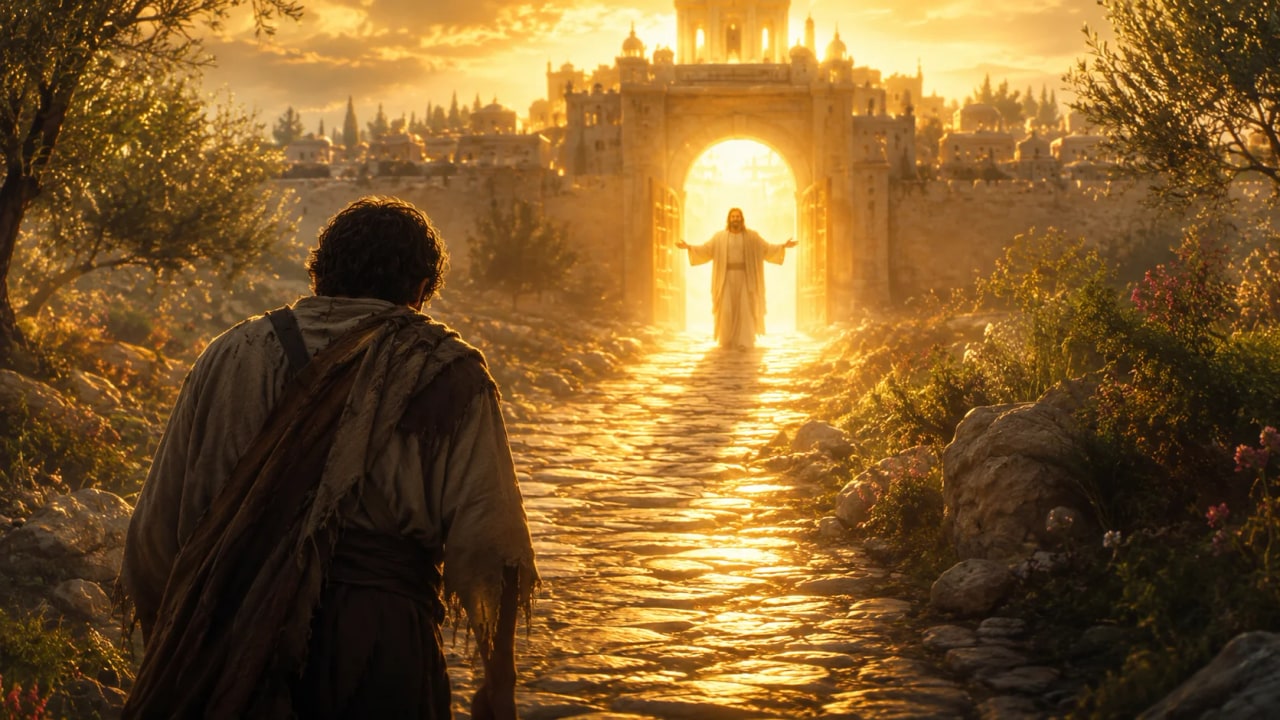
So we end where every honest telling of this story must end — not with a chart, but with a question. When the sky tears open, there will be no time to decide. Lightning does not schedule appointments. The deciding is done now, on the quiet mornings, in moments like this one.
Being ready is not about decoding prophecy correctly. It is about knowing the King. “Believe in the Lord Jesus, and you will be saved” (Acts 16:31). He came the first time precisely so that His second coming would be your rescue and not your ruin — the robe dipped in blood at His return is only good news because, at His first coming, the blood was His own, shed for you. “If you confess with your mouth Jesus as Lord, and believe in your heart that God raised Him from the dead, you will be saved… for whoever will call on the name of the Lord will be saved” (Romans 10:9, 13).
If you have never done that, do it now — today, this moment, in your own words: turn from your sin, and trust the crucified and risen Jesus as your Lord and Savior. “Behold, now is ‘the acceptable time,’ behold, now is ‘the day of salvation’” (2 Corinthians 6:2). And if you have — then live like a watchman: awake, unashamed, telling the others. Someone you love needs to hear what you have just read. Send it to them. That is what watchmen are for.
The Father is waiting. Christ has made the way. Home is still being offered.
Questions People Ask
Can anyone know the date of Christ’s return?
No — and anyone who claims otherwise has contradicted Jesus in the act of quoting Him (Matthew 24:36; Acts 1:7). Scripture gives seasons and signs, never dates. Watchfulness is commanded; calculation is forbidden. This site sets no dates, ever.
Will the Second Coming be secret or quiet?
The opposite. It is compared to lightning that lights the sky from east to west (Matthew 24:27), seen by “every eye” (Revelation 1:7), announced with clouds, glory, angels, and a trumpet (Matthew 24:30–31). The catching up of the church happens “in the twinkling of an eye”; the Second Coming is the most public event in human history.
What is the difference between the rapture and the Second Coming?
At the rapture, Christ comes for His people and meets them in the air (1 Thessalonians 4:16–17). At the Second Coming, He comes with His people all the way to earth, to judge the nations and reign (Revelation 19:11–14; Zechariah 14:4). One is a rescue before the storm; the other is the sunrise after it.
What is Armageddon, really?
Not a nuclear accident and not a metaphor: Har-Magedon, the hill country of Megiddo in northern Israel — the staging ground where demonic persuasion gathers “the kings of the whole world” for the war against Jerusalem and, in truth, against the Lamb (Revelation 16:13–16; 19:19). It is less a battle than an execution of sentence: the armies gather, and He speaks (Revelation 19:21).
Do all Christians agree on this order of events?
On the center — Jesus’ personal, visible, glorious return to judge the living and the dead — yes, universally, in every creed of the church. On the sequence — the timing of the rapture, the nature of the thousand years — no; premillennial, amillennial, and postmillennial believers order the furniture differently. This treatise follows the premillennial reading because it takes the prophetic texts in their plainest sense, and it labels its interpretation so you can test everything against the open Bible (Acts 17:11). Good watchmen can differ on the timetable; no watchman may sleep.
Why has He waited two thousand years?
Peter answered this exact taunt: “The Lord is not slow about His promise, as some count slowness, but is patient toward you, not wishing for any to perish but for all to come to repentance” (2 Peter 3:9). The delay is not absence. It is mercy — a door held open. It will not be held open forever (3:10).
Read It for Yourself
Do not take this treatise’s word for any of it. Sit down with these passages, in this order, and watch the day assemble before your eyes:
THE PROMISE — Acts 1:9–11 · John 14:1–3 · Titus 2:11–14 · Revelation 1:7. THE SEASON — Matthew 24 · Luke 21:25–36 · 2 Timothy 3:1–5 · 2 Peter 3:1–13. THE APPEARING — Revelation 19:11–21 · Zechariah 12:10; 14:1–9 · Matthew 24:27–31 · 2 Thessalonians 1:6–10 · Jude 14–15. THE AFTERMATH — Daniel 12 · Ezekiel 20:33–38 · Matthew 25:31–46 · Revelation 20–22 · Isaiah 2; 11; 35; 65:17–25.
For deeper study, this treatise stands on the shoulders of careful students of prophecy across the spectrum — John Walvoord, J. Dwight Pentecost, Charles Ryrie, Arnold Fruchtenbaum, John MacArthur, George Eldon Ladd, and (for the alternative orderings) Anthony Hoekema — and on the companion studies at theseedwartrilogy.com: Revelation 13 Explained, What Does the Bible Say About the End Times?, The Sheep and the Goats, and Home at the Center.
Scripture quotations taken from the New American Standard Bible® (NASB), Copyright © 1960, 1971, 1977, 1995 by The Lockman Foundation. Used by permission. www.lockman.org.
© 2026 Michael Kendrick · The Seed War Trilogy · theseedwartrilogy.com · Freely share, unaltered and unsold, with this notice intact. Soli Deo Gloria.
Free 24-Page Illustrated Scripture Guide
Keep the illustrated guide beside your Bible
Receive When the King Returns—Michael Kendrick’s 24-page illustrated Scripture guide, including the rapture comparison, 13-event sequence, interpretation labels, full-page artwork, and primary Scripture path.
- Compare the rapture and the visible return
- Follow the complete 13-event sequence
- Explore the Scripture atlas and selected scholarship
Enter your email once to unlock every free resource on this site.
Receive your free resource, a short welcome email series, and ministry updates. Unsubscribe anytime. Privacy policy.
Free instant access. Scripture first. No date-setting. Privacy.