
There is a moment before an answer when a person can still decide what question matters.
We can pause. We can listen again. We can remember something Christ said. We can discover that the interruption we wanted to escape is a person we ought to love.
That moment is becoming a place where technology offers to help.
On September 16, Snap introduced SPECS Intelligence, an AI service designed to learn from connected applications and offer relevant information before being asked. Its announcement describes assistance shaped by a person’s priorities, relationships, and routines, extending across devices and into the view of someone wearing its augmented-reality glasses. Snap’s announcement
The promise is useful. The question it raises reaches inward: when an artificial adviser gets there first, what happens to the habit of discernment?
The counsel arrives early
Snap calls the service “anticipatory.” One example is preparation for a meeting: the system could surface questions to ask, matters to remember, and decisions to consider. The announced fuller experience is entering invitation-only access on Mac. The public iOS preview offers insights from Gmail and Google Calendar; it does not yet include the broader service’s anticipatory suggestions or actions. These are announced capabilities and rollout plans, not the findings of an independent test. Snap’s announcement
On its product page, Snap describes an assistant that remembers personal priorities, brings information together across applications, and helps users pursue their goals. The glasses are one way to encounter this assistance; the service also works through iPhone and Mac. SPECS Intelligence
The proposed benefit is easy to understand. Remembering an appointment can spare someone distress. Recovering a forgotten detail can improve a conversation. Assistance can free attention for the person in front of us.
But a suggested question also directs attention. It puts one concern in the foreground while others remain outside the frame. A recommendation can begin shaping a decision before the user has consciously evaluated the situation.
That is the possibility this Dispatch is examining. Its eventual effect will depend on the system, the setting, and the habits of the person using it.
Who frames the next thought?
Imagine a future assistant helping you prepare for a difficult conversation. This is an illustrative scenario, not a reported SPECS feature or an account of someone’s experience.
The assistant has assembled the messages. It has found the unresolved issue. It offers an opening sentence and a preferred outcome. You read the suggestion before speaking.
Perhaps its preparation is excellent. Perhaps it has missed the grief behind the other person’s abrupt reply. Perhaps the goal you previously supplied—to resolve the matter quickly—is itself what needs reconsidering.
You still decide. Yet you are now deciding in response to a frame someone else has prepared.
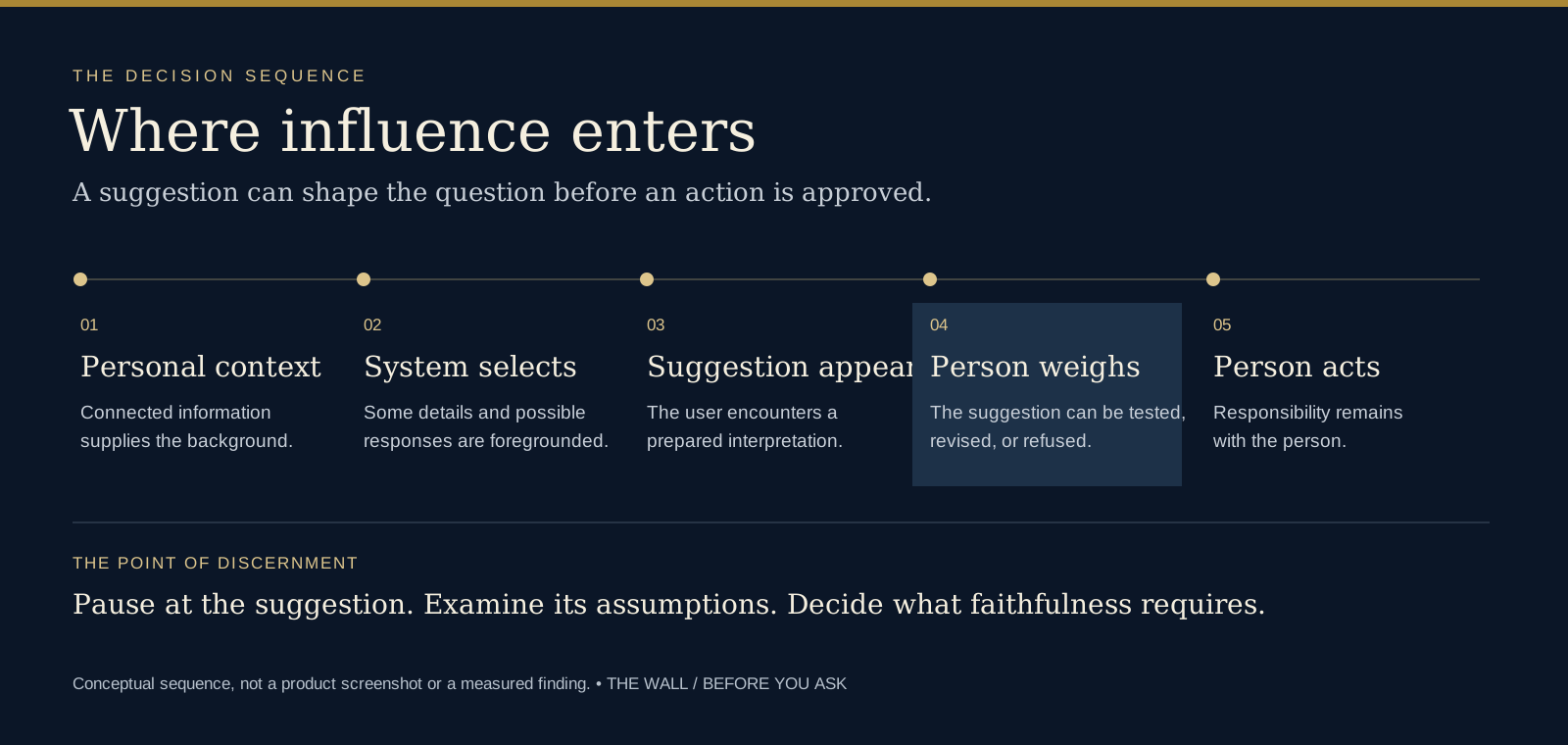
Where influence enters
A suggestion can shape the question before an action is approved.
Personal context
Connected information supplies the background.
System selects
Some details and possible responses are foregrounded.
Suggestion appears
The user encounters a prepared interpretation.
Person weighs
The suggestion can be tested, revised, or refused.
Person acts
Responsibility for the response remains with the person.
Pause at the suggestion. Examine its assumptions. Decide what faithfulness requires.
An adviser can serve us well by making that frame visible and inviting us to question it. Trouble begins when its account feels so convenient, so familiar, and so apparently tailored to us that we stop noticing the interpretation at all.
Then “the system suggests” can quietly become “this is what the situation requires.”
That is a possible path from assistance to dependence. No claim of mind reading is needed to take it seriously. Words, priorities, and repeated suggestions already have a way into human thought: our attention.
The question is who gets the first opportunity to tell us what matters—and whether we retain the habit of testing that counsel.
The inward life belongs to God
Christians have reason to examine this carefully because the inward life is part of our life before God. We are responsible for what we welcome, what we dwell upon, and whose judgment we learn to trust.
“Soul space” is a useful expression for that inward life: attention, conscience, prayer, desire, and discernment. It is a metaphor, not a claim that the soul contains a technological compartment. Nothing in the reporting establishes that these glasses can enter a soul or remove the Holy Spirit.
The spiritual concern is the authority we may give their counsel.
Before His crucifixion, Jesus promised His disciples the Holy Spirit, who would teach them and bring His words to their remembrance. The promise in John 14:26 is rooted in Christ’s teaching. In John 16:14, Jesus says of the Spirit, “He shall glorify me.” The direction of that ministry is toward Christ. John 14:26, John 16:13–14
An assistant that remembers our preferences has not thereby acquired spiritual wisdom. Knowing what we usually choose does not establish what we ought to choose. Helping us pursue a goal leaves open the question of whether that goal is good.
That distinction can become uncomfortable. We may want relief when repentance is needed. We may want an efficient reply when patience is needed. We may want our position reinforced when Scripture calls us to examine it.
Paul connects the renewal of the mind with discerning the will of God. His account of the Spirit’s fruit includes love, patience, gentleness, and self-control. These give Christians standards by which to examine the habits a tool encourages. Romans 12:2, Galatians 5:22–23
A manufactured adviser becomes a spiritual rival when we grant it final authority over conscience, truth, or obedience. That is an argument about misplaced trust. It is not an allegation that Snap’s engineers are attempting to impersonate God.
Permission leaves a question open
Snap’s stated safeguards deserve a fair hearing. Users choose which information to connect, and the company says actions such as sending a message require approval. It also says personal data is used to personalize the service rather than train AI models. These are company assurances, not independent verification by The Wall. SPECS Intelligence and FAQ
Those controls matter. A person should be able to withhold information and refuse an action.
The question about formation remains: what has happened before the approval screen appears? A user may be fully free to reject a suggestion while gradually becoming less practiced at forming a judgment without one.
Human advisers can also be mistaken, intrusive, or unwise. A pastor, friend, or author does not become trustworthy simply by being human. The Christian obligation to test counsel applies across these relationships. Paul’s instruction to the Thessalonians joins receptivity to the Spirit with examination: “Prove all things; hold fast that which is good.” 1 Thessalonians 5:19–22
The application to AI is ours to make carefully. Familiarity, speed, and personalization cannot settle whether counsel is true.
Keep the interval open

The practical response begins with habits we can choose now.
Before accepting advice about a relationship or a moral decision, put the device aside long enough to name the question yourself. Ask what the suggestion assumes, what it leaves out, and whether its preferred outcome deserves pursuit.
Read Scripture in context. Pray. Seek mature Christian counsel, especially from people who know you well enough to challenge your account. Preserve occasions when another person can speak without a system supplying the interpretation alongside them.
A pause does not make every inward impression divine. Discernment requires testing our own desires as well as the advice placed before us.
Nor must every reminder become a spiritual crisis. The useful appointment alert and the surrender of conscience are different things. The boundary deserves attention precisely because ordinary, helpful uses may become the setting in which deeper trust develops.
The Wall’s earlier Dispatch, The Counterfeit Comforter, raised the concern that an ever-present artificial adviser could become a substitute for dependence on God. Snap’s announcement supplies a concrete occasion to examine that concern, while keeping the company’s claims and the theological interpretation distinct.
The danger is not inevitable. A person can set limits, question a recommendation, and change a habit. Within Christian life, those choices belong to the larger work of attending to Christ and growing in obedience.
“Keep thy heart with all diligence; for out of it are the issues of life.”
— Proverbs 4:23, KJV
As assistance arrives earlier, we must become more deliberate about the authority we give it.
Before the next suggestion, leave room to ask what faithfulness requires.
Soli Deo Gloria
Reporting and reading
- Android Authority: Snap’s powerful Specs smart glasses make the case for AR going mainstream, September 16, 2026. The news report that prompted this Dispatch.
- Snap: Introducing SPECS Intelligence, September 16, 2026. Primary source for the announced service, examples, and rollout distinctions.
- SPECS Intelligence product page and FAQ, checked September 18, 2026. Primary source for the product’s positioning, approval controls, and data assurances.
Scripture quotations are from the King James Version. Product statements are attributed to Snap; the implications for spiritual formation are the author’s interpretation. Original illustrations are conceptual, not photographs of Snap’s hardware or screenshots of its interface.