Neural Interface · Body / Perception
The Door Before the Sensor
Apple built a doorway for decoded neural intent. Its work with Synchron, its EEG patents and research, and its move for Sonera assets show how many kinds of human signal could eventually pass through it.
By Michael Kendrick · September 8, 2026 · 9 min read

“For thou, even thou only, knowest the hearts of all the children of men.”1 Kings 8:39 · KJV
If You Only Read This
- The software doorway is real. Apple’s BCI HID protocol is live in iOS, iPadOS and visionOS 26. An outside device decodes the signal and sends Apple a finished command.
- The public demonstration was clinical. Synchron showed an ALS trial participant navigating an iPad without hands, voice or eye control. Its implant remains investigational.
- The Sonera record is narrower than the headlines. A European Commission notice says Apple intended to acquire certain assets and hire certain employees; it gives no price or product plan.
- Sonera has shown muscle sensing, not thought reading. Its published gesture and silent-speech studies used commercial magnetometers rather than the company’s S1 chip.

Apple solved the operating-system problem before choosing every sensor.
In May 2025, Apple announced a protocol that would let people with severe mobility disabilities control an iPhone, iPad or Vision Pro through Switch Control using a compatible brain-computer interface. Apple later published the technical reference. The BCI maker records and interprets the biological signal; the Apple device receives standardized events such as button presses, pointer movement, direct selection and signal quality. [P1] [P2]
The distinction matters. Apple has not shown an operating system reading raw thoughts. It has built a durable handoff point after another device has already done the difficult work of separating noise from signal and signal from intent.
The platform can accept new sensors without changing every app.
A Chain of Custody for Intent
Person
Brain, nerve or muscle activity begins the chain.
Sensor
Implant, EEG, optics or magnetics captures a faint signal.
Decoder
Calibration and models convert the signal into intent.
Apple BCI HID
A standard command crosses into the operating system.
Native Action
Messages, apps and controls respond through accessibility.
Apple controls the right side of this chain. Partners still control most of what happens close to the body.
Synchron showed that the doorway can be used.
In August 2025, Synchron demonstrated an ALS trial participant using its implanted Stentrode system with Apple’s protocol to navigate an iPad, open apps and compose text without using his hands, voice or eye tracking. The neural signal was recorded by Synchron’s implant and decoded outside the Apple device. [P3]
That is a serious accessibility milestone. It is not a consumer launch. Synchron says the system remains investigational and is not approved for commercial use. Apple does not manufacture the implant or sponsor its clinical trials.
The pieces form a program, even if Apple has not named one.
Apple’s public record extends beyond one protocol. A 2023 patent application describes an ear-worn device that dynamically selects electrodes for signals including EEG. A separate retention-band application describes repositionable EEG and optical brain-sensing elements in head-mounted hardware. Apple has also pursued wrist-EMG gesture and force estimation—muscle sensing rather than brain sensing. [P4] [P5]
Its published machine-learning work shows continuity: EEG representation learning, masked reconstruction, models that transfer across several biosignal types, and a 2026 “Device Passport” paper tested on adapting models to different ear-EEG layouts. These are real research outputs. They are not proof that current AirPods, Apple Watch or Vision Pro contain neural sensors. [P6] [P7]
What Apple Has Shown
Shipped
BCI HID across three operating systems, with decoding assigned to the outside controller.
Demonstrated
Native iPad control through Synchron’s investigational implant and decoder.
Patented
Ear EEG, head-mounted biosignal sensing and adjacent wrist-EMG methods.
Published
EEG and multimodal biosignal models, including transfer to ear layouts.
Acquired
Q.ai was reported in January; Sonera assets and talent appear in the EC register in May.
Not Announced
No consumer brain reader, Apple implant, raw-thought API or launch date.
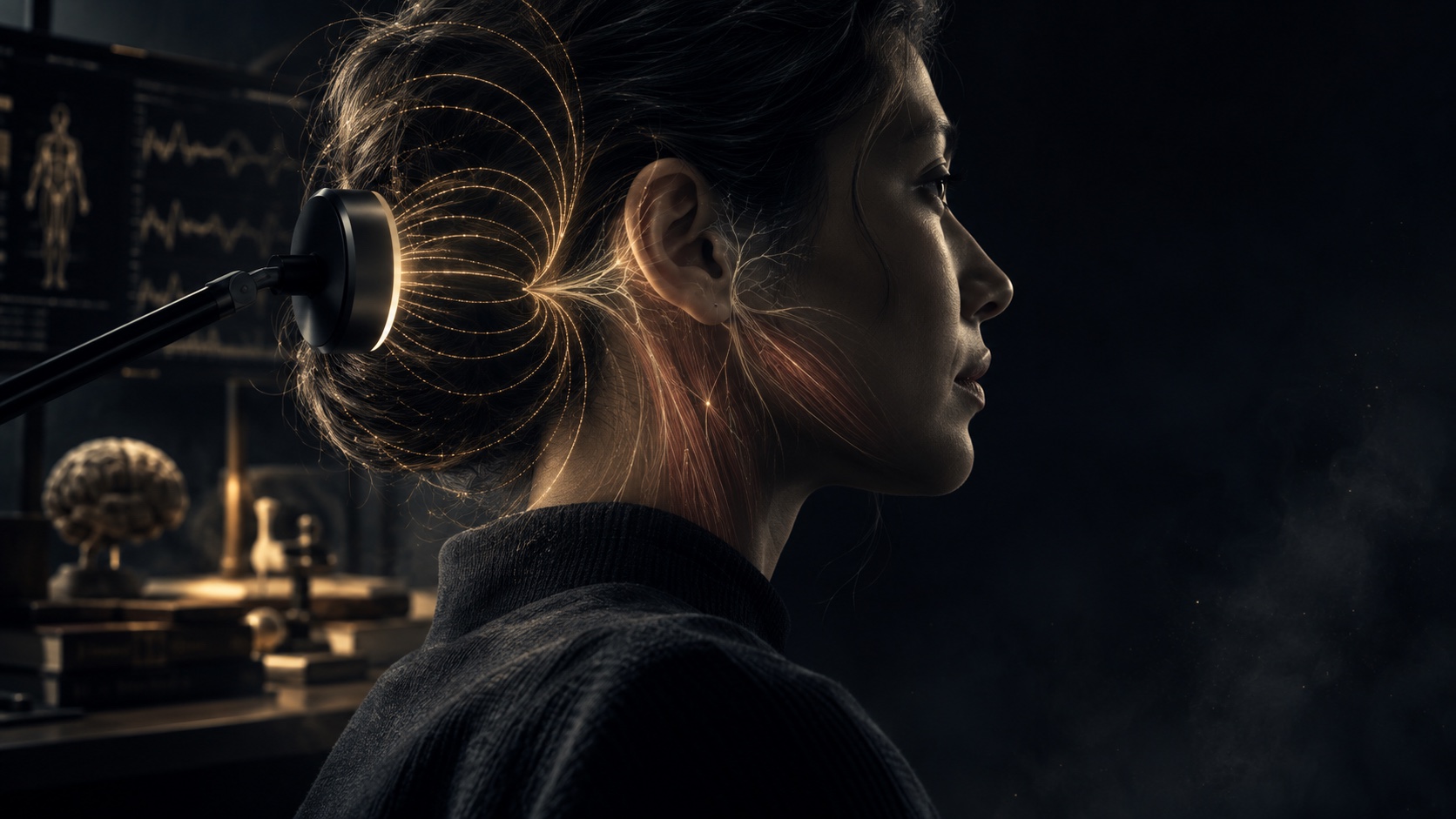
A possible route to the signal without an electrode on the skin.
Nerves and muscles move electrical charge, and moving charge produces a magnetic field. EEG and EMG usually measure voltage through electrodes touching the body. Magnetic sensing measures the accompanying field and can work without conductive skin contact.
Sonera’s core patents describe acoustically driven ferromagnetic resonance. A radio-frequency surface wave crosses a piezoelectric material beneath a thin magnetic film. An external magnetic field changes the film’s absorption of that wave; measuring the altered output reveals the field. Sonera has described the S1 as a chip-scale, room-temperature, low-power magnetometer intended to move biomagnetic sensing out of heavily shielded laboratories. Those are company and patent claims, not a public human-brain performance dataset.
The transaction record is equally specific. A European Commission Digital Markets Act notice dated May 8, 2026 says an Apple subsidiary intended to acquire certain Sonera assets and offer employment to certain employees. It does not say Apple bought every share, every patent or the entire corporate entity, and it discloses no price, closing date or intended product. [P8]
The strongest public results concern muscle, gesture and silent articulation.
In a forearm study, Sonera-affiliated researchers reported 95.4 percent average accuracy for nine gestures within a single session and participant. Cross-session and cross-person results were lower. In a separate silent-speech study, wearable magnetometers near the face and throat classified twelve mouthed commands with about 86 percent user-dependent accuracy among nine participants. Both papers were preprints, and both used commercial magnetometers rather than Sonera’s S1 chip. [P9] [P10]
That makes subtle gesture, accessibility, neuromuscular monitoring and silent input more plausible near-term destinations than magnetic brain reading. A future Sonera-derived sensor may reach weaker neural fields, but the public record reviewed for this Dispatch does not demonstrate the S1 recording a human brain.
Three Routes to Intent
Neural Implant
Motor-cortex activity is decoded by an investigational medical system, then sent through BCI HID.
Magnetic Muscle Signal
Contact-free sensing could capture gestures or articulation near the wrist, ear, jaw or neck.
Optical Micromovement
Reporting on Apple’s acquisition describes optical detection of tiny facial movements for quiet input.
Different biological sources can become the same kind of command once an outside decoder crosses Apple’s software doorway.
Restored communication is not the danger. Coercion is.
For a person who cannot move or speak, a reliable interface can restore communication, work, relationship and control of the surrounding world. Contact-free muscle sensing could reduce irritation, setup time and calibration burden. Those benefits should not be minimized to make a warning sound louder.
The boundary arrives when measurement becomes less visible, consent becomes less explicit, and a helpful option becomes an expected condition of participation. Neural and muscular data can reveal more than the command a person meant to send. The difficult questions concern collection, retention, model training, secondary inference, vendor telemetry and who may revoke access.
Apple’s architecture offers one useful limit: the host can receive a high-level command rather than the raw neural stream. But that also moves much of the privacy burden upstream to the sensor and decoder maker. The public Apple BCI documents do not yet supply a complete policy for neural data or derived mental-state inferences.
Evidence discipline is part of the watch.
The record does not establish that Apple can read thoughts, is building an implant, has integrated Sonera technology with Synchron, or will ship a consumer brain sensor. A patent preserves an option; it is not a product plan. A preprint reports an experiment; it is not commercial validation. A regulatory notice identifies a transaction; it does not reveal the buyer’s roadmap.
It also does not establish that any of these systems is the Mark of the Beast. The narrower and more defensible observation is architectural: Apple has made decoded intent legible to its operating systems, and it is accumulating several ways to sense or infer that intent closer to the body.
The door is already open. The question is which signals will be invited through it—and under whose terms.
Watch the movement from chosen aid to required gate.
Scripture reserves the knowledge of the heart to God. Technology can measure correlates, classify patterns and predict actions with growing precision; it does not become omniscient, morally authoritative or divine. The Christian task is neither panic nor surrender. It is to tell the truth about what the system can do, protect the person who needs its mercy, and resist the moment when assistance becomes a condition of access or allegiance.
For now, Apple’s BCI work is an accessibility pathway surrounded by patents, research and acquisitions. The responsible watch is to follow what happens next: Sonera inventors appearing on Apple filings, magnetic sensing in Apple job descriptions, EEG or MMG in product specifications, BCI privacy rules, clinical programs, and any expansion of the protocol beyond Switch Control.
What Happened
Apple shipped a standard pathway for finished BCI commands across iOS, iPadOS and visionOS.
Synchron demonstrated native iPad control with an investigational implanted BCI.
Apple’s patent and research record includes ear EEG, head-mounted biosignals and generalizable EEG models.
The European Commission recorded Apple’s plan to acquire certain Sonera assets and hire certain employees.
Sonera’s strongest public human results involve muscle signals, not thought reading or a validated brain-sensing chip.
Documentation
Primary records are separated from acquisition reporting, and every material limitation stays attached to its claim.
Primary Technical and Government Records
- Apple Newsroom — Accessibility features and BCI support
- Apple Developer — BCI HID reference
- Synchron — First thought-controlled iPad demonstration
- Apple patent — Ear-worn biosignal sensing with dynamic electrodes
- Apple patent — Head-mounted health-sensing retention band
- Apple Machine Learning Research — Multimodal biosignal pretraining
- Apple Machine Learning Research — Device Passport and ear-EEG transfer
- European Commission — Digital Markets Act acquisitions register
- bioRxiv — Generalizable gesture recognition using magnetomyography
- bioRxiv — Silent speech recognition with wearable magnetometers
Contemporaneous Reporting
Soli Deo Gloria
✶Free Biblical Briefing
The Mark Will Not Look Like a Mark
Receive The Watchman’s Dossier—a focused guide to Revelation 13, AI, digital identity, programmable money, biometric control, and neural interfaces.
Enter your email once to unlock every free resource on this site.
Receive your free resource, a short welcome email series, and ministry updates. Unsubscribe anytime. Privacy policy.