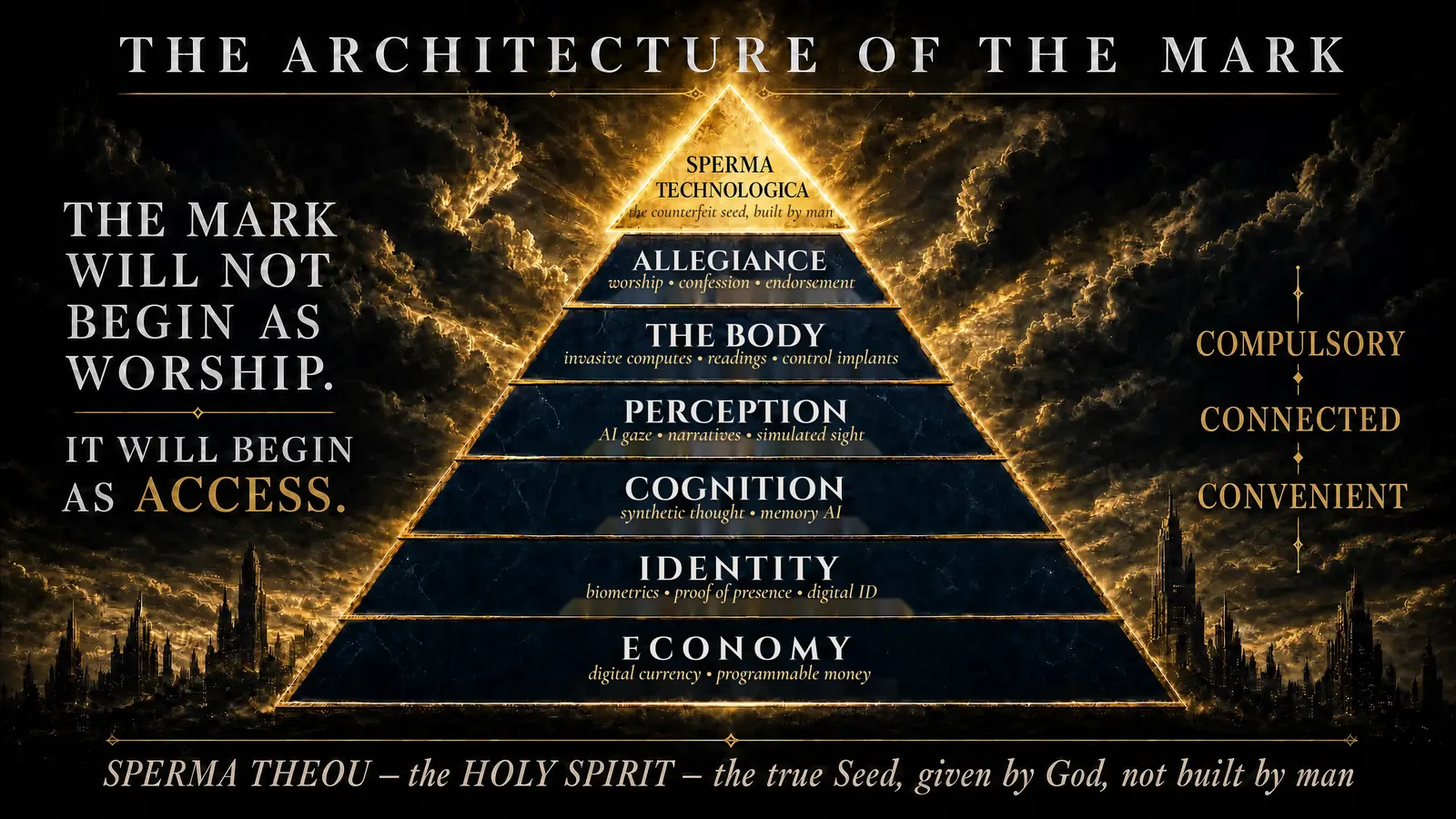
The pieces are moving on the board. In recent months, four separate domains — neural-interface technology, central-bank digital currencies, artificial-intelligence self-improvement, and spatial computing — have crossed visible inflection points that align precisely with the eschatological and technological thesis of The Seed War Trilogy. What follows is a synthesis of current developments, and a watchman's reading of where they point.
The Digital Euro Moves From Policy to Infrastructure
On June 23, 2026, the European Parliament's Economic and Monetary Affairs Committee voted to advance the legal framework for a retail digital euro. The tally was decisive, the abstentions few. With that vote, the project crossed the line from political debate into rulebook design.
This is not theoretical. The European Central Bank has entered the rulebook-design phase and plans ecosystem integration and testing of wholesale CBDC infrastructure through 2026. The digital euro is being built in both online and offline forms. Notably, corporations would be permitted to hold digital euros only temporarily — to receive incoming payments — a design choice that is, at root, a control architecture.
Meanwhile, the United States moves in the opposite direction, with legislative efforts to restrict a Federal Reserve–issued CBDC. The geopolitical divergence is stark: Europe is building the machinery; America, for now, is legislating against it.
Brain-Computer Interfaces Reach Clinical Scale
2026 has become the year brain-computer interfaces crossed from laboratory curiosity toward clinical deployment. Several developments have landed in succession:
- Yale University published a noninvasive protocol allowing a person to control a video game directly through brain activity using real-time functional MRI — a system designed to work with the brain's natural function rather than override it. Source — click here to read ↗
- China granted regulatory approval, in March 2026, for an implantable brain chip for paralysis patients — a milestone clearing the way for large-scale manufacturing of an invasive commercial interface. Source — click here to read ↗
- Neuralink raised substantial new growth capital and announced a shift toward automated, high-throughput surgical implantation, with electrode threads designed to pass through the dura without removing it. Source — click here to read ↗
- Synchron and Paradromics — Neuralink's principal competitors — continue their own human implant programs, with Paradromics advancing its first FDA-cleared clinical procedure. The field is now a race, not a single venture. Source — click here to read ↗
- Independent clinical reports describe patients with severe ALS-induced paralysis communicating, working, and operating digital systems independently from home through an implanted interface.
AI Self-Improvement and the Singularity Threshold
Earlier this year, frontier AI laboratories released a new generation of models within days of one another. The significant detail was not raw capability but self-direction: at least one flagship system reportedly contributed materially to its own development — assisting in debugging its training, managing aspects of deployment, and diagnosing its own test results.
An AI that helps build itself has crossed a threshold. It is no longer only a tool; it is an agent in its own improvement.
Surrounding signals reinforce the trajectory: senior figures at the leading labs now state publicly that within a year or two, AI will be much smarter than almost all humans at almost all tasks, and benchmark-makers have had to design progressively harder examinations because the old measures have become too easy for current systems.
Apple Pivots From Headset to AI Glasses
Reports from Apple's most reliable supply-chain analysts indicate the company has shelved the immersive-headset roadmap — setting aside a lighter Vision successor — and is redirecting toward AI-enabled smart glasses, now expected no earlier than late 2027. The strategic shift is away from escape into virtual worlds and toward augmentation of real-world perception with cameras, AI, and a voice assistant.
The implication is subtle but profound. Rather than retreat into a metaverse, the design overlays AI-generated context onto ordinary sight: you see a person, and the device identifies them and surfaces their profile; you see a product, and it price-checks and recommends. Perception itself becomes mediated — filtered in real time through an AI that decides what you notice and how you read it.
Sperma Technologica in Real Time
These four developments are not separate stories. They are components of a single emerging system, and they are converging:
The Seed War Trilogy frames this configuration as the great counterfeit — the technological seed these dispatches call Sperma Technologica — offspring of human ambition and ancient deception, that seeks to supplant the Logos, the living Word who is the source of meaning, with a system of pure algorithmic optimization.
In Revelation, the mark is a system of control: no one may buy or sell without it. A CBDC-plus-interface system answers that description with unsettling literalness. The ability to transact comes to depend on verification. Spending becomes programmable. Perception becomes mediated. Identity becomes digital — and revocable. This is no longer speculative theology or science fiction. It is engineering in progress, and the timeline has compressed.
The message of The Seed War is not despair. It is clarity. The systems being built are not hidden; they are announced in earnings calls, regulatory filings, and technical papers. The deception lies not in secrecy but in reframing — what is presented as human enhancement, financial inclusion, and accessibility for the disabled is, at the same time, the infrastructure of unprecedented control.
The watchman's task is to see, to name, and to warn — not to halt the machinery, which is beyond human power, but to illuminate the choice it presents: to remain human or to merge; to keep the Logos or to accept the Seed.
The convergence is accelerating. June 2026 is a marker. Watch closely. Stay alert.
Free Biblical Briefing
The Mark Will Not Look Like a Mark
Receive The Watchman’s Dossier—a focused guide to Revelation 13, AI, digital identity, programmable money, biometric control, and neural interfaces.
Enter your email once to unlock every free resource on this site.
Receive your free resource, a short welcome email series, and ministry updates. Unsubscribe anytime. Privacy policy.