
Begin with the Bible’s own vocabulary
“Hell” is one English word.
Scripture gives us several.
The Bible’s picture becomes clearer when we stop forcing every passage into one undifferentiated idea. The terms name different stages, different occupants, and different aspects of judgment. Confusing them produces caricature. Distinguishing them produces sobriety.
Biblical words associated with Hell
Sheol
The realm of the dead in the Old Testament—the graveward destination spoken of before the final resurrection and judgment.
Hades
The interim custody of the dead. Revelation says Hades itself is finally emptied and cast into the Lake of Fire.
Gehenna
His principal word for final punishment, carrying the history of the Valley of Hinnom and its terrible associations.
Tartarus
Peter’s term for the confinement of certain fallen angels awaiting judgment—not the ordinary destination of human souls.
The Lake of Fire
The “second death” after the Great White Throne: the final, irreversible state described in Revelation 20.
The order of judgment
From death to the second death
The treatise separates the intermediate state from final judgment. The biblical sequence is more deliberate—and more morally exact—than the popular image of a soul simply falling into a generic underworld.
- Death
The body dies; personal existence continues before God.
- Hades
An interim state of custody, awaiting resurrection and judgment.
- Resurrection of the unjust
The dead stand bodily before the Great White Throne.
- The books are opened
Works are exposed; the Book of Life answers the question of belonging.
- The second death
Final judgment is executed in the Lake of Fire.
- Outside the City
Revelation’s final geography places the redeemed within and the unrepentant outside.
A question many studies avoid
Are there degrees of punishment in Hell?
Yes—the words of Jesus point to measured judgment. He spoke of servants receiving “many” or “few” stripes according to knowledge and responsibility (Luke 12:47–48). He said it would be “more tolerable” for some cities than for others (Matthew 11:20–24), warned of “greater condemnation” (Mark 12:40), and identified “greater sin” (John 19:11).
The Book of Life answers where a person belongs. The opened books answer how perfect justice is rendered. No sin is exaggerated. No secret is missed. No sentence is careless.
Few stripes.
for some.
condemnation.
The geography of distance
The Throne is the center.
Evil is driven outward.
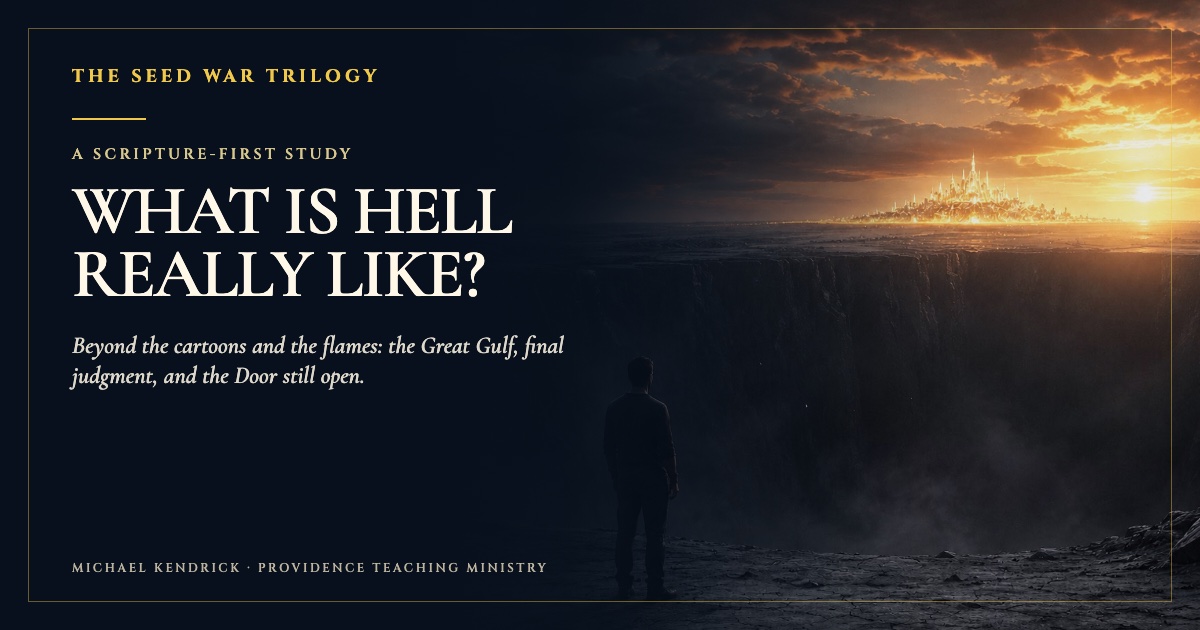
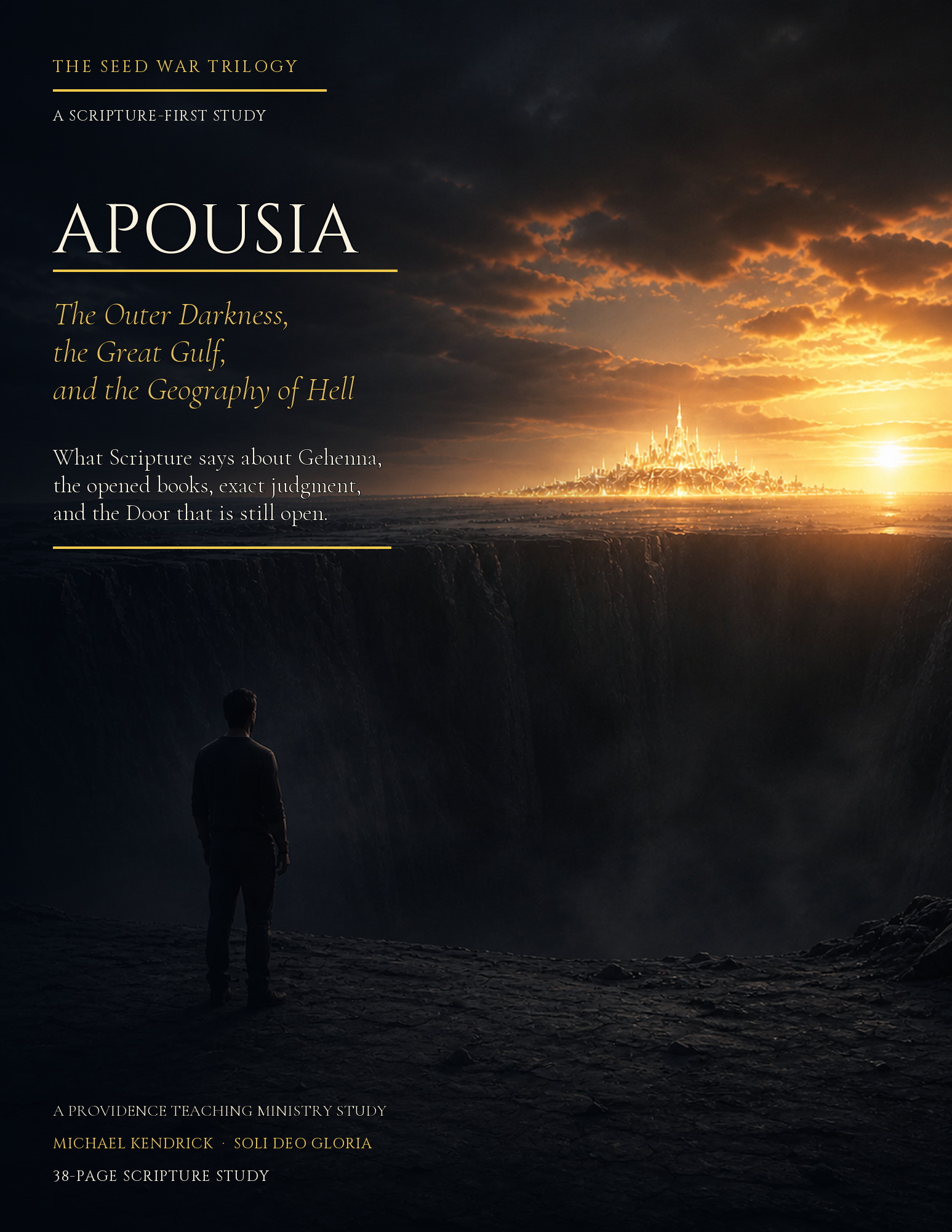
Jesus described a “great gulf fixed” that no one could cross (Luke 16:26). He also spoke of people seeing the kingdom of God while being cast out (Luke 13:28), and Revelation closes with the Holy City filled by God’s Presence while everything unclean remains outside.
Apousia draws these passages together as concentric distance: not because Scripture supplies a cartographer’s diagram, but because it repeatedly makes nearness to God the center of blessedness and exclusion from His fellowship the essence of loss.
Who goes to Hell?
The books reveal works.
The Book reveals belonging.
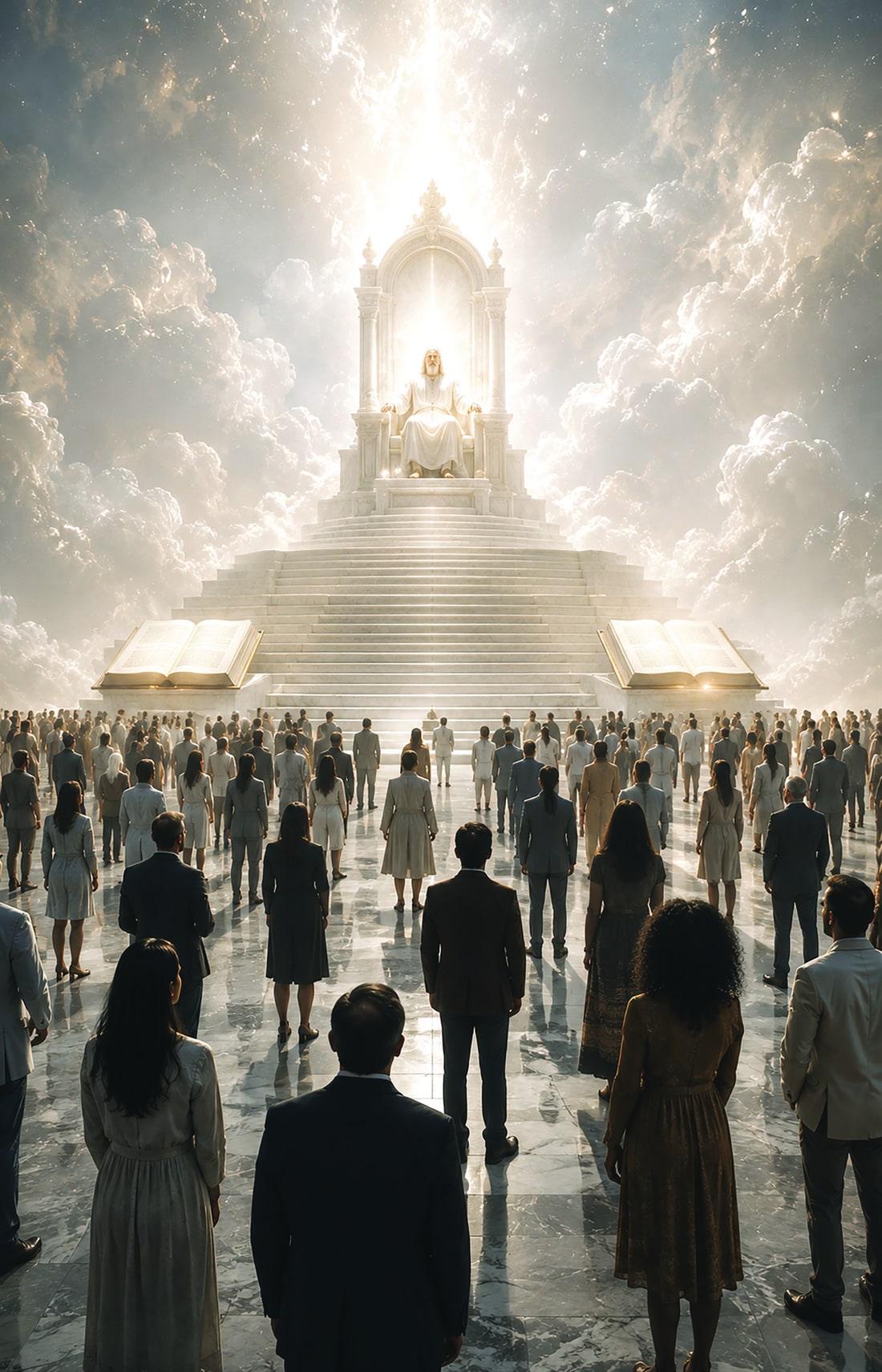
At the Great White Throne, “books” are opened and the dead are judged according to their works. Then another Book is opened: the Book of Life (Revelation 20:12–15). Scripture presents a judgment that is at once public, personal, evidential, and exact.
No one is condemned because God lacks information. No one is saved by comparing favorably with a neighbor. The gospel’s center is not self-improvement but union with Christ—the One who bears judgment and gives His own life to those who trust Him.
The deepest inversion
Satan is not Hell’s king.
He is its furthest inmate.
Popular imagination gives the devil a throne below. Scripture gives him a sentence. The everlasting fire was “prepared for the devil and his angels” (Matthew 25:41). Evil does not build a rival kingdom. It is finally stripped of borrowed power and exiled from the Presence it tried to counterfeit.
Questions honest readers ask
No slogans. No evasions.
What is Hell like according to the Bible?
Scripture uses several images—fire, darkness, exclusion, shame, destruction, a fixed gulf. They are not cartoon scenery. Together they describe irreversible judgment, the loss of God’s covenant fellowship, conscious awareness, and a sentence exactly fitted to truth.
Are Sheol, Hades, Gehenna, and the Lake of Fire the same?
No. Sheol and Hades usually describe the realm or custody of the dead. Gehenna is Jesus’ leading term for final punishment. Tartarus describes confinement for certain fallen angels. The Lake of Fire follows final judgment and is called the second death.
Is Hell eternal—or does the lost soul cease to exist?
The historic Christian reading understands final punishment as conscious and everlasting. Annihilationist readers emphasize language of death and destruction. The full treatise treats that view seriously, then explains why Jesus’ parallel language of eternal punishment and eternal life, together with Revelation’s imagery, supports the historic reading.
How can a loving God judge anyone forever?
Love does not require God to call cruelty harmless or rebellion freedom. Biblical judgment is the final vindication of truth and the oppressed. Yet the Judge is also the One who entered our darkness in Christ and paid the cost of reconciliation. The cross forbids both a sentimental view of evil and a cold view of God.
What about those who never heard the gospel?
Scripture insists that God judges impartially, according to the light and responsibility actually received, and that the Judge of all the earth will do right. It also insists that the gospel must be carried to every people. Mystery is not permission for indifference; it is a summons to mission.
Is preaching about Hell just fear-mongering?
It can be—when terror is used to manipulate, spectacle replaces Scripture, or the preacher enjoys the warning. Jesus spoke of judgment because love tells the truth about danger and points to rescue. Faithful teaching should leave a reader sober, not fascinated with pain—and looking toward Christ, not toward a preacher.
The Door Out
The gulf is not yet fixed.
The Door is still a door.
At the cross, Christ entered the darkness sin deserves. The One who had always lived in the Father’s fellowship cried, “Why have You forsaken Me?” so that those who were far off could be brought near (Ephesians 2:13).
The Father is waiting. Christ has made the way. Home is still being offered.
Read the complete treatise
Apousia: The Geography of Hell
Get all 38 pages, the complete Scripture corpus, the chronology of judgment, five hard questions, and selected sources.
Enter your email once to unlock every free resource on this site.
Receive your free resource, a short welcome email series, and ministry updates. Unsubscribe anytime. Privacy policy.
Free access plus occasional ministry emails. Unsubscribe any time. Privacy.