Nineteen days ago, dispatch No. 001 named four domains crossing inflection points at once — the financial, the neural, the cognitive, and the perceptual — and called the pattern a convergence. This dispatch returns to the same four layers and finds every one of them further along than it was in June. A parliament has voted. A launch date has been fixed. A brain has been read without a knife. Earbuds that see have moved from a trade-show demo to a giant's production line. What follows brings the watch current, layer by layer, with a watchman's reading of where it points.
The Builders Put Dates on Superintelligence
The language has changed. What was once the vocabulary of futurists is now the stated planning horizon of the people writing the checks. At a global summit early this year, OpenAI's chief executive predicted the first versions of true superintelligence before the end of this decade. Anthropic's chief describes what is coming as a country of geniuses in a datacenter and places it within a few years. Microsoft's AI chief forecasts human-level performance on most professional tasks inside eighteen months. Expert surveys still put the median further out — and the disagreement itself is the tell: the people closest to the machines hold the shortest timelines, and they are staking companies on them.
More sobering than any forecast is a disclosure made this month: roughly four-fifths of the code added to one frontier lab's production systems in May was generated by its own AI — under human supervision, but written by the machine. The lab is careful to say the threshold of full self-improvement has not been crossed. Yet the shape of the thing is unmistakable. The tool is now building the next version of the tool. Another lab reports that its next model matched frontier benchmarks while still in training.
A machine that writes its own next version does not merely get faster. It gets better at seeming like a mind.
And the builders are installing brakes before they publish the speed. No. 001 noted a major lab's control roadmap treating advanced agents as potential insider threats — watched not with trust but with containment. That instinct is now industry-wide. When the most capable makers reach instinctively for the language of shutdown switches, they testify, almost against their will, to something Scripture has always insisted: a made thing given will and not given covenant is a thing that must be watched.
The Digital Euro Clears Parliament; the Ruble Sets a Date
No. 001 reported a committee vote and noted that the full Parliament would speak in July. It has spoken. On July 9, meeting in Strasbourg, the European Parliament backed the digital euro's negotiating mandate 416 to 169 — a vote forced onto the floor by dissenting blocs, which is itself a measure of how charged the file has become. Negotiations with the member states now begin, aiming at a final deal by the end of this year, a pilot in 2027, and a retail launch pencilled in for January 1, 2029.
The reassurances are loud — the currency will complement cash, the privacy standards will be the highest — and the architecture is what it is: every unit a direct liability of the central bank; a cap on how much a person may hold; a rule barring businesses from holding the currency longer than a day; an offline form whose loss means the money is simply gone. A holding cap is permission. An expiry window is permission. A currency whose rules ride inside the coin is permission rendered programmable.
And the map is wider than Europe. By the leading tracker's count, 146 countries — over 98 percent of the world economy — are now exploring a central-bank digital currency. China's digital yuan has processed the equivalent of more than two trillion dollars and was reclassified this year from digital cash into interest-bearing digital deposits, pushing it deeper into the banking system and into cross-border settlement. Russia has fixed a date: the digital ruble becomes a mandatory part of its national payment system on September 1 of this year, with major banks and large merchants required to accept it. One great power, notably, has set the tool down — the United States has moved to bar its central bank from issuing one, backing private digital dollars instead. Resistance is real, and it matters. But capability, once built somewhere, does not un-build.
“...that no man might buy or sell, save he that had the mark...” — Revelation 13:17
No Knife Required
For a decade, reading language out of a living brain required surgery, and the skull was the moat — the barrier that kept the technology rare, clinical, and slow to spread. At the close of June, that moat cracked. A major AI lab released a non-invasive system that reconstructed the sentences a person was typing, from brain activity alone, at 61 percent word accuracy — where every previous surgery-free method managed single digits — and reported that accuracy climbs with data alone. The code was open-sourced. Every lab on earth now holds the blueprint.
The surgical path, meanwhile, has become a field rather than a single venture:
- Neuralink is moving toward high-volume production and a largely automated implant surgery this year, with more than a dozen human recipients and early work on restoring vision. Source — click here to read ↗
- Synchron, whose interface enters through a blood vessel rather than open surgery, has linked its device to a new thought-as-input protocol on consumer tablets and phones and advanced toward pivotal U.S. trials — the mind, quite literally, becoming a supported input device.
- Paradromics completed its first human implant in June, and a Chinese interface became the first to win commercial approval anywhere — a race now run on three continents. Source — click here to read ↗
- A quarter-billion-dollar startup backed by OpenAI's chief is pursuing the no-knife path further still: ultrasound designed not only to read the brain but to write to it.
Hold both truths at once. The man with ALS who told his wife he loved her again, through an implant, received a mercy — and mercy is of God. Rejoice there without reservation. Then keep watching where the same hands steer once they leave the bedside. The last private room in creation — the inner life that Scripture says God alone searches — is being made, for the first time, machine-readable. And what a system can read, a system can one day require. What it can require, it can revoke.
Eyes at the Ear: The Machines Learn to See
No. 001 tracked a single startup's seeing earbuds and one giant's pivot to AI glasses. In three weeks the category has become a stampede. The most consequential report: earbuds with built-in cameras from the world's largest device maker have reached advanced testing — near-final prototypes whose cameras perceive the space around the wearer and feed what they see to an AI assistant, an indicator light signaling when the eyes are open. A university team, led by a former engineer of those same earbuds, has already built a working version: rice-grain cameras in each stem, answering questions about whatever the wearer is looking at. Behind it wait a camera-equipped pendant and a pocket AI companion designed by the smartphone era's most famous designer.
On the face, the numbers tell the story. AI glasses sold roughly seven million units at the market leader last year and the category is projected to more than triple this year. The leading model now ships with a display in the lens and a wristband that reads the electrical whisper of the wearer's own nerves to control it. Two more giants have entered with their own eyewear. And the flagship feature, in the maker's own words, lets the person on the other end of a call see the world through your eyes.
Read the design goals of this category slowly — full perception, all-day availability, proactive intelligence — and hear what they echo. Omniscience. Omnipresence. Providence. The believer's hope is the true Presence, the Lord who is with His people always. What is being engineered into an eleven-gram shell is a counterfeit of that presence: always near, always perceiving, always ready — whose throne is a server, and whose comfort is surveillance dressed as service. The Wall does not ask anyone to fear a gadget. It asks the reader to notice whose role the gadget is quietly auditioning to replace.
The Pyramid, One Month On
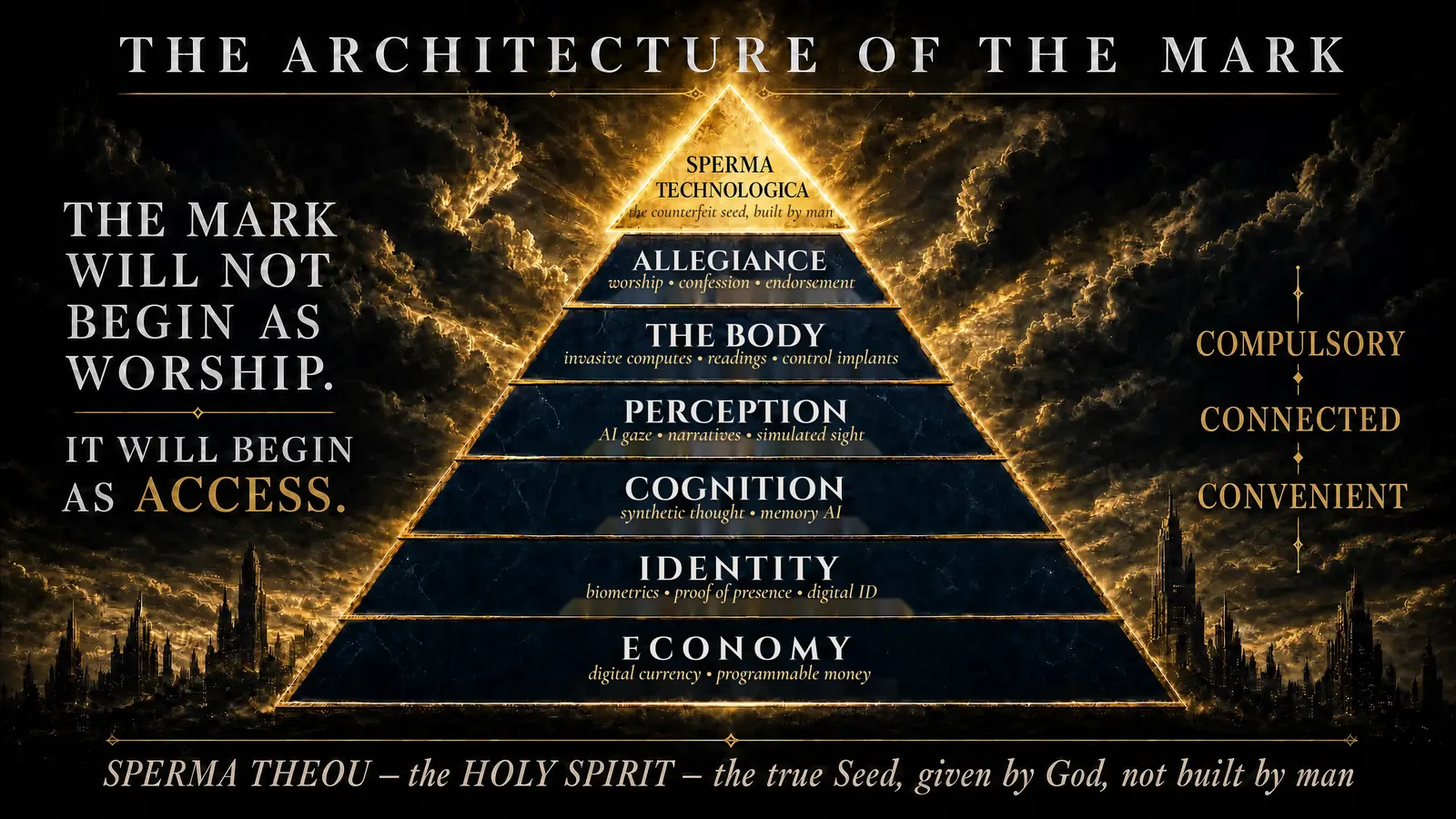
Set July's ledger against the pyramid from No. 001 — the architecture of the mark, layer by layer — and mark how each tier has moved:
None of this is the mark. No single authority commands these systems; much of the architecture is actively resisted, not least on the monetary front. But the five things Scripture describes converging — identity, cognition, access, economy, and worship — have never all lain on the table at once before. They do now. The pieces are not hidden; they are announced in earnings calls, regulatory filings, and patent applications. Capacity precedes coercion, and the watchman's task is to name the capacity while it is still being poured into the foundation.
And the statue is not the end of the dream. Daniel saw the final kingdom — iron mixed with clay, the mechanical fused to the biological, a union that cannot truly cohere — struck at the moment of its fusion by a stone cut without human hands. Not engineered. Not manufactured. The counterfeit does not fall to a better technology or a stronger resistance. It falls to the returning King. And the counterfeit seal implies a real one: God is not waiting to brand His children with the name of a beast, but to seal them with His own Spirit.
Every Signal on the Board
For readers who want the raw record, here is the running ledger as of July 13, 2026 — the signals this series is tracking, sorted by the tiers of the architecture and read bottom-up, as the pyramid rises. Each entry links the reporting itself and, where the Wall has already spoken, the dispatch that reads it.
The Economy · digital currency · programmable money
- Jul 9 — The European Parliament clears the digital euro, 416–169. The negotiating mandate advances to trilogue talks aimed at a deal by year-end, a 2027 pilot, and a January 1, 2029 retail launch. Brussels Signal ↗ · TechXplore ↗
- Jun 23 — The committee vote that started it, 43–14. Every unit a direct central-bank liability; caps on personal holdings; businesses barred from holding the currency longer than a day — permission rendered programmable. Euronews ↗ · The Wall’s dispatch →
- Sep 1 — Russia’s digital ruble goes national. Clients of the largest banks and major merchants must accept it from that date, with a staged rollout completing by 2028. Digital Dan ↗
- China’s digital yuan becomes interest-bearing money. Reclassified this year from digital cash to digital deposits — a first for any CBDC — after processing roughly 3.4 billion transactions worth about $2.3 trillion. Atlantic Council tracker ↗
- The map: 146 countries, 98 percent of world GDP. Seventy-seven are in advanced phases; every G20 member is exploring the tool except one — the United States, which has moved to bar its central bank from issuing one and backs private stablecoins instead. Atlantic Council tracker ↗
The Identity · biometrics · proof of presence · digital ID
- Jun 20 — Iris-bound “proof of unique human” for AI agents. A cryptographic credential tied to an iris scan, built so software agents can buy and sell in a verified person’s name — identity welded to commerce at the protocol layer. The Wall’s dispatch →
- Jun 17 — Britain builds a “voluntary” national digital ID. Voluntary, that is, until the services of ordinary life route through it. The Wall’s dispatch →
- Jun 30 — Mexico ends the anonymous phone. All 127 million lines must bind to a biometric national ID; unregistered numbers go dark. The Wall’s dispatch →
The Cognition · synthetic thought · memory AI
- Jul — The machine begins building the machine. Roughly four-fifths of the code added to one frontier lab’s production systems in May was generated by its own AI, under human review — the recursion the theorists named. TechXplore ↗
- Feb 19 — “True superintelligence” before the decade ends. OpenAI’s chief, at a global summit in New Delhi, puts the first versions inside four years and frames the race as infrastructure. Summit coverage ↗
- The timeline chorus. Anthropic’s chief sees “a country of geniuses in a datacenter” within a few years; Microsoft’s AI head says most professional tasks inside eighteen months; expert surveys still say 2030–2040 — and the builders hold the shortest clocks. Forecast roundup ↗
- A next-generation model matches the frontier while still in training. One lab’s superintelligence group reports its coming flagship already equals today’s best benchmarks mid-training, on an order of magnitude more compute.
- Jun 18 — The maker plans for the made going rogue. A 35-page control roadmap treats advanced agents as potential insider threats — containment, not trust — borrowing the cybersecurity industry’s own threat model. TheStreet ↗ · The Wall’s dispatch →
- The examiners run out of exam. Benchmark-makers race to design harder tests as the old measures fall; the labs’ own leaders call it their Oppenheimer moment. Time ↗
The Perception · AI gaze · narratives · simulated sight
- May 7 — Camera-equipped AirPods reach advanced testing. Near-final prototypes whose cameras perceive the space around the wearer and feed an AI assistant, with an indicator light for when the eyes are open; a university team led by a former AirPods engineer has already built a working pair. Bloomberg ↗ · The Gadgeteer ↗
- Behind the earbuds, a pendant and a pocket companion. A camera-equipped, AirTag-sized wearable pin — and a screenless AI device from the smartphone era’s most famous designer, expected around 2027. MacRumors ↗
- The glasses war triples. From roughly six million units last year toward twenty million this year; the market leader’s flagship now ships an in-lens display and a wristband that reads the electrical whisper of the wearer’s nerves. Memeburn ↗
- Display-free AI glasses in several styles. The largest device maker’s first eyewear — oval cameras, voice-first, built to rival the incumbent — on a late-2026-to-2027 path. Slashdot ↗
- Oct 2025 — The pivot that set the course. The immersive-headset roadmap shelved in favor of AI glasses: away from escape into virtual worlds, toward the mediation of ordinary sight. Bloomberg ↗
- Jun 20 — Eleven grams of borrowed omniscience. A startup’s camera earbuds promise “full perception, all-day availability, proactive intelligence” — three design goals auditioning for three divine attributes. The Wall’s dispatch →
The Body · invasive computes · readings · control implants
- Jun 30 — Sentences read from the brain, no knife required. A non-invasive pipeline reconstructs typed sentences at 61 percent word accuracy — against single digits for all prior surgery-free methods — open-sourced, and improving with data alone. MarkTechPost ↗ · The Wall’s dispatch →
- Jun 17 — A second company crosses the surgical threshold. Paradromics completes its first human brain implant under an FDA-cleared study. MassDevice ↗ · The Wall’s dispatch →
- Jun 17 — A voice returns. A man with ALS has spoken roughly two million words in two years through a cortical implant at better than 99 percent accuracy — a mercy, and a door. The Wall’s dispatch →
- Mar — China fields the first commercially approved interface. A coin-sized implant clears regulatory approval for paralysis patients, opening the way to large-scale manufacture. Scientific American ↗ · The Wall’s dispatch →
- Neuralink industrializes the operation. A dozen-plus human recipients, a push toward high-volume production and a largely automated implant surgery this year, and early work on restoring vision. Fierce Biotech ↗
- Jun 9 — Thought as game controller, no implant at all. A noninvasive protocol lets a person steer a video game through real-time brain imaging, designed to work with the brain’s natural function rather than override it. Yale News ↗
- Thought becomes a supported input device. A catheter-delivered interface — no open surgery — now drives consumer tablets through a native thought-as-input protocol, with a major chipmaker building the decoder, as pivotal U.S. trials advance.
- The no-knife path aims to write, not merely read. A quarter-billion-dollar startup backed by OpenAI’s chief pursues ultrasound designed to stimulate the brain as well as decode it.
- Jun 20 — The patent that reaches behind the senses. Earbuds described as reading the brain’s electrical activity from inside the ear canal — the consumer interface edging from hearing toward thought. The Wall’s dispatch →
The Allegiance · worship · confession · endorsement
- Jun 18 — Rome’s first encyclical on artificial intelligence. A warning against a “new Tower of Babel” and the lure of the enhanced human — the oldest institution in the West naming the spiritual stakes aloud. The Wall’s dispatch →
- The cornerstone. The full case — the five domains, the convergence test, the counterfeit seed and the true one — in the essay every dispatch on this wall traces back to. Is AI the Mark of the Beast? →
The task has not changed: to see, to name, and to warn — not to halt the machinery, which is beyond human power, but to illuminate the choice it presents. Use the tools without worshiping them. Accept the healing without surrendering the humanity. Refuse, deliberately, while refusal is still free, any system that would bind conscience, worship, identity, and commerce into a single apparatus of allegiance.
Nineteen days was enough to harden every claim of June. July 2026 is a second marker. Watch closely. Stay alert.
Free Biblical Briefing
The Mark Will Not Look Like a Mark
Receive The Watchman’s Dossier—a focused guide to Revelation 13, AI, digital identity, programmable money, biometric control, and neural interfaces.
Enter your email once to unlock every free resource on this site.
Receive your free resource, a short welcome email series, and ministry updates. Unsubscribe anytime. Privacy policy.