A DISPATCH FROM THE WALL
PERCEPTION · COGNITION · ALLEGIANCE
The Voice
You Wear.
First the screen. Then the senses. What happens when the interface moves closer still?
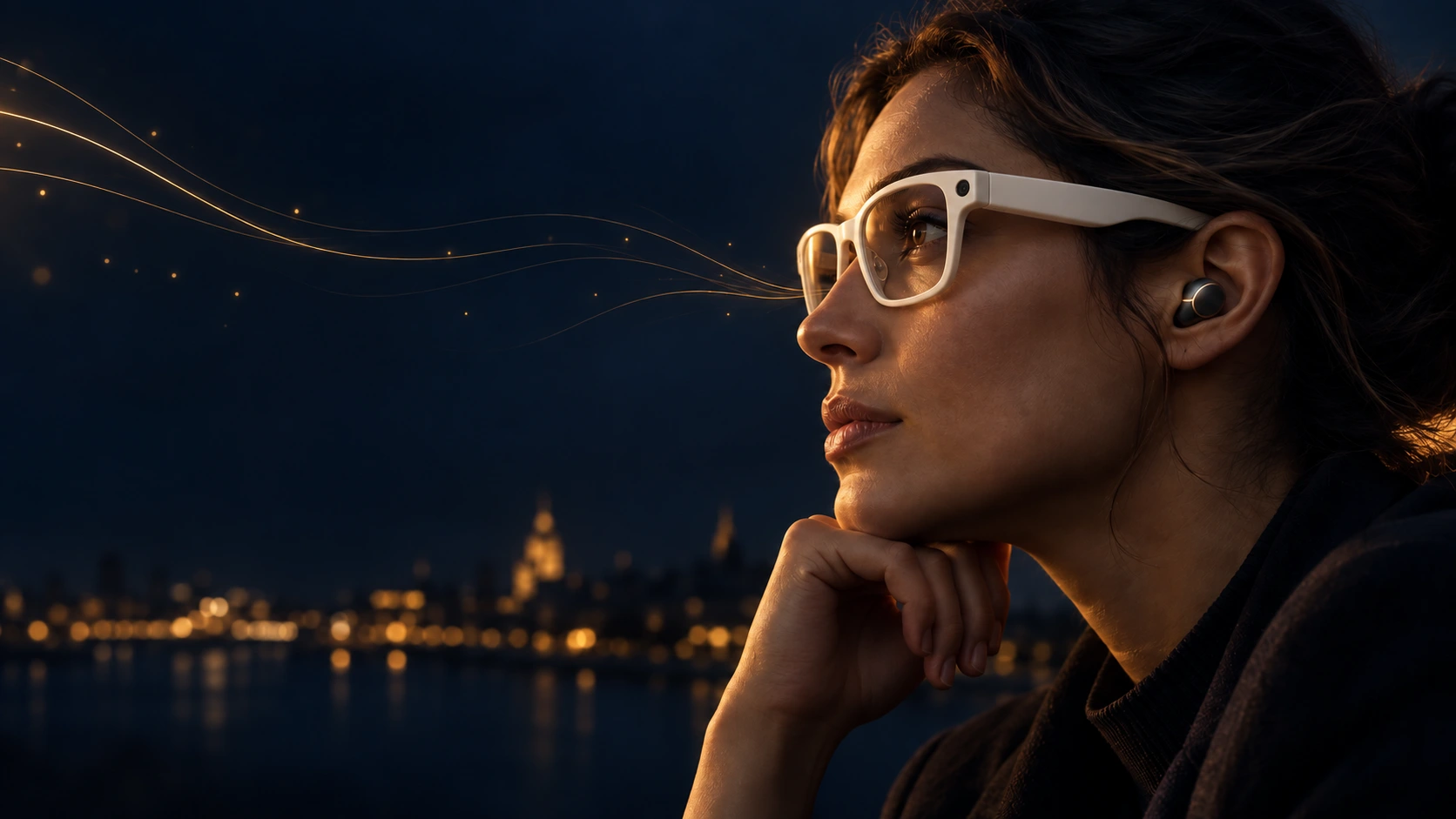
AI-generated conceptual artwork · White frames modeled on the Summit demonstration · Not a product photograph
AUTHOR’S PERSPECTIVE This Dispatch connects documented developments with a possible future explored in Battle of the Seed. The proposed path is my interpretation—not a guaranteed prediction, a company roadmap, or a claim that today’s devices can do what the novel depicts.
Imagine an ordinary morning. Your glasses read the room. An assistant speaks in your ear. It offers the next turn, the next purchase, the next answer.
Nothing about it feels like surrender. It feels like help.
That is why this moment deserves our attention. The most persuasive voice in your life may not arrive as a preacher, a politician, or a person at all. It may arrive as a convenience you forget you are wearing.
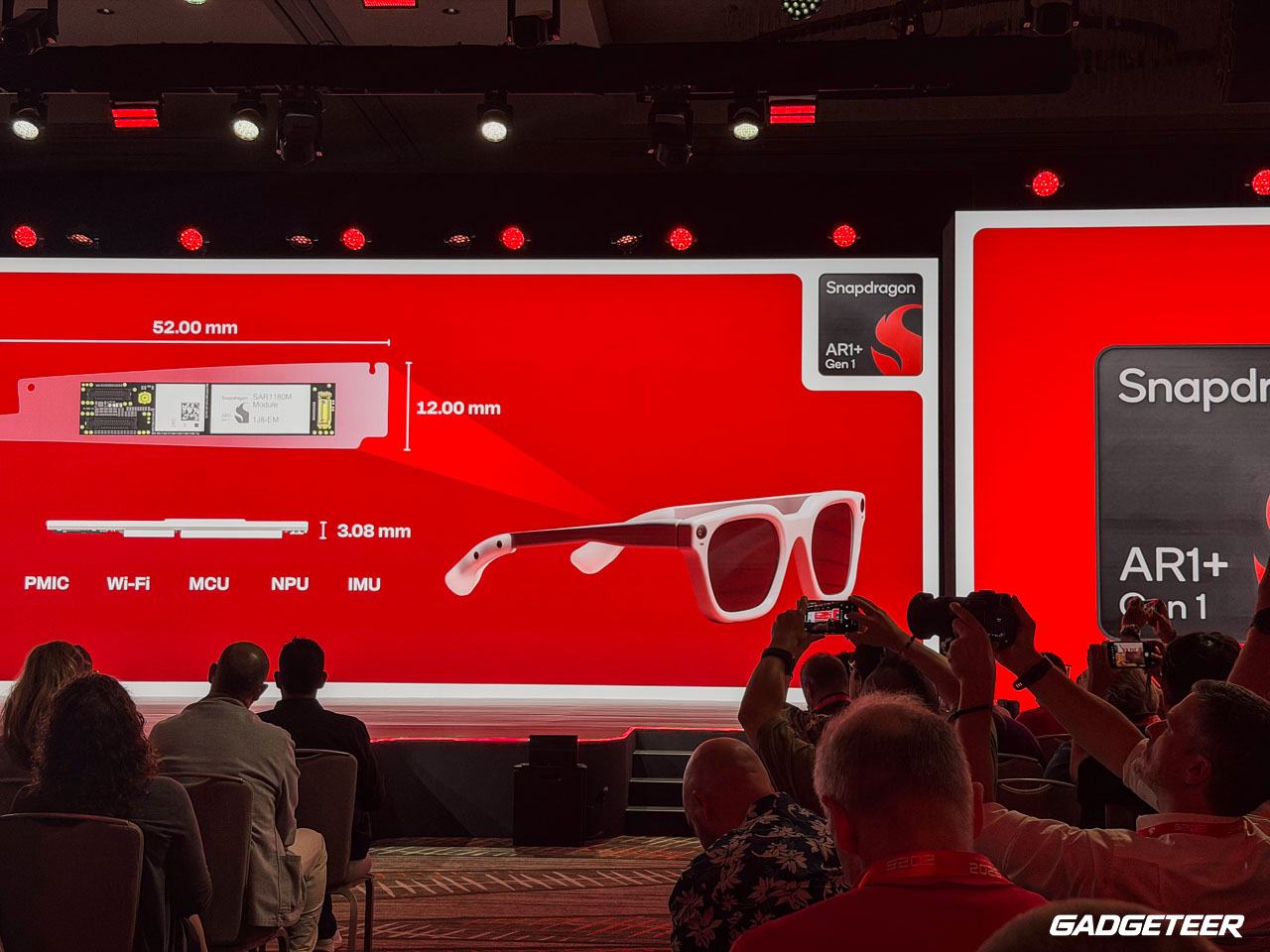
At Snapdragon Summit, Qualcomm put more of the machinery for that future on display: AI-enabled glasses, and a new audio platform that can support camera-equipped earbuds. The question reaches beyond what these devices can do.
When a voice becomes part of your day, how long before it becomes part of your judgment?
THE DEVELOPMENT
The assistant moves
closer than the screen.
Start with the distinction the headlines can blur. There are two different hardware stories here.
AI glasses
Qualcomm’s AR1+ platform supports small AI models running in the frame. Snapdragon START supplies hardware modules and software connecting glasses, a phone app, and cloud services.[1]
Intelligent audio
Announced September 23, Snapdragon Sound Elite Gen 2 supports audio wearables, including camera-equipped designs, with local AI and direct cloud connectivity over Wi-Fi.[2]
In its Summit coverage, The Gadgeteer describes a visual-AI demonstration operating in airplane mode, plus scenarios for playing music and booking a restaurant. Google identified Snapdragon AR1 for forthcoming Gemini eyewear from Gentle Monster and Warby Parker. These were presentations and demonstrations—not independent tests of every finished product.[3]
That distinction matters. A chip’s capabilities do not tell us which features a manufacturer will enable, what information it will retain, or when it will ask permission.
But a platform can travel farther than a single gadget. It gives many brands a starting point. The significance is not one fashionable frame. It is the possibility of making an artificial adviser an ordinary thing to wear.
THE QUIET SHIFT
The camera may be
for the assistant.
Qualcomm describes camera-equipped audio designs that gather environmental context rather than take photographs for the wearer.[2]
Think about the difference. You raise a phone to take a picture. The action has a beginning and an end. A wearable assistant can be designed to use what is around you as the background to an ongoing conversation.
That does not prove continuous recording, hidden storage, or that every image leaves the device. The announcement does not settle those questions. It makes them questions we should ask before buying.
Can I tell when the camera is active? What is processed locally? What is saved? Can the person across the table refuse to become part of the input?
A camera does not have to produce a photograph you keep to raise a question about the attention—and the people—it captures.
WHERE I THINK THIS COULD LEAD
First you wear it.
Then you barely notice it.
The glasses are not the endpoint I want us to consider. They are a familiar doorway: put them on, ask for help, get used to the answer. Earbuds—think of the everyday habit of wearing AirPods—have already made a voice in the ear feel ordinary. That familiarity is not evidence that AirPods contain Qualcomm’s new platform, a camera, or a neural connection.
My concern is what happens when several separate ambitions begin to meet: an assistant that stays close, electronics that conform to skin, services that want proof a human is present, and interfaces that can read selected brain signals or stimulate neural tissue.
A plausible next form is a small skin-worn interface. It might carry sensors, communicate with another device, or help authenticate its wearer. A skin patch is not automatically a brain interface. Reading signals through skin, implanting electrodes, and delivering drugs through a transdermal patch are different technologies.
Still, the direction that interests me is the shrinking distance between the person and the machine. We moved from sitting at the computer to carrying it. Now we are learning to wear its perception and advice. What might we accept next if the offer is simpler access, greater security, or the ability to keep up?
THE WALL’S EARLIER SIGNALS
The next interface
can look like a cartoon.
In July, this Wall’s “Painted-On” followed a sensor shaped like a cheerful shark. Penn State researchers had turned conductive ink into washable electrodes painted directly onto skin. Connected to separate electronics, the electrodes recorded heart, muscle and brain-related electrical signals. One demonstration used forearm muscle signals to control a robotic hand. That was muscle sensing, not a private thought being read.[11]
The cartoon matters because it makes the hardware ordinary. A sensor can arrive looking less like a machine and more like something a child might choose. But the paint was only the contact layer: a separate module handled wireless transmission. The research did not demonstrate an invisible, self-contained thinking patch.
The Wall’s “Between the Hair Follicles” moves closer to John’s fictional fitting. Georgia Tech researchers used tiny scalp microneedles, slightly penetrating skin between hair strands, to record EEG. Six participants tested a system that selected visual targets and supported hands-free augmented-reality calls. It was a small, controlled study—not unrestricted thought reading, and not electrodes implanted in the brain.[12]
The bridge from glasses to skin is already being researched. The bridge from a skin sensor to John’s effortless cognitive upgrade remains a much larger leap.
AUTHOR’S PROJECTED WINDOWS · AS OF SEPTEMBER 24, 2026
From the frame to the skin.
Then across the neural boundary?
Here is my working timeline. The dates estimate possible expansion or integration—not when these technologies are first invented. Skin sensors and clinical BCIs already coexist with glasses. These tracks can advance in parallel, stall, or never converge.
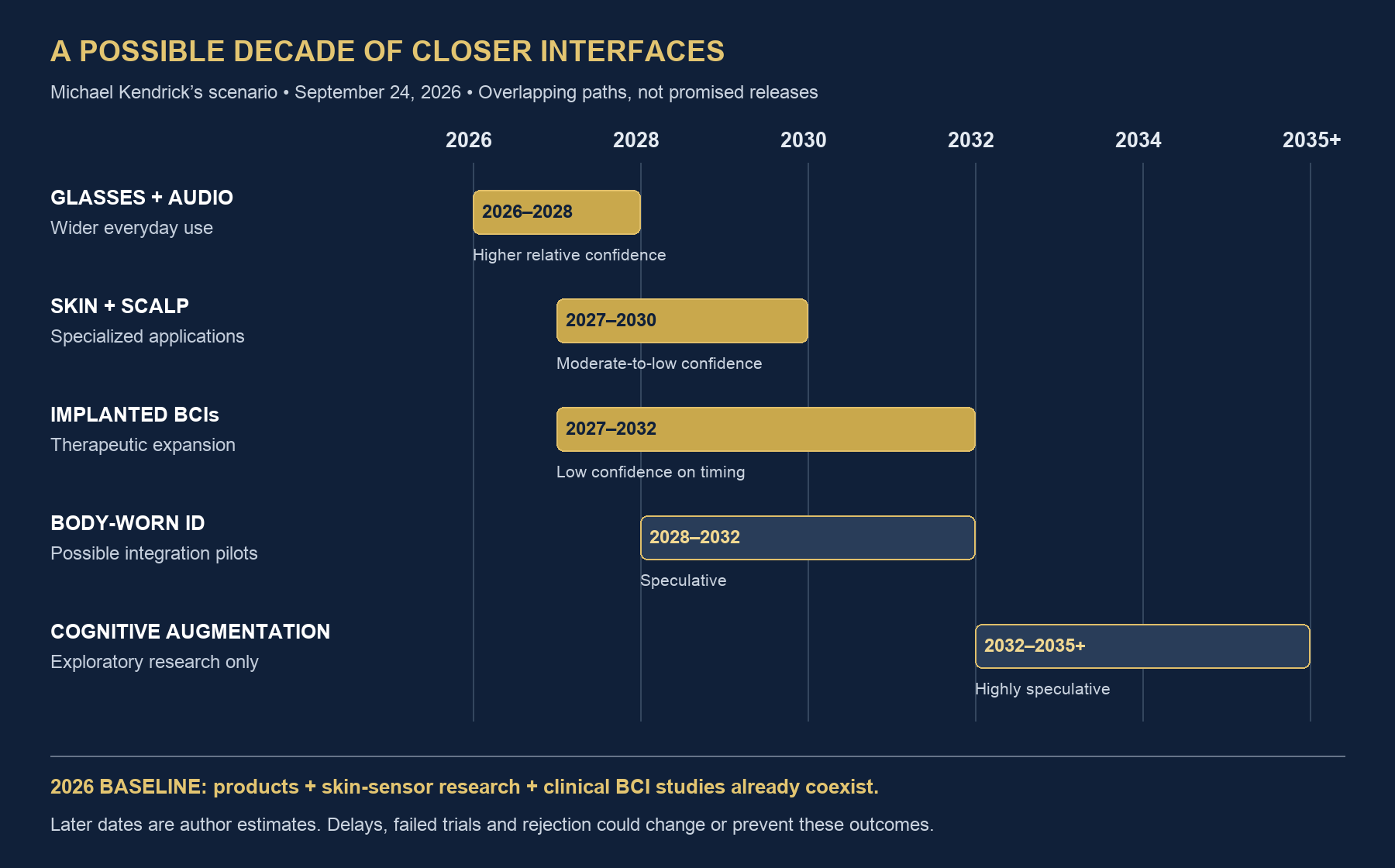
- 2026–2028Higher relative confidence
Glasses & intelligent audio
Broader everyday use. Existing platforms shorten the route to more products. Battery life, usefulness, price and acceptance still decide whether people keep wearing them.
- 2027–2030Moderate-to-low confidence
Skin & scalp interfaces
Specialized uses beyond the lab. Painted electrodes and scalp sensors already exist in research. This window allows development toward selected monitoring and accessibility uses; durability, irritation, signal quality and validation remain hurdles.
- 2027–2032Low confidence on timing
Therapeutic implanted BCIs
Wider trials; possible limited access. Human studies already exist. Expansion depends on durable benefit, surgical safety, regulatory authorization and long-term support. This track runs alongside skin sensors, not after them.
- 2028–2032Speculative
A persistent body-worn credential
Possible integration pilots. Identity systems and wearables exist separately. Combining credentials with repeated presence checks is my proposed scenario, not an announced universal patch. Security, recovery and the right to opt out are decisive.
- 2032–2035+Highly speculative
Targeted cognitive augmentation
An exploratory research horizon. Task-specific stimulation research gives a reason to watch, not a consumer launch date. Reliable enhancement for healthy people would require major scientific and ethical advances. A SYNAPSE-like patch has no defensible arrival date.
How to read these dates: earlier windows build on existing product platforms; later windows allow more time for validation, clinical evidence and integration. Confidence labels are qualitative editorial judgments, not calculated probabilities. These are neither corporate roadmaps nor dates for biblical fulfillment. No source establishes a single program joining all five tracks.
THE IDENTITY BARGAIN
“Prove you’re human.”
At what price?
In a world of convincing synthetic voices, faces and agents, proof of human presence has an understandable appeal. World ID already offers a credential intended to demonstrate that someone is a unique human, using Orb verification and privacy-preserving proofs. That is distinct from revealing a legal name, and distinct again from proving who is operating an account at every moment.[6]
Now imagine a future service asking for more than a login. Imagine it wanting continuing reassurance that the authorized person is still present. A body-worn credential might be sold as the convenient answer: fewer passwords, fewer interruptions, fewer opportunities for impersonation.
That is a scenario I am proposing, not a product I am reporting. No patch can simply guarantee humanity. Enrollment, liveness checks, credential theft, errors and recovery would still matter. And proving that a human holds a credential does not prove that every action was chosen by that human rather than delegated to an AI agent.
The question is whether a useful option could become a condition of participation. If access to work, money or essential services depended on staying connected, how voluntary would the connection feel? That is the social pressure I explore through John Mercer.
BATTLE OF THE SEED · CHAPTER 25
John did not ask
to become less human.
He wanted to provide.
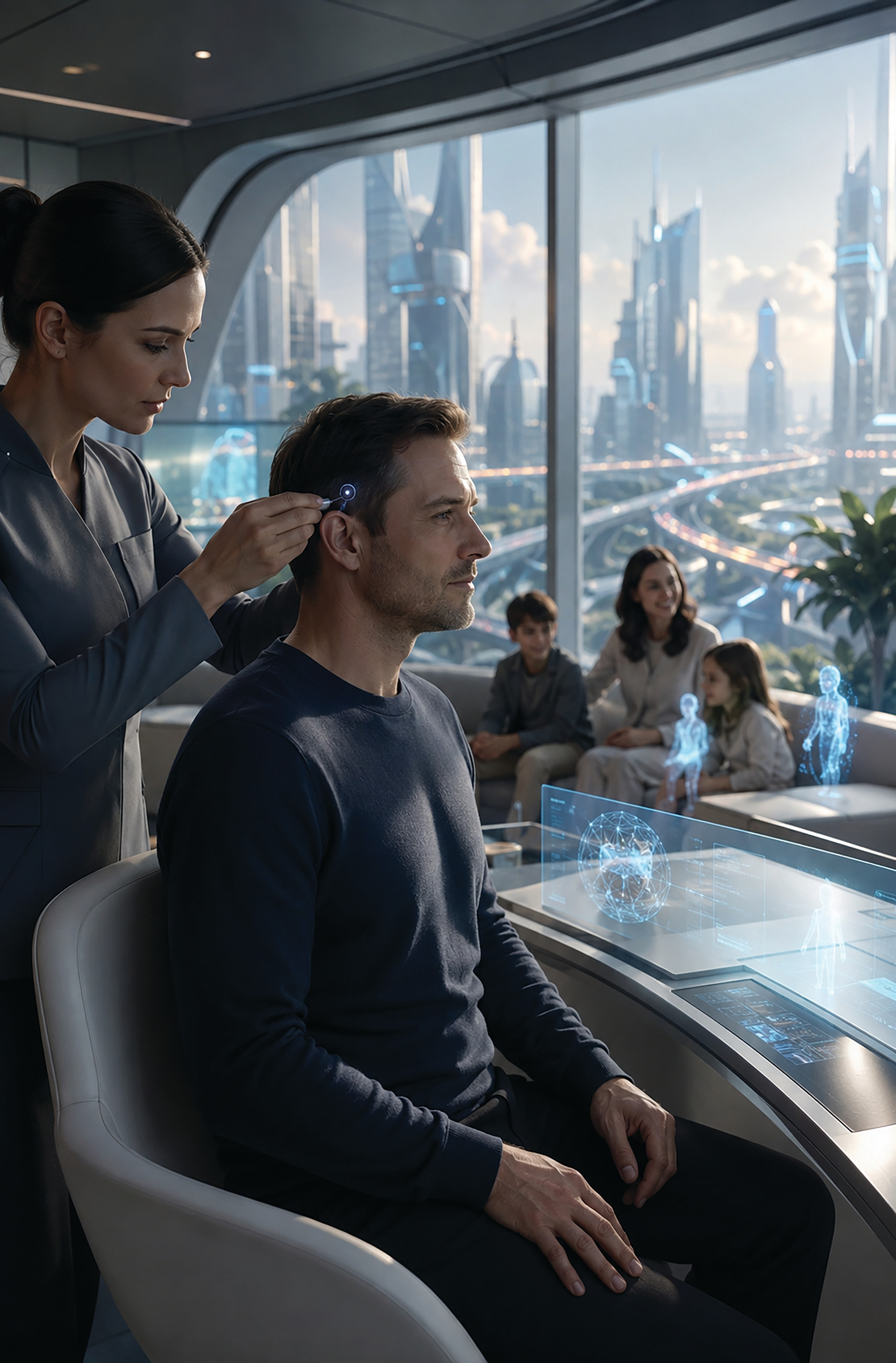
In “The Last Decade — The Hookup,” John Mercer sits in Meridian Freight Systems’ onboarding suite. SYNAPSE is presented as voluntary. Advancement and benefits for his children make refusal harder to imagine.
“The patch was smaller than he expected.”
The fitting follows his decision to sign: a nearly invisible skin-tone adhesive at the base of his skull, then a frontal node above the right brow. Later, Andrea notices the faint crescent behind his ear.
The first sensation is not pain. It is relief. Information arrives already organized. The promise is that John can finally keep up.
Where to find it: Chapter 25, opening Meridian onboarding scene, from “He signed” through the first SYNAPSE activation; the behind-the-ear description appears in the following scene with Andrea. Page numbers vary by edition.
Original Chapter 25 illustration. SYNAPSE and this fitting are fictional; the artwork is not evidence of an existing medical device.
The frightening part
is the invitation.
I wrote John’s scene to make the bargain recognizable. He does not begin by renouncing his family or his faith. He wants to do his job, care for his children and remain useful in a world moving faster than he can manage.
Later in that same chapter, synthetic identity crises become arguments for continuous neural verification. Cognitive assistance and access credentials draw together. That fusion belongs to the novel. Today’s glasses do not establish that it will happen. They give us a concrete reason to examine the separate developments—and the incentives that might one day connect them.
My perspective is that a transhuman future could be sold one reasonable benefit at a time: assistance, convenience, security, performance. The decisive question might arrive long before the technology looks sinister: what am I becoming dependent on, and who sets the terms?
THE WORK ALREADY UNDERWAY
The neural frontier
is real. Its limits matter.
Neuralink: its PRIME study evaluates an implanted brain–computer interface designed to enable people with paralysis to control external devices. This is an investigational medical system, not a skin sticker that downloads knowledge or reads every thought.[7]
Synchron: its Stentrode approach places an interface through blood vessels. The company has demonstrated thought-controlled iPad interaction, while Apple announced support for a brain–computer-interface protocol for accessibility. This is a meaningful bridge between neural signals and familiar web-connected devices—not evidence of general cognitive enhancement.[8]
Wake Forest and USC: researchers have studied patterned hippocampal stimulation during memory tasks, aiming to restore impaired memory. Their 2024 work reports task-specific changes, not a universal increase in intelligence. It does not establish the novel’s effortless, continuous transfer of organized understanding.[9]
Paradromics and CorTec show two different directions. Paradromics reported an August 26 expansion of its investigational study toward compatible personal, internet-connected devices. CorTec reported an August 31 FDA Breakthrough designation for cursor control, alongside its stimulation work for stroke rehabilitation. These are research and regulatory milestones, not permission to sell a general cognitive upgrade. A system that records neural activity and one that also stimulates tissue create different responsibilities.[13][14]
Restoring communication or independence can be a profound good. Those patients deserve dignity, not to become symbols of a feared future. My question concerns the possible expansion from treatment to enhancement, and from an optional aid to an expected condition of ordinary life.
READING THE WALL TOGETHER
The device is one story.
The terms are another.
Across the Wall’s June–September Convergence editions, six questions recur: what sees us, what identifies us, what advises us, what lets us transact, what touches the body, and what receives our allegiance. The Dispatches on payment and identity gates add the question a hardware demonstration cannot answer: what happens to the person who declines?
“The Door Before the Sensor” supplies another piece: an operating-system pathway can receive decoded intent from an outside interface. The practical convergence might occur in accounts, permissions and software long before every sensor fits into one patch.
The Wall’s articles on AI autonomy and oversight add an equally necessary check: the assistant’s growing capability does not make its judgment authoritative. Nor does a government or company become trustworthy merely by offering protection. In my reading, the critical threshold is dependence—when the aid becomes so useful, and refusal so costly, that the person’s choice begins to narrow.
That is why John’s scene belongs here. The novel compresses these separate pressures into a single fitting. Reality is messier, contested and still open to human decisions. Medical restoration can be a gift. A demand to surrender judgment or allegiance is a different bargain.[15]
THE CONVERGENCE
From your surroundings
to a suggestion—and an action.
A conceptual map. Actual features depend on the device and its permissions.
Sense
A camera or microphone supplies context.
Interpret
An AI system selects an answer or a next step.
- YOUR BOUNDARY
Pause. Weigh. Permit.
What did it infer—and what have you actually authorized?
Act
You choose, or an authorized agent carries out a task.
Perception supplies the input. Cognition shapes the suggestion. Allegiance concerns the authority you give it.
A CHRISTIAN READING
A helpful voice
is not a holy voice.
The first temptation in Genesis came through speech. The serpent questioned what God had said and offered another account of what was good. The danger was not the existence of a voice. It was the authority the listener gave it.Genesis 3:1–6
That is a pattern for discernment, not a prediction about a particular processor.
Scripture connects hearing with faith: “So then faith cometh by hearing, and hearing by the word of God.” Jesus describes the Holy Spirit as the Comforter who teaches and brings His words to remembrance. He gives a decisive test: “He shall glorify me.”[4]
An assistant may remind you of an appointment. It may even recite a Bible verse accurately. Neither makes it a spiritual authority.
My concern is the habit of reaching first for a personalized answer, until prayer, Scripture, and wise human counsel become the slower options we rarely choose.
Qualcomm’s announcement is not evidence of the Mark of the Beast, mind reading, or religious intent. The spiritual question belongs to us: will we use the tool, or begin to let it set the terms of our trust?
BEFORE IT BECOMES A HABIT
Keep your judgment.
Keep room for silence.
You do not need to fear a chip to set a boundary.
Ask what it keeps.
Look for clear recording indicators, retention settings, deletion controls, and a practical way to turn sensing off.
Keep consequential choices yours.
Require confirmation before purchases, messages, bookings, or other actions made in your name.
Give people your undivided attention.
Ask before using a recording or sensing device in a private conversation. Put it away when its presence changes the encounter.
Let the first word be God’s.
Protect time for Scripture, prayer, and silence before inviting an assistant to fill the day. Convenience is a poor test of truth.
The Wall’s earlier Dispatches, The Counterfeit Comforter and Before You Ask, considered the influence of an ever-present artificial adviser. Qualcomm’s hardware brings that question closer to the body—and closer to ordinary life.
These devices may earn a place in our routines. They do not automatically earn a place above our judgment.
“Prove all things; hold fast that which is good.”1 Thessalonians 5:21 · KJV
The next voice may be in your ear.
It does not have to have the last word.
Soli Deo Gloria
REPORTING & READING
The record behind the reflection
- Qualcomm: Snapdragon START announcement, June 16, 2026; and AR1+ Gen 1 platform overview. START predates the September Summit; the new reporting concerns its presentation and applications there.
- Qualcomm: Snapdragon Sound Elite Gen 2, September 23, 2026. Manufacturer description of supported capabilities; not a test of a finished consumer product.
- Vincent Nguyen, The Gadgeteer: Qualcomm puts AI agents on smart glasses, September 23, 2026. Summit reporting and the stage photograph reproduced above. The author discloses that Qualcomm covered his trip.
- Scripture: Romans 10:17; John 14:26; John 16:13–14. Quotations from the King James Version.
- Northwestern / Illinois: skin-worn wireless health-monitoring patches. 2014. Evidence of flexible sensing electronics; not of a cognitive enhancement patch.
- World ID: proof of human. Provider’s description of its identity-related service. Does not establish continuous neural authentication.
- Neuralink: PRIME study brochure. Investigational implant and external-device control in people with paralysis.
- Synchron: August 4, 2025 iPad demonstration. See also Apple’s May 13, 2025 accessibility announcement for the BCI protocol.
- Wake Forest / USC: neural memory-prosthesis research. February 13, 2024. Early, task-specific research, not a demonstrated general-intelligence upgrade.
- Michael Kendrick, Battle of the Seed, Chapter 25, “The Last Decade — The Hookup.” Opening SYNAPSE fitting and subsequent identity-verification passages. Fiction, referenced separately from technical evidence.
- Penn State: paintable electrodes. July 13, 2026; updated July 17. Painted contact electrodes with separate recording/transmission hardware.
- Georgia Tech: wearable scalp BCI. April 7, 2025. Six-person study; visual-target selection and AR calling, not general thought reading.
- Paradromics: personal-device pathway. August 26, 2026. Company account of an expanded investigational study pathway.
- CorTec: second Breakthrough designation. August 31, 2026. Recording and stimulation applications remain distinct from a consumer enhancement product.
- The Watchman’s Wall: complete archive review. All 25 Dispatches and four Convergence editions linked on the live Wall were read for this revision on September 24, 2026. The synthesis is the author’s interpretation, not evidence of a unified deployment plan.
Technology claims are attributed to their sources. The discussion of attention, spiritual formation, and allegiance is Michael Kendrick’s Christian interpretation. The opening portrait is AI-generated conceptual artwork, not a photograph of a Qualcomm product; the Summit photograph is labeled separately.