Begin with Christ
When a jailer asked Paul and Silas, “What must I do to be saved?” they directed him to the Lord Jesus. They then spoke the word of the Lord to him and to everyone in his household. Read the whole account in Acts 16:30–34.
“Believe on the Lord Jesus Christ, and thou shalt be saved.”
Acts 16:31, opening clause · King James Version
The answer is personal trust in Christ. It is not confidence in a family’s religious history, a moral record, or a ceremony performed without faith. In John 14:1–6, Jesus comforts His disciples with the promise of His Father’s house and identifies Himself as the way to the Father.
What am I being asked to believe?
Paul summarizes the gospel in 1 Corinthians 15:1–4: Christ died for our sins, was buried, and rose again on the third day according to the Scriptures. Christian faith rests on who Jesus is and what He has done.
Faith is more than knowing religious facts. It means entrusting yourself to the crucified and risen Lord. Romans 10:9–13 connects believing in Christ’s resurrection with confessing Him as Lord and calling upon Him.
Must I become good enough first?
Ephesians 2:8–10 places grace before our good works. Salvation is the gift of God, not an achievement that gives us grounds to boast. The same passage says that those made new in Christ are created for good works.
Our understanding is that good works are the fruit of salvation, not its purchase price. Coming to Christ does not mean pretending that sin is harmless. It means bringing our need to the Savior rather than trying to repair ourselves before we may approach Him.
How do I respond?
Jesus’ call in Mark 1:14–15 is to repent and believe the gospel. Turn toward God, acknowledge your sin, and place your trust in Jesus Christ. You can speak to Him honestly in prayer; a particular wording is not a formula that saves.
Begin reading a Gospel, such as John. Seek a faithful local church where Scripture is taught and where you can ask questions, learn about baptism, worship, and grow with other believers. In Acts 16, the response to the gospel continues into baptism and a changed household life.
Can I know that I have eternal life?
1 John 5:11–13 locates eternal life in God’s Son and says that those who believe in His name may know they have eternal life. The ground of this hope is Christ and God’s promise, not the strength of a passing feeling.
If you are uncertain, bring your questions into the open with a trusted pastor and read these passages in context. This short study is a starting point for that conversation.
This study presents the understanding taught by Providence Teaching Ministry. Christians differ on some questions about baptism, assurance, and the order of future events. Follow the linked passages, read their surrounding context, and examine every explanation against Scripture. The direct quotation above is from the public-domain King James Version.
What does this hope lead toward?
The Bible’s vision includes resurrection and life with God in the new heaven and new earth. Revelation 21:1–5 describes God dwelling with His people and the end of death, mourning, and pain.
Open the one-page Scripture map →
An illustrated, printable companion to the Scripture map in The Hope of Heaven. It follows the ministry’s broad reading of the biblical story; it is a study aid, not a detailed timetable.
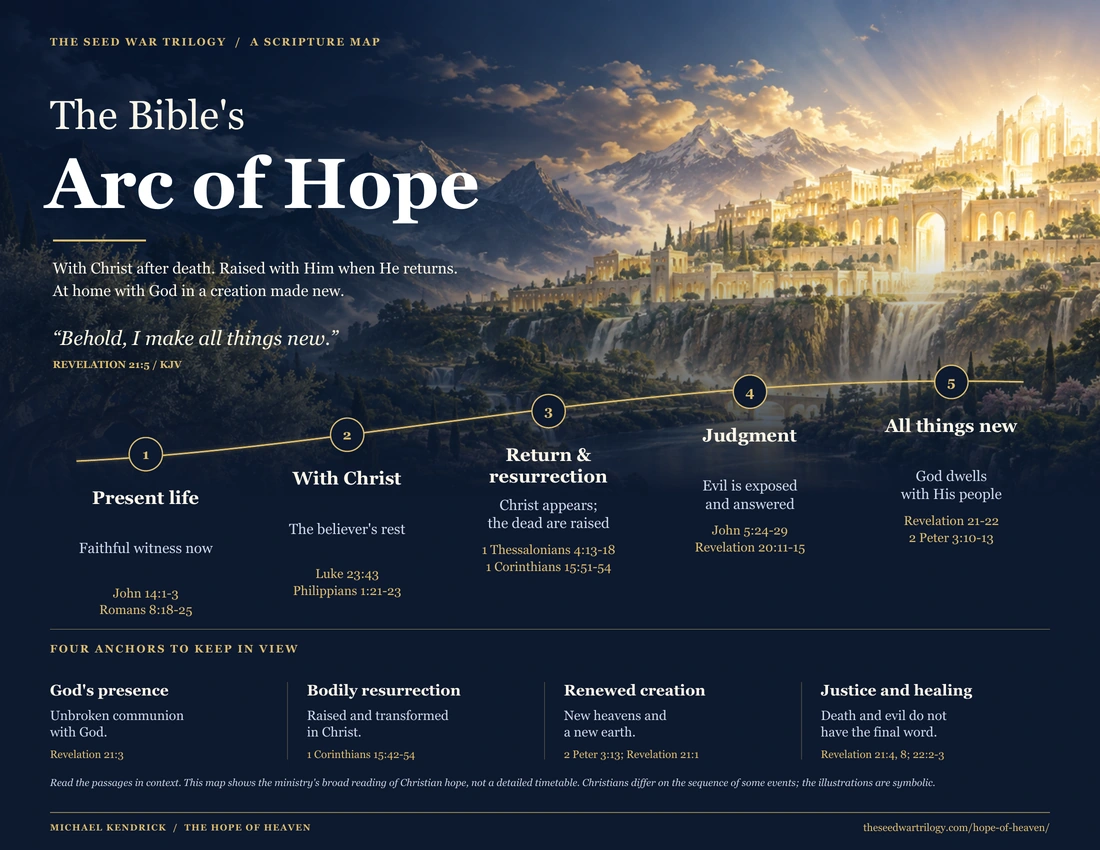
With Christ after death. Raised with Him when He returns. At home with God in a creation made new.
Artistic interpretation. This map presents the ministry’s broad reading of Christian hope; Christians differ on the sequence of some events.For a fuller study, read Home at the Center, or get the free 13-page guide.