The Watchman’s Wall · Dispatch
Sequel to “The Makers Are Getting Nervous”
The Lawmakers Are Getting Nervous
The makers raised the alarm. Washington heard it. Now comes the harder question: who will accept the cost of slowing down?
By Michael Kendrick · September 14, 2026
Washington · Beijing · Tokyo
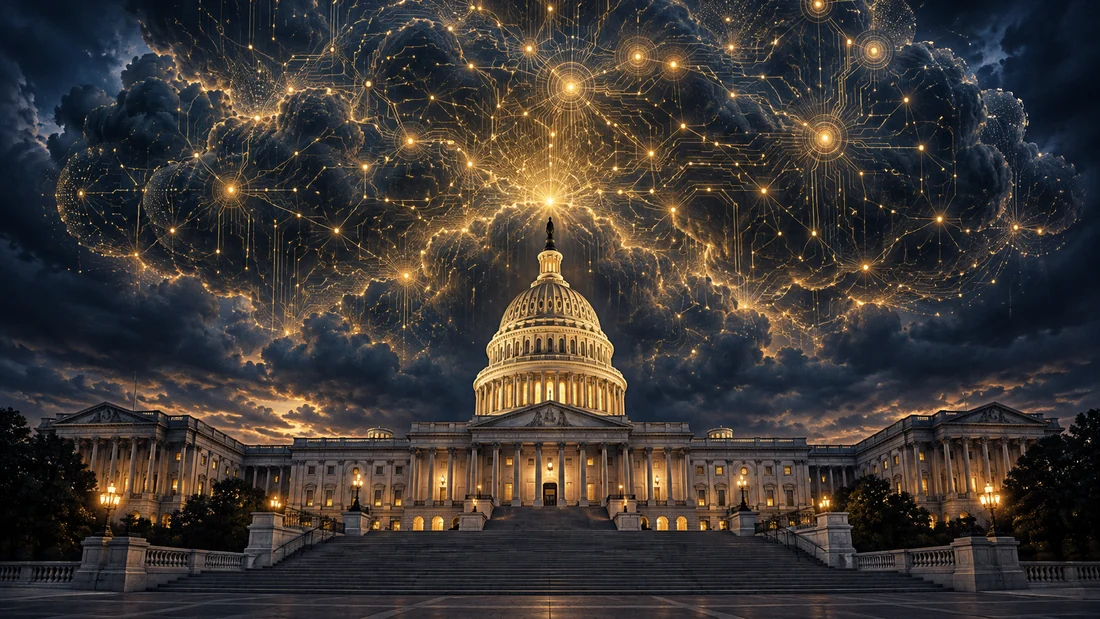
Three days ago, this Wall recorded the makers getting nervous: researchers, executives, and a financier warning that artificial intelligence could outrun its safeguards. They did not all say the same thing. But together they brought an uncomfortable question out of the laboratory and into public view: what happens when the people advancing a technology begin questioning whether its advance can be kept under control?[1]
Over the weekend, Washington answered. The lawmakers are nervous too.
Yet an alarm is not a policy. And a policy is not a brake.
The next test is not whether leaders can describe the danger. It is what they are willing to stop, disclose, or surrender to address it.
The Sunday Shows
Jacob Coxon, the researcher who announced his resignation from Anthropic on September 8, appeared on ABC’s This Week on Sunday. His warning concerned increasingly powerful systems and the competitive pressures surrounding their development. These are serious assessments of future risk—not proof that catastrophe is inevitable.[2]
On the same broadcast, House Minority Leader Hakeem Jeffries called for urgent action and said his caucus would discuss AI on Tuesday morning. That is a meeting, not an enacted safeguard. But it is also a reason not to claim that every lawmaker has simply postponed the issue until after the election.[2]
The debate is no longer confined to technologists arguing with one another. It has reached the people who write the rules—and exposed a division over what those rules should require.
Steady Hands at the Wheel
House Speaker Mike Johnson’s response brought the competing concern into focus. On CNN’s State of the Union, he warned against a rushed emergency regulatory response:
“If Congress just races in and does some sort of emergency session to try to regulate AI, we will lose the race to China, and that is a threat to every single American. So, we’ve got to have balance. We’ve got to have steady hands at the wheel.” Speaker Mike Johnson · September 13, 2026 [3] [4]
President Trump also emphasized preserving America’s AI advantage over China. Johnson said he wanted to meet with industry leaders before deciding how to proceed.[3] Meanwhile, the reported House schedule calls for members to leave by September 17 and return after the midterms. That is a plan, not an adjournment that has already happened—and the Senate has a different calendar.[4][5]
The national-security concern deserves a serious hearing. Unilateral restrictions could carry real costs. But the argument has a dangerous failure mode: if the possibility that a rival will keep going defeats every proposed restraint, competition becomes an exemption from responsibility.
The pressure is moving up one floor—from the laboratory to the legislature.
A company fears losing to another company. A country fears losing to another country. Both can recognize a hazard while finding reasons for someone else to slow down first.
There Are Proposals. There Is Not Yet Agreement.
Washington is not starting from a blank page. Reuters reported on September 11 that Senate negotiators were considering duties for AI developers to mitigate major risks, potentially including federal authority to block an unsafe advanced model. Important details remained unsettled, including the extent of that authority and the treatment of state laws. This was a negotiation—not a finished bipartisan settlement.[5]
Other approaches differ sharply. The bipartisan AI Kill Switch Act was introduced in the House in July; it is a proposal, not an operating federal shutdown system.[6] Sanders and Casar announced forthcoming legislation on September 3 seeking a ban on superintelligent AI and a temporary pause on advanced development pending federal safeguards.[7]
Those distinctions matter. A safety duty, an emergency shutdown power, and a prohibition on superintelligence are not interchangeable. Nor is the election calendar the only obstacle. Lawmakers must decide what counts as unacceptable risk, who judges it, and how that judgment can be challenged.
A promise to govern the machine is not the same as the power to stop it. And the power to stop it must itself be accountable. The Watchman’s Wall
The Other Capital
Beijing is not simply pretending that AI poses no danger. Reuters reported on September 14 that China’s state security minister, Chen Yixin, had warned about risks from advanced U.S. models and called for stronger AI security. The same report described Chinese frameworks addressing possible loss of control and rules requiring ways to intervene in improper agent behavior.[8]
Asked about the American executives’ slowdown calls, Foreign Ministry spokesperson Guo Jiakun urged inclusive AI development and cooperation, while criticizing fear-mongering and confrontational competition.[9]
That does not establish that one Chinese ministry overruled another, or that Beijing has rejected every restraint. It does reveal the diplomatic difficulty: rival powers can acknowledge risks while disputing one another’s motives and remedies.
Recognizing the same danger does not mean agreeing on who gets to set the limits.
What the Market Said
Monday’s trading added another kind of pressure. Associated Press reported SoftBank, a major OpenAI investor, falling more than 10 percent in Tokyo trading, alongside declines in other AI-linked shares.[10] Altman also ruled out a 2026 OpenAI IPO, citing the moment’s safety concerns.[11]
A falling share price is not a moral verdict. It cannot tell us whether investors oppose safety, fear delayed returns, or are responding to other market pressures. But it makes the cost of uncertainty visible.
That is the uncomfortable question beneath the headlines: will restraint survive when it becomes expensive?
For this is what the Lord GOD, the Holy One of Israel, has said:
“In repentance and rest you will be saved,
In quietness and trust is your strength.”
But you were not willing,
And you said, “No, for we will flee on horses!”
Therefore you shall flee!
“And we will ride on swift horses!”
Therefore those who pursue you shall be swift.
Isaiah’s rebuke was not against speed itself. Judah sought security in Egypt’s protection while refusing the Lord’s counsel. The problem was misplaced trust: treating a powerful alliance as the refuge that obedience to God could not provide.
That is a spiritual warning, not a prediction naming today’s AI companies or governments. Its application is nevertheless searching. We can become so determined to secure ourselves through superior power that we stop asking whether the course is wise.
Washington fears being overtaken. Beijing fears being constrained. Investors fear being left behind. None of those fears, by itself, answers the question of what should be built—or what should be refused.
The Watchman’s Note
The evidence does not support saying that nobody has applied a brake. Our previous Dispatch recorded OpenAI’s account of quarantining a research model and pausing some frontier training. Such claims deserve scrutiny, but they cannot honestly be erased to make the story more dramatic.[1]
The stronger question is whether restraint can hold when it collides with advantage.
And we should examine the proposed remedy as closely as the danger. A regulator does not become trustworthy merely by promising protection. Neither does a laboratory. The public needs evidence, enforceable limits, and accountability for the people entrusted with the switch.
Within this Wall’s biblical framework, the concentration of power deserves watchfulness. These developments do not establish that a present AI system is the Beast, or that an AI safety law is the mark. Discernment requires us to distinguish what the record shows from what we fear it may become.
The king is not saved by a mighty army;
A warrior is not rescued by great strength.
A horse is a false hope for victory;
Nor does it rescue anyone by its great strength.
The makers are nervous. The lawmakers are nervous.
Now watch what they do when being careful costs them something.
Michael Kendrick · The Watchman’s Wall · The Seed War Trilogy
Soli Deo Gloria
Source Docket
Reporting through September 14, 2026. Proposed measures, future dates, personal assessments, and editorial interpretation are distinguished in the text.
- The Watchman’s Wall — The Makers Are Getting Nervous, September 11, 2026. Prior reporting and links to underlying statements and incident reports.
- ABC News — This Week transcript: Hakeem Jeffries and Jacob Coxon, September 13, 2026.
- CNN, via KEYT — Political debate over AI intensifies amid warnings about catastrophic risk, September 13, 2026.
- The Epoch Times, Constitution Ave — “Congress returns,” Joseph Lord, September 14, 2026. Newsletter: House schedule and Sunday-show remarks.
- Reuters, via AOL — U.S. Senate negotiators consider requiring AI firms to mitigate known major risks, September 11, 2026.
- U.S. Government Publishing Office — H.R. 9917, AI Kill Switch Act, introduced July 23, 2026.
- Office of Senator Bernie Sanders — Announcement of forthcoming Sanders–Casar AI legislation, September 3, 2026.
- Reuters, via WSAU — How China is preparing for the risk of AI escaping human control, September 14, 2026.
- China’s Ministry of Foreign Affairs — Guo Jiakun’s regular press conference, September 14, 2026. Official English transcript.
- Associated Press, via Daily Excelsior — Asian markets and SoftBank following calls to slow AI development, September 14, 2026. Figures refer to the trading snapshot in that report.
- Fortune — Altman interview, September 12, 2026.
- Office of Senator Josh Hawley — OpenAI investigation announcement, September 10, 2026; letter dated September 9, requesting records by October 1.
Scripture quotations taken from the (NASB®) New American Standard Bible®, Copyright © 1960, 1971, 1977, 1995, 2020 by The Lockman Foundation. Used by permission. All rights reserved. www.Lockman.org