Two thrones—never confused
This is not a second trial for salvation.
The believer’s condemnation was answered at the cross. “There is therefore now no condemnation to those who are in Christ Jesus” (Romans 8:1). The Bema does not decide whether Christ’s people belong to Him. It evaluates how they built upon the foundation already laid.
Belonging is settled.
Stewardship is examined.
- Believers appear before Christ
- Works and motives are tested
- Reward or loss of reward follows
- The person remains saved
Romans 14:10–12 · 2 Corinthians 5:10 · 1 Corinthians 3:11–15
A different judgment
at the end of the age.
Revelation 20 describes the final judgment of the dead before the Lake of Fire. It must not be collapsed into the believer’s accounting before Christ.
Revelation 20:11–15
The fire tests the work—not the soul
The Day will reveal what your work was made of.
In 1 Corinthians 3:11–15, Christ is the fixed foundation. The variable is the life built upon Him: gold, silver, and precious stones—or wood, hay, and straw. The fire discloses quality, not publicity. Hidden obedience may endure when celebrated achievement vanishes.
The Judge also reads beneath the deed. First Corinthians 4:5 says He brings hidden things to light and reveals the purposes of the heart. The Bema is therefore both sobering and deeply hopeful: no compromise is concealed, but no forgotten cup of cold water is lost.
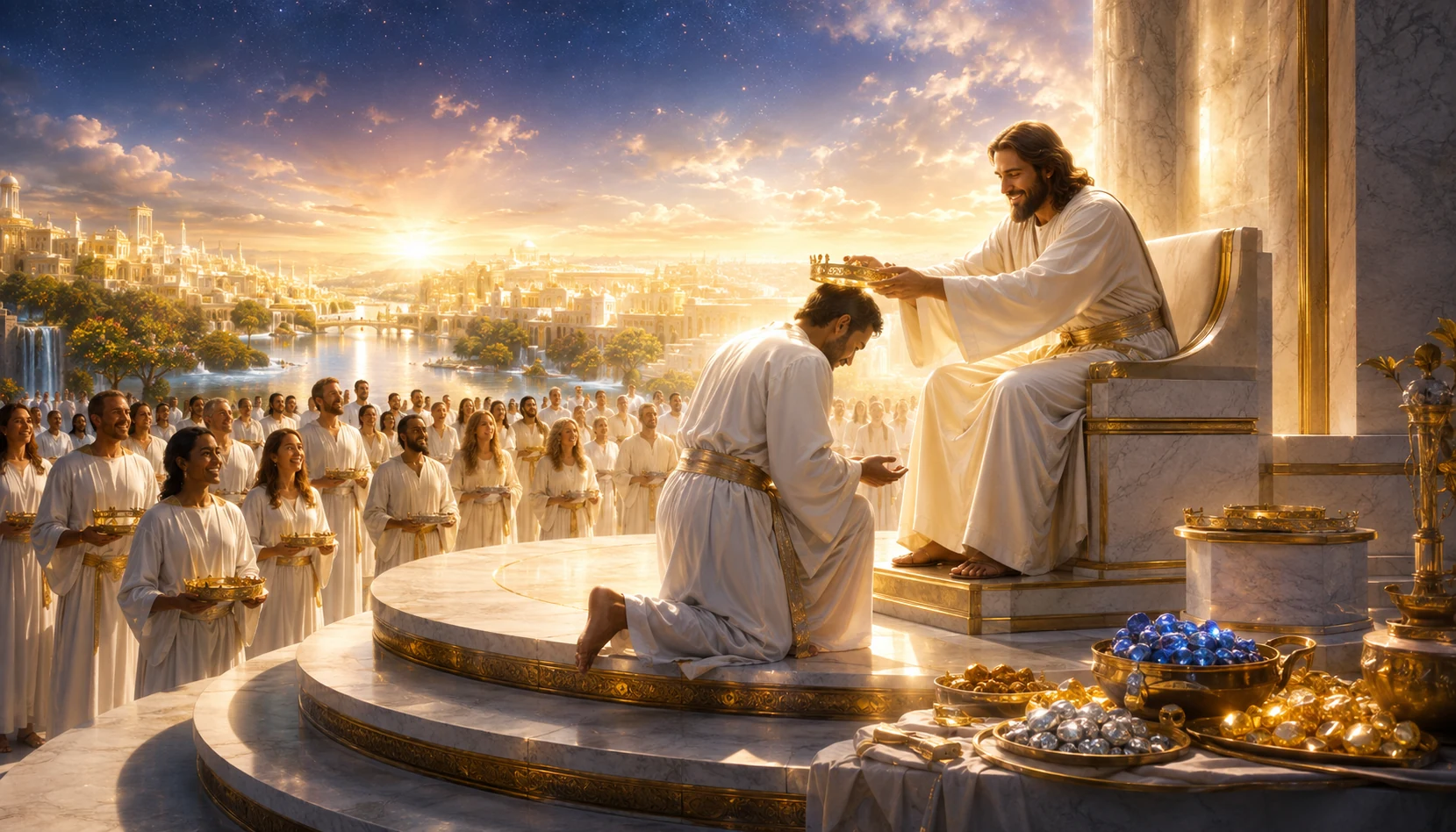
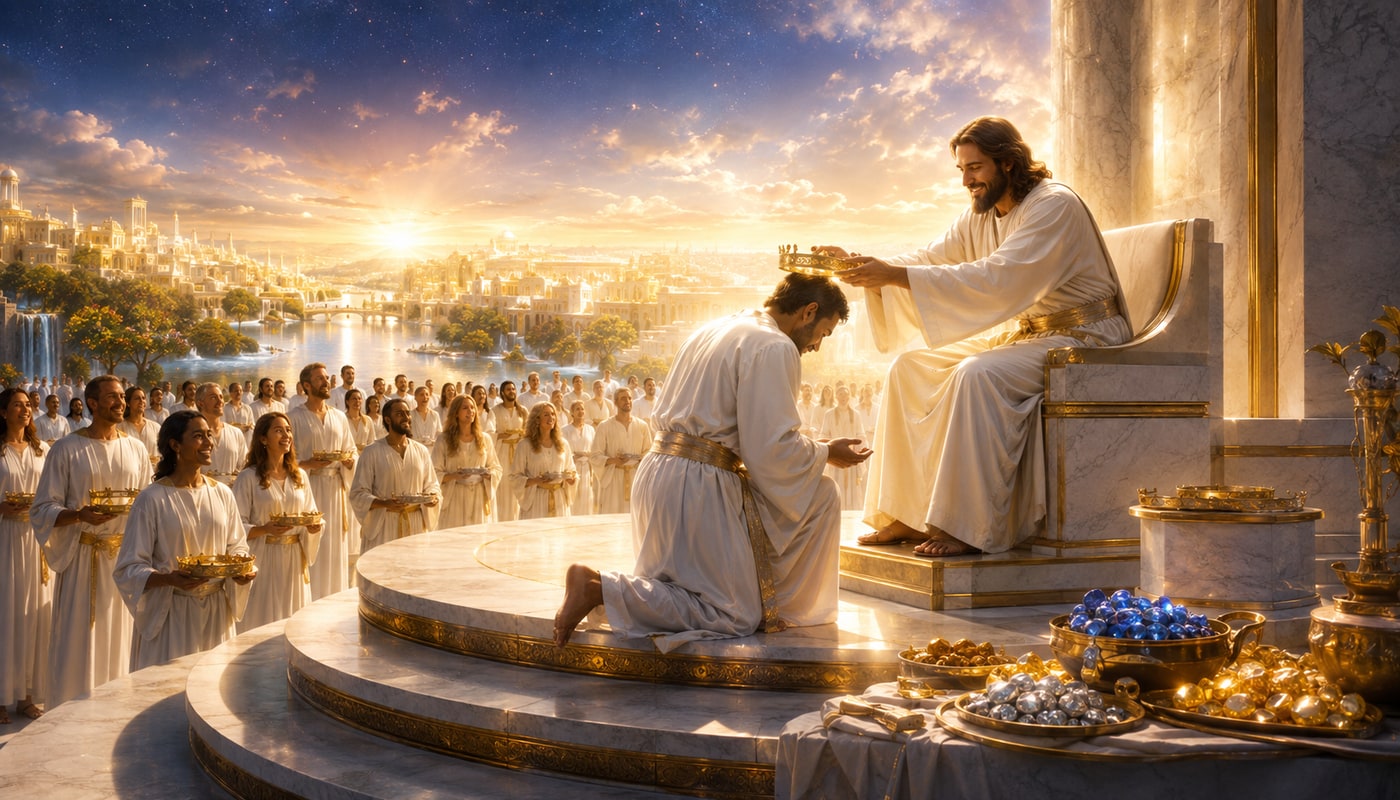
The crowns named in the New Testament
Not private trophies.
Visible praise returned to the King.
The New Testament gathers its language of reward into five recurring crown images. They are not a catalog for spiritual vanity. Revelation shows crowns laid before the throne: every reward becomes another reason to worship the One who made faithfulness possible.
The Imperishable Crown
For disciplined pursuit of the eternal prize.
1 Corinthians 9:24–27The Crown of Rejoicing
The joy of lives reached and people loved toward Christ.
1 Thessalonians 2:19–20The Crown of Righteousness
For those who finish the course and love His appearing.
2 Timothy 4:7–8The Crown of Life
For steadfast love and faithfulness under trial.
James 1:12 · Revelation 2:10The Crown of Glory
For shepherding God’s people willingly and by example.
1 Peter 5:1–4The conventional “five crowns” grouping is a useful synthesis of New Testament reward language; Scripture does not present it as a numbered master list.
The stewardship of everything
Your one life is an apprenticeship for the Kingdom.
Time, money, influence, suffering, opportunity, attention, spiritual gifts, and the people placed within reach—none of these are spiritually neutral. Scripture repeatedly joins present faithfulness to future responsibility (Matthew 25:14–30; Luke 19:11–27; 1 Corinthians 4:1–2).
Within the premillennial framework followed by Battle of the Seed, the Bema occurs after the resurrection of the church and before the saints reign with Christ. This places reward in relation to future service and stewardship. Other faithful Christian traditions arrange the end-times chronology differently; the central truth remains: Christ evaluates His people, commends faithfulness, and His reward matters eternally.
A Bema audit for the life you are living now
Bring the wood into the light
while there is still time to build in gold.
- What has God placed in my hands?
Name the gifts, relationships, resources, opportunities, and responsibilities you have been entrusted to steward.
- What am I building for the approval of others?
Ask where visibility, applause, comfort, or self-protection has become the hidden motive beneath good-looking work.
- What obedience have I postponed?
Delayed forgiveness, generosity, witness, repentance, and service do not become easier by remaining unnamed.
- Where is faithfulness costing me?
Suffering carried with Christ is never wasted. Scripture calls it an eternal weight of glory.
- What would “Well done” require today?
Not a dramatic reinvention—perhaps one prayer, one truth told, one person served, one temptation refused, one gift used.
The complete illustrated teaching paper
Go deeper into the crowns, the timing, the reign, and the questions believers ask.
The Medal Ceremony of Eternity is a 46-page study with fourteen sections, an extensive Scripture corpus, and selected sources for further study.
- Two thrones—never confused
- What the fire finds and what loss means
- The crowns, stewardship, nearness, and future reign
- Hard questions about grace, reward, regret, and faithfulness
Where should we send your copy?
Enter your email once to unlock every free resource on this site.
Receive your free resource, a short welcome email series, and ministry updates. Unsubscribe anytime. Privacy policy.
Questions believers ask
Serious accounting.
Settled belonging.
Will my sins be displayed at the Bema?
Scripture plainly teaches that Christ evaluates believers and reveals motives. It also plainly teaches that their condemnation has been removed and their sins forgiven. Scripture does not give a cinematic description of the proceedings. The safest emphasis is the one Paul gives: the quality of each person’s work is tested, loss is possible, and the believer remains saved (1 Corinthians 3:11–15).
Does reward contradict salvation by grace?
No. Salvation is God’s gift, not a wage earned by works (Ephesians 2:8–9). The next verse says believers are created in Christ for good works God prepared for them. Grace supplies both the new life and the power to live it; reward is the Father’s generous commendation of faithful stewardship.
Can a believer suffer loss?
Yes. First Corinthians 3:15 describes work being burned and the builder suffering loss, while also saying that the person will be saved. Second John 8 warns believers not to lose what they have worked for but to receive a full reward. This is loss of reward, not loss of salvation.
Should Christians pursue reward?
Paul tells believers to run in such a way as to obtain the prize (1 Corinthians 9:24) and presses toward the goal for the prize of God’s upward call (Philippians 3:14). Biblical reward is not self-exaltation; it is Christ’s approval, enlarged usefulness, and a greater capacity to return glory to Him.
Live now for the Well done
The Judge will be the Friend who bled for you.
You are living in the brief and unrepeatable hour in which faith can obey in the dark, love can cost, generosity can require trust, and a cross can be carried. No hidden faithfulness is forgotten. No surrendered suffering falls outside His accounting.
One life. One apprenticeship. One Day.
Build accordingly.