The Final Interface
No Knife Required
On June 30, Meta read full sentences off a human brain — no surgery, no implant. Four other labs are sprinting through the same door, and their own engineers say the rest is just a matter of scale. The wall around the mind is cracking.
By Michael Kendrick · June 30, 2026
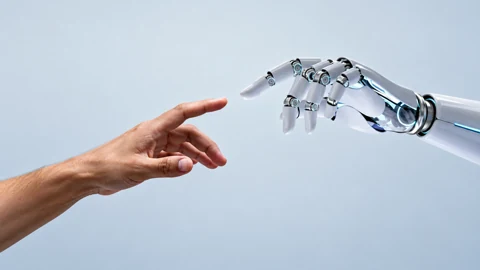
Nine people sat for ten hours inside a brain scanner and typed while a machine read along. When it was done, the machine could reconstruct the sentences they had written — with no chip, no incision, and nothing touching them but a helmet of sensors.
That is what Meta’s AI lab released this morning: Brain2Qwerty v2, a non-invasive “brain-to-text” system. It got 61% of words right — the best volunteer hit 78% — against roughly 8% for every prior surgery-free method. One AI reads the raw brain signal; a second supplies the meaning. Meta published the code for anyone to use, alongside the research paper.
The number is not the story. The word is. The word is non-invasive.
For a decade, reading the mind required cutting into the skull.
Every real breakthrough in decoding language from the brain has demanded a hole in the head. Elon Musk’s Neuralink drills one and threads electrodes into the cortex. Others snake a device up through a vein. The skull was the moat — the one barrier that kept this technology rare, surgical, and slow to spread.
Meta just showed the no-knife path climbing the same curve the implants are on — and then handed the blueprint to every lab on earth. Their own finding is the part to underline: accuracy rises “through data scaling alone.” No miracle required. Just more recordings. That is the exact logic that took chatbots from a curiosity to something in every pocket inside of three years.
And Meta is only one signal. They are all pointing the same way.
Pull back from the single headline and a pattern resolves — five separate efforts, one direction of travel:
Neuralink is moving to mass production and near-automated brain surgery in 2026. Synchron let a paralyzed man operate an iPhone by thought through Apple’s new brain-input protocol, with Nvidia building the model behind it. Sam Altman’s Merge Labs raised a quarter-billion dollars — OpenAI’s money — to read, and write to, the brain with ultrasound. And at Stanford, researchers decoded a person’s silent inner speech — the voice in your head — and had to invent a “mental password” to keep it from leaking out.
Look at the names: Meta. Apple. Nvidia. OpenAI. The same houses that already decide what you read, watch, and buy are now moving to the layer beneath language itself.
They are not hiding what it is for.
The medical case is restoration — giving a man back a voice he lost. No believer should be anything but glad of that. But listen to the men with the most money in the room describe the destination, in their own words.
Humanity is “the biological bootloader for digital intelligence.” We will be “the first species ever to design our own descendants.”
— Sam Altman, founder of Merge Labs & OpenAI, on “the merge” of man and machine (reported by Futurism)That is not the language of a hospital. It is the language of a new theology — of the human being as hardware to be upgraded, and of his Creator’s design as a limitation to be engineered past. It is the oldest promise on record: ye shall be as gods.
There was always one room no creature could enter uninvited.
The inner monologue. The place where you rehearse a confession before you say it, where temptation is fought before it is seen, where the Spirit intercedes with groanings too deep for words. Since Eden, it has been yours and God’s alone — and Scripture is emphatic about whose prerogative it is to read it.
The law is already scrambling. Colorado, California, and Montana now classify your “neural data” as protected information, and a neurorights movement is pressing for more. Good — and not nearly enough. Those statutes guard the file. They cannot answer the deeper question they are circling: whether the inner man should be made readable at all. That one is not for legislatures. It is for the conscience, and for the Church.
Hear this plainly, so no one can wave it away.
Brain2Qwerty is not the mark of the beast. To say it is would be a lie, and a lie spends the watchman’s credibility on the day he can least afford it. The mark, in John’s vision, was never a gadget — it was worship, a sign of whose you are.
What this generation is building is something quieter and more patient: the scaffolding. An interface between the human interior and a centralized, AI-run system — the architecture within which such a demand could one day be made to seem reasonable, even merciful. Battle of the Seed never claimed a chip is the seal. It argued that the world is being carefully fitted for the possibility of one — and that the household of faith should understand the fitting while there is still time to think clearly, and unafraid.
So hold both at once. Rejoice without reservation over the man with ALS who, through one of these very devices, told his wife he loves her again. That is mercy, and mercy is of God. Then keep your eyes open about where the same hands are steering once they leave the bedside.
Not the spirit of fear — God did not give us that. Not the spirit of sleep, either. The command was always to keep thy heart with all diligence. This morning that command got a deadline. Stand the watch.
What Happened
On June 30, 2026, Meta’s AI research lab released Brain2Qwerty v2, a non-invasive “brain-to-text” pipeline. Nine participants spent roughly ten hours each inside a magnetoencephalography (MEG) scanner, typing sentences while the system read along.
It reconstructed their text at 61% word accuracy — 78% for the best participant — against roughly 8% for prior surgery-free methods. One model decodes the raw brain signal; a second supplies linguistic meaning. Meta open-sourced the code and published the research paper, and reported that accuracy improves “through data scaling alone.”
What the Watch Is Tracking
- Synchron’s 2026 pivotal trial — the gate to the first FDA-approved brain implant, and the moment thought-control crosses from study to product.
- The scaling curve — whether “more data alone” really does close the gap with surgery, as Meta predicts. If it does, the timeline compresses fast.
- Apple and OpenAI — the tell will be the first push of neural input toward healthy consumers, not patients. Watch for the word “accessibility” doing heavy lifting.
- The framing war — every step will be introduced as healing. Discernment is learning to see the scaffolding underneath the mercy.
Free Biblical Briefing
The Mark Will Not Look Like a Mark
Receive The Watchman’s Dossier—a focused guide to Revelation 13, AI, digital identity, programmable money, biometric control, and neural interfaces.
Enter your email once to unlock every free resource on this site.
Receive your free resource, a short welcome email series, and ministry updates. Unsubscribe anytime. Privacy policy.