ARTIFICIAL INTELLIGENCE
Rome Issues Its First Encyclical on Artificial Intelligence — and Warns of a "New Tower of Babel"
By Michael Kendrick · June 18, 2026
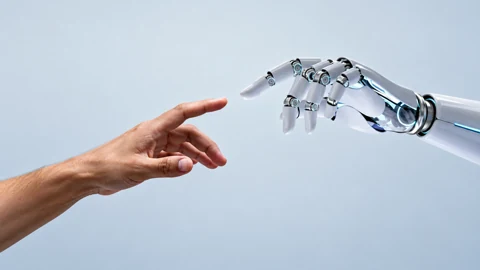
I am not Catholic, and Magnifica Humanitas is not my creed. But a watchman does not only read the friendly signs. When the largest religious institution on earth devotes the first major teaching of a pontificate not to a doctrine of the church but to a machine, the choice of subject is itself the message. Rome looked at artificial intelligence and reached, instinctively, for Babel — for the oldest story of humanity building a name for itself toward heaven, and for what came of it. That instinct is worth marking, because it converges with what these books have argued from the first page. The encyclical's sharpest warning is not about killer drones or lost jobs. It is about a subtler substitution: the temptation to see the human person as a product, and to accept an "enhanced" self as an improvement on the one we were given. That is the counterfeit precisely as Scripture frames it — not a frontal assault on the image of God, but an offer to upgrade it. The same hand that was promised in the Garden that we would be as gods is extended again, now wearing a lab coat. And in a detail almost too on-the-nose to invent, the document was unveiled with one of the architects of frontier AI standing in the room — the altar and the laboratory, for a moment, sharing a podium.
What Happened
On May 25, 2026, the Vatican released Magnifica Humanitas ("Magnificent Humanity"), the first encyclical of Pope Leo XIV, subtitled On Safeguarding the Human Person in the Time of Artificial Intelligence. The roughly 42,000-word letter — signed May 15 on the 135th anniversary of Leo XIII's Rerum Novarum — extends Catholic social teaching to the age of AI, situating human dignity, labor, truth, and the common good within the tradition running from Rerum Novarum through Laudato Si'. It frames the present as a choice between building "a new Tower of Babel" and a society where God and humanity dwell together. The encyclical holds that AI, while not inherently evil, is also not morally neutral; warns that it is an extractive technology built on people's data; and names dangers including job insecurity, the mass manipulation of information, autonomous weapons, and the lure of an enhanced human being — with a deeper danger beneath them all: that human beings may begin to see themselves and one another as products. Leo writes that no machine can ever replace the God-given grandeur of the human person. The document was presented at the Vatican with testimony from the pope, cardinals, theologians, and a co-founder of the AI company Anthropic.
Free Biblical Briefing
The Mark Will Not Look Like a Mark
Receive The Watchman’s Dossier—a focused guide to Revelation 13, AI, digital identity, programmable money, biometric control, and neural interfaces.
Enter your email once to unlock every free resource on this site.
Receive your free resource, a short welcome email series, and ministry updates. Unsubscribe anytime. Privacy policy.