The short answer
The book of Revelation is about Jesus Christ: His victory, His return and His kingdom. It opens as “The Revelation of Jesus Christ” (Revelation 1:1) and promises a blessing to everyone who reads it (1:3). Its visions move through judgment on a rebellious world to Christ’s visible return (19:11–16) and a new heaven and new earth where “there shall be no more death” (21:4). No one knows the day of His coming (Matthew 24:36), and this site sets no dates.
Free Biblical Briefing
The Mark Will Not Look Like a Mark
Receive AI and Bible Prophecy Report—a focused guide to Revelation 13, AI, digital identity, programmable money, biometric control, and neural interfaces.
Enter your email once to unlock every free resource on this site.
Receive your free resource, a short welcome email series, and ministry updates. Unsubscribe anytime. Privacy policy.
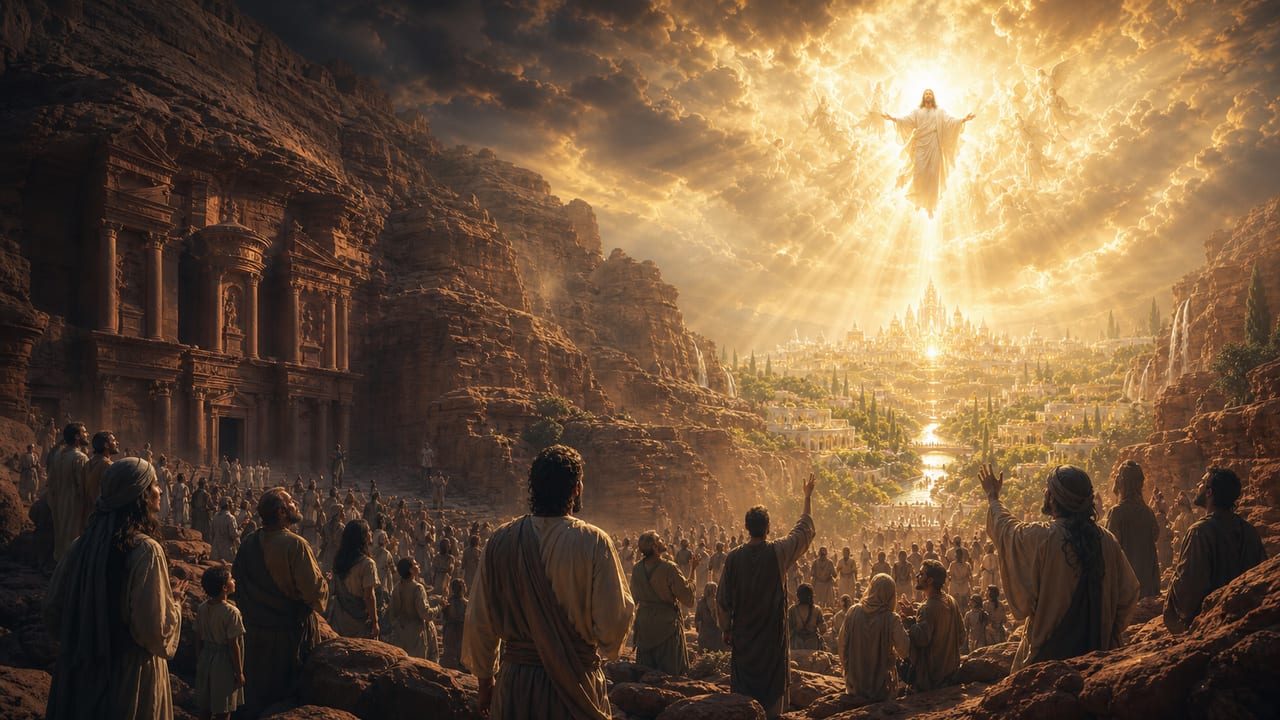
“Behold, he cometh with clouds; and every eye shall see him, and they also which pierced him: and all kindreds of the earth shall wail because of him. Even so, Amen.”Revelation 1:7, KJV
Revelation at a Glance: Chapter Map and Studies
Revelation gives its own outline: “Write the things which thou hast seen, and the things which are, and the things which shall be hereafter” (Revelation 1:19). The table follows the book in order and links every study on this site that covers each section.
| Chapters | What happens | Study on this site |
|---|---|---|
| Revelation 1 | The risen Christ among the churches; “Behold, he cometh with clouds” (1:7) | When the King Returns |
| Revelation 2–3 | Letters to the seven churches | Planned study |
| Revelation 4–5 | The throne in heaven; the Lamb opens the sealed scroll (5:5) | Planned study |
| Revelation 6–11 | The seven seals and seven trumpets; the seventh trumpet sounds (11:15), where this site places the rapture | Seals, Trumpets and Bowls · The Tribulation · The Rapture · The Seed Enthroned: Earth’s Midnight |
| Revelation 12 | The woman, the child and the dragon: Genesis 3:15 in Revelation | Revelation 12 Explained · Genesis 3:15 guide |
| Revelation 13 | The beast, the image and the mark; 666 | Revelation 13 Explained · The Mark of the Beast · Who Is the Antichrist? · Is AI the Mark of the Beast? |
| Revelation 14–16 | The harvest and the seven bowls; Armageddon (16:16) | The Seven Bowls · The Second Coming of Christ |
| Revelation 17–18 | The fall of Babylon | Planned study |
| Revelation 19 | Christ returns: “KING OF KINGS, AND LORD OF LORDS” (19:16) | The Second Coming of Christ · The Seed Enthroned: The King Returns |
| Revelation 20 | The thousand years and the Great White Throne | The Seed Enthroned: Reigning with the King · The Lake of Fire · What Is Hell Really Like? |
| Revelation 21–22 | New heaven, new earth, New Jerusalem, the river and tree of life | What Will Heaven Really Be Like? · New Jerusalem (Day 11) · River and Tree of Life (Day 12) · The Hope of Heaven |
The Second Coming: What Every Christian Can Agree On
Christians disagree about the order of end-time events, but the center is shared: Jesus Christ will return personally, bodily and visibly.
“Ye men of Galilee, why stand ye gazing up into heaven? this same Jesus, which is taken up from you into heaven, shall so come in like manner as ye have seen him go into heaven.”Acts 1:11, KJV
“And he hath on his vesture and on his thigh a name written, KING OF KINGS, AND LORD OF LORDS.”Revelation 19:16, KJV
For the full study of what happens when He appears, read The Second Coming of Christ. For an illustrated walk through the same hope, read When the King Returns, and for the whole story to the New Jerusalem, The Seed Enthroned.
The Rapture and the Tribulation
The promise itself is plain:
“For the Lord himself shall descend from heaven with a shout, with the voice of the archangel, and with the trump of God: and the dead in Christ shall rise first: Then we which are alive and remain shall be caught up together with them in the clouds, to meet the Lord in the air: and so shall we ever be with the Lord.”1 Thessalonians 4:16–17, KJV
The timing is where faithful readers differ. Some place the rapture before the seven years of tribulation, and some at their end. This ministry teaches a midpoint rapture. We understand Daniel’s final “week” as a future seven-year period (Daniel 9:27) and place the catching up of the church at its midpoint, at the last trump, before God’s wrath is poured out. The Scriptures behind that reading:
- The last trump. Paul ties the resurrection and change of believers to a trumpet: “In a moment, in the twinkling of an eye, at the last trump: for the trumpet shall sound, and the dead shall be raised incorruptible, and we shall be changed” (1 Corinthians 15:52). Revelation is a book of numbered trumpets, and when the seventh sounds, heaven proclaims, “The kingdoms of this world are become the kingdoms of our Lord, and of his Christ” (Revelation 11:15). Linking the two trumpets is part of this interpretation; neither passage names the other.
- Not appointed to wrath. “For God hath not appointed us to wrath, but to obtain salvation by our Lord Jesus Christ” (1 Thessalonians 5:9). Revelation describes the vials as “the seven last plagues; for in them is filled up the wrath of God” (Revelation 15:1), and this ministry places them in the second half of the week.
- “Come up hither.” At the middle of the book, God’s two witnesses are raised and called home: “And they ascended up to heaven in a cloud; and their enemies beheld them” (Revelation 11:12).
- The middle of the week. Daniel says that “in the midst of the week he shall cause the sacrifice and the oblation to cease” (Daniel 9:27), and Jesus calls what follows “great tribulation, such as was not since the beginning of the world” (Matthew 24:21).
“The church sails through tribulation, as she always has; she is lifted out before the wrath.”
From this site: The Seed Enthroned: Caught UpHold the position with charity. Christians who place the rapture elsewhere love the same Lord and read the same Book, and no one’s salvation hangs on the timing. They weigh texts like Jesus’ appearing “immediately after the tribulation of those days” (Matthew 24:29) and His promise to keep the faithful “from the hour of temptation” (Revelation 3:10) differently. For the whole case, step by step, read The Seed Enthroned, a free five-week study from the rapture to the New Jerusalem.
Start with the two short studies on this site: The Rapture: Is It Biblical, and When Will It Happen? and What Is the Tribulation?
When Will Jesus Return?
“But of that day and hour knoweth no man, no, not the angels of heaven, but my Father only.”Matthew 24:36, KJV
Scripture gives signs and seasons, never a date. Searches like “is the rapture coming in 2026” are common, and the Bible’s answer is the same as it has always been: watch, stay faithful, and keep the door open for others. Read What Does the Bible Say About the End Times? for why this ministry never sets dates, and can anyone know the date?
Revelation 13, the Beast and the Mark
No chapter draws more questions than Revelation 13. This site has a full set of studies on it, each separating what the text says from what interpreters infer:
Judgment and New Creation
Revelation ends with judgment and a home. Believers will stand before the judgment seat of Christ for reward (Bema Seat Judgment Explained). The dead stand before the Great White Throne (Revelation 20:11–15; see What Is Hell Really Like?). Then God makes all things new.
“And God shall wipe away all tears from their eyes; and there shall be no more death, neither sorrow, nor crying, neither shall there be any more pain: for the former things are passed away.”Revelation 21:4, KJV
Continue with What Will Heaven Really Be Like? or begin Made for Forever, a free 14-day Bible study on Heaven.
From Genesis 3:15 to Revelation 12
Revelation finishes a story that began in Eden. The promise that the woman’s seed would bruise the serpent’s head (Genesis 3:15) returns in Revelation 12, where “that old serpent, called the Devil, and Satan” makes war on “the remnant of her seed” (Revelation 12:9, 17), and it ends when the devil is cast into the lake of fire (Revelation 20:10). Read the Genesis 3:15 guide to see the whole thread.
How to Read Revelation Without Fear
- Start with Christ. The book’s first vision is of Jesus, not the beast (Revelation 1:12–18).
- Read it aloud and whole. It was written to be read aloud to the churches (1:3, 11), so read it through before you study the details.
- Let Revelation explain itself first. It interprets some of its own symbols (1:20; 17:9–18).
- Keep the Old Testament open. Revelation draws heavily on Daniel, Ezekiel, Isaiah and Zechariah.
- Hold the center firmly and the chart loosely. The return of Christ is certain; the sequence is where Christians differ.
Questions People Ask
What is the book of Revelation about?
Revelation calls itself “The Revelation of Jesus Christ” (Revelation 1:1). It shows the risen Christ speaking to seven churches, the Lamb on the throne opening a sealed scroll, judgments on a rebellious world, the defeat of the dragon and the beast, Christ’s return as “KING OF KINGS, AND LORD OF LORDS” (Revelation 19:16), the final judgment, and a new heaven and a new earth where God wipes away every tear (Revelation 21:4).
Who wrote the book of Revelation?
The book names its human author as John, a servant of Jesus Christ, who received the visions on the island of Patmos (Revelation 1:1, 4, 9). Christian tradition has long identified him as the apostle John.
Is the rapture in the Bible?
The English word “rapture” does not appear in the King James Bible. It comes from the Latin translation of 1 Thessalonians 4:17, where believers are “caught up together with them in the clouds, to meet the Lord in the air.” Christians agree on that promise but differ on its timing. This ministry places it at the midpoint of the seven-year tribulation, at “the last trump” (1 Corinthians 15:52).
What is the difference between the rapture and the Second Coming?
This site’s Second Coming study explains it this way: at the rapture, Christ comes for His people and meets them in the air (1 Thessalonians 4:16–17); at the Second Coming, He comes with His people all the way to earth to judge the nations and reign (Revelation 19:11–14; Zechariah 14:4). In this ministry’s reading, the rapture comes at the midpoint of the seven years and the Second Coming at their close.
When does the rapture happen?
This ministry teaches a midpoint rapture. Daniel’s final “week” is read as a future seven-year period (Daniel 9:27), and the church is caught up at its midpoint, at “the last trump” (1 Corinthians 15:52), before the seven last plagues, in which “is filled up the wrath of God” (Revelation 15:1), are poured out, because “God hath not appointed us to wrath” (1 Thessalonians 5:9). Other Christians place it before or after the seven years. Scripture gives no date: “of that day and hour knoweth no man” (Matthew 24:36).
When will Jesus return?
No one knows the day or the hour (Matthew 24:36), and this site sets no dates. Scripture promises that “this same Jesus … shall so come in like manner” as the disciples saw Him go (Acts 1:11), and calls believers to watch, stay faithful and keep sharing the gospel.
Should the book of Revelation be read literally or symbolically?
Revelation uses many symbols, and it explains some of them itself: the seven stars are angels of the churches and the seven candlesticks are the churches (Revelation 1:20). Christians differ on how much of the book describes future events and how much is symbolic. This site’s studies read it in a premillennial way and label that interpretation.
Is Revelation scary to read?
Revelation opens with a blessing for the reader: “Blessed is he that readeth, and they that hear the words of this prophecy” (Revelation 1:3). Its judgments are real, but its center is Christ’s victory and its last word is an invitation: “Even so, come, Lord Jesus” (Revelation 22:20).