A WHITE PAPER FROM THE SEED WAR TRILOGY
THE MEDAL CEREMONY OF ETERNITY
The Bema Seat Judgment, the Believer's Reward,
and the Architecture of Nearness
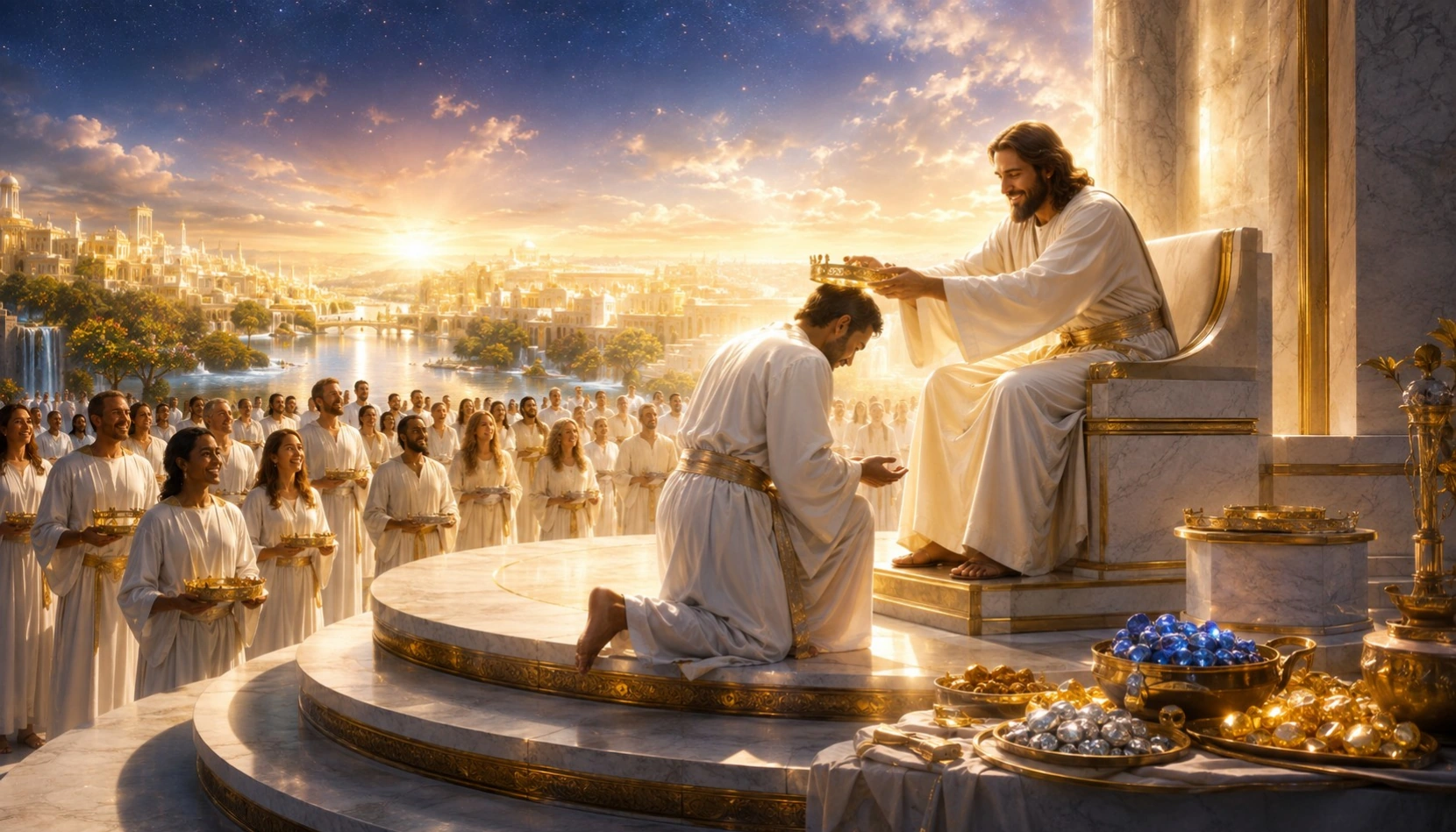
A theological treatise on the judgment of the believer, the crowns of the faithful, the Millennial reign of Christ, and the rewards that endure forever
MICHAEL KENDRICK
PROVIDENCE TEACHING MINISTRY
A companion study to BATTLE OF THE SEED - Book One of The Seed War Trilogy
THESEEDWARTRILOGY.COM - MMXXVI
CONTENTS
PROLOGUE — You Will Stand in the Light
SECTION I — Two Thrones, Never Confused
SECTION II — The Word Paul Chose
SECTION III — The Hour and the Order
SECTION IV — What the Fire Finds
SECTION V — The Loss That Grace Allows
SECTION VI — The Crowns and the Praise
SECTION VII — Should You Run for the Prize?
SECTION VIII — The Stewardship of Everything
SECTION IX — The Architecture of Nearness
SECTION X — Robed in Light
SECTION XI — Kings and Priests of the Regardened Earth
SECTION XII — From the Thousand Years into Forever
SECTION XIII — The Questions You Did Not Ask
SECTION XIV — The Bema and the Battle of the Seed
EPILOGUE — Live Now for the Well Done
APPENDIX — The Scripture Corpus
SOURCES & FURTHER STUDY — The Witness of the Teachers
“For we must all appear before the judgment seat of Christ, that each one may receive the things done in the body, according to what he has done, whether good or bad.” — 2 Corinthians 5:10
PROLOGUE
You Will Stand in the Light
Close your eyes and let me take you forward.
The trumpet has sounded. The dead in Christ have risen. In a moment, in the twinkling of an eye, the mortal has put on immortality, and you are standing in a body that will never again know fatigue, fever, or fear. The war of the flesh is over. The long ache of the fallen world is behind you.
And now you are being called forward.
Not into a courtroom. There is no prosecutor here. The Accuser has no standing in this place, and the record of your sins was nailed to a cross outside Jerusalem two thousand years before you were born. You checked, the moment you saw Him. It is not here. It is gone, as far as the east is from the west.
What stands before you is a throne of another kind — the bema, the raised seat where the Judge of the games crowns His runners. And on it sits the Lord Jesus Christ, eyes like a flame of fire, feet like fine brass, His face like the sun shining in its strength. The One who was pierced for you. The One who has loved you longer than you have existed.
In His hands is your life.
Every hour of it. Every motive beneath every hour. The words you spoke in kitchens and boardrooms and hospital corridors. The money that moved through your hands. The gifts He folded into you before you were born. The people He placed in your path. The secret prayers. The secret compromises. The cup of cold water you gave and forgot. The years you buried in a napkin and called it prudence.
And now the fire falls on the whole of it — not to burn you, but to reveal you. The wood goes up first, weightless. The hay. The straw. So much of it, vanishing like breath on cold glass. You feel the loss of what might have been, and it is real loss, and there are tears in this place.
But then — there. In the ash. Something is shining.
Gold. Silver. Stones of fire. Deeds you barely remember, refined and radiant and permanent. He steps down from the seat. He is holding a crown. And He is not frowning. He is smiling like a Father at a finish line, and He says the words you were made to hear, the words that will define your next ten thousand years:
Well done, good and faithful servant. You were faithful over a few things. I will make you ruler over many things. Enter into the joy of your lord.
This is not fiction. This is not sentiment. This is the sober, repeated, unambiguous testimony of the Word of God about the next event on your eternal calendar. Every believer will stand there. You will stand there.
The question this treatise exists to ask is the question that day will answer:
When the fire falls on your life, what will be left shining?
SECTION I
Two Thrones, Never Confused
The judgment of the believer is not the judgment of the lost
Begin here, or fear will poison everything that follows.
Scripture speaks of more than one great judgment at the end of the age, and the failure to distinguish them has filled the church with a dread God never assigned to His children. There is a judgment where eternal destiny is at issue — the Great White Throne of Revelation 20, where the unredeemed dead, small and great, stand before God, where books are opened, and where anyone not found written in the Book of Life is cast into the lake of fire. That throne is real. Its terror is real. This author has written an entire chapter of Battle of the Seed to make the reader feel its weight.
But the believer in Jesus Christ will never stand before it.
Hear the Lord Himself:
Most assuredly, I say to you, he who hears My word and believes in Him who sent Me has everlasting life, and shall not come into judgment, but has passed from death into life.
— JOHN 5:24 (NKJV)
There is therefore now no condemnation to those who are in Christ Jesus.
— ROMANS 8:1 (NKJV)
The judgment for the believer's sins has already happened. It happened at nine in the morning on a hill shaped like a skull, when the Father laid on His Son the iniquity of us all. Justice does not collect a debt twice. As the theologians of the last century loved to say: the believer has already been to court, already been condemned, already been executed — in his Substitute. Lewis Sperry Chafer put it bluntly: the judgment seat of Christ is unrelated to the problem of sin; it is “more for the bestowing of rewards than the rejection of failure.”
So what remains to be judged?
Not the believer's standing — that was settled by blood. What remains is the believer's stewardship. Not whether you belong to the King, but what you did with the King's goods while He was away. Not entrance into the Kingdom, but rank, capacity, radiance, and reward within it. The Great White Throne asks one question: What did you do with My Son? The Bema asks a different question entirely: Child, what did you do with My gifts? Two thrones. Two questions. Two utterly different atmospheres. Confuse them and you will either live in servile terror of a Father who has already embraced you, or — the subtler error — you will assume that because your destination is secure, your life between now and glory has no eternal consequence at all.
Both errors are lies. The first insults the cross. The second wastes it.
Salvation is a gift. Reward is a wage. Scripture refuses to blur them — and so must we.
Paul holds the two in one sentence without strain: “For by grace you have been saved through faith, and that not of yourselves; it is the gift of God, not of works, lest anyone should boast” (Ephesians 2:8–9) — and then, in the very next breath, “For we are His workmanship, created in Christ Jesus for good works, which God prepared beforehand that we should walk in them” (Ephesians 2:10). The gift brings you into the family. The works — prepared by God, empowered by God, and yet truly, mysteriously yours — are what the family business is built on. And the Father, it turns out, keeps books.
SECTION II
The Word Paul Chose
What a Greek runner's platform tells us about the judgment of the saints
Twice the apostle Paul names this event, and both times he reaches past the vocabulary of the courtroom to the vocabulary of the games.
For we shall all stand before the judgment seat of Christ. … So then each of us shall give account of himself to God.
— ROMANS 14:10,12 (NKJV)
For we must all appear before the judgment seat of Christ, that each one may receive the things done in the body, according to what he has done, whether good or bad.
— 2 CORINTHIANS 5:10 (NKJV)
The phrase “judgment seat” translates a single Greek word: bema. A bema was a raised platform, a step, a place of official standing. Yes, a Roman magistrate could sit on one — Pilate did, the morning he washed his hands. But in the world of the Greek cities to which Paul wrote, the bema had a second life, older and brighter: it was the judge's stand at the athletic games, the platform beside the finish line at Isthmia and Olympia where the umpire watched every contestant — and where, when the race was over, the victor was called up to receive the wreath.
Here is the detail that should make you sit still. Paul wrote the words “judgment seat of Christ” in a letter to Corinth — and in the middle of the Corinthian marketplace stood a great blue-and-white marble bema, which archaeologists have unearthed and which you can stand before today. Paul himself had been dragged before that very platform by a mob while Gallio was proconsul of Achaia (Acts 18:12–17). And just outside the city, every two years, the Isthmian Games crowned their athletes at a bema of their own — games Paul almost certainly watched, games he mined for metaphor after metaphor: the race, the prize, the boxer, the perishable wreath.
So when the Corinthians heard “we must all appear before the bema of Christ,” they did not picture a criminal dock. They pictured the place of verdicts and the place of victory wreaths — a platform where an examined life receives its outcome. As one writer memorably observed of the games: the judge at the bema bestowed rewards on the victors. He did not whip the losers.
This is why the scholars who have studied this doctrine most carefully — Samuel Hoyt, whose Dallas Seminary dissertation and Bibliotheca Sacra articles remain the standard theological treatment; Chafer and Walvoord before him; Joseph Dillow, Erwin Lutzer, Joe Wall, Paul Benware, and Randy Alcorn in the generation since — converge on a mediating position that holds two truths in tension. The Bema is serious: an omniscient, holy Christ will evaluate every believer's entire life, and real loss is possible. And the Bema is not punitive: no wrath, no retribution, no display of forgiven sin to shame the blood-bought. The fire tests works, not souls. The examination is severe precisely because the love behind it is infinite — the King is deciding how much of His Kingdom He can entrust to you.
The Bema is not where you find out whether the King loves you. It is where you find out how much He can trust you.
SECTION III
The Hour and the Order
When the Bema occurs — and where it falls in the chronology of the end
Eschatology is architecture. Get the load-bearing walls in the wrong place and the whole house leans. So let us lay out, carefully, the sequence Scripture gives — the same sequence that structures the closing chapters of Battle of the Seed — and locate the Bema precisely within it.
1. The Vanishing — the resurrection and rapture of the church
The next event on the church's calendar is not the Tribulation and not Armageddon. It is a shout. “For the Lord Himself will descend from heaven with a shout, with the voice of an archangel, and with the trumpet of God. And the dead in Christ will rise first. Then we who are alive and remain shall be caught up together with them in the clouds to meet the Lord in the air” (1 Thessalonians 4:16–17). In a moment, in the twinkling of an eye, the corruptible puts on incorruption (1 Corinthians 15:51–53). This is the moment the believer receives the glorified body — the “upgraded hardware,” flesh-and-bone and deathless, patterned on Christ's own resurrection body (Philippians 3:20–21; 1 John 3:2). The Bema cannot precede this moment, because the Judge rewards whole persons, and reward is bound up with resurrection: “you shall be repaid at the resurrection of the just” (Luke 14:14).
2. The Bema — in heaven, while judgment falls on the earth
Where does the risen church go? “In My Father's house are many mansions… I will come again and receive you to Myself” (John 14:2–3). The church is taken up, into the Father's house, while the seven-year Tribulation — Daniel's seventieth week, the time of Jacob's trouble — unfolds below. And it is there, in the heavenlies, in the presence of the Lord, that the Bema convenes. Three lines of evidence fix the timing:
First, the crowned elders. In Revelation 4 — before a single seal of judgment is opened — John sees twenty-four elders around the throne, clothed in white, already wearing golden crowns, which they cast before the throne in worship (Revelation 4:4, 10). Crowns are Bema wages. Whoever these elders represent, heaven's opening scene shows redeemed, rewarded worshipers in glory before the wrath begins.
Second, the dressed bride. At the end of the seven years, when heaven opens for the Second Coming, the marriage of the Lamb is announced and “His wife has made herself ready. And to her it was granted to be arrayed in fine linen, clean and bright, for the fine linen is the righteous acts of the saints” (Revelation 19:7–8). Ponder that sentence until it changes your week. The bride's wedding garment is woven out of Bema verdicts — the tested, surviving, gold-and-silver deeds of the saints. For her to descend already dressed, the evaluation must already be complete. The Bema falls between the rapture and the Return.
Third, the reward that comes with Him. “Behold, I am coming quickly, and My reward is with Me, to give to every one according to his work” (Revelation 22:12; cf. Isaiah 40:10; 62:11). When He appears, the reward is already in hand — determined, allotted, ready to be exercised in the Kingdom He is about to establish.
Some able interpreters, reading Matthew 16:27 and Revelation 11:18, place the formal ceremony at the Second Advent itself. The difference is small and the substance identical: the church is evaluated after resurrection and before the Kingdom offices are filled. The classic sequence — rapture, then examination in heaven, then the marriage, then the Return — remains the most natural reading of the whole fabric, and it is the sequence this treatise, and Battle of the Seed, follow: the saints who ride out of opened heaven behind the King in Revelation 19:14 have already stood at the Bema. They return not to be judged but to reign.
3. The Return, and the judgments of the living
At the end of the seven years the King appears — not secretly now, but in flaming glory, every eye seeing Him, the armies of heaven (His rewarded saints, Zechariah 14:5; Jude 14; Colossians 3:4) behind Him. The Beast and the False Prophet are cast alive into the lake of fire; the Dragon is bound for a thousand years (Revelation 19:20; 20:1–3). Then the Son of Man sits on the throne of His glory and judges the living — the mortal survivors of the Tribulation. The nations are parted as a shepherd divides sheep from goats (Matthew 25:31–46); Israel is made to pass under the rod (Ezekiel 20:33–38). The sheep — those whose treatment of the King's hunted brethren revealed hearts that had bent to the King Himself — enter the Kingdom in natural, mortal bodies. The goats are removed. This judgment is distinct from the Bema in every particular: different subjects (living survivors, not the raptured church), different time (after the Tribulation, not during it), different issue (entrance into the Kingdom, not reward within it).
4. The completion of the first resurrection
Now the Old Testament saints awake — “at that time,” Daniel is told, after the time of trouble, “many of those who sleep in the dust of the earth shall awake… and those who are wise shall shine like the brightness of the firmament” (Daniel 12:1–3) — and with them the Tribulation's martyrs, beheaded for the witness of Jesus, who “lived and reigned with Christ for a thousand years” (Revelation 20:4). Each company is raised, evaluated, and rewarded in its own order (1 Corinthians 15:23). “Blessed and holy is he who has part in the first resurrection… they shall be priests of God and of Christ, and shall reign with Him a thousand years” (Revelation 20:6).
5. The Thousand Years — and everything after
Then the Kingdom: Christ reigning visibly from Jerusalem, the curse rolled back, the earth re-gardened, the glorified saints administering the King's government over a repopulating world of mortal nations — the age Sections IX through XII of this treatise will open in full. At its end, the serpent's brief release and the final revolt (Revelation 20:7–10); then the Great White Throne (20:11–15); then the new heavens, the new earth, and the New Jerusalem descending like a bride (Revelation 21–22) — the eternal state, where, as we shall see, the rewards of the Bema do not expire. They ripen.
Mark the order well: the church is rewarded in heaven while the earth is judged below — so that when the King descends, He descends with a bride already dressed, and an administration already appointed.
Swipe or scroll the table if needed.
| THE ORDER OF EVENTS | SCRIPTURE |
|---|---|
| 1. The Rapture — resurrection & translation of the church; glorified bodies | John 14:1–3; 1 Thess. 4:13–18; 1 Cor. 15:51–53 |
| 2. The Bema Seat — the church examined & rewarded in heaven | 2 Cor. 5:10; 1 Cor. 3:11–15; Rev. 4:4, 10 |
| 3. The Tribulation on earth — Daniel's seventieth week (7 years) | Dan. 9:27; Rev. 6–18; Jer. 30:7 |
| 4. The Marriage of the Lamb — the bride arrayed in her rewarded works | Rev. 19:7–9 |
| 5. The Second Coming — Christ returns with His rewarded saints | Rev. 19:11–16; Zech. 14:4–5; Jude 14 |
| 6. Beast & False Prophet judged; Satan bound | Rev. 19:20–20:3 |
| 7. Judgment of living Israel & the nations (sheep and goats) | Ezek. 20:33–38; Matt. 25:31–46 |
| 8. Resurrection of Old Testament & Tribulation saints | Dan. 12:1–3; Rev. 20:4–6 |
| 9. The Millennium — Christ reigns; glorified saints govern mortal nations | Rev. 20:4–6; Isa. 2; 11; 65; Zech. 14 |
| 10. Final revolt; Great White Throne; the lost judged | Rev. 20:7–15 |
| 11. New heavens & new earth; New Jerusalem — rewards carried forward, forever | Rev. 21–22; Isa. 65:17; 2 Pet. 3:13 |
- THE ORDER OF EVENTS
- 1. The Rapture — resurrection & translation of the church; glorified bodies
- SCRIPTURE
- John 14:1–3; 1 Thess. 4:13–18; 1 Cor. 15:51–53
- THE ORDER OF EVENTS
- 2. The Bema Seat — the church examined & rewarded in heaven
- SCRIPTURE
- 2 Cor. 5:10; 1 Cor. 3:11–15; Rev. 4:4, 10
- THE ORDER OF EVENTS
- 3. The Tribulation on earth — Daniel's seventieth week (7 years)
- SCRIPTURE
- Dan. 9:27; Rev. 6–18; Jer. 30:7
- THE ORDER OF EVENTS
- 4. The Marriage of the Lamb — the bride arrayed in her rewarded works
- SCRIPTURE
- Rev. 19:7–9
- THE ORDER OF EVENTS
- 5. The Second Coming — Christ returns with His rewarded saints
- SCRIPTURE
- Rev. 19:11–16; Zech. 14:4–5; Jude 14
- THE ORDER OF EVENTS
- 6. Beast & False Prophet judged; Satan bound
- SCRIPTURE
- Rev. 19:20–20:3
- THE ORDER OF EVENTS
- 7. Judgment of living Israel & the nations (sheep and goats)
- SCRIPTURE
- Ezek. 20:33–38; Matt. 25:31–46
- THE ORDER OF EVENTS
- 8. Resurrection of Old Testament & Tribulation saints
- SCRIPTURE
- Dan. 12:1–3; Rev. 20:4–6
- THE ORDER OF EVENTS
- 9. The Millennium — Christ reigns; glorified saints govern mortal nations
- SCRIPTURE
- Rev. 20:4–6; Isa. 2; 11; 65; Zech. 14
- THE ORDER OF EVENTS
- 10. Final revolt; Great White Throne; the lost judged
- SCRIPTURE
- Rev. 20:7–15
- THE ORDER OF EVENTS
- 11. New heavens & new earth; New Jerusalem — rewards carried forward, forever
- SCRIPTURE
- Rev. 21–22; Isa. 65:17; 2 Pet. 3:13
SECTION IV
What the Fire Finds
The materials, the motives, and the searching gaze of the Judge
What exactly will be examined? Paul answers with a builder's metaphor, and it deserves to be read slowly, because it is the single most detailed description of the Bema in all of Scripture:
For no other foundation can anyone lay than that which is laid, which is Jesus Christ. Now if anyone builds on this foundation with gold, silver, precious stones, wood, hay, straw, each one's work will become clear; for the Day will declare it, because it will be revealed by fire; and the fire will test each one's work, of what sort it is. If anyone's work which he has built on it endures, he will receive a reward. If anyone's work is burned, he will suffer loss; but he himself will be saved, yet so as through fire.
— 1 CORINTHIANS 3:11–15 (NKJV)
Notice what is fixed and what is variable. The foundation is fixed: Jesus Christ, laid once, immovable. No believer builds his own footing, and no believer's footing is at risk in this fire. What varies is the superstructure — the life each believer erects, day by day, decision by decision, on top of the salvation he was given.
And the materials sort into two families. Gold, silver, precious stones: costly, quarried, refined, rare — and fireproof. Wood, hay, straw: cheap, abundant, quickly gathered, impressive in bulk — a man can build something enormous out of straw — and gone in one breath of flame. The contrast is not between religious deeds and secular deeds. It is between what is real and what is flammable: between work done in the Spirit, for the glory of Christ, out of love — and work done in the energy of the flesh, for the applause of men, out of self. Two men may build the same visible ministry, the same company, the same family, the same reputation; the fire is not impressed by square footage. “The fire will test each one's work, of what sort it is” — the Greek word is hopoios, quality, kind, essence — not how much it is.
This is the most searching sentence in the doctrine, and it cuts in both directions. It means a widow's two mites can outweigh an endowment, a hidden intercessor can outrank a platformed celebrity, and forty years of faithful obscurity can blaze brighter than a famous decade. And it means that bulk is no refuge. Busyness is not gold. Prominence is not gold. Even orthodoxy is not gold, if it was worn as a costume for the self.
The Judge reads motives
Paul presses further in the next chapter, and here the examination becomes almost unbearably intimate:
Therefore judge nothing before the time, until the Lord comes, who will both bring to light the hidden things of darkness and reveal the counsels of the hearts. Then each one's praise will come from God.
— 1 CORINTHIANS 4:5 (NKJV)
The fire does not stop at the deed. It goes beneath the deed, into the chambers where the deed was conceived. Why did you give? Why did you serve? Why did you post it, mention it, build it, refuse it? The Lord who “searches the minds and hearts” and gives “to each one of you according to your works” (Revelation 2:23) will read the motive inside every act as easily as you read this page. Deeds done to be seen by men have, Jesus said with terrifying finality, already received their reward in full (Matthew 6:1–5). The applause was the payout. The account is closed. But the deed done in secret — the alms no one saw, the fast no one suspected, the prayer behind the shut door — that deed is still on deposit, still compounding, and “your Father who sees in secret will Himself reward you openly” (Matthew 6:4).
And the ledger is wider than deeds. “For every idle word men may speak, they will give account of it in the day of judgment” (Matthew 12:36) — words too are works. Opportunities are inventoried: “to whom much is given, from him much will be required” (Luke 12:48). Even endurance is entered in the book — every affliction carried without apostasy, every temptation refused in the dark, is “working for us a far more exceeding and eternal weight of glory” (2 Corinthians 4:17).
Nothing good is lost
Here the doctrine turns pastoral, and you must let it comfort you as ruthlessly as it has searched you. The same omniscience that exposes every false motive also guarantees that no true one is ever overlooked. “God is not unjust to forget your work and labor of love which you have shown toward His name” (Hebrews 6:10). A cup of cold water given in a disciple's name “shall by no means lose its reward” (Matthew 10:42). Malachi saw it: those who feared the LORD spoke to one another, “and the LORD listened and heard them; so a book of remembrance was written before Him… ‘They shall be Mine,’ says the LORD of hosts, ‘on the day that I make them My jewels’” (Malachi 3:16–17).
You have forgotten most of your own obedience. He has forgotten none of it. The visit that cost you an afternoon. The gossip you declined to repeat. The tithe given in a lean year. The child you taught to pray. The enemy you forgave in an unwitnessed act of the will, driving home. It is all written. It is all quarried stone, waiting in the yard of the Great Architect, and on the Day it will come through the fire glowing.
The fire is not your enemy. The fire is the friend of everything real in you.
SECTION V
The Loss That Grace Allows
Suffering loss, feeling shame, and being saved “yet so as through fire”
We must be honest about the dark line in the passage: “If anyone's work is burned, he will suffer loss; but he himself will be saved, yet so as through fire” (1 Corinthians 3:15).
Suffer loss — the Greek is a commercial word: to be fined, to forfeit, to see an asset written off. The loss is not salvation; the verse itself slams that door — “he himself will be saved.” The loss is the reward that could have been. It is the city never governed, the crown never worn, the capacity never formed, the “well done” spoken more quietly than it might have been spoken. Imagine a man who escapes a house fire in his nightclothes — alive, utterly alive, but standing on the lawn watching everything he spent his life building go up in orange light. Saved, yet so as through fire. That sentence describes a real possibility for a real Christian, and it should sober every one of us into a different relationship with our remaining years.
Will there be sorrow at the Bema? The apostle John thought it worth warning about:
And now, little children, abide in Him, that when He appears, we may have confidence and not be ashamed before Him at His coming.
— 1 JOHN 2:28 (NKJV)
Confidence — parrhesia, boldness, the free face of a child who has nothing to hide — or shame. Those are the two ways to meet His eyes. The shame will not be Christ humiliating His own; it will be the involuntary grief of seeing, in perfect light, what our unfaithfulness cost — what He wanted to give and we made ourselves unable to receive. Samuel Hoyt's balance here is the wisest in the literature: to overstate the sorrow of that day “is to make heaven hell”; to understate it “is to make faithfulness inconsequential.” The tears will be real. And then — Scripture is explicit about the order — “God will wipe away every tear from their eyes” (Revelation 21:4). The regret is momentary; the joy is eternal; but the difference in capacity the regret mourns endures. The tear is wiped; the smaller vessel remains a smaller vessel — brimful forever, as we shall see, but smaller.
Let the fear of God do its proper work here. Paul himself, immediately after describing the Bema, writes: “Knowing, therefore, the terror of the Lord, we persuade men” (2 Corinthians 5:11), and he disciplined his own body like an athlete “lest, when I have preached to others, I myself should become disqualified” (1 Corinthians 9:27) — disqualified not from heaven but from the prize. If the man who wrote half the New Testament ran scared of forfeiting his crown, what is our excuse for coasting?
You can be fully forgiven and still forfeit a fortune. The blood secures the believer; it does not insure the wood.
SECTION VI
The Crowns and the Praise
What, exactly, are the rewards? A survey of everything Scripture names
So what is actually handed out at the medal ceremony of eternity? Scripture describes the rewards in seven overlapping forms — deliberately general enough to keep us from crass calculation, specific enough to set the heart on fire.
1. The crowns
Five times the New Testament promises a stephanos — not the diadem of inherited royalty (that word belongs to Christ alone, Revelation 19:12), but the victor's wreath of the games, awarded for a race actually run. Each crown names a virtue the King loves enough to immortalize:
The Imperishable Crown (1 Corinthians 9:24–27) — for the disciplined life: the believer who ran with self-control, who made the body a servant and not a master, who did not coast. “They do it to obtain a perishable crown, but we for an imperishable crown.”
The Crown of Rejoicing (1 Thessalonians 2:19–20; Philippians 4:1) — the soul-winner's crown. Paul names actual people as his crown: “For what is our hope, or joy, or crown of rejoicing? Is it not even you in the presence of our Lord Jesus Christ at His coming?” The men and women you bring to the King — and every believer can bring someone — become a living wreath that laughs and worships beside you forever.
The Crown of Righteousness (2 Timothy 4:7–8) — for those who finish, and for “all who have loved His appearing”: the believers who lived leaning toward the eastern sky, whose daily choices were bent by the expectation of seeing Him.
The Crown of Life (James 1:12; Revelation 2:10) — the sufferer's crown, promised to the one who endures trial and temptation, faithful under pressure, faithful, if called to it, unto death. “Be faithful until death, and I will give you the crown of life.”
The Crown of Glory (1 Peter 5:1–4) — the shepherd's crown, for those who fed the flock of God willingly, eagerly, exemplarily, not for money and not as lords: “and when the Chief Shepherd appears, you will receive the crown of glory that does not fade away.” Every pastor, every teacher, every discipler of children, every leader of a living room Bible study stands in that promise.
2. The praise of God
“Then each one's praise will come from God” (1 Corinthians 4:5). Stop and hear it. Not praise of God — praise from God. The Father of lights, who needs nothing, will commend you. The most famous sentence in all reward-literature — “Well done, good and faithful servant” (Matthew 25:21) — is not a pleasantry. C. S. Lewis, in The Weight of Glory, confessed that the promise of being “noticed” by God, of pleasing Him, of receiving from Him the accolade of a Father delighted in His child, is a weight of glory “almost beyond the reach of our thoughts”: “it remains an accolade… the divine accolade, ‘Well done, thou good and faithful servant.’” To be known, examined to the bottom — and approved. There is no honor in the universe above it.
3. Authority in the Kingdom
The commendation comes with a commission: “you were faithful over a few things, I will make you ruler over many things” (Matthew 25:21, 23). In the parable of the minas the reward is startlingly concrete: “Well done, good servant; because you were faithful in a very little, have authority over ten cities” — and to the next, five (Luke 19:17–19). Cities. Real jurisdiction in a real Kingdom on a real earth, proportioned exactly to present faithfulness. Add the promises: “he who overcomes… to him I will give power over the nations” (Revelation 2:26); “to him who overcomes I will grant to sit with Me on My throne” (3:21); “Do you not know that the saints will judge the world?… we shall judge angels” (1 Corinthians 6:2–3); “If we endure, we shall also reign with Him” (2 Timothy 2:12). Section XI will show what these thrones govern.
4. Treasure in heaven
“Lay up for yourselves treasures in heaven, where neither moth nor rust destroys and where thieves do not break in and steal” (Matthew 6:20). Jesus is not embarrassed by the language of assets, portfolios, and compounding — He invented it. He tells the rich to give “and you will have treasure in heaven” (Matthew 19:21); He praises the shrewd steward for converting temporary currency into everlasting friendships (Luke 16:9); Paul tells the wealthy to be “rich in good works… storing up for themselves a good foundation for the time to come” (1 Timothy 6:18–19). Whatever heavenly treasure is in substance, it is transferable now and only now. This present life is the one window in all eternity in which wealth can be wired forward.
5. The overcomer's intimacies
To the overcomers of Revelation 2–3 the Lord promises gifts that read less like wages and more like love-tokens: hidden manna; a white stone with a new name written, “which no one knows except him who receives it” (2:17) — a private name, a secret between two hearts, intimacy beyond the reach of any crowd; the morning star (2:28); white garments and a name confessed before the Father and His angels (3:5); a pillar's permanence in the temple, inscribed with the name of God, the name of the City, and Christ's own new name (3:12). These are rewards of nearness — Section IX opens them fully.
6. Radiance
“Those who are wise shall shine like the brightness of the firmament, and those who turn many to righteousness like the stars forever and ever” (Daniel 12:3). Glory itself — visible, embodied luminosity — is promised as reward, and differing luminosity at that. Section X is devoted to it.
7. The inheritance
“Whatever you do, do it heartily, as to the Lord and not to men, knowing that from the Lord you will receive the reward of the inheritance; for you serve the Lord Christ” (Colossians 3:23–24). Every believer is an heir of God and a joint heir with Christ (Romans 8:17); yet Scripture also speaks of inheritance language in reward tones — an “inheritance incorruptible… reserved in heaven for you” (1 Peter 1:4) whose enjoyment and administration are shaped by faithfulness. The Kingdom is the family estate; the Bema settles each child's portfolio within it.
Crowns, praise, thrones, treasure, secret names, radiance, inheritance — and every one of them, at bottom, is a single reward wearing seven robes: more of Christ.
SECTION VII
Should You Run for the Prize?
On the fear that pursuing reward is mercenary — and why Jesus commands the pursuit
Now the objection, and it deserves a straight answer, because it lives in sincere hearts: Isn't all this a little mercenary? Shouldn't I serve God for love alone, and not for wages?
Three answers, in ascending order of force.
First: Jesus commands it. “Lay up for yourselves treasures in heaven” is an imperative, not a concession. “Rejoice and be exceedingly glad, for great is your reward in heaven” (Matthew 5:12). “Invite the poor… and you will be blessed, because they cannot repay you; for you shall be repaid at the resurrection of the just” (Luke 14:13–14) — Jesus explicitly teaches His disciples to make present decisions by calculating resurrection returns. A piety too refined to want what Jesus promises is not humility. It is unbelief wearing humility's coat.
Second: the great souls all ran this way. Moses “esteemed the reproach of Christ greater riches than the treasures in Egypt; for he looked to the reward” (Hebrews 11:26). Paul ran “that I may obtain it” and boxed to win an imperishable crown (1 Corinthians 9:24–27), and died telling Timothy about the crown laid up for him (2 Timothy 4:8). And the Lord Jesus Himself, “for the joy that was set before Him, endured the cross, despising the shame” (Hebrews 12:2). If looking to the reward were carnal, the sinless One could not have done it.
Third — and here is the answer beneath the answers — the reward is not a payment external to the love; it is the love, consummated. C. S. Lewis untied this knot for a century of Christians. A man who marries a woman for her money is mercenary, because money is an alien reward to love — it could as well come from anyone. But marriage itself is not an alien reward to courtship; “it is the consummation.” The general who fights for a peerage is mercenary; the soldier who fights for victory is not, because victory is what the battle is for. So with the Bema. What is actually offered there? His praise. His nearness. Larger capacity to see Him, serve Him, carry His glory to others. The reward for loving Christ faithfully is — more of Christ. Only a confusion could call that mercenary. As Lewis pressed further: our problem is not that we desire reward too strongly but “far too easily pleased,” fooling about with drink and ambition and lesser loves “when infinite joy is offered us… like an ignorant child who wants to go on making mud pies in a slum because he cannot imagine what is meant by the offer of a holiday at the sea.”
And notice what the rewarded actually do with their trophies. The twenty-four elders, crowned in glory, “cast their crowns before the throne, saying, ‘You are worthy, O Lord’” (Revelation 4:10– 11). The crown, won, becomes worship. It was never going to sit in a case. Every reward at the Bema is grace crowning its own gifts — “What do you have that you did not receive?” (1 Corinthians 4:7) — Augustine's old formula holds: when God crowns our merits, He crowns nothing other than His own gifts. The pursuit of reward, rightly understood, is simply the pursuit of having something worthy to lay at His feet.
Run for the crown — not to wear it, but to have something to cast.
SECTION VIII
The Stewardship of Everything
The engine of reward: what the King left in your hands, and what faithfulness looks like before the audit
If the Bema is the audit, stewardship is the ledger. And Scripture's controlling picture of the Christian life — pressed by Jesus into parable after parable in His final week — is precisely this: a Master going on a long journey, entrusting His property to His servants, and returning to settle accounts.
Moreover it is required in stewards that one be found faithful.
— 1 CORINTHIANS 4:2 (NKJV)
A steward — oikonomos, the manager of a household — owns nothing and administers everything. That is your exact legal position in the universe. You arrived with nothing; you will exit with nothing; in between, for a handful of decades, an estate is placed in your hands. The Parable of the Talents (Matthew 25:14–30) fixes the rules of the engagement: the Master distributes unequally — five, two, one, “to each according to his own ability” — and rewards equally by proportion. The five-talent and the two-talent servants doubled different amounts, yet receive the identical commendation, word for word: “Well done, good and faithful servant; you were faithful over a few things, I will make you ruler over many things.” Heaven grades on faithfulness relative to entrustment, not on gross output. The audit does not compare you to anyone else who ever lived. It compares you-as-you-were to you-as-you-might-have-been.
And the parable's terror is reserved not for a squanderer but for a burier — the servant who kept the talent perfectly safe, folded in a napkin, and returned it intact. His sin was not embezzlement. It was risklessness. “You wicked and lazy servant… you ought to have deposited my money with the bankers.” The Kingdom has no category for a safety that does nothing. Unused capital is judged as betrayed capital.
What, then, is in your trust? Take the inventory the way the Master will:
Time
“Redeeming the time, because the days are evil” (Ephesians 5:16). “Teach us to number our days, that we may gain a heart of wisdom” (Psalm 90:12). Time is the only asset in your portfolio that cannot be earned back, hedged, or bought at any price; every hour is spent the moment it arrives. The steward's question is not “how do I feel about this hour?” but “what did the Owner intend by it?” A believer with an ordinary lifespan holds roughly seven hundred thousand hours. The Bema will read all of them.
Treasure
Jesus talked about money more than about heaven and hell combined, and His steward-teaching is ruthless in its clarity: “He who is faithful in what is least is faithful also in much… if you have not been faithful in the unrighteous mammon, who will commit to your trust the true riches?” (Luke 16:10–11). Money, in Kingdom accounting, is test capital — the least thing, the practice field on which God observes whether a soul can be trusted with real wealth: souls, cities, glory. The shrewd steward of Luke 16 is praised for one insight: he used an asset he was about to lose to secure standing in the place he was about to go. “Make friends for yourselves by unrighteous mammon, that when you fail, they may receive you into an everlasting home” (16:9) — persons converted, missionaries sent, children fed in Christ's name become a welcoming committee on the far side of death. For the man or woman of means, 1 Timothy 6:17–19 is the portfolio directive: do not trust riches, do good, be rich in good works, ready to give, willing to share — “storing up… a good foundation for the time to come.” Giving is not losing money. It is wiring it ahead.
Gifts
“As each one has received a gift, minister it to one another, as good stewards of the manifold grace of God” (1 Peter 4:10). Every believer is supernaturally gifted — teaching, mercy, administration, generosity, exhortation, helps — and the gift is inventory, not decoration. The one-talent tragedy is most often a gifting tragedy: capacity buried under fear, busyness, or false modesty.
Truth
The gospel itself is entrusted property: “approved by God to be entrusted with the gospel” (1 Thessalonians 2:4); stewards “of the mysteries of God” (1 Corinthians 4:1). Whom did you tell? The Crown of Rejoicing is waiting on the answer.
Relationships, suffering, and the secret life
The people in your reach are entrusted to you — spouse, children, employees, enemies. Your sufferings are entrusted to you — each one raw material for an “eternal weight of glory” if carried in faith (2 Corinthians 4:17). Even your obscurity is entrusted to you: the prayers, fasts, and kindnesses done where only One can see, which He has promised — three times in one sermon — to reward openly (Matthew 6:4, 6, 18).
The portrait of a good steward
So what does good stewardship actually look like, walking around in clothes? It looks like a woman who tithes her first fruits and then quietly funds a translator's decade because she decided long ago that her money belongs to the King. It looks like a man who treats Monday through Friday as liturgy — “whatever you do, do it heartily, as to the Lord and not to men” (Colossians 3:23) — because Scripture promises that even a bondservant's unnoticed diligence “will receive the same from the Lord” (Ephesians 6:8). It looks like a grandmother interceding through the small hours, a teenager unashamed in a hostile classroom, an executive who tells the truth at the cost of the quarter, a sufferer who worships from the hospital bed and makes the nurses wonder. None of it viral. All of it gold. And over every one of them stands the sentence that turns stewardship from a burden into a romance: “God is not unjust to forget” (Hebrews 6:10).
Stewardship here is preparation there. Faithfulness here is capacity there. This life is the apprenticeship of your eternity — the audition, as it were, for how much of His light you will be trusted to carry and to give.
SECTION IX
The Architecture of Nearness
Degrees of intimacy with Christ and the Father — the rings of the Kingdom
We come now to the question beneath all the others: what is the reward made of? Strip away the imagery of wreaths and cities and the answer Scripture keeps giving, from the Tabernacle to the New Jerusalem, is a single word: nearness.
The Kingdom of God is not flat. Heaven is not a blank white field where every distinction dissolves into sameness. Jesus speaks freely of “least in the kingdom of heaven” and “great in the kingdom of heaven” (Matthew 5:19), of first and last, of greatest and least. He tells James and John that the seats at His right and left hand are real seats, really assigned: “to sit on My right hand and on My left is not Mine to give, but it is for those for whom it is prepared by My Father” (Matthew 20:23) — He does not deny that some will sit nearer; He reveals that the placements are the Father's sovereign, prepared gift. The Kingdom is ordered, layered, alive with degrees of entrusted glory — and, as we shall see, utterly free of envy.
The Temple was a map
God drew the architecture of nearness in stone and linen before He wrote it in doctrine. The Tabernacle and the Temple were not floor plans of convenience; they were theology you could walk through — or rather, mostly could not. An outer court open to Israel. A Holy Place open to priests. Behind the veil, the Holy of Holies, entered by one man, once a year, never without blood. Concentric rings of ascending holiness converging on the blazing center of the Presence. The entire structure preached one sermon: God is near; God is holy; and nearness to Him is not casual. When the veil tore at the crucifixion, the sermon did not end — it inverted. The way in stood open. But an open way still must be walked, and the walking is what this life is for. The Temple pattern does not disappear in glory; it blossoms into the very structure of eternal life: at the center, the throne of God and of the Lamb; around it, ring upon ring of redeemed life, every ring full of joy, and some rings nearer than others.
Nearness to Christ
The overcomer promises of Revelation 2–3 are a ladder of proximities, and the top rung takes the breath: “To him who overcomes I will grant to sit with Me on My throne, as I also overcame and sat down with My Father on His throne” (Revelation 3:21). Not near the throne. On it. Shared session with the King of kings — the closest that omnipotence can draw a creature without unmaking it. Below and around that summit the other intimacies array themselves: the pillar that never again goes out from His presence, bearing His new name (3:12); the white stone with the secret name, a private channel of knowing between the Lamb and one soul (2:17); the morning star, which is Christ Himself given (2:28; 22:16); the company of the 144,000 “who follow the Lamb wherever He goes” (14:4) — nearness expressed as unrestricted access, a standing invitation into His every movement. And in the Kingdom's government, nearness is operational: some serve at the immediate side of the throne, some over ten cities, some over five, some over one — each placement a measure of how much of the King's mind a servant has learned to share. John, who reclined against Jesus' breast at supper, was not loved more than the others. He had positioned himself closer. The Bema makes such positioning permanent.
Nearness to the Father
And what of the Father? Is nearness to Him a separate wonder from nearness to the Son? Scripture answers with some of the most neglected promises Jesus ever spoke. “If anyone serves Me, let him follow Me; and where I am, there My servant will be also. If anyone serves Me, him My Father will honor” (John 12:26). The Father Himself, personally, honoring individual servants of His Son. Again: “He who loves Me will be loved by My Father, and I will love him and manifest Myself to him… We will come to him and make Our home with him” (John 14:21, 23) — Father and Son together taking up residence, a shared address, begun now in the Spirit and consummated in glory. It is “your Father who sees in secret” who “will Himself reward you openly” (Matthew 6:4) — the Bema's wages are, three times over in that sermon, the Father's wages. The seats flanking Christ are “prepared by My Father” (Matthew 20:23). And the crescendo of the entire Bible is Trinitarian nearness distributed to the redeemed: “Behold, the tabernacle of God is with men… They shall see His face, and His name shall be on their foreheads” (Revelation 21:3; 22:4). Every believer will see the face. But the vision has apertures: Jesus prayed “Father, I desire that they also whom You gave Me may be with Me where I am, that they may behold My glory” (John 17:24) — and the capacity to behold, to take in, to bear that glory is exactly what a lifetime of obedience enlarges. The pure in heart shall see God (Matthew 5:8); purity of heart is not the ticket to the vision but the optics of it. Holiness now is eyesight then.
Full vessels, no envy
Here every honest reader feels the objection rise: doesn't ranked nearness make heaven a hierarchy of regret — the outer rings forever wistful, the inner rings forever preening? Two of the deepest thinkers in Christian history answered with one voice. Jonathan Edwards: the saints in glory are like vessels of different sizes lowered into the same infinite ocean — “every vessel that is cast into this ocean of happiness is full, though there are some vessels far larger than others; and there shall be no such thing as envy in heaven, but perfect love shall reign throughout the whole society.” The larger vessel does not diminish the smaller; and — Edwards presses on — those most advanced in glory will also be most advanced in humility and in love, so that the nearest saints pour themselves out toward the rest, and the farther saints rejoice in the brighter as men rejoice in sunrise. Augustine, fourteen centuries earlier, saw the same wonder in the City of God: there will be degrees of honor and glory suited to degrees of holiness, yet no one will envy his superior, “as now the other members do not envy the eye” — the finger does not resent the eye, because the body is one and love makes another's glory your own. And each will possess, Augustine adds, the gift of desiring no more than he has. In a world without sin, distinction without envy is not a paradox. It is a family.
This is the very architecture Battle of the Seed names the rings of Parousia: ordered circles of capacity radiating out from the throne, every vessel full, every placement just, every distinction converted by love into service. Not favoritism — fitness. The saint nearest the center is not hoarding the light. He is carrying it outward. Nearness, in the Kingdom, is a job description.
The reward of the faithful is not leisure. It is nearness — and the deeper the nearness, the greater the joy of the service it exists for.
SECTION X
Robed in Light
Degrees of radiance: will some believers literally shine brighter than others?
Dare we ask whether the reward includes differing degrees of literal, visible radiance — whether some of the redeemed will actually shine brighter than others, forever? Here the Scriptures are more explicit than almost anywhere else in the doctrine. Follow the golden thread.
It begins on Sinai, where a mortal man spent forty days in the immediate presence of God and came down not knowing “that the skin of his face shone while he talked with Him” (Exodus 34:29) — shone so fiercely that Israel begged him to veil it. Mark the physics: exposure to the Presence produces radiance in the creature. Nearness becomes luminosity. That is the whole doctrine in one verse, and it was only a mortal preview.
It blazes into full view on the Mount of Transfiguration: “He was transfigured before them. His face shone like the sun, and His clothes became as white as the light” (Matthew 17:2). For one unveiled moment the disciples saw what glorified humanity looks like — and then heard the staggering promise repeated across the New Testament that this is not a spectacle we will watch but a state we will share: He “will transform our lowly body that it may be conformed to His glorious body” (Philippians 3:21); “when He is revealed, we shall be like Him, for we shall see Him as He is” (1 John 3:2); “when Christ who is our life appears, then you also will appear with Him in glory” (Colossians 3:4). Jesus put it without metaphor: “Then the righteous will shine forth as the sun in the kingdom of their Father” (Matthew 13:43).
But will all shine alike? Two texts answer, and they are among the most motivating sentences God ever caused to be written.
Those who are wise shall shine like the brightness of the firmament, and those who turn many to righteousness like the stars forever and ever.
— DANIEL 12:3 (NKJV)
Radiance here is not generic resurrection glow; it is indexed — the wise shine, and the soul-winners shine “like the stars forever and ever.” A specific ministry (turning many to righteousness) produces a specific, everlasting brightness. Then Paul, teaching the resurrection itself:
There is one glory of the sun, another glory of the moon, and another glory of the stars; for one star differs from another star in glory. So also is the resurrection of the dead.
— 1 CORINTHIANS 15:41–42 (NKJV)
So also is the resurrection of the dead. Paul reaches up into the night sky for his analogy of resurrected humanity and chooses its one unmissable feature: differentiated brightness. Sirius is not Polaris. Antares is not the Pleiades. Every star burns; no two burn alike. The ancient expositors — Chrysostom, Jerome — read the verse exactly this way: a plain declaration of diversity of glory among the raised. And it makes profound sense of the Bema's materials: gold, silver, precious stones are not merely valuable things. They are light-bearing things — substances that receive fire and give back radiance. The works that survive the flame become, in some manner Scripture is content to leave shimmering at the edge of sight, the measure of the glory the risen body carries. Moses' face after forty days; your face after a lifetime — and then forever.
Already the transformation is underway: “we all, with unveiled face, beholding as in a mirror the glory of the Lord, are being transformed into the same image from glory to glory” (2 Corinthians 3:18). Every hour of beholding is adding wattage now, in the hidden man of the heart, against the Day when the hidden becomes visible. This is why Paul dares to call our afflictions light: they are “working for us a far more exceeding and eternal weight of glory” (2 Corinthians 4:17) — glory with mass, glory in degrees, glory being minted out of present faithfulness. And it is why the wedding imagery matters so much: the bride's linen, “clean and bright,” is woven of righteous acts (Revelation 19:8). Every believer will be robed in light. Not every robe will blaze alike. You are weaving yours today.
One star differs from another star in glory — so also is the resurrection of the dead. Your radiance is being decided now.
SECTION XI
Kings and Priests of the Regardened Earth
The Millennium: how glorified saints and mortal nations share one healed world
Now the thousand years — and the questions almost no pulpit ever touches. Who is on the millennial earth? How do glorified saints and mortal humans actually coexist? Do the glorified minister to the mortal? Do they evangelize the children born under the reign of the King? Scripture, read whole, gives more answer than most believers have ever been shown.
Two orders of redeemed humanity, one Kingdom
When the smoke of Armageddon clears and the sheep have entered the Kingdom, the millennial earth holds two distinct orders of redeemed humanity walking the same soil. The glorified: the raptured and resurrected church, the risen saints of the Old Testament, the raised martyrs of the Tribulation — deathless, sinless, in bodies like Christ's own resurrection body. The mortal: the sheep of the nations and the surviving remnant of Israel, who entered the Kingdom in natural bodies — believing, redeemed, yet still mortal, still marrying, still bearing children. To them Isaiah's astonishing prophecies belong: “No more shall an infant from there live but a few days, nor an old man who has not fulfilled his days; for the child shall die one hundred years old… as the days of a tree, so shall be the days of My people” (Isaiah 65:20–22). Lifespans stretch toward the antediluvian; death, though not abolished, becomes a rarity so extreme that a sinner dying at a hundred is reckoned accursed. They build houses and inhabit them, plant vineyards and eat their fruit, bear children “blessed of the LORD” (65:21–23) — and those children, born of mortal parents in a perfect world, are born with Adam's nature still, each one needing, as every child in every age has needed, to be born again.
The government of the King
Over this world Christ reigns visibly from Jerusalem — “the LORD of hosts will reign on Mount Zion and in Jerusalem… gloriously” (Isaiah 24:23); the law goes forth from Zion; the nations beat swords into plowshares (Isaiah 2:2–4); the earth is “full of the knowledge of the LORD as the waters cover the sea” (Isaiah 11:9); the wolf dwells with the lamb, and a little child leads them (11:6). And under the King, an administration — staffed entirely by Bema outcomes. Resurrected David serves as prince over Israel (Ezekiel 34:23–24; 37:24–25; Jeremiah 30:9; Hosea 3:5). The twelve apostles sit on twelve thrones, judging the twelve tribes (Matthew 19:28; Luke 22:29–30). The church reigns over cities in exact proportion to present faithfulness — ten, five (Luke 19:17– 19); “the saints shall judge the world” (1 Corinthians 6:2); “and have made us kings and priests to our God; and we shall reign on the earth” (Revelation 5:10); “they shall be priests of God and of Christ, and shall reign with Him a thousand years” (Revelation 20:6); “the greatness of the kingdoms under the whole heaven shall be given to the people, the saints of the Most High” (Daniel 7:27). Every crown won at the Bema is a portfolio in this government. The medal, as Battle of the Seed puts it, is not sentimental. It is governmental.
Can the glorified and the mortal truly mingle?
Critics of the premillennial hope have long scoffed at the picture of resurrected and mortal people sharing a world — “irreconcilables,” one amillennial writer called them. The scoff dies on one fact: it has already happened. For forty days the glorified Christ walked the same hills as mortal men. He was not vapor; He was flesh and bone; “Handle Me and see” (Luke 24:39). He walked the Emmaus road with two travelers. He stood in locked rooms without opening the door. He kindled a charcoal fire on a beach and cooked breakfast for fishermen. He ate broiled fish and honeycomb in front of witnesses. He was touched, questioned, embraced, doubted, and worshiped — mortal and immortal at one table, forty days running. The mode of His risen life is the prototype of ours (Philippians 3:21; 1 John 3:2), and His forty days are the divinely published proof-of-concept for a thousand years. Add the long biblical record of embodied angels — eating at Abraham's table, gripping Lot's hand, walking Sodom's streets — and the alleged impossibility stands revealed as a failure of imagination, not a problem in the text. Walvoord and Pentecost, who examined this question as carefully as any theologians of the last century, conclude that the resurrected saints — headquartered, likely, in the heavenly Jerusalem above the earth — move in and out of the mortal world in exactly the manner of the risen Christ: real presence, real fellowship, real government, unbound by the old limits of distance and decay.
Do the glorified minister to the mortal?
Consider what the offices require. A king judges, orders, restores; a priest stands between God and men, teaching, interceding, mediating blessing. If the glorified are “kings and priests… reigning on the earth” over mortal nations, then ministry to mortals is not a speculation about their role; it is their role. The shepherd-texts of the Kingdom age say as much: “I will give you shepherds according to My heart, who will feed you with knowledge and understanding” (Jeremiah 3:15; 23:4). Isaiah, describing Zion's coming teachers: “Your teachers will not be moved into a corner anymore, but your eyes shall see your teachers. Your ears shall hear a word behind you, saying, ‘This is the way, walk in it’” (Isaiah 30:20–21). Zechariah shows the nations streaming up to Jerusalem year after year to worship the King and keep the Feast of Tabernacles (Zechariah 14:16) — festivals, courts, instruction, adjudication: an entire civilization of contact between the throne and the nations, staffed by the King's glorified household. Picture it — the manuscript of Battle of the Seed does, and the picture holds exegetically: a glorified saint sitting in a doorway with a Tribulation widow, unhurried by her grief, speaking of the King “not as doctrine, but as one speaks of Someone one has seen and knows and loves.” A farmer learning equity from a magistrate who once stewarded wealth without loving it. A governor over five cities settling a boundary dispute with the tenderness of someone who remembers what injustice cost. Authority in that age is cruciform — greatness expressed as washing feet — because every officer in it was trained under the cross and examined at the Bema precisely for the shape of his love.
Do the glorified evangelize the children of the Kingdom?
Here is the question almost no one asks, and it may be the most beautiful in the whole subject. The mortal sheep enter the Kingdom redeemed — but their children, and their children's children for a thousand years, arrive the way all Adam's children arrive: innocent of the old world's horrors, heirs of its nature. A generation born under perfect government, perfect justice, perfect abundance — who must still individually choose the King. The Millennium's final rebellion (Revelation 20:7–9) proves with terrible finality that many, at the end, will have rendered outward obedience while withholding the heart; Satan's release finds dry tinder in hearts that loved the peace of the King but never the Person of the King. Which means the entire millennial age is, among all its other glories, a mission field — the strangest and sweetest in history: evangelism not out of persecution but out of paradise, wooing hearts that have never seen evil win. And who are the evangelists? The priests. “They shall be priests of God and of Christ” (Revelation 20:6) — and what does a priest of Christ do among generations who must come to know Him? The knowledge of the LORD covers the earth as the waters cover the sea (Isaiah 11:9) because someone carries it into every valley. The glorified saints — who cannot die, cannot lie, cannot tire, who have seen His face and wear His light — walk among the young of the nations as living testimony that death is beaten and the King is worth every heart. A child of the year 2900 will learn the crucifixion not from a book but from a woman who was at the Bema, whose face still carries the brightness of it. That is evangelism with the veil off. And still — sobering beyond words — some will hear it all, see it all, and at the serpent's last whisper choose the self. The final revolt is Scripture's last, unanswerable proof that what damns a soul was never lack of evidence. It is the refusal to love the Light.
For a thousand years, resurrection will not be a doctrine mortals believe. It will be their magistrates, their teachers, and their friends — glory walking the same roads as flesh, wooing every newborn heart toward the King.
SECTION XII
From the Thousand Years into Forever
Do the rewards survive the Millennium — or does eternity reset every crown?
The question deserves its own section, because a whole theology hangs on it: when the Millennium closes, the last rebellion is crushed, the Great White Throne is past, and the new heavens and new earth descend into view — do the Bema's distinctions carry over? Or does the eternal state flatten every believer into sameness?
Some sincere teachers have assumed a flattening — that rewards are, in effect, a thousand-year lease that expires with the millennial age. But Scripture's own language will not permit it. Consider five converging lines:
First, the rewards are explicitly denominated in eternity. The crown is “imperishable” (1 Corinthians 9:25), “the crown of glory that does not fade away” (1 Peter 5:4), an inheritance “incorruptible… that does not fade away, reserved in heaven” (1 Peter 1:4), treasure laid up “where neither moth nor rust destroys” (Matthew 6:20), an “eternal weight of glory” (2 Corinthians 4:17), friendships secured in “an everlasting home” (Luke 16:9). Daniel's soul-winners shine “forever and ever” (Daniel 12:3) — not for ten centuries. If the rewards expired with the Millennium, every one of these adjectives would be false advertising.
Second, the reign itself continues past the thousand years. The saints “shall reign with Him a thousand years” (Revelation 20:6) — and then, of the New Jerusalem in the eternal state, the Spirit says: “His servants shall serve Him. They shall see His face… and they shall reign forever and ever” (Revelation 22:3–5). The millennial administration is not dissolved at the end of the age; it is promoted into an everlasting one. The Kingdom is delivered up to the Father (1 Corinthians 15:24–28) — the mediatorial phase completes — but the servants keep serving and the kings keep reigning, world without end.
Third, the resurrection body itself carries the differences. This is decisive. Paul's star-glory teaching (1 Corinthians 15:41–42) is about the resurrection body — and the resurrection body is the equipment of the eternal state, not a millennial costume. If one glorified body differs from another in glory, and glorified bodies are forever, then differing glory is forever by definition. The capacity formed in seventy years of faithfulness is not a rank that can be un-pinned; it is what the saint has become — the size of the vessel itself.
Fourth, the eternal city is built of remembered faithfulness. The New Jerusalem's very gates bear the names of the twelve tribes and its foundations the names of the twelve apostles (Revelation 21:12–14) — individual, historical faithfulness memorialized in the architecture of forever. The bride's linen — righteous acts — is her wedding dress into eternity, not a garment for the reception only.
Fifth, the logic of love requires it. What was rewarded at the Bema was, at bottom, capacity for God — enlarged ability to know, bear, reflect, and minister His glory. Eternity does not need less capacity; it is the very theater where capacity matters most. In the eternal state, as Battle of the Seed renders it from these texts, “the saints rewarded for faithfulness still bore that faithfulness as a kind of luminosity” — fuller vessels serving as richer conduits of the joy of God to all around them, the brighter enriching the dimmer, the nearer serving the farther, forever.
But hold this beside its balancing truth, or the doctrine curdles. In everything that constitutes salvation, all believers are eternally, absolutely equal: equally justified, equally adopted, equally indwelt, equally loved with the very love the Father has for the Son (John 17:23), equally beholding His face (Revelation 22:4). The workers of Matthew 20 all receive the same denarius — eternal life is not graded, and heaven admits no second-class citizens. And there is more comfort still: the eternal state is not static. “Joy there did not plateau. It increased.” If, as Edwards believed and Scripture implies (2 Corinthians 3:18 knows no terminus), every vessel grows forever in its knowledge of the infinite God, then eternity is not the freezing of the Bema's rankings but their endless, envyless flowering — every saint forever full, forever growing, forever discovering that the God who is infinite can always be tasted more deeply. The differences remain real. The fullness is universal. The envy is impossible. And the whole shining order exists for one end: “that in the ages to come He might show the exceeding riches of His grace in His kindness toward us in Christ Jesus” (Ephesians 2:7).
The denarius is the same for all — eternal life, unearned and equal. The crown is not the denarius. The crown is forever.
SECTION XIII
The Questions You Did Not Ask
Further chambers of the doctrine — each one worth a lifetime's pondering
Can a crown be lost before it is won?
Yes — and the warnings are addressed to the faithful, not the careless. “Behold, I am coming quickly! Hold fast what you have, that no one may take your crown” (Revelation 3:11) — spoken to Philadelphia, the church He had no criticism for. “Look to yourselves, that we do not lose those things we worked for, but that we may receive a full reward” (2 John 8). “Do not cast away your confidence, which has great reward” (Hebrews 10:35). A reward accruing across decades of faithfulness can be forfeited by a late-life collapse into compromise, bitterness, or unbelief — not salvation lost, but wages. This is why endurance saturates the reward texts: “let us not grow weary while doing good, for in due season we shall reap if we do not lose heart” (Galatians 6:9). The race is scored at the tape.
Is the examination public or private?
Scripture shows each believer dealt with individually — “each one may receive the things done in the body” (2 Corinthians 5:10); “each of us shall give account of himself” (Romans 14:12). Whatever exposure occurs unfolds before the Judge whose verdict is the only one that has ever mattered, and whose scars purchased the security of everyone standing there. The praise, however, appears to be gloriously public: rewarded “openly” (Matthew 6:4), a name confessed “before My Father and before His angels” (Revelation 3:5), commendation “from God” before the assembled family. God whispers His discipline and shouts His delight.
What about the thief on the cross — and every deathbed believer?
The eleventh-hour workers of Matthew 20 receive the same denarius as the dawn-hired: eternal life, whole and equal. Paradise was promised to the thief that very day. But the parable teaches the equality of the gift, not the abolition of the prize — the same Lord elsewhere promises differing cities for differing faithfulness. A soul saved at the last breath is fully saved and fully loved; the years he never had cannot be judged against him, for the Judge weighs faithfulness against opportunity (Luke 12:48). What the doctrine does forbid is the deliberate wager of the man who intends decades of self-rule with a deathbed surrender at the end — he gambles what no man controls (the hour of his death), and even should he win the wager, he arrives saved, embraced… and empty-handed for eternity. Loved forever; entrusted with little.
Doesn't judging works contradict grace?
Only if the works were self-generated — and they never are. “By the grace of God I am what I am… I labored more abundantly than they all, yet not I, but the grace of God which was with me” (1 Corinthians 15:10). God prepares the works (Ephesians 2:10), supplies the power (Philippians 2:13), and then — this is the scandal of His generosity — rewards us for what His own grace performed through our willing yes. Augustine saw it and worshiped: when God crowns our merits, He crowns His own gifts. The Bema is not a merit system competing with grace. It is grace running the whole circuit: grace saving, grace empowering, grace rewarding — and the crowns coming home to His feet at the end (Revelation 4:10).
Will I regret my wasted years forever?
No. The sorrow of the Bema is real and then it is done — “God will wipe away every tear” (Revelation 21:4), and He does not wipe tears by falsifying memory but by swallowing loss in joy. What endures is not the regret but the person the regret revealed: capacity is fixed where faithfulness formed it, and then — mercy upon mercy — the vessel grows forever from wherever it began. No saint in glory nurses a grievance; every saint in glory is fuller than he can contain. But do not let the promise of wiped tears anesthetize you now. There is one Person in the universe entitled to look at your life with perfect satisfaction on that Day. Live so that He can.
How do I judge myself before He does?
“For if we would judge ourselves, we would not be judged” (1 Corinthians 11:31). The believer who drags his own motives into the light now — who confesses quickly, repents specifically, and lets the Word do its surgical work daily (Hebrews 4:12–13) — is conducting a rolling pre-audit under the gentlest possible terms. Every day you may quietly burn your own wood before the Day burns it for you, and replace it with gold while there is yet time to build. Self-judgment is not morbidity. It is portfolio management.
Is my suffering an investment?
The most tender arithmetic in Scripture says yes. “Our light affliction, which is but for a moment, is working for us a far more exceeding and eternal weight of glory” (2 Corinthians 4:17) — the affliction is not merely endured; it is producing, compounding, minting glory. “If indeed we suffer with Him, that we may also be glorified together. For I consider that the sufferings of this present time are not worthy to be compared with the glory which shall be revealed in us” (Romans 8:17 –18). Blessed are you when they revile you — “rejoice and be exceedingly glad, for great is your reward in heaven” (Matthew 5:11–12). Every unchosen pain carried in faith — the disease, the betrayal, the ruin, the grave — is quarrying stone for a weight of glory that will make the pain look, from the far side, like a light and momentary thing. No tear falls outside the Book (Psalm 56:8).
What of the Old Testament saints and the Tribulation martyrs?
The Bema of 2 Corinthians 5 belongs to the church; but the principle of the Bema — resurrection, evaluation, reward — spans every company of the redeemed, each in its own order (1 Corinthians 15:23). Daniel is told to rest, “for you shall rest, and will arise to your inheritance at the end of the days” (Daniel 12:13), when the wise shine star-bright; the Tribulation's beheaded receive thrones and a thousand-year reign (Revelation 20:4); at the last, “the time of the dead, that they should be judged, and that You should reward Your servants the prophets and the saints, and those who fear Your name, small and great” (Revelation 11:18). No era of faithfulness escapes the accounting; no era's faithful miss the reward.
Does the doctrine make heaven competitive?
It cannot, because the sin that makes distinction bitter dies at glorification. On earth every hierarchy is poisoned by insecurity; men want rank so that others will feel small beside them. Nothing of that survives the resurrection. In a society of perfected love, your brother's brighter crown is your joy, not your loss — “if one member is honored, all the members rejoice with it” (1 Corinthians 12:26) will finally be effortlessly true. The only competition Scripture sanctions is the runner's competition against his own sloth — “run in such a way that you may obtain it” (1 Corinthians 9:24) — and the honor-contest of Romans 12:10: outdo one another in showing honor. In the Kingdom, they will all, finally, win it.
SECTION XIV
The Bema and the Battle of the Seed
Why the enemy of your soul wants you saved and barren
Step back now and see this doctrine inside the war that frames all of history — the war Battle of the Seed traces from before the sky to beyond the stars: the long campaign of the serpent against the Seed of the woman, counterfeit against genuine, Apousia against Parousia, from Eden's whisper to the Nephilim to Babel to the manger to the cross to the coming counterfeit communion of the last days.
Understand the enemy's arithmetic. Once a soul is sealed with the Spirit of God — the Sperma Theou, God's own life planted in the believer — that soul is beyond the Dragon's reach forever. He cannot damn you. So he does the next thing his hatred can conceive: he wars against your reward. If he cannot keep you out of the Kingdom, he will labor to march you into it empty-handed — saved, yet so as through fire; loved, yet entrusted with nothing; a child of infinite capacity who arrives with a thimble. Every hour dissolved into distraction, every gift buried in a napkin of fear, every generosity strangled by the love of money, every secret compromise that hollowed a ministry, every offense nursed until it curdled a family line — these are not random failures. They are strategy. The thief who cannot steal the soul comes to steal the crown; the counterfeit voice that cannot unseal you will happily narcotize you, entertain you, flatter you, and busy you straight past your one apprenticeship into an eternity of smaller glory. It will not look like damnation. It will look like comfort.
And the Bema is heaven's answer to that strategy — the day the war's hidden ledgers are opened and every quiet victory the enemy thought he had erased comes through the fire shining. The mother's unrecorded prayers. The businessman's integrity that cost him the deal. The widow's mites. The missionary's unmarked grave. On that day it is revealed that nothing — nothing — done for the true Seed was ever lost, and everything built for the counterfeit was always straw. The same fire that unmasks the enemy's lifelong sabotage crowns the believer's lifelong resistance. This is why the doctrine of rewards is not a footnote to the Seed war. It is the Seed war's settlement.
So let the watchman say it plainly, to the reader of this white paper as to the reader of the book: you are not merely avoiding a mark. You are building a capacity. You are not merely enduring an age of deception. You are weaving a wedding garment. The voice that has learned your name wants your evenings, your affections, your attention, your decades — because it knows, better than most pulpits will tell you, that those are the raw materials of your eternal weight of glory. Guard them like the treasury they are.
The serpent's last consolation is to make the unlosable soul a barren steward. Refuse him. Build in gold.
EPILOGUE
Live Now for the Well Done
Come back, one last time, to the platform and the fire.
You will stand there. This is not a doctrine you are reading; it is an appointment you are keeping. The Judge will be the Friend who bled for you, and in His hands will be the whole of your one mortal life — the only span in all your endless existence in which faith is possible in the dark, in which love can cost, in which giving requires trust, in which a cross can be carried. Angels do not get such a life. The glorified cannot return to one. You are living, right now, in the brief and unrepeatable hour in which eternal capacity is formed and eternal treasure is banked. The dead in Christ would not trade one of your remaining Mondays for a century of rest.
So run. Run to win. Not for a fading wreath but for the everlasting weight of nearness. Pray in secret, and be rewarded openly. Give until heaven holds your portfolio. Tell someone about the King — a soul won is a crown that laughs. Endure the trial without letting go; there is a crown for that. Shepherd whoever is in your fence line; there is a crown for that. Love His appearing until your choices bend toward the eastern sky; there is a crown for that too. Judge yourself gently and daily, burn your own straw early, and build with the costly materials: obedience no one sees, forgiveness no one applauds, faithfulness no one measures — no one, except the Auditor who never forgets, before whom no cup of cold water has ever gone missing from the books.
And if you have read this far and do not yet belong to Him — the Bema is not your appointment. There is another throne, great and white and final, and no one at that throne is reviewing rewards. Do not go there. The bridge still stands. The blood still speaks. The door of mercy is open at the price of your surrender, this hour: say yes to the atonement of Jesus Christ, yes to His Lordship, yes to His Spirit, yes to His presence forever — and your judgment moves, in a moment, from the throne of the dead to the platform of the crowned, from Apousia to Parousia, from the fire that consumes to the fire that only reveals gold.
One life. One apprenticeship. One Day when the fire falls and the only opinion in the universe that ever mattered is spoken over you.
Live now for the Well done. What we do in this body echoes past the Millennium, past the Great White Throne, past the making of all things new — forever and ever. Build accordingly.
SOLI DEO GLORIA
APPENDIX
The Scripture Corpus
The biblical witness to the Bema, the rewards, and the reign — gathered for study
Read these aloud, slowly, with a pen. This is the evidence on which every claim in this treatise rests.
THE BEMA ITSELF
Romans 14:10–12 · 2 Corinthians 5:9–11 · 1 Corinthians 3:5–15 · 1 Corinthians 4:1–5 · 1 John 2:28 · 1 John 4:17 · Revelation 22:12 · Matthew 16:27 · Isaiah 40:10; 62:11 · Revelation 11:18
NO CONDEMNATION FOR THE BELIEVER
John 5:24 · Romans 8:1, 31–39 · Romans 5:1 · Colossians 2:13–14 · Hebrews 8:12; 10:14–18 · Psalm 103:12 · Micah 7:19 · Isaiah 43:25; 44:22
THE RACE AND THE PRIZE
1 Corinthians 9:24–27 · Philippians 3:12–14 · 2 Timothy 2:5; 4:7–8 · Hebrews 12:1–3 · Galatians 6:9
THE FIVE CROWNS
1 Corinthians 9:25 (imperishable) · 1 Thessalonians 2:19–20; Philippians 4:1 (rejoicing) · 2 Timothy 4:8 (righteousness) · James 1:12; Revelation 2:10 (life) · 1 Peter 5:1–4 (glory) · Revelation 3:11 (hold fast your crown) · Revelation 4:10–11 (crowns cast)
STEWARDSHIP AND THE SETTLED ACCOUNTS
Matthew 25:14–30 (talents) · Luke 19:11–27 (minas) · Matthew 24:45–51 (faithful servant) · Luke 16:1–13 (shrewd steward) · Luke 12:42–48 (much given, much required) · 1 Corinthians 4:1–2 · 1 Peter 4:10 · Colossians 3:23–25 · Ephesians 6:8 · Ephesians 2:10 · Titus 2:11–14
TREASURE, GIVING, AND THE FATHER’S OPEN REWARD
Matthew 6:1–6, 16–21 · Matthew 19:21, 27–30 · Luke 14:12–14 · 1 Timothy 6:17–19 · 2 Corinthians 9:6–11 · Proverbs 19:17 · Matthew 10:41–42 · Mark 9:41 · Hebrews 6:10 · Malachi 3:16–17 · Psalm 56:8
REWARD THROUGH SUFFERING
Matthew 5:10–12 · Romans 8:17–18 · 2 Corinthians 4:16–18 · 1 Peter 1:6–7; 4:12–13 · James 1:2–4, 12 · Hebrews 10:32–36; 11:24–26
DEGREES OF GLORY AND RADIANCE
Daniel 12:2–3 · Matthew 13:43 · 1 Corinthians 15:35–49 (esp. 41–42) · Exodus 34:29–35 · Matthew 17:1–8 · 2 Corinthians 3:7–18 · Philippians 3:20–21 · Colossians 3:4 · 1 John 3:2–3 · Romans 2:6– 10 · Proverbs 4:18
NEARNESS, HONOR, AND THE OVERCOMER
Revelation 2:7, 10–11, 17, 26–28; 3:4–5, 11–12, 21 · Matthew 5:8, 19; 20:20–23 · John 12:26; 14:2–3, 21–23; 17:24 · 1 Samuel 2:30 · Revelation 14:1–5 · Revelation 21:3; 22:3–5
THE RAPTURE AND RESURRECTION OF THE CHURCH
John 14:1–3 · 1 Thessalonians 4:13–18; 5:9–11 · 1 Corinthians 15:20–23, 51–58 · Philippians 3:20– 21 · Titus 2:13
THE MARRIAGE OF THE LAMB AND THE RETURN
Revelation 19:6–16 · Zechariah 14:3–9 · Jude 14–15 · Colossians 3:4 · Matthew 25:1–13
THE JUDGMENTS OF THE LIVING, AND THE OTHER RESURRECTIONS
Matthew 25:31–46 (sheep and goats) · Ezekiel 20:33–38 (Israel) · Daniel 12:1–3, 13 (Old Testament saints) · Revelation 20:4–6 (Tribulation martyrs; the first resurrection)
THE REIGN OF THE SAINTS IN THE MILLENNIUM
Revelation 5:9–10; 20:4–6 · 2 Timothy 2:12 · Matthew 19:28; Luke 22:28–30 · Luke 19:17–19 · 1 Corinthians 6:2–3 · Daniel 7:18, 22, 27 · Revelation 2:26–27; 3:21
THE MILLENNIAL EARTH AND ITS MORTAL NATIONS
Isaiah 2:2–4; 11:1–10; 24:23; 25:6–9; 30:19–26; 35:1–10; 60; 61:4–11; 65:17–25; 66:18–23 · Ezekiel 34:23–31; 36:33–38; 37:21–28; 40–48 · Jeremiah 3:15–17; 23:3–6; 30:9; 31:31–40 · Zechariah 2:10– 13; 8:3–23; 14:8–21 · Micah 4:1–5 · Amos 9:11–15 · Joel 3:17–21 · Hosea 3:5 · Psalm 72 · Zephaniah 3:9–20
THE END OF THE AGE AND THE ETERNAL STATE
Revelation 20:7–15 (the last revolt; the Great White Throne) · 1 Corinthians 15:24–28 · 2 Peter 3:10–13 · Revelation 21–22 · Isaiah 65:17; 66:22 · Hebrews 11:10, 13–16; 12:22–24 · Ephesians 2:7
SOURCES & FURTHER STUDY
The Witness of the Teachers
This treatise stands on Scripture alone; the following faithful workmen were consulted in its preparation, and are commended — with the usual Berean caution (Acts 17:11) — to the reader who would dig further.
Samuel L. Hoyt, The Judgment Seat of Christ: A Biblical and Theological Study (Grace Gospel Press), and “The Judgment Seat of Christ in Theological Perspective,” Bibliotheca Sacra 137 (1980) — the standard scholarly treatment; the source of this paper's balance between solemnity and commendation.
J. Dwight Pentecost, Things to Come: A Study in Biblical Eschatology (Zondervan) — the classic systematic chronology: the Bema's timing, the marriage of the Lamb, the millennial government, and the heavenly Jerusalem (pp. 563–583).
John F. Walvoord, The Millennial Kingdom and “The Doctrine of the Millennium,” Bibliotheca Sacra — the relation of resurrected saints to the mortal nations, and the New Jerusalem's place over the millennial earth.
Lewis Sperry Chafer, Systematic Theology, Vol. IV — the Bema as “unrelated to the problem of sin… more for the bestowing of rewards than the rejection of failure.”
Joseph C. Dillow, Final Destiny: The Future Reign of the Servant Kings (4th ed.) — the most exhaustive modern defense of the servant-kings vision: rewards, co-reigning, and the metochoi.
Erwin W. Lutzer, Your Eternal Reward: Triumph and Tears at the Judgment Seat of Christ (Moody) — pastoral and searching on the tears, the triumph, and the permanence of outcomes.
Joe L. Wall, Going for the Gold (Moody) — the athletic frame of the Bema and the believer's training regimen.
Paul N. Benware, The Believer's Payday (AMG) — accessible, thorough treatment of accountability and reward.
Randy Alcorn, The Law of Rewards and Heaven (Tyndale) — treasure transferred forward, and the continuity of reward onto the New Earth.
Jonathan Edwards, “The Portion of the Righteous” and Heaven Is a World of Love — degrees of glory; every vessel full; the impossibility of envy among perfected saints.
Augustine, The City of God, Book XXII, ch. 30 — degrees of honor and glory without envy: “as now the other members do not envy the eye.”
C. S. Lewis, “The Weight of Glory” — the answer to the mercenary objection; the divine accolade; “far too easily pleased.” Michael Kendrick, Battle of the Seed (Book One of the Seed War Trilogy, 2026) — chapters 41–50: the Judgment of the Nations, the Regardened Earth, the Architecture of Nearness, and the Eternal Kingdom, from which this paper's ring-and-capacity framework is drawn.
Scripture quotations are from the New King James Version®. Copyright © 1982 by Thomas Nelson. Used by permission. All rights reserved.
THE SEED WAR TRILOGY · THESEEDWARTRILOGY.COM