The Mark of the Beast
No Card, No Phone: Australia’s Checkout Counters Learn to Read the Body
A payment terminal has arrived that accepts the hand or the face in place of the card. Not a lab demo. Not a pilot city. Retail hardware, shipping through the banks.
By Michael Kendrick · August 14, 2026
Stand at the counter and count what you no longer need. Not the card. Not the phone. Not the PIN. Verifone — whose terminals sit on more counters than perhaps any company’s on earth — has brought its Victa range to Australia, and among the ways it accepts payment is this: the customer presents a face, or a palm, and the machine decides whether the body before it matches the body on file.
The Wall has tracked this pattern in pieces. Manila writing biometric identity into the account itself, so that no verified body means no bank. Amazon teaching America to pay with its palm. Singapore’s transit gates learning faces. Visa buying its way into the biometrics of behavior. Each of those was a component — a mandate here, a pilot there, an acquisition upstream. What shipped in Australia this week is something plainer and therefore easier to miss: the gate at the point of sale, manufactured as a commodity, sold by the pallet, distributed through the ordinary channels of banking.
Read the old prophecy again and notice where the mark goes. John writes that all — small and great, rich and poor, free and bond — receive it in their right hand, or in their foreheads, and that the consequence is commercial: no man might buy or sell save he that had it. Two thousand years before the point-of-sale terminal, the text named the two places on the human body where permission to transact would sit. The device now on Australian counters reads exactly two things. The hand. The face. The watchman is not required to make anything of this. He is required not to look away from it.
Consider the shape of the product line, because the shape is the ambition. This is not one device but a topology: portable and mobile units for the market stall, a register for the merchant, a lane device facing the customer, ruggedized unattended models for kiosks, vending machines, transit, and parking. That list is a map of everywhere buying happens — attended and unattended, staffed and automated. The range is designed so that no venue of commerce need lack a reader.
The stated reasons are the reasons that are always given, and most of them are true. Fraud is real and biometrics resist it. The cryptography is serious — certified hardware, point-to-point encryption, tokenization. The biometric profile lives with the enrolling provider, not on the terminal. Enrollment requires consent, the option must be actively chosen at checkout, and the card, the phone, and the PIN all remain. The machine is even built of recycled plastic and navigates by touch and sound for those who cannot see it. The watchman is not required to pretend the engineering is careless or the convenience unreal. He is required to notice that the mercy and the mechanism run along the same wire.
Listen, though, to how the company itself explains the moment. “People already use biometrics to unlock phones, access apps and confirm payments online,” says Verifone’s head of strategic partners. That single sentence is the whole sequence, spoken as reassurance. The optional becomes the ordinary, the ordinary becomes the expected — and the expected, as Manila showed us four days ago, is eventually written into the memorandum. Capacity precedes compulsion. Compulsion is only the paperwork catching up.
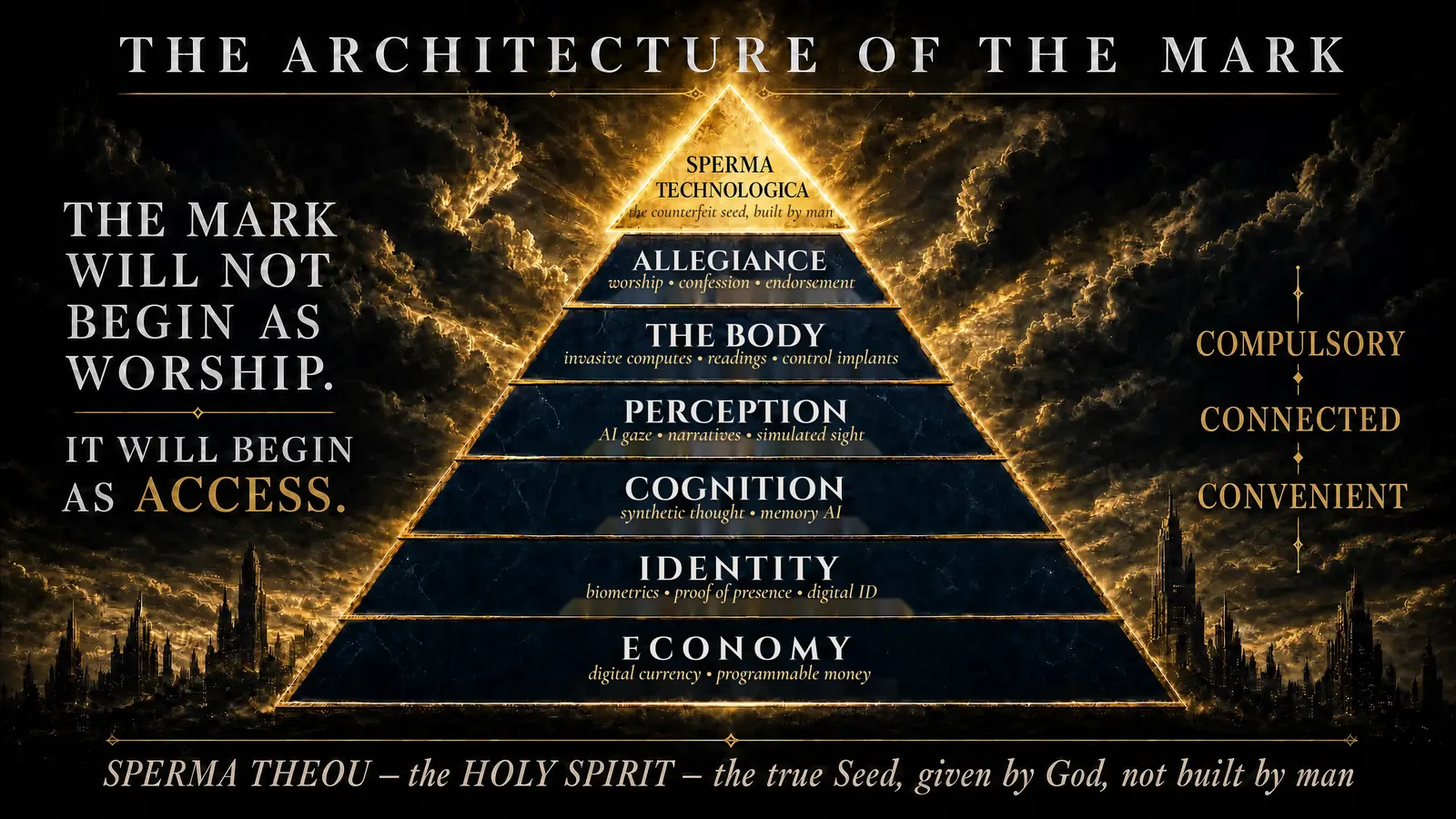
Let us say the qualifications plainly, because credibility is the watchman’s only currency. This terminal inscribes nothing on anyone. It mandates nothing; a shopper in Sydney may pay with a card tomorrow and never enroll at all. It carries no allegiance, no worship, no name and no number of a beast — and those, not the biometrics, are the substance of the mark. We are not announcing a fulfillment. We are reporting that the hardware of ordinary commerce now reads the two places the prophecy names, and that it arrived not with a decree but with a product launch.
Set this dispatch beside the last one and see the architecture whole. Manila built the gate at the account: no verified body, no participation in banking. Australia now installs the reader at the counter: the body as the credential of the individual purchase. One is regulation, the other retail; one compels, the other charms. They are converging on the same threshold from opposite ends of a transaction — and New Zealand received these terminals a month before Australia did, with the banks and acquirers to distribute them across the region in the months ahead.
So watch the counters, not just the capitals. Decrees announce themselves; product lines simply ship. Watch which conveniences are offered, how quickly they become defaults, and who someday decides that the older ways may be retired. And remember that there is one ledger where no scanner will ever be installed — the Lamb’s book of life, where the names were not read off any man’s hand, but written in His own blood.
What Happened
On August 13, ID Tech Wire reported that Verifone has introduced its Victa terminal range to Australia, enabling customers to authenticate point-of-sale payments with facial recognition or palm-vein verification. The range spans portable and mobile units, a merchant-facing register, a customer-facing lane device, and ruggedized unattended models for kiosks, vending, transit, and parking. Australia is among the first Asia-Pacific markets to receive the devices; New Zealand’s launch preceded it by roughly a month.
Consumers enroll through participating providers — merchants, digital wallets, or banks — and must give consent. At checkout, an enrolled customer actively selects the biometric option and presents a face or palm for verification against a profile retained by the provider, not the terminal. Biometric payment remains optional alongside card, phone, and PIN. The devices carry PCI PTS 7.x certification with point-to-point encryption and tokenization, are built with 60 percent recycled plastics and field-replaceable batteries rated for at least twelve hours, and include haptic and audio navigation cues. The platform also supports loyalty check-ins, ordering, split payments, donations, and third-party applications.
Verifone’s head of strategic partners, Kristy Gregory, framed adoption as continuous with existing habits: “People already use biometrics to unlock phones, access apps and confirm payments online.” Ben Hughes, head of product for Asia Pacific, pointed to loyalty and alternative-payment applications already operating in New Zealand. Merchant distribution through Verifone’s banking and acquiring partners is anticipated in the coming months.
Free Biblical Briefing
The Mark Will Not Look Like a Mark
Receive The Watchman’s Dossier—a focused guide to Revelation 13, AI, digital identity, programmable money, biometric control, and neural interfaces.
Enter your email once to unlock every free resource on this site.
Receive your free resource, a short welcome email series, and ministry updates. Unsubscribe anytime. Privacy policy.