The Mark of the Beast
No ID, No Account: Manila Makes Biometric Identity the Key to Banking
A central bank has proposed that a face and a fingerprint become the precondition of an account. Not a pilot. Not a forecast. A compliance clock.
By Michael Kendrick · August 10, 2026
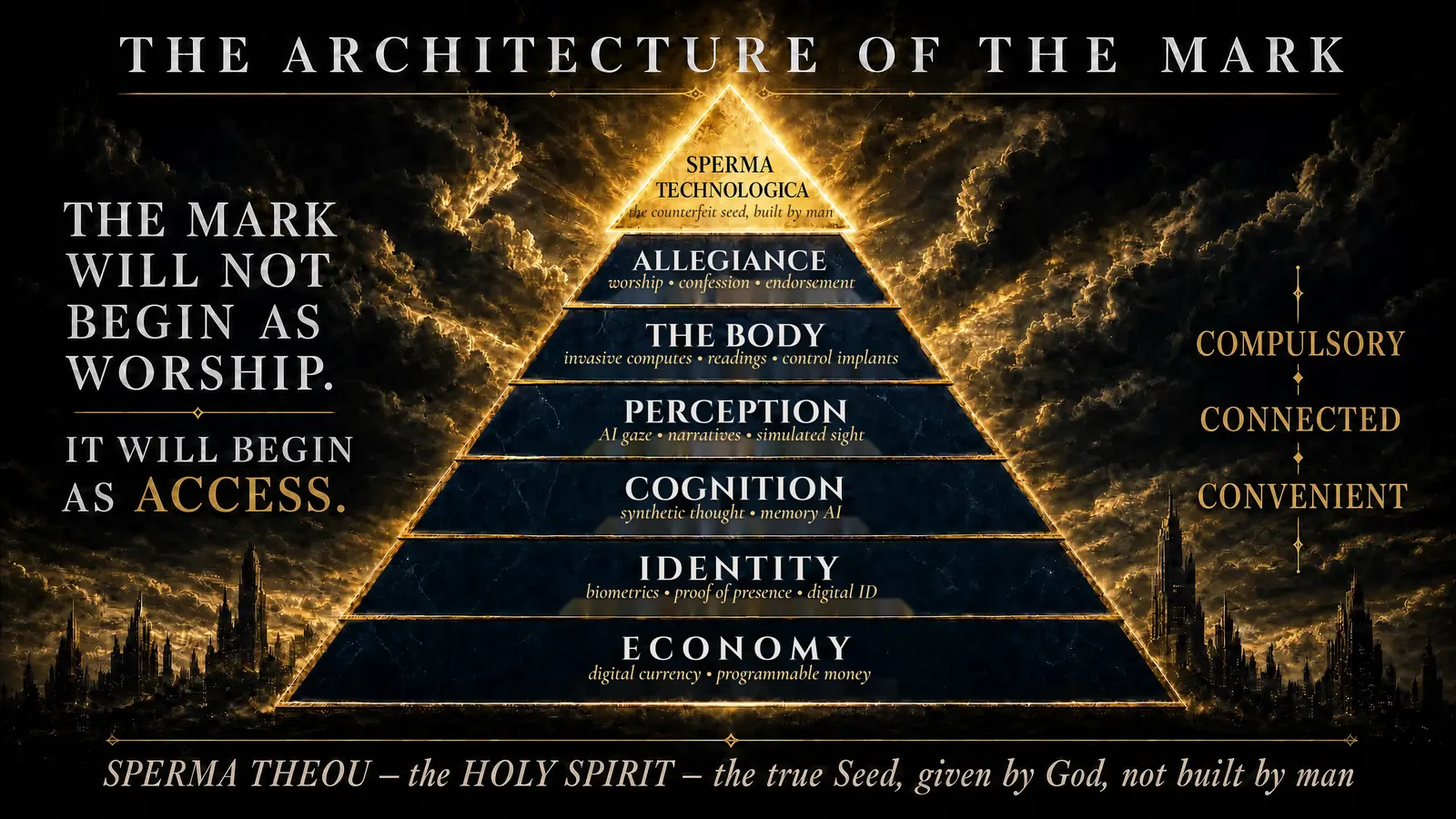
Read the proposal slowly, because the sentence that matters inside it is short: no verified identity, no account. The Bangko Sentral ng Pilipinas has asked that every supervised financial institution in the country wire the government’s National ID Authentication Services directly into the moment a customer is identified — onboarding, account opening, the routine refreshing of a customer’s file. The verification is biometric. A face. A fingerprint. A national number held in a government system.
The Wall has tracked this pattern in pieces. Europe pouring the rails for a programmable central-bank euro. World issuing cryptographic proof of unique humanity to agents that buy and sell. Mexico binding a biometric record to every phone line in the country. Each of those was a component — the money, the credential, the tether. What Manila has proposed is different in kind, and it deserves to be named precisely: this is a monetary authority writing the gate itself into regulation.
Consider what a gate is. Surveillance watches what you do. A gate decides whether you may do it at all. Under this proposal a bank does not merely record that you opened an account; the bank cannot open it until a government service returns a match on your body. Identity stops being something you assert and becomes something that must be granted — in real time, by a system you do not own, from which there is no appeal at the counter.
Note the clock, too. Three months for the institutions with the largest retail bases and the deepest digital operations. Six months for everyone else. That is not a horizon; it is a construction schedule, measured out in fiscal quarters, for the institutions that already hold the accounts of a nation. Brussels penciled its digital euro in for 2029. Manila has penciled this in for winter.
The stated reasons are the reasons that are always given, and several of them are true. Stronger controls against fraud. Accuracy and security in identity checks. Financial inclusion — the poor man with no documents can be enrolled by his own hand and face, and in a country where millions have never been bankable that is a real mercy. The watchman is not required to pretend otherwise. He is required to notice that here the mercy and the mechanism run along the same wire.
Because Revelation 13 does not describe a surveillance state. It describes a threshold. The second beast causes all — small and great, rich and poor, free and bond — to receive a mark, and the consequence John names is not that they are watched, but that no man might buy or sell save he that had it. The prophecy turns on permission attached to the body. And the architecture now being poured attaches permission to the body: an authentication that reads the face and the hand, standing between a person and the account through which he is paid, buys food, and pays rent.
Let us say the qualifications plainly, because credibility is the watchman’s only currency. This is a proposal out for comment, not a final memorandum. It authenticates a person against a national ID; it inscribes nothing on anyone. It carries no allegiance, no worship, no name and no number of a beast — and those, not the biometrics, are the substance of the mark. We are not announcing a fulfillment. We are reporting that a central bank has written into ordinary banking regulation the one clause the prophecy requires: no verified identity, no participation.
Watch also what came before the mandate. GoTyme Bank had already tied account opening to national-ID authentication — voluntarily, as a convenience, a faster way to get through the paperwork. That is how the sequence runs. The optional becomes the ordinary, the ordinary becomes the expected, and the expected is written into the memorandum. Capacity precedes compulsion, and compulsion is only the paperwork catching up.
So learn to read a compliance schedule the way you read a map. Watch which gates are built, who holds the keys, and how quietly a convenience hardens into a condition. And remember that the Shepherd who calls His own sheep by name has never once required them to prove it.
What Happened
On August 6, the Bangko Sentral ng Pilipinas proposed requiring supervised financial institutions to integrate the government’s National ID Authentication Services (NIDAS) into customer identification and verification. NIDAS, developed by the Philippine Statistics Authority, confirms identity through facial recognition, fingerprints, national ID numbers, and related credentials held in the government system.
The scope covers universal and commercial banks, thrift banks, rural and cooperative banks, covered payment-system operators, and any institution performing know-your-customer or know-your-merchant functions. It would apply at customer onboarding, at account opening, and at risk-based updates to customer information. Institutions with large retail customer bases and digital operations would have three months from the issuance of the final memorandum to comply; other covered entities would have six.
The BSP frames the measure as improving the accuracy, security, and efficiency of identity checks, strengthening know-your-customer controls, and advancing wider national ID adoption, financial inclusion, digitalization, and financial integrity. Reported the same day by the same outlet: GoTyme Bank has already connected account opening to Philippine national ID authentication.
Free Biblical Briefing
The Mark Will Not Look Like a Mark
Receive The Watchman’s Dossier—a focused guide to Revelation 13, AI, digital identity, programmable money, biometric control, and neural interfaces.
Enter your email once to unlock every free resource on this site.
Receive your free resource, a short welcome email series, and ministry updates. Unsubscribe anytime. Privacy policy.