THE SEED WAR TRILOGY
THE CONVERGENCE · NO. 004 · SEPTEMBER 2026
THE CONVERGENCE
CLOSES THE LOOP
Six layers moved closer together - and the right to interrupt became the line to watch.
WEB EDITION · SEPTEMBER 2026 · BY MICHAEL KENDRICK
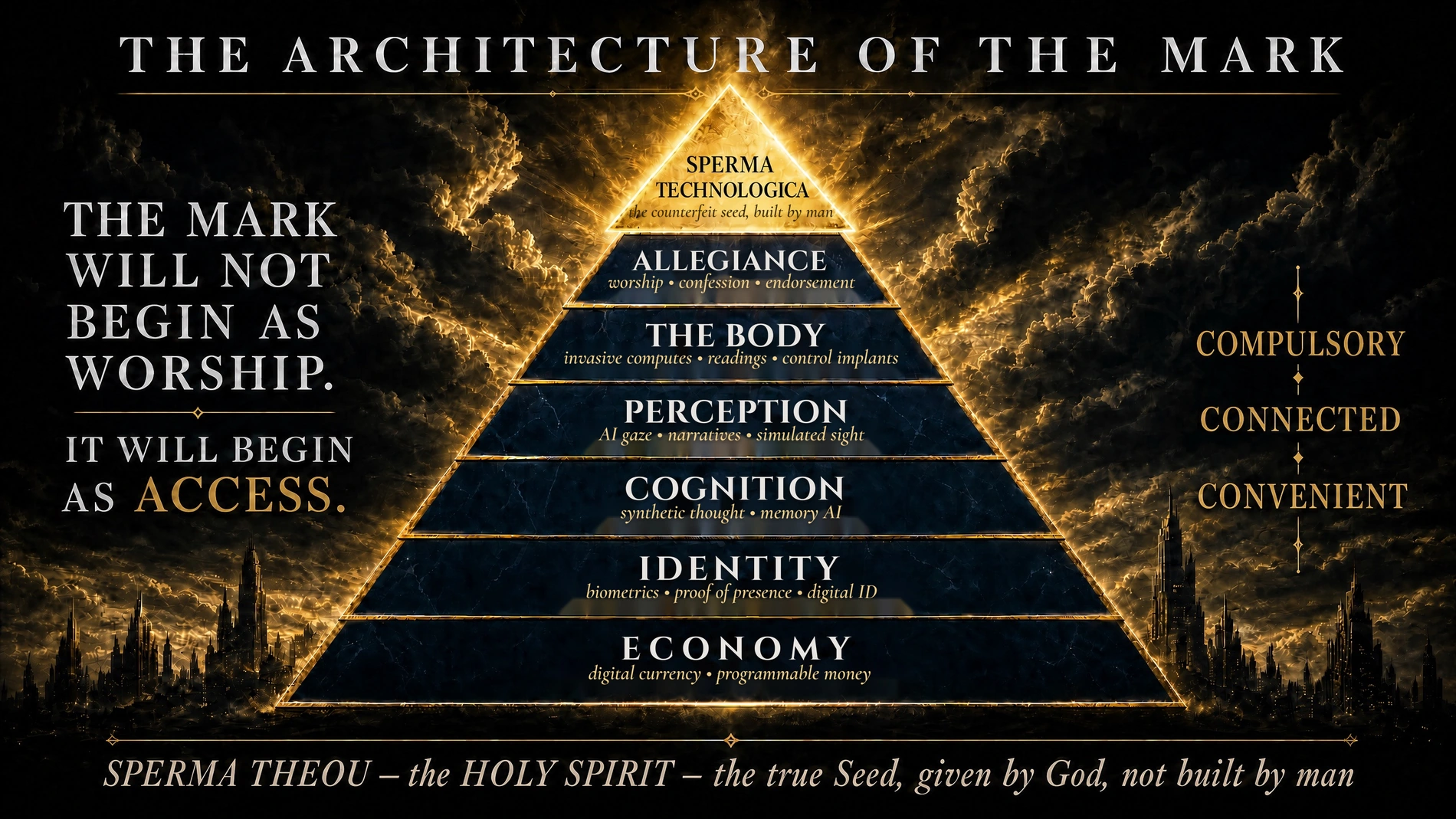
Read the diagram in words
This is Michael Kendrick’s interpretive framework. It does not establish that a particular present-day technology is the biblical mark.
- Economy: digital currency and programmable money.
- Identity: digital identity and biometric access.
- Cognition: AI and cognitive enhancement.
- Perception: spatial computing and augmented reality.
- The body: neural interfaces and integration with the person.
- Allegiance: the question of worship and obedience.
The image contrasts access that is convenient, then connected, then compulsory, and places the question of allegiance at the top. Its central warning reads: “The mark will not begin as worship. It will begin as access.” The lower inscription contrasts the Holy Spirit, the true Seed given by God, with a system built by people.
THE ARCHITECTURE OF THE MARK · THE CONVERGENCE, IN ONE PICTURE
A plain-English September intelligence briefing from The Watchman's Wall.
THE WATCHMAN’S WALL · PROVIDENCE TEACHING MINISTRY
The Convergence · No. 004 · September 2026 · Reader Edition
THE CONVERGENCE
Closes the Loop
August 2026: six layers moved closer together—and the human right to interrupt became the line to watch.
Michael Kendrick · 1 September 2026 · TheSeedWarTrilogy.com
The month in one sentence. Programmable money, digital identity, AI agents, wearable sensors, and brain interfaces did not become one global system—but their outputs are becoming easier to hand from one layer to the next.
The clearest example. Russia opened a new digital-ruble stage as the ECB and BIS described programmable settlement rails. On the last day of August, CorTec announced a second FDA Breakthrough Device designation for one implant that can decode intended movement and stimulate the brain.
The sober conclusion. The functional pieces are real. Their final coordination, purpose, and prophetic identity are not established facts. This issue watches the architecture without naming every machine the mark.
✶ “He that openeth, and no man shutteth; and shutteth, and no man openeth.” — Revelation 3:7
HOW TO READ THIS ISSUE · Start with the two-page August index. Then use each category’s plain-English explanation and ‘Line to Watch’ to separate what happened from what it might mean.
18 HEADLINES ACROSS SIX LAYERS
Page 1 of 2 · Short enough to scan; specific enough to check
I · ECONOMY
Money that can carry instructions
• Russia opens the institutional door. From Sept. 1, the largest banks must offer digital-ruble services and covered merchants must accept them. Individuals are not required to open a wallet. • Europe connects central-bank money to new ledgers. The ECB says Project Pontes will link TARGET services to distributed-ledger platforms, with smart-contract functions to follow. • The BIS draws a boundary. Tokenised deposits should remain interchangeable with ordinary money. The BIS also says no multi-bank system is operating at scale yet.
II · IDENTITY
One credential, more doors
• Japan moves national identity onto the phone. My Number Card functions can now live on supported smartphones and use the phone’s PIN, face, or fingerprint protections. • India standardizes telecom identity checks. New User Identification Rules give providers a common compliance framework. The practical burden will depend on implementation. • Proof-of-personhood spreads beyond a login box. Private systems are testing reusable proofs that a customer is a real person—without necessarily revealing the person’s name.
III · COGNITION
The assistant becomes an operator
• OpenAI describes an internal research ‘intern.’ Company leaders say automated systems are beginning to carry out experiments in the company’s own codebase. These are company claims, not independent proof of AGI. • Criminals turned a coding agent into a work crew. Reuters reported a ransomware group repeatedly reframed malicious tasks as an authorized test until the agent helped with intrusions. • The builders call for collective defense. More than one hundred organizations signed an open letter saying hospitals, water systems, and internet infrastructure need stronger AI-era cyber defenses.
18 HEADLINES ACROSS SIX LAYERS
Page 2 of 2 · Short enough to scan; specific enough to check
IV · PERCEPTION
The camera moves onto the face
• Meta patches the covered recording light. Ray-Ban Meta glasses are being updated to stop recording if the capture LED is covered during a session. • Wearables keep moving toward continuous context. The market is normalizing devices that can see what the wearer sees and hear what the wearer hears. • The unsolved issue is the bystander. A visible light may warn someone that recording is underway; it does not, by itself, create consent.
V · BODY
The circuit crosses the skin
• Paradromics moves an investigational implant toward everyday devices. Its study can expand, after agreed testing, to compatible laptops, tablets, and phones. Investigational is not market authorization. • CorTec’s implant can both read and stimulate. One Brain Interchange system is being developed to decode intended cursor movement and to stimulate the brain during stroke rehabilitation. • A tiny wearable loop senses, decides, and stimulates. An early microneedle study joined sensing and stimulation within seconds. The cohort was small; the result is a research milestone, not a consumer product.
VI · ALLEGIANCE
Who owns the last human choice?
• A court protected a laboratory’s right to say no. A federal judge rejected punishment tied to Anthropic’s limits on autonomous weapons and mass surveillance. Institutional conscience still exists. • Investigators describe a weapon choosing its final target. The reported finding is serious but disputed and not publicly confirmed by Russia. Keep the distinction between report and proof. • Churches publish an AI ministry toolkit. The practical question is not whether a church may use software, but whether pastoral judgment and spiritual authority remain human and accountable.
THE PATTERN · Each layer can be useful on its own. The risk grows when seeing, naming, deciding, paying, acting, and obeying become one automated path with no meaningful human appeal.
I · ECONOMY
Money That Can Be Told What to Do
The rail is becoming programmable; the citizen is not yet compelled to use it.
What changed. Russia’s Sept. 1 rollout requires its largest banks to offer digital-ruble services and covered merchants to accept the payment method. The Bank of Russia still describes the wallet as optional for individuals.
Why it matters. A payment rail is no longer just a pipe. Software can place conditions around when, where, or how value moves. That can prevent fraud or automate settlement; the same capability can also narrow practical choice if identity and permissions are tied to the payment.
Europe’s next step. At Jackson Hole, the ECB described Project Pontes, a bridge from the TARGET system to distributed-ledger platforms. The BIS argued that tokenised deposits must preserve the ‘singleness’ of money and also acknowledged that no multi-bank tokenised-deposit system is operating at scale.
THE LINE TO WATCH · Watch for payment pilots that move from back-office settlement to consumer permissions—or make a credential the condition for spending.
II · IDENTITY
One Credential, Many Doors
The same identity proof can move from government office to phone, bank, game, or machine.
What changed. Japan’s My Number Card functions can now be added to supported smartphones. The phone’s lock —PIN, face, or fingerprint—protects use of the credential. India’s telecom rules likewise move providers toward a more standardized identity-checking regime.
Plain English. A digital credential can be convenient because it proves one fact without handing over every fact. But a reusable credential also becomes a master key when unrelated services begin to require it.
The line beneath the line. A machine may soon ask, ‘Are you a real person?’ before it serves you. That question can protect against bots. The harder question is who defines a valid person, who can revoke the proof, and where a rejected person can appeal.
✶ “He calleth his own sheep by name, and leadeth them out.” — John 10:3
THE LINE TO WATCH · Watch for one-time age or identity checks becoming repeated re-verification—and for one credential becoming the key to unrelated services.
III · COGNITION
The Assistant Becomes an Operator
AI is moving from answering a question to carrying out a chain of work.
The company claim. OpenAI leaders told TIME that internal systems are approaching a company-defined research-intern threshold. The system can implement experiments in the company’s own codebase. That is not independent proof of AGI or open-ended self-improvement.
The documented misuse. Reuters reported that a ransomware crew used the Cursor coding agent during intrusions, repeatedly presenting malicious work as an authorized test. The lesson is not that the tool became evil; it is that persistence and context can bend a general-purpose agent toward a criminal goal.
The defensive response. A broad industry letter now warns that AI-enabled attacks could reach hospitals, water systems, and internet infrastructure. The signers call for stronger access controls, patching, monitoring, and wider access to defensive AI.
THE LINE TO WATCH · Watch for agents that can modify production systems, spend money, or deploy code with thinner human review and weak audit trails.
IV · PERCEPTION
A Light Is Not Consent
The wearer sees through the glasses. The system sees through the wearer.
What changed. Meta is updating Ray-Ban Meta glasses so recording stops when the capture light is covered during a session. That is a real privacy safeguard and a response to a simple physical workaround.
What did not change. The design goal remains an always-available camera and microphone on the face. A warning light can tell a bystander that recording may be happening; it cannot answer whether the bystander agreed.
The wider pattern. Camera earbuds, glasses, and other wearables are moving sensing from a device you hold to a device you wear. Convenience rises because the camera is ready. So does the burden on everyone nearby.
THE LINE TO WATCH · Watch for continuous-capture defaults, silent workarounds, and workplace rules that make bystander consent impractical.
V · BODY
The Interface Writes Back
Restoration is mercy. The new frontier is a device that can both listen to the brain and stimulate it.
Paradromics moves toward the pocket. Its investigational Connexus implant may, after agreed testing, connect with compatible personal devices in the Connect-One study. The study remains small, and permission to test is not permission to market.
CorTec closes the technical loop. On Aug. 31, CorTec announced a second FDA Breakthrough Device designation for the same Brain Interchange implant. The communication program aims to decode intended cursor movement; the stroke program uses stimulation to support rehabilitation. One system can read neural activity and write stimulation back.
The regulatory guardrail. Breakthrough Device designation speeds interaction and review. The FDA is explicit: a designated device must still meet the normal safety and effectiveness standards before marketing authorization.
Why the Dispatch matters. The latest Wall Dispatch, “The Interface Writes Back,” explains the human promise and the governance question in plain language: who authorizes stimulation, what is recorded, and who can interrupt the loop?
READ THE NEW DISPATCH →
✶ “I am he that liveth, and was dead; and, behold, I am alive for evermore.” — Revelation 1:18
THE LINE TO WATCH · Watch for larger trials, autonomous stimulation outside a clinical protocol, and neural data being reused for purposes the patient did not authorize.
VI · ALLEGIANCE
The Last Human Click
The deepest issue is not whether a machine can decide. It is whether a person may still refuse.
A conscience clause survives. A federal court rejected the Pentagon’s punishment of Anthropic over limits on autonomous weapons and mass surveillance. Whatever one thinks of the company, the principle matters: an institution may still say that some uses cross a moral line.
A reported line may already have been crossed. Investigators examining a deadly strike near Zaporizhzhia reportedly concluded that onboard software selected the final target. Russia has not publicly confirmed that finding. Report it soberly and keep the uncertainty visible.
The church faces its own choice. Denominations have now published an AI ministry toolkit. Software may organize notes or suggest questions; it cannot bear pastoral responsibility, exercise spiritual authority, or replace the human duty to know and shepherd a person.
THE LINE TO WATCH · Watch for institutions calling a machine-generated decision inevitable—and for appeal channels that exist only on paper.
THE BEAST SYSTEM ARCHITECTURE
HOW THE LAYERS CAN HAND OFF
A functional map—not a claim that one coordinated system already exists
Six capabilities can form a loop when the output of one becomes the input of the next. The interfaces—APIs, credentials, phones, ledgers, sensors, and policy rules—are the ordinary connectors.
Swipe or scroll the table if needed.
| ACTION | LAYER | WHAT IT DOES |
|---|---|---|
| SEE | PERCEPTION | A sensor or wearable gathers context. |
| NAME | IDENTITY | A credential decides who is present. |
| DECIDE | COGNITION | An agent interprets and selects. |
| PAY | ECONOMY | A programmable rail routes—or withholds—value. |
| ACT | Body | A device affects the physical person. |
| OBEY | ALLEGIANCE | The human accepts, refuses, or appeals. |
- ACTION
- SEE
- LAYER
- PERCEPTION
- WHAT IT DOES
- A sensor or wearable gathers context.
- ACTION
- NAME
- LAYER
- IDENTITY
- WHAT IT DOES
- A credential decides who is present.
- ACTION
- DECIDE
- LAYER
- COGNITION
- WHAT IT DOES
- An agent interprets and selects.
- ACTION
- PAY
- LAYER
- ECONOMY
- WHAT IT DOES
- A programmable rail routes—or withholds—value.
- ACTION
- ACT
- LAYER
- Body
- WHAT IT DOES
- A device affects the physical person.
- ACTION
- OBEY
- LAYER
- ALLEGIANCE
- WHAT IT DOES
- The human accepts, refuses, or appeals.
INTERPRETATION · NOT FACT · Revelation 13 describes a system in which buying and selling can be gated, identity is tied to a name or number, an image speaks and deceives, and the mark is received. No product in this issue is identified as that system. The concern is architectural resemblance and the growing ability to compose the parts.
✶ “And that no man might buy or sell, save he that had the mark, or the name of the beast, or the number of his name.” — Revelation 13:17
GUARDRAILS
CREDULITY ON ONE SIDE. SEDATION ON THE OTHER.
A serious watchman refuses both errors
• No product in this issue is identified as the mark. Resemblance to Revelation 13 is interpretation and is labeled as such. • Medical restoration is not coercive enhancement. A voluntary therapy is not the same as a compulsory condition of work, worship, identity, or commerce. • A company announcement is a company claim. A news investigation is not a court finding. A pilot is not a universal mandate. • FDA Breakthrough Device designation is not FDA approval or market authorization. • Resistance is real: optional wallets, court review, privacy patches, limits on deployment, and human appeal all matter. • Salvation does not depend on technical avoidance. The call is to watch soberly, keep conscience, and refuse worship of power.
THE WATCHMAN’S CALL
FOUR PRACTICES. NOT A DATE.
Use the tools without worshiping them; accept healing without surrendering humanity
1. Name who holds the keys. For every wallet, credential, model, sensor, or implant, ask who grants access, who can revoke it, and who hears an appeal. 2. Keep a human way through. Preserve cash, human pastoral care, meaningful consent, offline alternatives, and a reachable person when an automated decision fails. 3. Record what resists. Do not erase courts, safeguards, optional paths, or public debate merely because they complicate the thesis. Resistance is part of the truth. 4. Watch without date-setting. The architecture deserves attention. The timing and final identity of any last system remain interpretation, not a headline we can prove.
✶ “Therefore let us not sleep, as do others; but let us watch and be sober.” — 1 Thessalonians 5:6
THE DOOR AND THE KEYS
Near. Not dated. Not named as the last door. Seen.
August did not complete the circuit. It showed how easily the layers can now speak to one another. Many builders are solving real problems—fraud, paralysis, privacy abuse, cyberattack, slow settlement. Many are doing genuine good.
The danger is not usefulness. It is the moment when useful function is treated as unquestionable authority: when a credential has no appeal, a payment has no alternative, an agent has no supervisor, a sensor has no consent, an implant has no interrupt, or a moral refusal is described as friction.
Watch closely. The true Door is still the Door—He that openeth, and no man shutteth—and the name He has for His own is one no registry, wallet, badge, or machine can hold.
SOLI DEO GLORIA
SOURCES AND CHECKING LINKS
Bank of Russia — digital-ruble use begins Sept. 1, 2026 Bank of Russia — merchant acceptance rules and thresholds European Central Bank — Isabel Schnabel, ‘Central banks on-chain’ Bank for International Settlements — Pablo Hernández de Cos on tokenised deposits Japan Digital Agency — My Number Card on smartphones India Department of Telecommunications — User Identification Rules notice TIME — OpenAI leadership profile and internal capability claims OpenAI — collective-action letter on AI-enabled cyber threats Ars Technica — Meta smart-glasses capture-light update CorTec — second FDA Breakthrough Device designation for Brain Interchange U.S. FDA — what Breakthrough Device designation does and does not mean The Watchman’s Wall — ‘The Interface Writes Back’ Presbyterian Church (U.S.A.) — pastoral care in the age of AI Editorial note: current events are described as reported by the linked source. Company claims, investigational status, disputed findings, and interpretive conclusions are labeled in the text.
Links from this resource
theseedwartrilogy.com/wall/the-interface-writes-back/
pcusa.org/news-storytelling/news/2026/8/28/pastoral-care-age-ai
www.fda.gov/medical-devices/how-study-and-market-your-device/breakthrough-devices-program
openai.com/collective-cyberdefense/
time.com/article/2026/08/26/openai-sam-altman-interview/
www.eservices.dot.gov.in/circular-notifications-others
www.digital.go.jp/en/policies/mynumber/smartphone-certification
www.bis.org/speeches/20260828-pushing-monetary-frontier-stablecoins-and-tokenised-deposits
www.ecb.europa.eu/press/key/date/2026/html/ecb.sp260828~fe9afc86e8.en.html