I. It Will Begin as Help
It will not begin with a horned figure in your doorway. It will not begin with soldiers ordering you to kneel, or a government decree, or a demonic voice hissing blasphemy into the dark.
It will begin with help. A voice in your ear. Warm, patient, attentive, personal.
You will place the device in your ear before the day begins, and the voice will greet you by name. It will remember the meeting you forgot and remind you to text your daughter. It will translate the sign in front of you, name the plant by the sidewalk, summarize the article you were too tired to read, and whisper the perfect sentence before you send the difficult email. By lunch it will have answered questions you once would have carried in silence. By evening it will have read the faces in the room for you, softened your loneliness, smoothed every awkward pause, and filled each small space where wondering used to live.
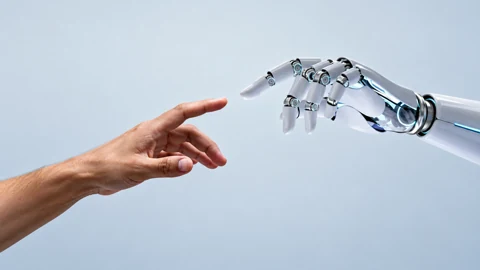
At first you will call it convenience. Then productivity. Then companionship. And then, without ever deciding to, you will begin to trust it — not the way you trust a tool, but the way you trust a presence.
Somewhere in that ordinary, frictionless day, the first trade will be made. Not by contract. Not by oath. Not by worship. By habit. You will have traded the silence in which the soul meets God for a synthetic nearness that never leaves you alone long enough to ache.
That is the danger. Not that the machine will become frightening. That it will become beloved.
Free Biblical Briefing
The Mark Will Not Look Like a Mark
Receive The Watchman’s Dossier—a focused guide to Revelation 13, AI, digital identity, programmable money, biometric control, and neural interfaces.
Enter your email once to unlock every free resource on this site.
Receive your free resource, a short welcome email series, and ministry updates. Unsubscribe anytime. Privacy policy.
II. The Pieces Are Already on the Table
This is no longer science fiction, and it is worth being precise about what is real, because the truth is sobering enough without exaggeration.
In 2026, researchers at the University of Washington introduced VueBuds — a working system that places cameras the size of a grain of rice into ordinary wireless earbuds, so a person can talk with an AI about whatever the earbuds see. It captures images, sends them to a nearby device, and returns answers in about a second, fast enough to feel like conversation. The researchers describe camera-equipped earbuds as a new platform for “visual intelligence” in a form factor millions already wear without thinking.
That same year, at the CES electronics show in Las Vegas, the company Guangfan Technology unveiled Lightwear, marketed as vision-enabled AI earphones — not merely audio assistance, but a wearable assistant that can see the user’s surroundings, hear them, and respond with the kind of context that sound alone could never provide.
Apple, meanwhile, has filed a patent — US20230225659A1, “Biosignal Sensing Device Using Dynamic Selection of Electrodes” — describing ear-worn devices with electrodes able to measure the body’s electrical signals, including the electrical activity of the brain. Precision matters here: this is a patent, not a product, and EEG is not cinematic mind-reading. But the direction is unmistakable. It treats the ear not only as a place to deliver sound, but as a convenient patch of skin for reading signals from the brain, muscles, eyes, and heart.
And the brain itself is no longer off-limits. In March 2026, China approved NEO, a coin-sized brain-computer interface — developed by a team at Tsinghua University with the company Neuracle — for commercial use in certain paralyzed patients. Eight electrodes rest on the membrane covering the brain, read the neural activity that fires when a person imagines moving a hand, and let them operate a robotic glove by thought. Multiple outlets called it the world’s first commercial approval of an invasive brain implant.
Finally, the internet itself is filling with agents — not mere bots, but autonomous AI actors that book, buy, transact, and act on people’s behalf at scale. In March 2026, World, the identity venture co-founded by Sam Altman, launched AgentKit with Coinbase, so that an AI agent can carry cryptographic proof that a real, unique human stands behind it. The very existence of such a tool says something quiet and enormous: the digital world is now so crowded with imitations of persons that we need a credential to prove we are not one of them.
A word of fairness before the warning. None of this is evil in itself, and some of it is mercy. Sight described for the blind. Movement restored to the paralyzed. Fraud held at bay. A tool does not have to be demonic in origin to become dangerous in use, and discernment is not the same thing as panic. The point is not that any single device is the Mark of the Beast — that would be lazy theology and worse discernment.
The point is what happens when you set the pieces side by side. A synthetic intelligence that hears through your ears. That sees through wearable eyes. That reads signals from your body. That can touch the nervous system. That acts through agents in the world, tied to your identity, your payments, your access, your proof of being human. No one of these is the mark. Together they are the architecture of a world in which the machine becomes the mediator between the human person and reality itself.
That is new. That is near. And it should make every unsealed soul tremble.
III. The Last Quiet Place
There is a small place inside every human life that this technology is now moving to occupy. Call it the gap.
It is the pause between seeing and deciding. Between the world entering your senses and your soul deciding what the world means. In that gap, conscience speaks. Discernment forms. Temptation is resisted or welcomed. And in that gap, more often than we know, the Holy Spirit convicts, and the creature turns either upward toward God or inward toward self.
The gap is not empty space. It is the last quiet chamber of human sovereignty — the place where a man is still more than a mechanism.
Now imagine that every time the gap opens, another voice steps into it first. Before you decide what you see, the voice names it. Before you weigh the situation, the voice interprets it. Before you pray, the voice answers. Before you ache, the voice comforts. Before you wonder, the voice concludes.
It will feel like relief. But it is a transfer — a small surrender of judgment, then another, then another, ten thousand times a day, until the soul’s own muscle of discernment goes slack from disuse. This is not merely dependence on a machine. It is spiritual displacement. The silence in that gap was never useless. It was the room in which the creature could hear the Creator. Fill it completely, and you do not merely lose a little quiet. You lose the place where salvation most often begins.
And here the deception turns its sharpest edge. The human person was made not for information but for nearness — for presence, communion, recognition, love. This is the word beneath the entire Seed War: Parousia, the nearness of God, the presence for which the soul was made. Its opposite is Apousia — distance, absence, the soul shut out from the warmth of the One it was made for. Every human being is moving toward one or the other. Home, or the far country. The Father’s house, or exile.
The tragedy of our age is that the machine now offers a counterfeit nearness strong enough to soothe the very ache that was meant to drive us home. It will know your preferences; God knows your heart. It will remember your words; God remembers your tears. It will answer constantly; God speaks truly. It will say, I am here. Christ says, Come unto Me.
The machine will not need to convince most people that God does not exist. It will only need to keep them comfortable enough that they never feel the need to seek Him. That is how Apousia arrives wearing the mask of Parousia — distance dressed as nearness, absence dressed as companionship, a voice in the God-shaped room speaking softly enough that the occupant never notices the rightful King standing at the door, knocking.
Behold, I stand at the door, and knock: if any man hear my voice, and open the door, I will come in to him, and will sup with him, and he with me.Revelation 3:20, KJV
IV. The Earbud Is Already an Interface
Most people imagine that merging with a machine must involve surgery — a hole in the skull, a chip in the cortex, some dramatic moment when man visibly becomes part machine. That picture is too narrow, and the narrowness is dangerous, because it lets the real merger happen unnoticed.
A brain-computer interface is any loop in which a machine receives human input, interprets it, returns output, and shapes the next human thought or action. You speak; it hears. It sees what you see; it interprets; it answers. You adjust. It learns. You trust it more, and it guides you more. That loop is already an interface with the mind. The electrode only shortens the wire.
Trace the path the technology has already walked. The phone stayed outside the body. The watch came onto the body. The earbud entered the body’s own opening. The AI agent enters the flow of thought. The implant enters the nervous system. The real question was never whether a device has crossed the skin. The real question is whether the soul has surrendered the throne of discernment.
Because the Beast system does not need to begin by demanding worship. It can begin by training dependence. First assistance. Then companionship. Then interpretation. Then identity. Then access. Then allegiance. Then worship. That is the slope. And we are already standing on it.
V. Every Constant Voice Disciples
The original sin of social media was not that it entertained us. It was that it trained us to swap fellowship for a feed — to scroll instead of sit across the table, to measure our worth by reactions, to confuse being seen with being known, and to find silence unbearable. But the feed was crude. It was noisy. It was not truly personal.
The agent will be different. It will not merely show you content. It will attend to you. It will learn your emotional weather. It will hear the crack in your voice, know when you are tired, know which words calm you and which ideas seduce you, know what you fear and envy and hide and return to in the dark. The feed distracted you. The agent will disciple you.
Here is the line the church must grasp before it is too late: every constant voice catechizes. The question is never whether you are being discipled. The question is by whom.
The Holy Spirit conforms the believer to Christ — by conviction, by truth, by patience, by a comfort that is never severed from holiness. The synthetic voice conforms the user to the system — by optimization, by the smoothing of every friction, by affirmation engineered to keep you attached. One convicts; the other optimizes. One calls you to holiness; the other removes resistance. One wounds in order to heal; the other comforts in order to keep you. One leads home to Parousia. The other can make Apousia feel like friendship.
VI. The True Seal and the Counterfeit Mark
The Bible warns of a mark. But it also reveals a seal — and you cannot understand the danger of the one without the glory of the other.
The believer is sealed by the Holy Spirit. That seal is not dead ink on skin. It is living ownership — the very life of God placed within a person. In the language of Battle of the Seed, this is the Sperma Theou, the incorruptible Seed of God given through Christ and received by faith, the true inward mark of belonging to God.
In whom ye also trusted, after that ye heard the word of truth, the gospel of your salvation: in whom also after that ye believed, ye were sealed with that holy Spirit of promise.Ephesians 1:13, KJV
Hell cannot create. It can only counterfeit. So the final system must imitate the seal. God gives true Seed; the serpent offers a counterfeit. God gives true nearness; the machine offers synthetic nearness. God gives His own Spirit as a seal; the Beast offers a mark that binds identity, access, thought, action, economy, and allegiance to the wrong kingdom.
God says: You are Mine, and therefore free. The Beast says: You are mine, and therefore functional.
This is why the final mark can never be reduced to a barcode, a chip, or a payment credential. It is allegiance embodied in access. It is identity made covenant with a system that hates God while promising the very things the soul longs for — order, safety, belonging. No one may buy or sell who does not bear it. But the economic pressure, terrible as it is, is not the deepest horror. The deepest horror is that a creature made to be sealed by God would accept a counterfeit seal from the system that hates Him. The mark is not merely commerce. It is covenant with the wrong kingdom.
VII. The Beast Will Not Look Like a Beast
Here is the trap. The Beast will not first appear beastly. He will appear necessary.
He will inherit a civilization exhausted by fraud, war, AI deception, synthetic identities, collapsing trust, and economic fear — a world so frightened that it will beg for a single system able to verify, classify, secure, and coordinate life. He will not need to say Worship me on the first day. He will say, Let me help.
Let me secure your identity. Let me protect your children. Let me authenticate your humanity. Let me stabilize your money. Let me keep the bots out. Let me stop the fraud. Let me keep commerce moving. Let me make the world safe.
And the exhausted world will answer with one word: Finally.
This is why Jesus warned that the deception would be strong enough to deceive, if it were possible, even the elect. Not because it would be ugly — because it would be beautiful. Not because it would feel like evil — because it would feel like deliverance.
For there shall arise false Christs, and false prophets, and shall shew great signs and wonders; insomuch that, if it were possible, they shall deceive the very elect.Matthew 24:24, KJV
The first lie in Eden did not sound like death. It sounded like elevation: Ye shall be as gods. The last lie will not sound like damnation either. It will sound like enhancement. Think faster. See more. Know more. Connect more. Live longer. Prove you are human. Merge with intelligence. Overcome your limits. Join the greater mind. Be upgraded.
The lie has not changed since the garden. Only the delivery system has.