START HERE · THE ANSWER IN SIXTY SECONDS
What Happens at the Second Coming of Jesus Christ?
The Bible’s answer is not a date. It is a Person—and a sequence of saving, judging, and kingdom-
making acts centered on Him.
CENTRAL THESIS
The Second Coming is not Jesus returning to finish a struggle whose outcome remains uncertain. It is the public unveiling of the victory already secured by His cross and resurrection. The same Jesus who ascended will return personally, bodily, visibly, and gloriously. He will raise or transform His people, overthrow rebellious power, judge with perfect justice, reign as King, and carry creation to the day when death itself is gone.
Picture the moment without the haze of prediction charts. The heavens open. The Christ who once stood silent before human judges is revealed as the Judge of all. The world does not manufacture His kingship by recognizing it; the world discovers the kingship it has resisted. The trumpet is not a campaign signal. It is the announcement that history’s rightful Lord has arrived. Graves yield their dead. The living are changed. Violence meets a word it cannot outshout. Every rival authority is exposed as temporary.
This guide follows a literal-futurist, premillennial reading: Christ returns before the thousand-year reign described in Revelation 20. That reading provides a coherent order from Revelation 19 through Revelation 22 and takes seriously the surviving nations of Zechariah 14 and the mortal conditions of Isaiah 65. Yet it is a whole-Bible synthesis, not a timetable printed in one chapter. Wherever faithful Christians differ, the difference is named.
“This same Jesus, which is taken up from you into heaven, shall so come in like manner as ye have seen him go into heaven.”
— ACTS 1:11 | KJV
What this guide will show
• What Scripture states explicitly about Christ’s appearing. • A carefully qualified order of events after the heavens open. • How resurrection, Israel, judgment, the Millennium, and new creation fit together. • Where premillennial, amillennial, and postmillennial readers differ—and why. • How the promised return of Jesus should change the way we live now.
THE PROMISE CHRISTIANS CONFESS
The King Who Left Will Return
Before Christians debate the Millennium or the rapture, they stand together beneath a far older
confession: Jesus will come again in glory.
The church’s historic center is remarkably clear. The risen Jesus ascended as an embodied Lord. He now reigns at the Father’s right hand. He will return as the same Jesus, not as an idea, an invisible influence, or merely a symbol for social progress. His coming will be public and glorious; He will judge the living and the dead; His kingdom will have no end. That is the substance confessed across Nicene Christianity and affirmed by evangelical statements from Lausanne to the major Protestant traditions.
Four truths that should not be diluted
• Personal and bodily. Acts 1:9–11 anchors the return in the identity of ‘this same Jesus.’ Philippians 3:20– 21 connects His arrival to the transformation of our bodies. • Visible and public. Matthew 24:27–30 compares the coming to lightning across the sky. Revelation 1:7 says every eye will see Him. • Glorious and victorious. Matthew 25:31 surrounds Him with angels and a throne. Revelation 19 portrays the royal Word whose judgment ends the beast’s rebellion. • Saving and judging. Hebrews 9:28 speaks of His appearing for salvation to those who wait for Him; 2 Thessalonians 1:6–10 speaks of relief for the afflicted and justice against persistent evil.
The New Testament’s three great arrival words
PAROUSIA · PRESENCE / ROYAL ARRIVAL Used in Matthew 24:3, 27; 1 Corinthians 15:23; 1 Thessalonians 4:15; and 2 Thessalonians 2:1, 8. It emphasizes the arrival and presence of the King.
APOKALYPSIS · REVELATION / UNVEILING Used in 1 Corinthians 1:7, 2 Thessalonians 1:7, and 1 Peter 1:7, 13. The hidden Lord is disclosed to the world.
EPIPHANEIA · APPEARING / MANIFESTATION Used in 2 Thessalonians 2:8, 2 Timothy 4:1, 8, and Titus 2:13. Christ’s majesty becomes openly manifest.
INTERPRETIVE GUARDRAIL
These words overlap. They illuminate the same Christian hope from different angles; the vocabulary alone does not prove that one term means a secret phase and another a public phase. Chronology must come from passages and their canonical relationship, not from a dictionary shortcut.
THE BLESSED HOPE MADE VISIBLE
The King Appears
The Son of Man comes in power and great glory; every eye sees Him.
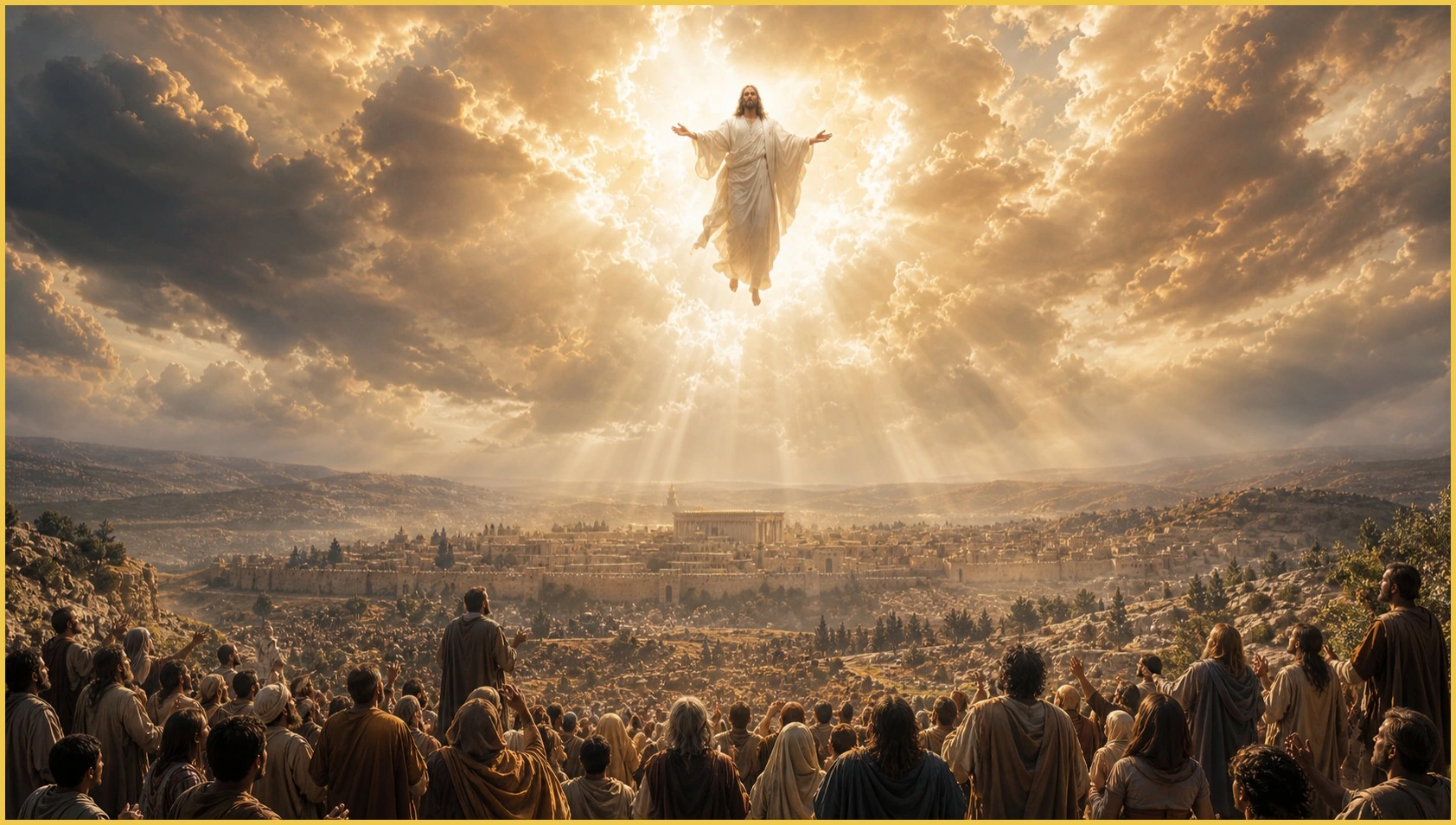
An artist’s visualization of Christ’s visible return—not a literal reconstruction. Scripture presents His appearing as public, glorious,
and judicial (Matthew 24:27–31; Revelation 1:7; 19:11–16).
“They shall see the Son of man coming in the clouds of heaven with power and great glory.”
— MATTHEW 24:30 | KJV
HOW PROPHECY GIVES US THE PICTURE
One Return, Several Windows
No single passage supplies every camera angle. Scripture gives several inspired sequences that must
be read together without forcing them into false precision.
The prophets often see mountain peaks without measuring every valley between them. Isaiah can place resurrection, judgment, kingdom blessing, and new creation inside one sweeping horizon. Jesus can move from Jerusalem’s fall to His final appearing with patterns that echo across both events. Revelation can retell the church’s conflict in cycles and also move forward in unmistakable narrative sequences. Responsible interpretation therefore listens first to each passage’s own order, then asks how the passages fit.
The four clearest internal sequences
MATTHEW 24:29–31 After tribulation: cosmic disturbance → the Son of Man appears → the peoples mourn → angels gather the elect.
1 THESSALONIANS 4:16–17 The Lord descends → the dead in Christ rise first → living believers are caught up with them → all meet the Lord.
1 CORINTHIANS 15:23–28, 50–58 Christ the firstfruits → those belonging to Christ raised at His coming → death abolished → the kingdom’s consummation. Revelation 20 supplies the premillennial interval; 1 Corinthians does not name its duration.
REVELATION 19:11–22:5 Christ appears → hostile powers fall → Satan is bound → saints reign → final revolt → final judgment → new heaven and new earth.
THE THREE LABELS USED IN THIS GUIDE
EXPLICIT TEXT means a passage states the point directly. STRONG SYNTHESIS means several passages fit together persuasively, although none coordinates every detail. DEBATED INFERENCE means a proposal is coherent within a system but remains meaningfully disputed.
This discipline matters because confidence in Christ’s return should not depend on confidence in every arrow on a chart. The event is certain. Many of its central acts are certain. Some of the spacing, overlap, and identity of prophetic groups are not. Humility about the latter strengthens rather than weakens faith in the former.
THE DAY THE SKY OPENS · PART ONE
The King Is Unveiled
The following chronology is Providence Teaching Ministry’s literal-futurist premillennial synthesis.
The opening acts are among Scripture’s clearest.
1 Cosmic signs announce the end of ordinary rule EXPLICIT TEXT Jesus places His visible coming after a period of great tribulation and amid the darkening of sun and moon and the shaking of heavenly powers. Apocalyptic language does more than describe weather: creation itself bears witness that the sovereign order is changing.
Key texts: Isaiah 13:9–13; Joel 2:30–31; Matthew 24:29; Luke 21:25–28
2 The Son of Man appears in the clouds EXPLICIT TEXT The sign is not hidden in a private chamber. The coming flashes like lightning across the sky. Daniel’s cloud-borne Son of Man is publicly unveiled, and the nations mourn. Some lament in terror; Zechariah also gives reason to see a pierced people mourning in repentance.
Key texts: Daniel 7:13–14; Zechariah 12:10–14; Matthew 24:27, 30; Revelation 1:7
3 The royal descent fills heaven with command and praise STRONG SYNTHESIS The Lord descends with a commanding cry, the voice of an archangel, and the trumpet of God. Mighty angels attend Him. Revelation sees the armies of heaven following the Faithful and True Rider. The scene is not a contest between equal powers; it is a royal procession into a world already claimed by its Creator.
Key texts: Matthew 16:27; 25:31; 1 Thessalonians 4:16; 2 Thessalonians 1:7; Revelation 19:11–16
4 The dead in Christ rise and the living are changed EXPLICIT CORE · TIMING DISPUTED Paul promises that believers who died will not miss the arrival. The dead in Christ rise first; living believers are caught up together with them; mortality puts on immortality. Historic premillennialism places the church’s gathering here. Pretribulational dispensationalism places the church’s transformation earlier and sees other elect gathered at the visible Advent.
Key texts: Matthew 24:31; 1 Corinthians 15:20–23, 51–55; 1 Thessalonians 4:13–18; Philippians 3:20–21
WHAT THE CLOUDS MEAN
In Scripture, clouds often mark divine glory and judgment, not concealment: Sinai, the tabernacle, Daniel’s Son of Man, the Transfiguration, the Ascension, and Revelation’s appearing. Jesus does not merely emerge from weather. Heaven’s authority is invading human sight.
THE DAY THE SKY OPENS · PART TWO
The Word Ends the Rebellion
The Antichrist’s regime does not collapse because another human coalition becomes stronger. It ends
when the true King speaks.
5 Israel beholds the pierced Messiah STRONG SYNTHESIS Zechariah foresees Jerusalem mourning over the One who was pierced and a fountain opened for cleansing. Paul says a hardening has come upon Israel in part until the fullness of the Gentiles enters, and ‘all Israel shall be saved.’ Providence understands this as a future widespread turning of ethnic Israel, without teaching salvation by ancestry. Its precise relation to the appearing may begin in the preceding crisis.
Key texts: Zechariah 12:10–13:1; Isaiah 59:20–21; Matthew 23:39; Romans 11:25–29
6 The lawless one is destroyed by Christ’s appearing EXPLICIT TEXT Paul’s man of lawlessness is not defeated by a technology, an election, or a battlefield maneuver. Jesus consumes him with the breath of His mouth and abolishes him by the manifestation of His coming. Revelation’s sword proceeds from the King’s mouth: His sovereign verdict is the decisive weapon.
Key texts: Psalm 2; Isaiah 11:4; 2 Thessalonians 2:8; Revelation 19:15, 21
7 The beast’s coalition falls EXPLICIT CORE · HARMONIZED SETTING Revelation gathers kings and armies against the Rider. The Beast and False Prophet are cast alive into the lake of fire, while the hostile forces are slain. Joel 3, Isaiah 63, and Zechariah 12–14 provide the Old Testament divine-warrior frame. Correlating every prophetic battle detail with a single engagement, however, goes beyond any one text.
Key texts: Joel 3:9–17; Zechariah 14:1–15; 2 Thessalonians 1:7–10; Revelation 16:12–16; 19:17–21
8 The Messiah stands as King over the earth STRONG CHRISTIAN SYNTHESIS Zechariah says the Lord’s feet stand on the Mount of Olives, the mountain divides, and the Lord becomes King over all the earth. Acts locates Jesus’ ascension in that vicinity and promises His return in like manner. Reading Zechariah’s divine Warrior as the returning Jesus is a powerful canonical conclusion, while the exact mechanics of every topographical detail remain disputed.
Key texts: Zechariah 14:3–9; Acts 1:9–12
WHY THIS MATTERS
The Second Coming is not the narrow escape of frightened believers. It is the rescue of the oppressed, the exposure of counterfeit sovereignty, and the arrival of government that cannot be corrupted.
THE DAY THE SKY OPENS · PART THREE
From the Throne to a World Made New
Revelation’s vision now moves from the defeat of the Beast to the reign of Christ and, beyond it, the
final end of death.
9 Satan is bound and the living are judged EXPLICIT ACTS · ORDER PARTLY INFERRED Revelation confines the dragon in the abyss so he cannot deceive the nations during the thousand years. Matthew places the Son of Man on His glorious throne judging the gathered peoples. Ezekiel depicts Israel brought under the rod. Premillennialism correlates these as a transition complex; Scripture does not synchronize every courtroom and resurrection across the books.
Key texts: Ezekiel 20:33–38; Matthew 25:31–46; Revelation 20:1–6
10 Christ and His saints reign for a thousand years EXPLICIT DURATION · HARMONIZED CONDITIONS Revelation repeats the thousand years six times and shows saints living and reigning with Christ. The prophets supply the color: justice from Zion, nations learning peace, creation flourishing, long life, worship, and the knowledge of the Lord spreading through the earth. Premillennialism sees glorified rulers living alongside mortal kingdom subjects.
Key texts: Isaiah 2:1–4; 11:1–10; 65:17–25; Zechariah 14:16–21; Revelation 20:4–6
11 A final revolt exposes the unrenewed heart EXPLICIT TEXT After the thousand years Satan is released and deceives nations pictured as Gog and Magog. Even perfect external government cannot regenerate the heart. The rebellion is vast but brief: fire from God ends it, and the devil is cast into the lake of fire.
Key texts: Revelation 20:7–10; compare Ezekiel 38–39
12 The dead stand before the Great White Throne EXPLICIT TEXT The books are opened. The dead are judged according to their works. Death and Hades surrender their captives and are themselves cast into the lake of fire. Judgment is neither arbitrary nor forgetful; the Judge knows every life and brings evil’s history to a morally perfect close.
Key texts: Daniel 12:2; John 5:28–29; Revelation 20:11–15
13 New Jerusalem descends EXPLICIT CONSUMMATION The final movement is not redeemed humanity drifting away from creation. The city comes down. God dwells with His people. The curse, death, mourning, and night disappear. The servants of God see His face and reign forever.
Key texts: Romans 8:18–25; 2 Peter 3:13; Revelation 21–22
ISRAEL, JERUSALEM, AND THE NATIONS
Covenant Faithfulness on Public Display
The prophets do not allow the reader to reduce the Second Coming to private spirituality. Peoples,
cities, rulers, land, worship, and justice all stand inside the promise.
Israel matters because God’s character matters. The covenants, the prophets, and Paul’s argument in Romans 9–11 refuse the conclusion that God has forgotten His promises. Providence understands Zechariah 12–14, Jeremiah 30–33, Ezekiel 36–39, and Romans 11:25–29 to anticipate a future, large-scale turning and restoration of ethnic Israel under Messiah. This is not a second gospel. No person is reconciled to God by bloodline, passport, or national merit. The Deliverer removes ungodliness through the same mercy purchased by Christ.
Jerusalem in the prophetic horizon
Zechariah pictures Jerusalem encircled, the Lord intervening, the Mount of Olives divided, and surviving nations coming to worship the King. Isaiah and Micah see instruction proceeding from Zion and nations learning war no more. Literal premillennialism expects a concrete earthly fulfillment in Messiah’s reign. Other orthodox readings understand Zion and Jerusalem typologically in Christ, the church, or the final New Jerusalem. The debate is real; the common truth is that human empires do not own the future—Messiah does.
The nations are not scenery
Psalm 2 presents the nations raging and the Father installing His Son as King. Psalms 96 and 98 summon the world to rejoice because the Lord comes to judge in righteousness. Matthew 25 gathers ‘all nations’ before the Son of Man, yet the grammar moves from gathered peoples to separated persons. Modern states are not saved or condemned as anonymous blocks; individuals answer to the King. Zechariah 14 then depicts survivors from the nations living under His rule.
SCRIPTURE SAYS
The biblical hope is neither ethnic erasure nor ethnic pride. The redeemed are one people in Christ, drawn from every tribe and language, while God’s covenant faithfulness to Israel becomes a theater of mercy rather than a competing means of salvation.
Why this matters: the returning Christ does not abandon public life. He heals what sin has deformed—worship, government, land, justice, culture, and the relationship of peoples under God.
RESURRECTION, TRANSFORMATION, AND THE RAPTURE
What Happens to Believers When Jesus Comes?
Paul wrote about the Lord’s descent to comfort grieving Christians—not to give the church a code for
guessing dates.
“The dead in Christ shall rise first: Then we which are alive and remain shall be caught up together with them in the clouds.”
— 1 THESSALONIANS 4:16–17 | KJV
The English word rapture comes through Latin from Paul’s verb meaning ‘caught up.’ The event is biblical: Christ descends, dead believers rise, living believers are seized up with them, and all meet the Lord. First Corinthians 15 adds the mystery of instantaneous transformation—corruptible bodies become incorruptible; mortality puts on immortality. Philippians 3 says Christ will conform our lowly body to His glorious body. The hope is embodied, communal, and permanent: ‘so shall we ever be with the Lord.’
Is the rapture the same moment as the visible return?
Faithful premillennial Christians answer differently. Historic premillennialism and posttribulational interpreters identify the descent, resurrection, catching up, and public Advent as one royal arrival. Pretribulational dispensationalism places the church’s catching away before the tribulation, followed later by Christ’s visible return with His saints; Matthew 24:31 is then commonly assigned to Israel or tribulation elect. Midtribulation and prewrath models place the catching up elsewhere in the final crisis.
WHAT 1 THESSALONIANS 4 DOES—AND DOES NOT—SAY
It explicitly names the descent, trumpet, resurrection, catching up, meeting in the air, and unbroken fellowship with Christ. It does not explicitly name the tribulation’s timing in that paragraph or state the group’s next geographic destination. The Greek word for ‘meeting’ can evoke welcoming an arriving ruler, but the noun alone cannot settle the complete itinerary.
Whatever position one adopts, Paul’s pastoral conclusion is the same: believers who have died are not lost, living believers will not outrun them into glory, and Christ Himself is the center of the hope. ‘Comfort one another with these words’ is the apostle’s command.
RESURRECTION HOPE
Together with the Lord
The dead in Christ rise, the living are changed, and His people are gathered to Him.
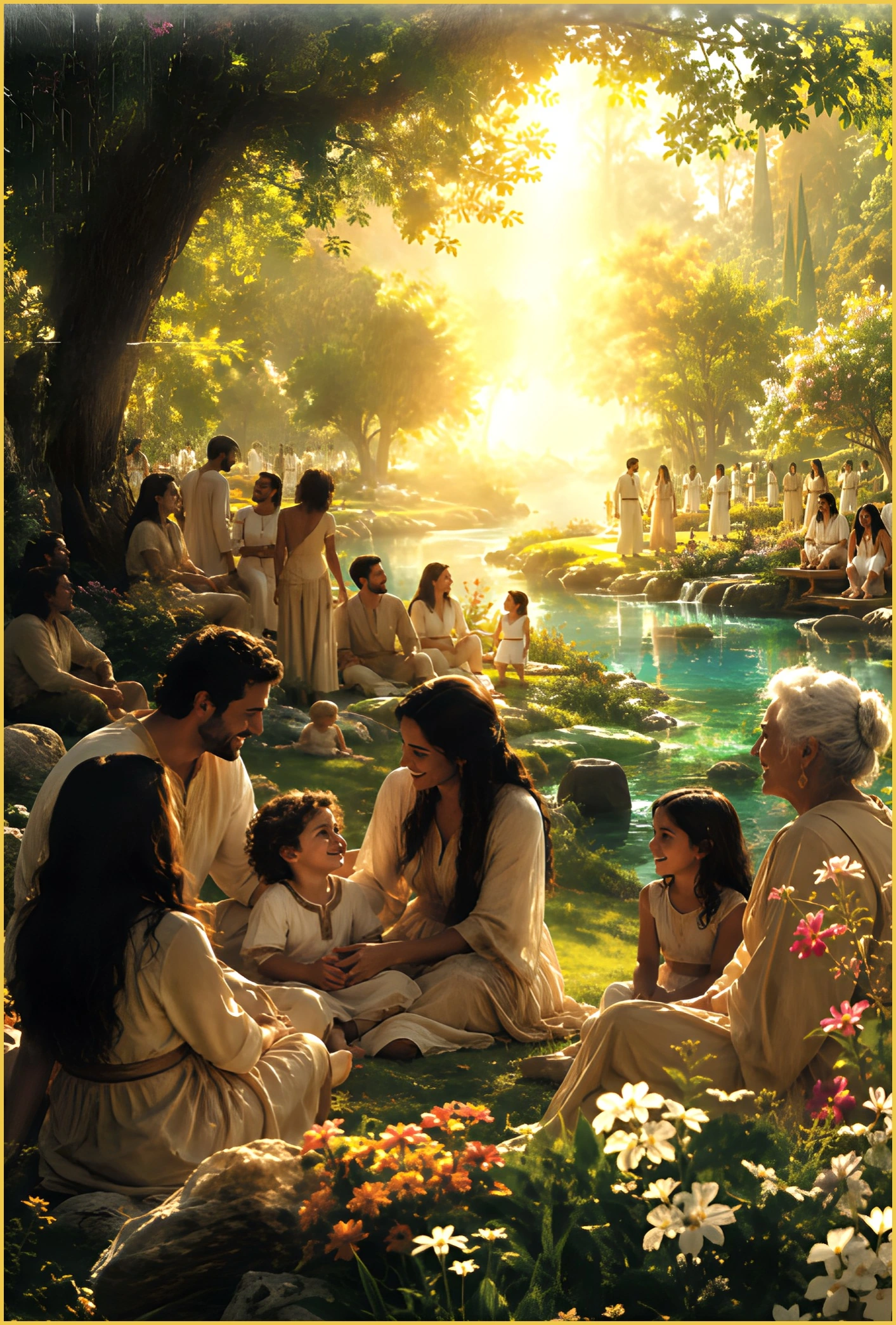
An artist’s meditation on resurrection reunion and unbroken fellowship. The gathering is certain; its timing relative to the tribulation and visible Advent remains disputed among premillennial Christians (1 Corinthians 15:51–55; 1 Thessalonians 4:13–18).
THE KING JUDGES WITH PERFECT MEMORY
Are There Several Judgments—or One Final Judgment Seen from Different Angles?
Scripture repeatedly connects Christ’s coming with judgment. Premillennial systems distinguish several scenes; other traditions see complementary portraits of one consummating assize.
Swipe or scroll the table if needed.
| SCENE | WHAT THE TEXT SAYS | PREMILLENNIAL PLACEMENT |
|---|---|---|
| Christ’s bēma | Believers answer for deeds; service is tested; reward may be gained or lost, while 1 Corinthians 3:15 still speaks of the person being saved. | Often placed after the church’s resurrection/rapture. Its exact relation to the public Advent is inferred. |
| Israel under the rod | Ezekiel gathers Israel, judges face to face, purges rebels, and brings a remnant into covenant blessing. | Classically treated as a post-Advent screening of living Israel before kingdom entrance. |
| Sheep and goats | The enthroned Son gathers all nations, separates persons, and assigns eternal life or eternal punishment according to deeds toward His vulnerable brothers. | Classically treated as the judgment of living Gentile survivors before the Millennium. |
| Great White Throne | After the final revolt, the dead stand before the throne; books are opened; Death and Hades enter the lake of fire. | Placed after the thousand years; traditionally focused on the wicked dead, though Revelation calls them simply ‘the dead.’ |
- SCENE
- Christ’s bēma
- WHAT THE TEXT SAYS
- Believers answer for deeds; service is tested; reward may be gained or lost, while 1 Corinthians 3:15 still speaks of the person being saved.
- PREMILLENNIAL PLACEMENT
- Often placed after the church’s resurrection/rapture. Its exact relation to the public Advent is inferred.
- SCENE
- Israel under the rod
- WHAT THE TEXT SAYS
- Ezekiel gathers Israel, judges face to face, purges rebels, and brings a remnant into covenant blessing.
- PREMILLENNIAL PLACEMENT
- Classically treated as a post-Advent screening of living Israel before kingdom entrance.
- SCENE
- Sheep and goats
- WHAT THE TEXT SAYS
- The enthroned Son gathers all nations, separates persons, and assigns eternal life or eternal punishment according to deeds toward His vulnerable brothers.
- PREMILLENNIAL PLACEMENT
- Classically treated as the judgment of living Gentile survivors before the Millennium.
- SCENE
- Great White Throne
- WHAT THE TEXT SAYS
- After the final revolt, the dead stand before the throne; books are opened; Death and Hades enter the lake of fire.
- PREMILLENNIAL PLACEMENT
- Placed after the thousand years; traditionally focused on the wicked dead, though Revelation calls them simply ‘the dead.’
These distinctions form a coherent premillennial model, but Matthew 25 does not say ‘Gentiles only,’ ‘mortal tribulation survivors,’ or ‘before the Millennium,’ and Revelation 20 does not label the throne’s subjects ‘wicked only.’ Amillennial and postmillennial readers therefore correlate the scenes as portraits of one final public judgment.
Judgment according to works is not salvation by merit
The Bible is equally clear that sinners are justified by grace through faith and that the final judgment is according to deeds. These truths are not enemies. Deeds do not purchase the verdict; they disclose the life. In Matthew 25, mercy toward Christ’s vulnerable representatives reveals allegiance to the King. In Revelation 20, the books demonstrate the moral truth of judgment, while the Book of Life identifies those who belong to God. Grace saves, and saving grace does not remain barren.
WHY THIS MATTERS
Nothing is forgotten—not hidden cruelty, unpraised mercy, or fidelity under persecution. The returning Christ will give history a truthful moral reading.
What Will Christ’s Millennial Kingdom Be Like?
Revelation gives the duration. The prophets give the landscape. Together they describe history under
the open government of Messiah.
Revelation 20 says the saints live and reign with Christ for a thousand years while Satan is restrained from deceiving the nations as before. Literal premillennialism reads this as a future earthly kingdom following Revelation 19. The Psalms and prophets then fill the scene with righteous rule, worship among the nations, covenant restoration, ordered labor, long life, creation’s peace, and the knowledge of the Lord.
Two bodily conditions in one kingdom
The model understands resurrected believers as glorified rulers who cannot die or marry, alongside mortal survivors who enter the kingdom alive. The coexistence is not narrated in one verse; it follows from reading Revelation 20’s resurrected reigners beside Zechariah 14’s surviving nations and Isaiah 65’s childbirth, work, longevity, and death. Mortal subjects marry, bear children, and populate the earth. Their children still require regeneration; ideal government cannot substitute for the new birth.
A kingdom of justice, worship, and embodied life
• Christ rules the nations with incorruptible justice (Psalm 2; Isaiah 11:1–5; Revelation 19:15). • The saints share delegated rule beneath Him (Daniel 7:18, 22, 27; Matthew 19:28; Revelation 20:4–6). • War is curbed and instruction goes out from Zion (Isaiah 2:1–4; Micah 4:1–4). • Creation’s disorder is restrained and the vulnerable are safe (Isaiah 11:6–9; 35:1–10). • Surviving nations come to worship the King (Zechariah 14:16–21). • The Spirit remains active in cleansing, regeneration, knowledge, obedience, and worship (Isaiah 32:15– 18; Ezekiel 36:25–28; Joel 2:28–32).
IMPORTANT QUALIFICATION
The Old Testament never calls this era ‘one thousand years’; Revelation 20 supplies the number. Isaiah 65 uses ‘new heavens and a new earth’ language while still speaking of death—a major reason premillennialists see an intermediate kingdom or prophetic telescoping, and a major reason other interpreters read the imagery differently.
The King Reigns
For a thousand years, Christ rules the nations in righteousness while Satan’s deception is restrained.
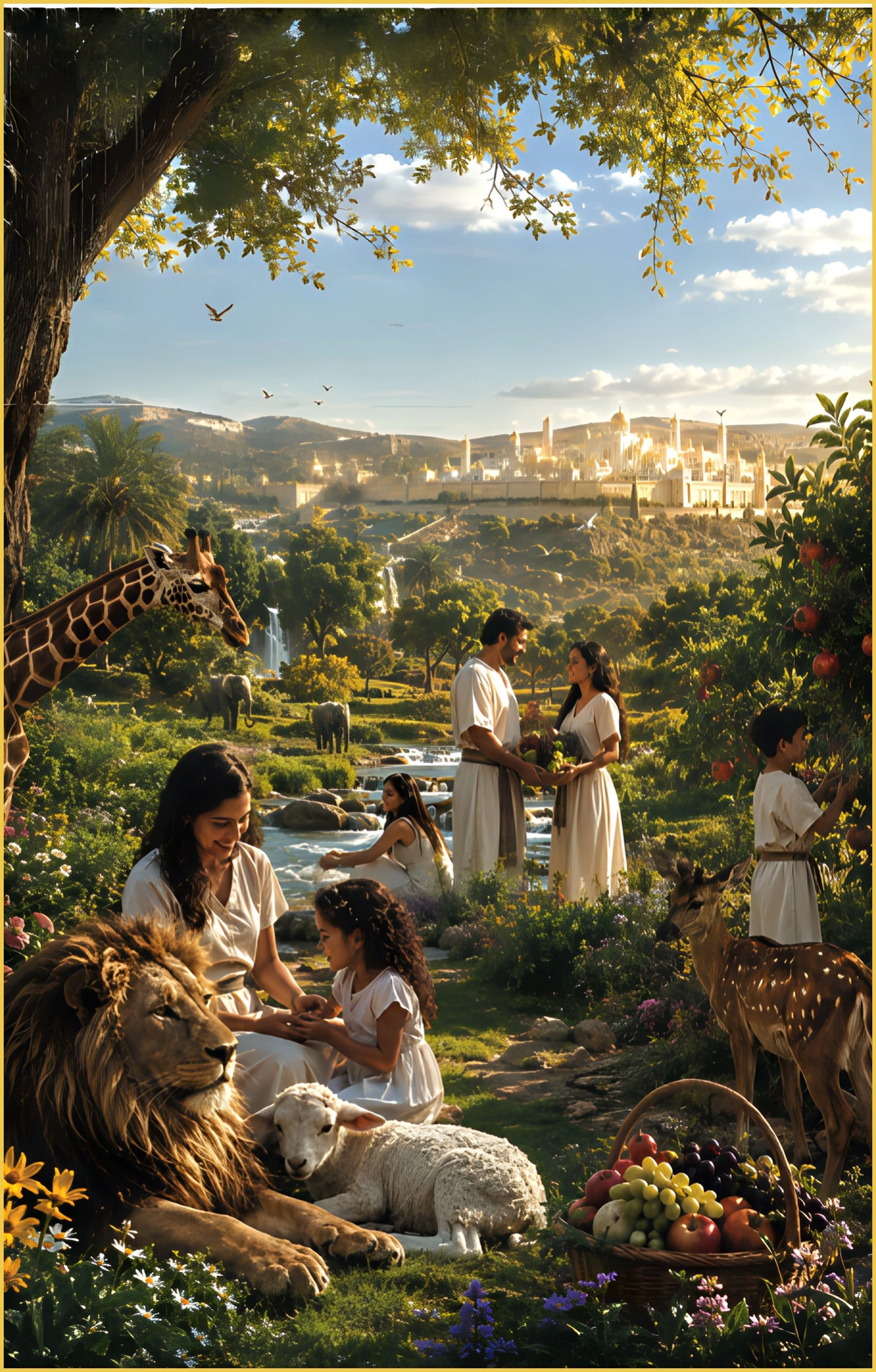
This artist’s visualization combines Revelation 20’s thousand-year reign with prophetic images of justice, abundance, longevity, and
peace in creation—a premillennial synthesis, not a literal portrait (Isaiah 11:1–10; 65:17–25; Revelation 20:1–6).
THE LAST ENEMY FALLS
Why Is Satan Released—and What Comes After the Millennium?
The thousand years are glorious, but they are not the final page. Revelation reserves one last
unveiling of the human heart before death itself disappears.
When Satan is released, he deceives nations from the four corners of the earth and gathers them as Gog and Magog. Their number is like the sand of the sea. The shock is theological: people can inhabit a world of righteous law, abundant blessing, and visible messianic rule and still resist the King. External conditions can restrain evil; only the Spirit’s new birth renews desire. The revolt proves that Christ’s government was never the problem and human autonomy was never the cure.
The rebellion does not become a second Armageddon of uncertain outcome. Fire descends; the devil joins the Beast and False Prophet in the lake of fire. Then the Great White Throne appears. Earth and heaven flee from the Judge’s face, the dead stand before Him, and the books disclose the truth. Death and Hades are thrown into the lake. Paul’s promise reaches its end: the last enemy destroyed is death.
The goal is not escape but new creation
John sees a new heaven and new earth, then the holy city descending from God. The direction matters. God’s dwelling comes to humanity. The resurrection body belongs in a renewed world. The nations bring their glory into the city; the river of life flows; the tree’s leaves are for the healing of the nations; the servants see God’s face. Scripture’s final hope is not a pale, disembodied forever. It is communion with God, embodied holiness, healed creation, meaningful service, and unending reign.
“Behold, I make all things new.”
— REVELATION 21:5 | KJV
THE END OF THE STORY
No grave remains occupied by death’s right. No empire waits beyond the horizon. No curse hides in the soil. The Lamb’s victory is not merely remembered; it becomes the atmosphere of creation.
THE FINAL ASSIZE
The Books Are Opened
After the thousand years and Satan’s final defeat, the dead stand before the throne.
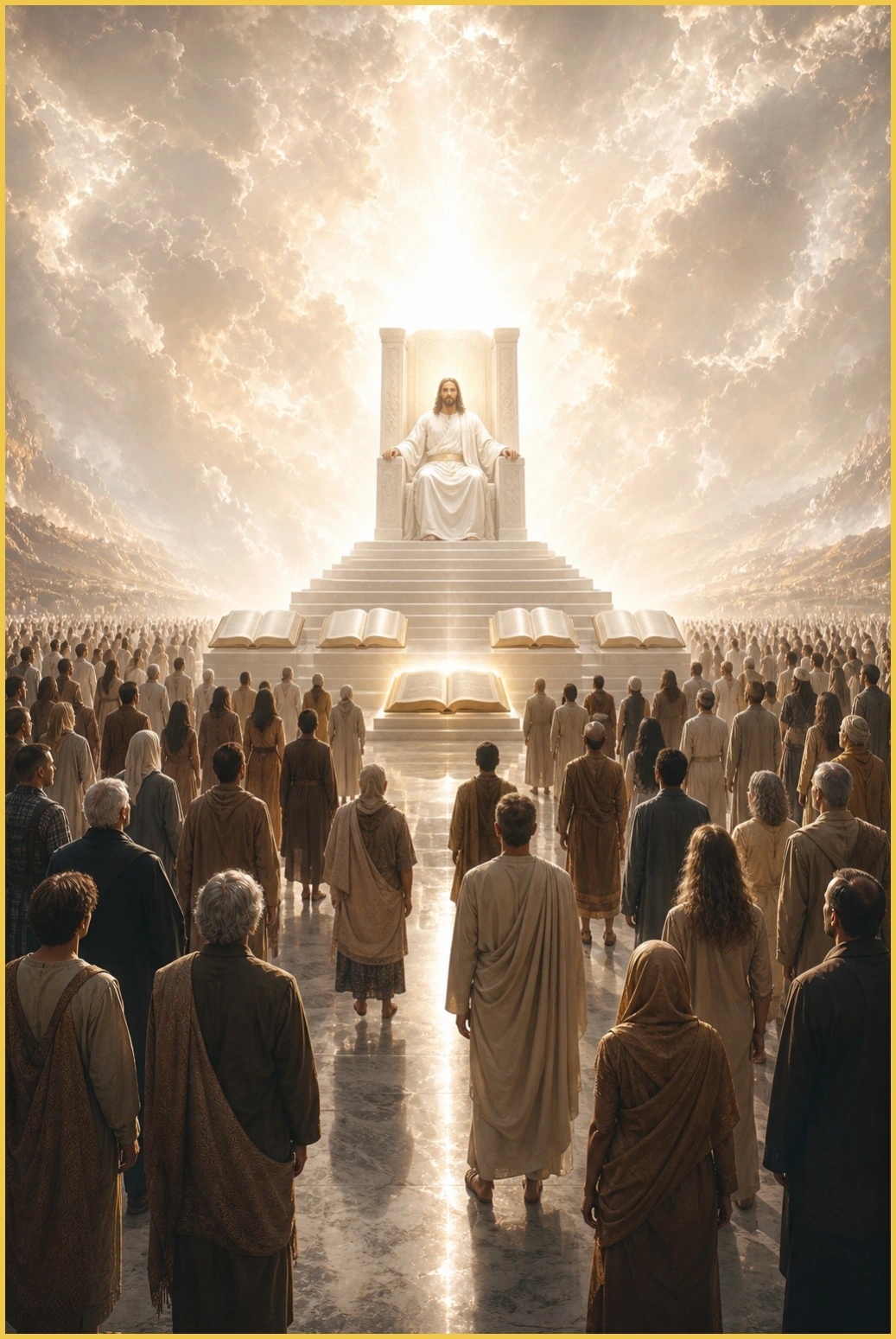
An artist’s visualization of the final judgment. Revelation shows the books opened, the dead judged according to their deeds, and the Book of Life consulted; portraying Christ and the throne-room architecture is a canonical and artistic synthesis (John 5:22, 27;
Revelation 20:7–15).
BEYOND THE LAST ENEMY
All Things Made New
Beyond the final judgment, God renews creation and death is no more.

An artist’s meditation on the new heaven and new earth. Scripture’s final hope is embodied life with God in a healed creation, not
escape from the created order (Romans 8:18–25; 2 Peter 3:13; Revelation 21:1–5).
THE DWELLING OF GOD WITH HUMANITY
The Holy City Descends
God’s dwelling comes to humanity, and the nations walk by His light.

An artist’s visualization of New Jerusalem, not an architectural map. Revelation emphasizes God’s presence, the Lamb’s light, open
gates, healed nations, and the end of the curse (Revelation 21:2–27; 22:1–5).
THE GATES WILL NEVER BE SHUT
Welcome to the City of God
The holy city is open, inhabited, radiant, and filled with the life of God.

An artist’s meditation on the open gates and shared life of New Jerusalem—not an architectural map. The city’s defining glory is the
presence of God and the Lamb (Revelation 21:22–27; 22:1–5).
WHERE FAITHFUL CHRISTIANS DIFFER
Five Frameworks, One Returning Lord
The debate concerns the relationship of the visions and the placement of the Millennium—not whether
Jesus is truly coming again.
Swipe or scroll the table if needed.
| FRAMEWORK | ORDER | REPRESENTATIVE VOICES |
|---|---|---|
| Traditional dispensational premillennial | Pretribulational rapture → tribulation → visible Advent → earthly Millennium → final revolt/judgment → new creation. Maintains a strong Israel/church distinction. | John F. Walvoord, J. Dwight Pentecost, Stanley Toussaint, Robert Thomas |
| Progressive dispensational premillennial | Retains future Advent and earthly Millennium, while emphasizing the kingdom’s present inauguration and greater unity within the people of God. | Craig Blaising, Darrell Bock; Michael Vlach represents a related revised dispensational approach |
| Historic premillennial | Normally one posttribulational Advent/rapture → earthly messianic reign → final revolt/judgment → new creation. Rejects a sharp church/Israel dualism. | George Eldon Ladd; contributors to A Case for Historic Premillennialism |
| Amillennial | The thousand years symbolizes the present interadvent reign of Christ and departed saints; one return brings general resurrection, judgment, and new creation. | Anthony Hoekema, G. K. Beale, Kim Riddlebarger, Sam Storms |
| Postmillennial | A long gospel-victory era occurs before Christ returns; the Advent then brings resurrection, judgment, and eternal consummation. | Kenneth Gentry, Keith Mathison |
- FRAMEWORK
- Traditional dispensational premillennial
- ORDER
- Pretribulational rapture → tribulation → visible Advent → earthly Millennium → final revolt/judgment → new creation. Maintains a strong Israel/church distinction.
- REPRESENTATIVE VOICES
- John F. Walvoord, J. Dwight Pentecost, Stanley Toussaint, Robert Thomas
- FRAMEWORK
- Progressive dispensational premillennial
- ORDER
- Retains future Advent and earthly Millennium, while emphasizing the kingdom’s present inauguration and greater unity within the people of God.
- REPRESENTATIVE VOICES
- Craig Blaising, Darrell Bock; Michael Vlach represents a related revised dispensational approach
- FRAMEWORK
- Historic premillennial
- ORDER
- Normally one posttribulational Advent/rapture → earthly messianic reign → final revolt/judgment → new creation. Rejects a sharp church/Israel dualism.
- REPRESENTATIVE VOICES
- George Eldon Ladd; contributors to A Case for Historic Premillennialism
- FRAMEWORK
- Amillennial
- ORDER
- The thousand years symbolizes the present interadvent reign of Christ and departed saints; one return brings general resurrection, judgment, and new creation.
- REPRESENTATIVE VOICES
- Anthony Hoekema, G. K. Beale, Kim Riddlebarger, Sam Storms
- FRAMEWORK
- Postmillennial
- ORDER
- A long gospel-victory era occurs before Christ returns; the Advent then brings resurrection, judgment, and eternal consummation.
- REPRESENTATIVE VOICES
- Kenneth Gentry, Keith Mathison
The premillennial case is literary and canonical: Revelation 19–21 reads naturally as appearing, binding, thousand-year reign, final revolt, judgment, and new creation. Zechariah 14 has surviving nations, while Isaiah 65 retains mortality amid extraordinary blessing.
The amillennial reply is that Revelation recapitulates the church-age conflict: chapter 20 returns to Christ’s first-advent victory and the saints’ present heavenly reign. John 5, Matthew 25, and 2 Peter 3 then support one consummation. Postmillennialism also places the Millennium before the return but expects wider gospel transformation within history.
OUR CONCLUSION
Providence finds the premillennial progression the strongest synthesis, especially when Revelation 19–20 is read with Zechariah 14 and Isaiah 65. But our hope rests in the returning Christ, not in pretending that every timing question has the same clarity as His promise.
WHEN WILL JESUS RETURN?
The Date Is Hidden; the Command Is Clear
Jesus gave signs to steady disciples in suffering—not a formula by which curiosity could overrule
obedience.
Jesus names birth pains, persecution, false messiahs, apostasy, the proclamation of the gospel among the nations, tribulation, and cosmic signs. Paul describes rebellion and the man of lawlessness. Revelation portrays beastly power, deceptive worship, and world conflict. Christians disagree about how much was foreshadowed in Jerusalem’s destruction in AD 70, how much spans the church age, and how much belongs to a concentrated final tribulation. They should agree on Jesus’ prohibition: no one knows the day or hour, and the times and seasons belong to the Father.
NO DATE-SETTING
A theory that requires disobedience to Jesus’ warning is not heightened faithfulness. Biblical watchfulness is not staring at a calendar until ordinary discipleship feels unimportant. It is being found faithful whenever the Master arrives.
Questions readers ask
WILL EVERYONE SEE JESUS? The biblical presentation is public and unmistakable: lightning, glory, angels, trumpet, worldwide mourning, and ‘every eye’ seeing Him (Matthew 24:27–31; Revelation 1:7).
WHAT HAPPENS TO BELIEVERS WHO HAVE DIED? They are raised bodily and imperishably. They do not miss the kingdom or enter it as permanent ghosts (1 Corinthians 15; 1 Thessalonians 4:13–18).
WHAT HAPPENS TO LIVING BELIEVERS? They are changed and caught up to meet Christ. The timing of that gathering relative to the tribulation is disputed; its reality is not.
DOES JUDGMENT HAPPEN IMMEDIATELY? Judgment is inseparable from the coming. Premillennialism distinguishes threshold judgments before the Millennium from the Great White Throne after it; other views correlate the scenes as one final judgment.
WILL CHRISTIANS KNOW THE SEASON? Jesus commands discernment and names signs, yet He also compares His coming to an unexpected thief. Recognition must never become date calculation.
IS THE SECOND COMING GOOD NEWS? For those in Christ, it is the blessed hope: resurrection, vindication, reunion, justice, and life with the King. It is also a sober warning that evil and unbelief will not remain unanswered.
HOW THEN SHOULD WE LIVE?
Ready for the King
Every major New Testament passage about Christ’s return turns from prediction to formation. The
future is meant to make a holy people in the present.
Six practices of a waiting church
• Wakefulness. Refuse spiritual sleep and live in the light (Matthew 24:42–44; 1 Thessalonians 5:4–8). • Holiness. The hope of seeing Christ purifies His people (Titus 2:11–14; 1 John 3:2–3; 2 Peter 3:11–14). • Endurance. Suffering is neither forgotten nor final; the Judge will set it right (2 Thessalonians 1:5–10; James 5:7–9). • Witness. The church’s task is not to decode dates but to bear Christ’s name to the ends of the earth (Acts 1:7–8; Matthew 24:14). • Mercy. The coming King identifies Himself with vulnerable disciples and remembers costly care (Matthew 25:31–46). • Comfort and worship. Resurrection hope makes grief honest but not hopeless (1 Thessalonians 4:13–18; Revelation 22:20).
Are you ready?
Readiness is not achieved by mastering a chart. It begins by being reconciled to the King. Jesus Christ, truly God and truly man, bore sin in His death and conquered death in His resurrection. He calls every person to repent, believe the gospel, and follow Him. Those who belong to Him do not face the future alone; the Judge is also their Savior, Shepherd, Advocate, and coming Bridegroom.
A PRAYER OF RESPONSE
Lord Jesus Christ, I confess that You are the risen King and that I need Your mercy. Forgive my sin, give me a living faith, and make me faithful while I wait. Teach me to love what You love, endure with hope, serve the vulnerable, and bear witness without fear. Keep my eyes on You until faith becomes sight. Amen.
The Bible ends with a promise and an answering prayer. The promise is Christ’s: ‘Surely I come quickly.’ The prayer is the church’s: ‘Amen. Even so, come, Lord Jesus.’ Not panic. Not speculation. Longing—because the One who comes is worthy.
THE KING’S INVITATION
Come Home
The biblical consummation is not escape from creation but life with Christ in a creation made new.
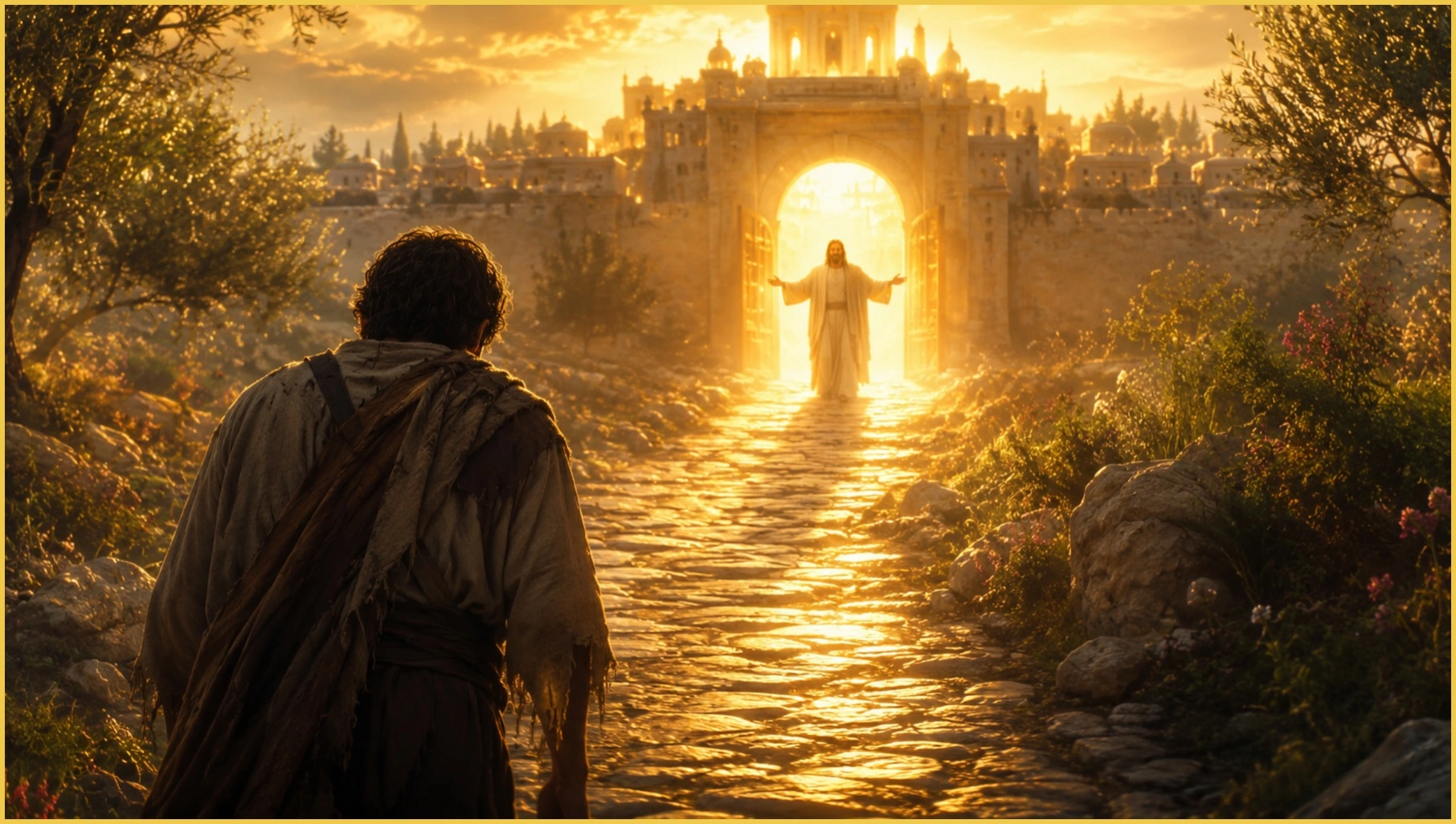
An artist’s meditation on Christ’s welcome in renewed creation—not a depiction of souls leaving earth or a map of entry into heaven
(Revelation 21:1–4; 22:17).
“And the Spirit and the bride say, Come. And let him that is athirst come.”
— REVELATION 22:17 | KJV
THE HEART OF THE HOPE
The One who returns in glory is the same Savior who now calls the weary, the thirsty, and the guilty to receive life. Christian readiness begins not with fear of a date, but with trust in the King.
GO DEEPER
Scripture Atlas and Selected Scholarship
This guide is a researched synthesis, not an exhaustive bibliography. These passages and
representative works provide the strongest routes for continued study.
A compact Scripture atlas
Swipe or scroll the table if needed.
| CORPUS | PRINCIPAL PASSAGES |
|---|---|
| Old Testament horizon | Psalms 2; 72; 96; 98; 110 · Isaiah 2; 11; 24–27; 35; 59; 63; 65–66 · Jeremiah 30–33 · Ezekiel 20; 36–39 · Daniel 2; 7; 12 · Joel 2–3 · Micah 4–5 · Zechariah 12–14 · Malachi 3–4 |
| Jesus and Acts | Matthew 13; 16:27; 19:28; 23:39; 24–25; 26:64 · Mark 13 · Luke 17; 21 · John 5:28–29; 6:39–54; 14:1–3 · Acts 1:9–11; 3:19–21; 17:30–31 |
| Paul and the Epistles | Romans 8; 11; 14 · 1 Corinthians 3; 15 · 2 Corinthians 5 · Philippians 3:20–21 · 1 Thessalonians 4–5 · 2 Thessalonians 1–2 · Titus 2:11–14 · Hebrews 9:28 · James 5 · 2 Peter 3 · 1 John 2–3 · Jude 14–15 |
| Revelation | Revelation 1:7; 6:12–17; 11:15–18; 14:14–20; 16:12–21; 19–22 |
- CORPUS
- Old Testament horizon
- PRINCIPAL PASSAGES
- Psalms 2; 72; 96; 98; 110 · Isaiah 2; 11; 24–27; 35; 59; 63; 65–66 · Jeremiah 30–33 · Ezekiel 20; 36–39 · Daniel 2; 7; 12 · Joel 2–3 · Micah 4–5 · Zechariah 12–14 · Malachi 3–4
- CORPUS
- Jesus and Acts
- PRINCIPAL PASSAGES
- Matthew 13; 16:27; 19:28; 23:39; 24–25; 26:64 · Mark 13 · Luke 17; 21 · John 5:28–29; 6:39–54; 14:1–3 · Acts 1:9–11; 3:19–21; 17:30–31
- CORPUS
- Paul and the Epistles
- PRINCIPAL PASSAGES
- Romans 8; 11; 14 · 1 Corinthians 3; 15 · 2 Corinthians 5 · Philippians 3:20–21 · 1 Thessalonians 4–5 · 2 Thessalonians 1–2 · Titus 2:11–14 · Hebrews 9:28 · James 5 · 2 Peter 3 · 1 John 2–3 · Jude 14–15
- CORPUS
- Revelation
- PRINCIPAL PASSAGES
- Revelation 1:7; 6:12–17; 11:15–18; 14:14–20; 16:12–21; 19–22
Selected research and further reading
R. T. France, The Gospel of Matthew (NICNT). Source link — A major literary-exegetical treatment and important partial-preterist challenge on Matthew 24. W. D. Davies and Dale C. Allison Jr., Matthew 19–28 (ICC). Source link — Technical exegesis and history of interpretation. Craig S. Keener, The Gospel of Matthew: A Socio-Rhetorical Commentary. Source link — Jewish and Greco-Roman context. Jeffrey A. D. Weima, 1–2 Thessalonians (BECNT). Source link — Detailed treatment of the Parousia and pastoral setting. G. K. Beale, The Book of Revelation (NIGTC). Source link — Leading technical evangelical amillennial/idealist reading. Grant R. Osborne, Revelation (BECNT). Source link — Eclectic evangelical commentary attentive to alternatives. George Eldon Ladd, A Commentary on the Revelation of John. Source link — Classic historic-premillennial exposition. Mark J. Boda, The Book of Zechariah (NICOT). Source link — Major Hebrew and literary study of Zechariah. Craig A. Blaising, ‘The Kingdom That Comes with Jesus.’ Source link — Strong progressive-premillennial harmonization. John F. Walvoord, ‘The Second Coming of Christ and the Millennial Kingdom.’ Source link — Classic dispensational chronology. Anthony A. Hoekema, The Bible and the Future. Source link — Mature Scripture-focused amillennial synthesis. Darrell L. Bock, ed., Three Views on the Millennium and Beyond. Source link — Premillennial, postmillennial, and amillennial dialogue. N. T. Wright, Surprised by Hope. Source link — Valuable emphasis on resurrection and renewed creation. John Piper, Come, Lord Jesus. Source link — Pastoral meditations on Christ’s coming and Christian readiness.
Full illustrated research edition · Updated August 25, 2026 · Providence Teaching Ministry
Links from this resource
www.eerdmans.com/9780802825018/the-gospel-of-matthew/
www.bloomsbury.com/uk/matthew-1928-9780567085184/
www.eerdmans.com/9781467465502/the-gospel-of-matthew/
bakeracademic.com/products/9780801026850_1-2-thessalonians
www.eerdmans.com/9780802821744/the-book-of-revelation/
bakeracademic.com/products/9781540968456_revelation
www.eerdmans.com/9780802875907/a-commentary-on-the-revelation-of-john/
www.eerdmans.com/9780802823755/the-book-of-zechariah/
bible.org/seriespage/15-second-coming-christ-and-millennial-kingdom
www.eerdmans.com/9780802808516/the-bible-and-the-future/
zondervanacademic.com/products/three-views-on-the-millennium-and-beyond