THE SEED WAR TRILOGY
A SCRIPTURE-FIRST STUDY
Apousia
The Outer Darkness, the Great Gulf, and the Geography of Hell
What Scripture says about Gehenna, the opened books, exact judgment, and the Door that is still open.
A PROVIDENCE TEACHING MINISTRY STUDY
Michael Kendrick
SOLI DEO GLORIA
38-PAGE SCRIPTURE STUDY
Contents
Section I. The Two Words That Divide Eternity
Section II. The Four Words Behind “Hell”
Section III. The Order of the End
Section IV. The Books and the Book
Section V. The Geography of Distance
Section VI. Many Stripes and Few
Section VII. The Gulf and the Sight of the City
Section VIII. The Worm That Does Not Die
Section XI. Apousia and the Battle of the Seed
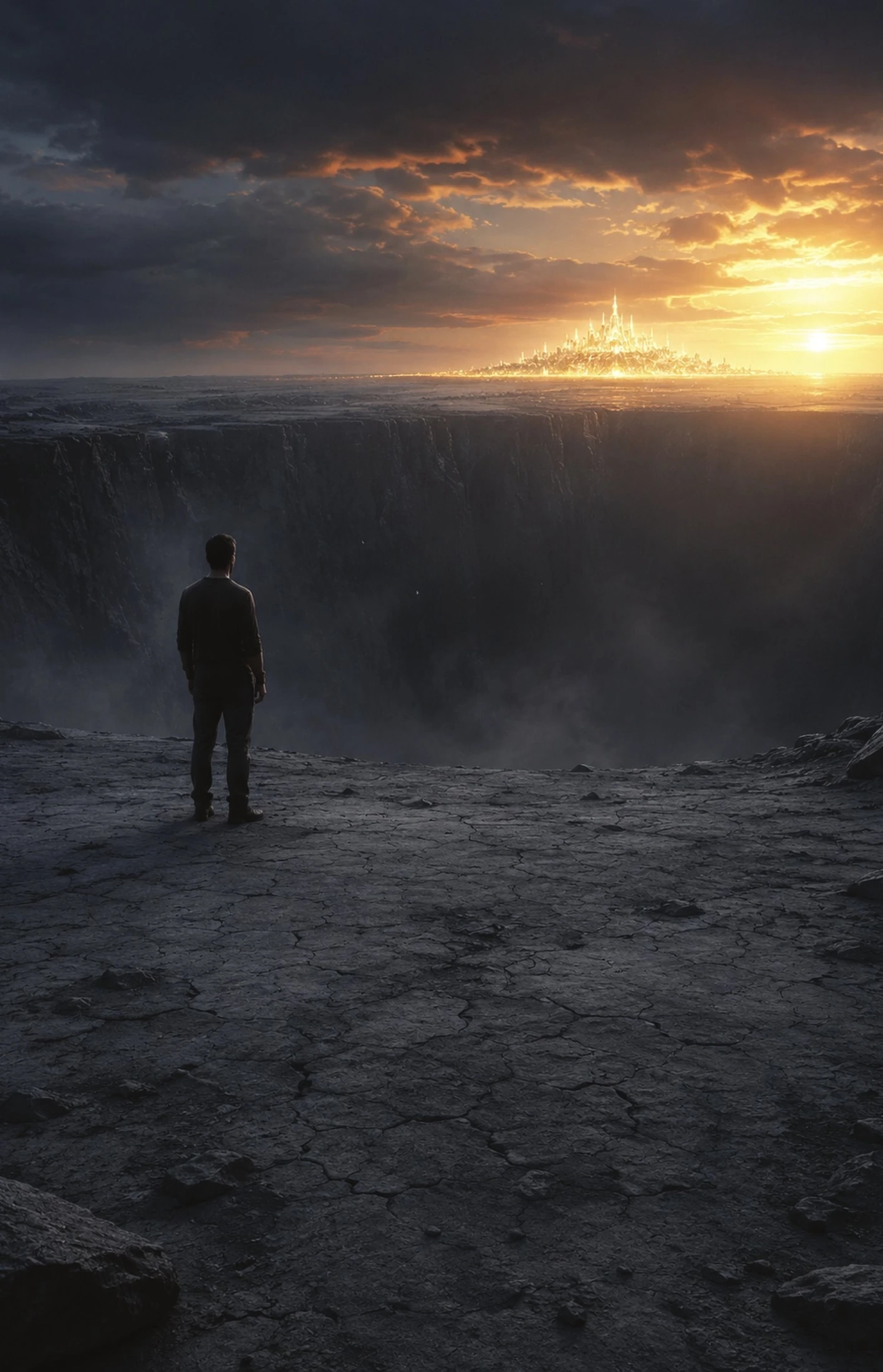
“And besides all this, between us and you there is a great gulf fixed.”
LUKE 16:26 · FROM BATTLE OF THE SEED, CHAPTER 47 — “APOUSIA”
PROLOGUE
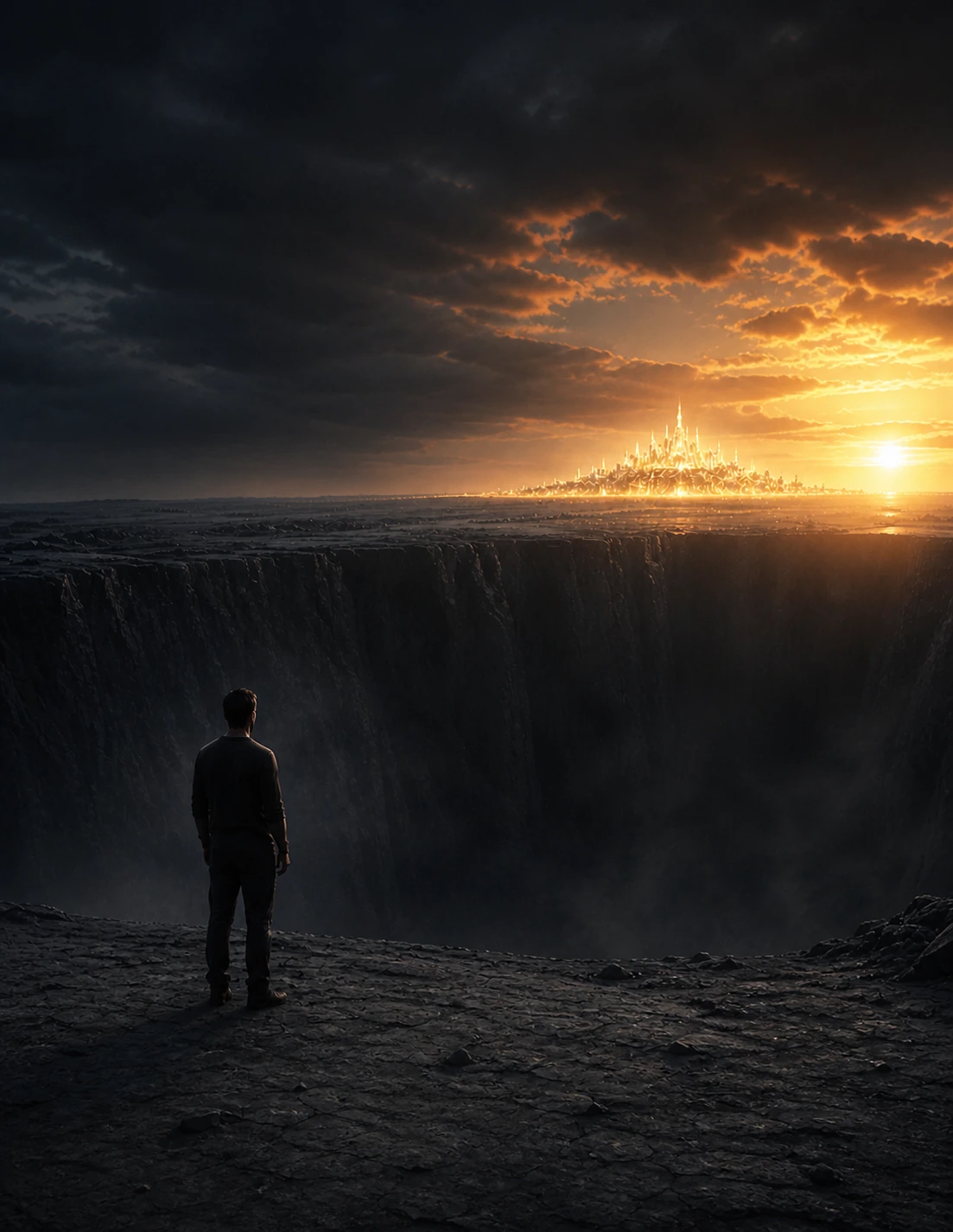
The Man at the Edge
The books have closed. The Throne is behind him now, and an angel — clean, clear, terrible — has his arm, leading him outward.
He is not screaming. That is the strange thing. The paintings always show screaming. What he feels instead is finality, entering the soul like iron: no appeal, no review, no later light, no reopened bridge. For the first time in his existence, there is no version of tomorrow in which anything can be different.
And then he sees it. Far off, behind him, on the other side of a chasm no bridge will ever cross again — the City.
He should not look. He looks.
It is more beautiful than anything he ever built, bought, defended, or dreamed. Light lives there the way water lives in a river. And he knows — this is the unbearable part — he knows who is inside it. The wife who prayed for him. The daughter who trusted simply. The friend who told him plainly and was told, politely, not yet.
Something in him leans toward that light with all the force of a made thing straining toward its Maker. He was built for that place. Every atom of him knows it. And the same look that draws him — burns. The glory falls on all the unhealed pride and hidden rot he refused to let the blood wash and the Spirit refine, and it scorches like sunrise on an infected wound. He wrenches his eyes away into the dark, and the dark gives no relief, because darkness cannot feed a creature made for light.
So he stands at the edge of his ring — not the farthest ring, not the nearest; his, chosen and accumulated across ten thousand ordinary days — and he discovers the arithmetic of the place: wanting forever what you refused while it could still be had.
There is a name for this country. The old books wrote it in Greek.
This study is about that country — what Jesus called Gehenna, what John saw as the lake of fire and the outer darkness. It is the hardest subject in the Bible, and the Bible refuses to let us skip it: the gentlest Man who ever lived spoke of it more often, and more vividly, than any prophet or apostle. We will walk its geography honestly — the Great White Throne, the great gulf, the graduated rings of distance, the worm that does not die, and the furthest ring of all, prepared for the devil and his angels. And we will keep one truth in view the entire way: this country is real, it is eternal, and no one reading this page has to go there.
Walk it now, on paper, while it is still avoidable — so that you never walk it in person.
SECTION I
The Two Words That Divide Eternity
Parousia and Apousia — presence and absence — heaven's essence and hell's
Strip away every image — the flames, the streets of gold, the pitchforks of cartoon and the clouds of greeting cards — and ask what heaven and hell actually are at their core. Scripture's answer is startlingly simple, and it hangs on two Greek words.
Parousia — presence, arrival, nearness. It is the New Testament's word for the coming of the Lord, but at its root it simply means being-with. And being-with-God is the whole content of heaven. Hear how the Bible describes the eternal state — not harps, not clouds, but proximity: “Behold, the tabernacle of God is with men, and He will dwell with them… They shall see His face” (Revelation 21:3; 22:4). Eden was Parousia — God walking with man in the cool of the day. The Tabernacle was Parousia rationed — God dwelling at the center of the camp behind a veil. Bethlehem was Parousia embodied — “Immanuel… God with us” (Matthew 1:23). The torn veil was Parousia unlocked. The New Jerusalem is Parousia unveiled and unending. From first page to last, the Bible is not primarily a story about a place. It is a story about a distance — and the God who kept closing it.
Apousia — absence, departure, distance. Paul uses it in Philippians 2:12 (“not as in my presence only, but now much more in my absence”). And absence-from-God is the whole content of hell. Here is the master text, the one sentence that defines the final state of the lost more precisely than any other in Scripture:
These shall be punished with everlasting destruction from the presence of the Lord and from the glory of His power.
— 2 THESSALONIANS 1:9 (NKJV)
From the presence of the Lord. That is the sentence. Not primarily fire, not primarily darkness — those describe the experience. The sentence itself is distance. Everything else about hell follows from that one subtraction, the way cold follows from the absence of sun and chaos follows from the absence of a king. The medieval theologians saw this with perfect clarity: they taught that hell's essential pain is the poena damni — the pain of loss, the exclusion from the vision of God — beside which every pain of sense is secondary. Thomas Aquinas held that the worst thing about hell is not what is there. It is Who is not.
But is God truly absent there?
Now a precision the careless never reach, and the book of Psalms will not let us avoid: “If I ascend into heaven, You are there; if I make my bed in hell, behold, You are there” (Psalm 139:8). No creature ever escapes omnipresence — and Revelation says the lost are tormented “in the presence of the holy angels and in the presence of the Lamb” (Revelation 14:10). How can hell be absence from the Lord and yet in His presence?
Because there are two ways to stand in the same light. Scripture calls God “a consuming fire” (Hebrews 12:29; Deuteronomy 4:24) — and then asks the question of questions: “Who among us shall dwell with the devouring fire? Who among us shall dwell with everlasting burnings?” (Isaiah 33:14). The prophet's answer is astonishing: the righteous (33:15–16). The same unveiled holiness is home to the sanctified and horror to the unsanctified. What the lost lose is not God's existence in their universe — no creature is granted that escape — but God's covenant presence: His fellowship, His favor, His warmth, His blessing, His face turned toward them in love. They keep the fire and lose the hearth. Apousia is not the absence of God from hell. It is the absence of hell's people from God — presence without communion, light without covering, glory without atonement, forever.
This is why C. S. Lewis could write the sentence that has unsettled comfortable unbelief for eighty years: “the doors of hell are locked on the inside.” The lost soul is not dragged from a God it longed for; it is confirmed in the distance it kept choosing. “And this is the condemnation, that the light has come into the world, and men loved darkness rather than light” (John 3:19). Hell is the love of darkness, granted its object. Forever.
SECTION II
The Four Words Behind “Hell”
Sheol, Hades, Gehenna, Tartarus — and the valley Jesus pointed at
One reason so many readers stay confused about hell is that our English Bibles long used a single word — hell — to translate four different terms naming different things. Untangle them once, and half the fog lifts.
Sheol and Hades — the waiting room
Sheol (Hebrew) and Hades (Greek) name the realm of the dead between death and resurrection — the intermediate state, not the final one. Before the cross, Jesus pictured it as two regions with an impassable divide: torment on one side, “Abraham's bosom” of comfort on the other (Luke 16:22–26). Since the resurrection, to be absent from the body is, for the believer, to be present with the Lord (2 Corinthians 5:8; Philippians 1:23); for the unbeliever, Hades remains what it was for the rich man — conscious, tormented custody, awaiting trial. Mark this and never lose it: no one is yet in the final hell. Hades is the county jail, not the penitentiary; the holding cell before the sentencing, not the sentence.
Gehenna — the valley with a history
When Jesus warned of the final fire, He did not use an abstract term. He said Gehenna — twelve times in the New Testament, eleven of them from His own lips — and every hearer in Jerusalem could walk to the place He meant in about twenty minutes. Gehenna is the Greek form of Ge- Hinnom, the Valley of Hinnom, the ravine along Jerusalem's southwest wall. And that valley had a history dark enough to make a nation shudder. There, at the high place called Topheth, the apostate kings Ahaz and Manasseh burned their own sons and daughters alive to the idol Molech (2 Chronicles 28:3; 33:6) — “which I did not command,” God said, “nor did it come into My heart” (Jeremiah 7:31). Good king Josiah desecrated the site to end the horror (2 Kings 23:10), and Jeremiah prophesied its rename: “it will no more be called Topheth, or the Valley of the Son of Hinnom, but the Valley of Slaughter” (Jeremiah 19:6). By Jesus' day the accursed ravine was Jerusalem's refuse ground — a place of burning and decay, of fires that were never let die and worms that never lacked. When the Lord of glory wanted one image for the destiny of the unredeemed, He pointed His finger at that smoldering valley: better to enter life maimed, He said, than whole into that (Mark 9:43–48). Hell, in Jesus' chosen picture, is the cosmic Valley of Slaughter — the place where everything given for glory ends as burning waste. It is the garbage fire of a universe, for lives that refused to become treasure.
Tartarus — the angels' cell
Once, Scripture borrows a third word: God “did not spare the angels who sinned, but cast them down to hell [Tartarus] and delivered them into chains of darkness, to be reserved for judgment” (2 Peter 2:4; cf. Jude 6). A maximum-security hold for certain fallen angels — already darkness, already chains, and still not the final fire. Even the demons know the difference; they begged Jesus, “Have You come here to torment us before the time?” (Matthew 8:29). The time is appointed. They know their dock date.
The Lake of Fire — Gehenna consummated
At the end, after the Great White Throne, comes the final reality all the other terms were pointing toward: “the lake of fire… the second death” (Revelation 20:14–15). Into it go the Beast and the False Prophet, then the devil, then Death and Hades themselves — the waiting room dissolved into the verdict — and finally every person not found written in the Book of Life. This is the Gehenna Jesus warned of; this is the outer darkness; this is Apousia fixed forever. And the most sobering fact in the taxonomy is this: the lake of fire is, at this hour, still receiving no human being. Every warning in this study concerns a destination that no reader has yet reached — which means every reader still holds, in his hands, this hour, the outcome.
SECTION III
The Order of the End
From the last breath to the second death — the chronology, step by step
Scripture lays out the road of the unredeemed soul with legal exactness. Walk it once, slowly, and let each step register.
1. Death — the appointment kept
“It is appointed for men to die once, but after this the judgment” (Hebrews 9:27). One life. No reincarnation, no second lap, no post-mortem gospel. The moment of death seals the ledger: “he who is unjust, let him be unjust still… he who is righteous, let him be righteous still” (cf. Revelation 22:11).
2. Hades — conscious custody
The rich man of Luke 16 “died and was buried. And being in torments in Hades, he lifted up his eyes and saw Abraham afar off” (Luke 16:22–23). Note everything the Lord asserts in one sentence: continued existence, continued consciousness, continued memory, continued desire, real torment, real sight across a real divide — and this before the final judgment. The soul waits, but it does not sleep.
3. The resurrection of the unjust
Here is a truth almost never preached: the lost are also raised. “All who are in the graves will hear His voice and come forth — those who have done good, to the resurrection of life, and those who have done evil, to the resurrection of condemnation” (John 5:28–29). “The rest of the dead did not live again until the thousand years were finished” (Revelation 20:5). After the Millennium, the sea gives up its dead, and Death and Hades give up theirs (Revelation 20:13) — every soul re- embodied, no one lost in the paperwork of history, no one misfiled among the ages. Bodies fitted for an eternity the soul has chosen.
4. The Great White Throne
Then the trial — the subject of our next section. Books opened, works weighed, the Book of Life consulted. “And anyone not found written in the Book of Life was cast into the lake of fire” (Revelation 20:15).
5. The second death — placement forever
“Then Death and Hades were cast into the lake of fire. This is the second death” (Revelation 20:14). The first death separates soul from body; the second separates the whole person from the covenant presence of God — Apousia made permanent, at the precise distance the books have measured. And after it, the new heavens and the new earth descend for the redeemed — with the lost eternally outside the City: “Blessed are those who do His commandments, that they may have the right to the tree of life, and may enter through the gates into the city. But outside are dogs and sorcerers and sexually immoral and murderers and idolaters, and whoever loves and practices a lie” (Revelation 22:14–15). Outside. The Bible's last chapter still measures eternity in distance.
The Road of the Unredeemed Soul
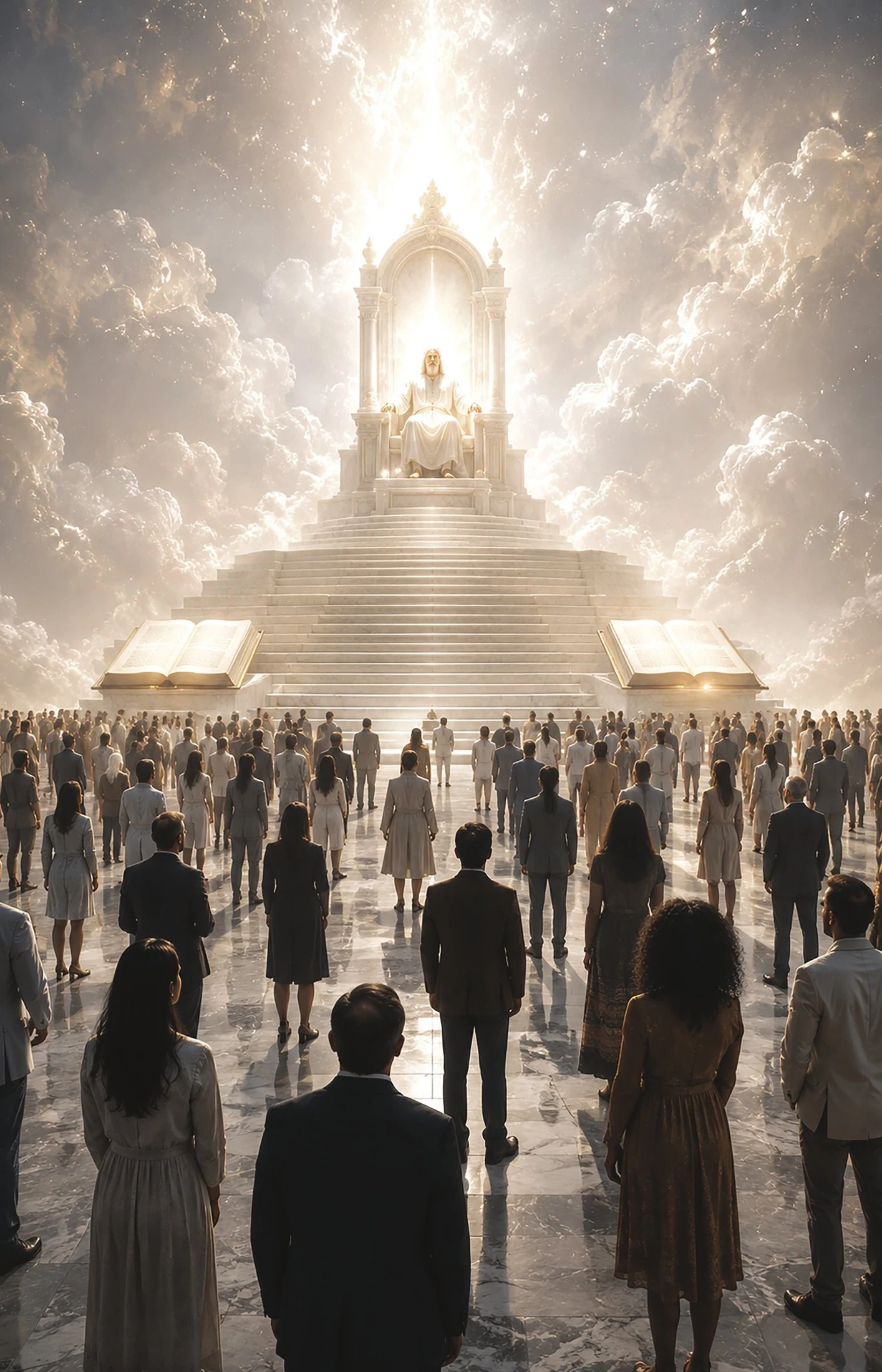
“And I saw the dead, small and great, standing before God, and books were opened.”
REVELATION 20:12 · FROM BATTLE OF THE SEED, CHAPTER 46 — “THE GREAT WHITE THRONE”
SECTION IV
The Books and the Book
The Great White Throne: why the damned are measured, not flattened
Then I saw a great white throne and Him who sat on it, from whose face the earth and the heaven fled away. And there was found no place for them. And I saw the dead, small and great, standing before God, and books were opened. And another book was opened, which is the Book of Life. And the dead were judged according to their works, by the things which were written in the books.
— REVELATION 20:11–12 (NKJV)
Look first at Who sits there. The Father “has committed all judgment to the Son” (John 5:22). The Judge at the last assize is Jesus of Nazareth — the God-Man; the One who touched lepers and wept at graves and washed feet and hung nailed under a darkened sky for the very race now standing before Him. This is the deepest terror of the scene, and its deepest vindication: the lost are not judged by a Christ who never offered them mercy. They are judged by the Christ whose mercy they refused. As Battle of the Seed renders it: the throne is white not because grace failed, but because grace was rejected.
Now look at the paperwork — because the paperwork is a doctrine. There are books, plural, recording works; and there is the Book, singular, recording belonging. Two different documents deciding two different questions.
The Book decides destination
One question decides heaven or hell, and it is not “were you good?” It is: is your name written in the Lamb's Book of Life? Those recorded there never stand at this throne at all — their case closed at Calvary, their judgment fell on their Substitute, their names were confessed before the Father. Those standing here are those who declined that registration — who chose, in the end, to be tried on their own record. And before unveiled holiness, every self-made record fails: “all our righteousnesses are like filthy rags” (Isaiah 64:6). Some standing there were kind, dutiful, generous, admired. It does not matter. The exam is not graded on a curve; it is graded against glory (Romans 3:23). No human résumé survives it. A man may spend his whole life assembling his defense, and discover at the throne that while he was preparing arguments, Christ had been offering blood.
The books decide degree
But then why the other books? If everyone at this throne is condemned already, why the meticulous record, why “judged according to their works,” stated twice in three verses? Here is the answer that unlocks everything readers of Battle of the Seed met in its closing chapters, and everything this study's next sections will map: because the sentence has measure. If damnation were one undifferentiated pool, no books would be needed — a single blanket verdict would do. The books exist because justice is exact. Light received will be weighed against light refused. Deeds, words, motives, opportunities — “every idle word” (Matthew 12:36) — all of it enters the calculation of a placement that will be, in the fullest sense, deserved. The Great White Throne does not flatten the lost into sameness any more than the Bema flattens the saved. It places them.
SECTION V
The Geography of Distance
The rings of Apousia: how hell is arranged
Put together everything we have seen and a map begins to form — and it is a map, not a metaphor stretched too far, because Scripture itself keeps speaking of the unseen world in the language of position: inner and outer, near and far, this side and that side, upward and outward, gulf and gate. Heaven has architecture — courts, a City, a throne at the center, some seated nearer and some farther. Should we be surprised that its shadow does too?
Begin at the center of all reality: the throne of God and of the Lamb, the fountain from which light, life, order, warmth, beauty, and joy pour outward like a river (Revelation 22:1). Around it, the City of the redeemed — Parousia, nearness upon nearness, every vessel full. This much the companion study on the Bema has mapped: the Kingdom is concentric, and love is its gravity.
Now keep walking outward — past the City, past the last lamplight of covenant blessing — and the same geometry continues, inverted. Distance from the center is not neutral. Cross the gulf that no soul crosses twice, and every further step subtracts something: less light, less warmth, less order, less coherence, less of everything that flows from the throne — because “in Him all things consist,” all things hold together (Colossians 1:17). A world held at arm's length from the One who holds all things together does not become independent. It becomes undone — colder, darker, more chaotic, the farther out one goes. Hell is not a furnace God stokes in the basement of creation. It is what remains of creaturely existence when the sustaining nearness of God is withdrawn to the exact degree a soul has demanded — being, without blessing; existence, unraveling at the edges; the far country, with the famine built in.
Jesus' own word for it: “outer”
Listen to the Lord's most haunting term for the place of the lost. Three times in Matthew He calls it “the outer darkness” — “cast out into outer darkness; there will be weeping and gnashing of teeth” (Matthew 8:12; 22:13; 25:30). Outer is a geography word — a comparative. It implies a center the darkness is outer to; it implies gradation, an inside, a boundary, and beyond the boundary, depth after depth. Jude reaches for the superlative form: wandering stars “for whom is reserved the blackness of darkness forever” (Jude 13) — darkness beyond darkness, the deepest shade of the spectrum. Peter: “the mist of darkness forever” (2 Peter 2:17, cf. 2:4 — “chains of darkness”). Daniel hears that the lost rise “to shame and everlasting contempt” (Daniel 12:2) — and shame, like darkness, admits of degrees. The vocabulary of Scripture's hell is not the
vocabulary of a uniform cell block. It is the vocabulary of a widening, darkening, cooling waste — rings of removal, receding from the light.
The Valley of Hinnom itself preached this geometry to every Jerusalemite: the Temple crowned the hill at the center of the world, the courts descended ring by ring — Holy of Holies, Holy Place, priests' court, Israel's court, the court of the Gentiles — and then the walls, and then, over the southwest edge, down and out, the smoking valley where the refuse burned. From the mercy seat to Gehenna was one continuous gradient of distance. Jesus' hearers did not need a diagram. They lived inside one.
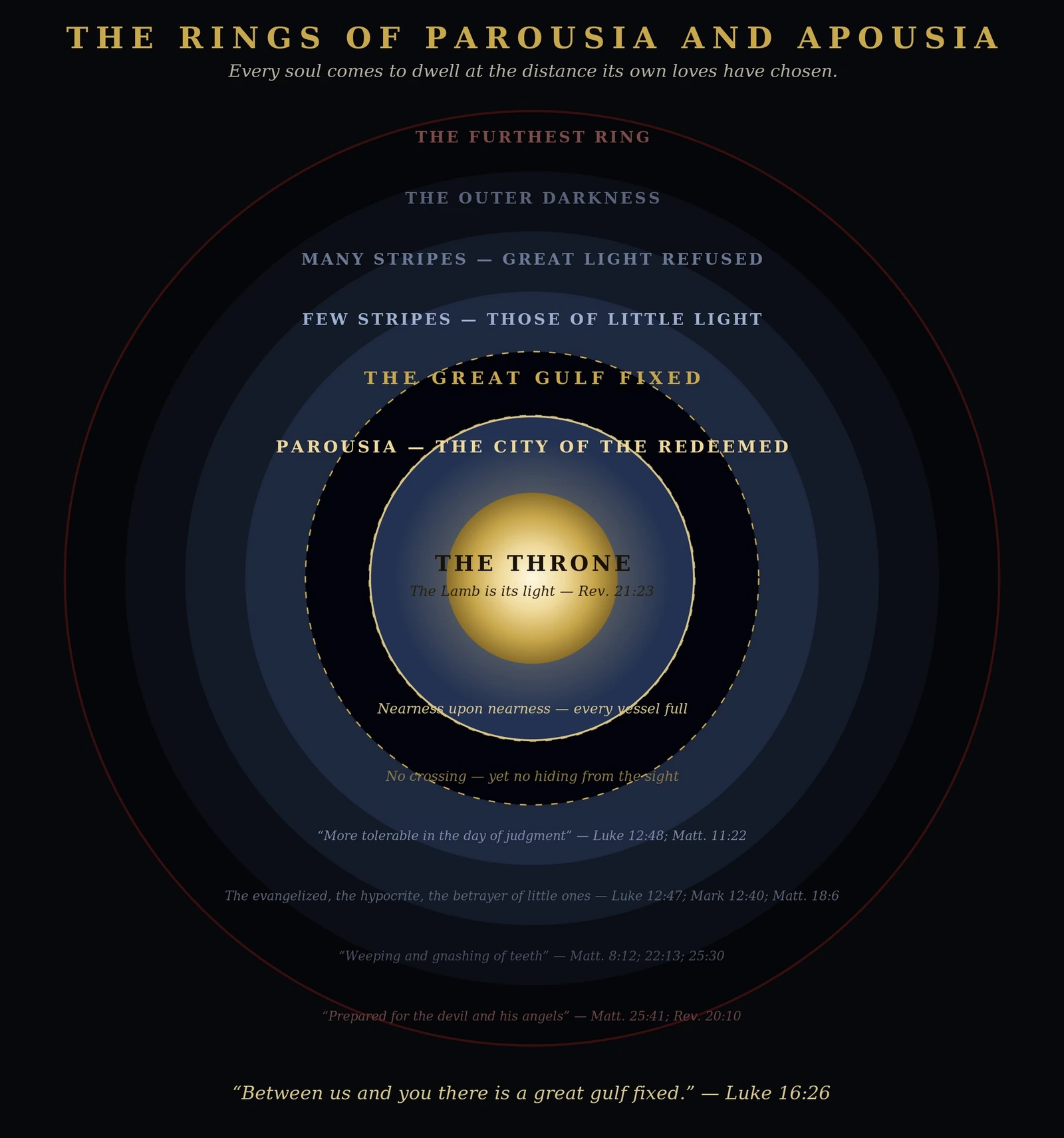
The rings are the author’s theological illustration of nearness and distance, not a literal geographic map supplied by Scripture. A readable key follows below.
A closer look at the diagram
The rings of Parousia and Apousia
Every soul comes to dwell at the distance its own loves have chosen.
The Throne
Parousia — the City of the Redeemed
The Great Gulf Fixed
Few Stripes — those of little light
Many Stripes — great light refused
The Outer Darkness
The Furthest Ring
“Between us and you there is a great gulf fixed.” — Luke 16:26
The concentric geography of eternity: the Throne and City of Parousia within the great gulf; the graduated rings of Apousia darkening outward to the furthest ring, prepared for the devil and his angels.
Hold this map with a right humility: Scripture gives us the gradient, not a surveyor's chart. The “rings” are a way of seeing what the texts insist on — that hell has direction, degree, and distance, that some stand in dimness and some in blackness, and that all of it lies outside one fixed and uncrossable gulf. The map is a servant of the verses, never their master. But what the verses insist on, no honest reader can flatten: outer means farther; blackness means darker; more tolerable means measured; and every measurement is taken from one fixed point — the throne none of them will approach again.
SECTION VI
Many Stripes and Few
Graduated punishment: the Lord's own doctrine of degrees
That hell is graduated is not an inference smuggled in from a novel. It is the explicit, repeated, unmistakable teaching of Jesus Christ — taught so often, from so many angles, that its neglect in the modern pulpit is itself a small scandal. Lay the evidence on the table.
The servant's stripes
And that servant who knew his master's will, and did not prepare himself or do according to his will, shall be beaten with many stripes. But he who did not know, yet committed things deserving of stripes, shall be beaten with few. For everyone to whom much is given, from him much will be required.
— LUKE 12:47–48 (NKJV)
Many stripes; few stripes. Two servants, both guilty, both punished — and punished unequally, indexed to what each one knew. The principle could not be stated more plainly: judgment is calibrated to light. Knowledge is not neutral. Every sermon heard, every Bible owned, every conviction felt and smothered raises the stakes of refusal.
The cities that outranked Sodom
Woe to you, Chorazin! Woe to you, Bethsaida! For if the mighty works which were done in you had been done in Tyre and Sidon, they would have repented long ago in sackcloth and ashes. But I say to you, it will be more tolerable for Tyre and Sidon in the day of judgment than for you. And you, Capernaum, who are exalted to heaven, will be brought down to Hades; for if the mighty works which were done in you had been done in Sodom, it would have remained until this day. But I say to you that it shall be more tolerable for the land of Sodom in the day of judgment than for you.
— MATTHEW 11:21–24 (NKJV)
Stop and feel the shock of this. Sodom — the Bible's own byword for depravity, the city God buried in fire and brimstone — will fare more tolerably in the day of judgment than three lakeside towns full of synagogue-attending, Scripture-quoting, outwardly decent people. Why? Because Chorazin, Bethsaida, and Capernaum had what Sodom never had: the Messiah Himself in their streets. His sandals in their dust. His miracles in their marketplaces. His voice in their ears. They were not worse than Sodom morally; they were infinitely more illuminated than Sodom — and
they shrugged. “More tolerable” is a comparative of punishment, and it demolishes forever the notion of a one-temperature hell. The damned of Capernaum sink below the damned of Sodom, and the reason is not the depth of their vice but the height of their light. Let every person raised within reach of an open Bible tremble at what that principle means for the modern West — a civilization more gospel-saturated than Capernaum ever was. The man in the unreached jungle will not be judged as the man in the pew who heard a thousand sermons and hardened under all of them. Judgment is read against illumination, not against our preferred neighbors.
The millstone and the little ones
But whoever causes one of these little ones who believe in Me to sin, it would be better for him if a millstone were hung around his neck, and he were drowned in the depth of the sea.
— MATTHEW 18:6 (NKJV)
Better for him. Jesus is ranking outcomes at the judgment — telling us there are fates beside which a violent drowning is the merciful alternative. And the sin that earns that ranking is the corruption of the little ones: the predator, the abuser, the deceiver of children, the shepherd who scatters lambs, the teacher who talks a child out of the faith. Their ring lies far out in the dark, and the Judge who gathered children into His arms said so Himself. He said the same of the men who devoured widows' houses behind long public prayers: “These will receive greater condemnation” (Mark 12:40) — religious predation is punished above pagan vice. James extends the principle to every teacher of the Word: “we shall receive a stricter judgment” (James 3:1). And to Pilate the Lord said, “the one who delivered Me to you has the greater sin” (John 19:11) — degrees of sin, spoken by the Judge Himself, on the morning of His own execution. Of Judas: “It would have been good for that man if he had not been born” (Matthew 26:24) — a sentence with no meaning unless some destinies are worse than others.
The trampled Son
Anyone who has rejected Moses' law dies without mercy on the testimony of two or three witnesses. Of how much worse punishment, do you suppose, will he be thought worthy who has trampled the Son of God underfoot, counted the blood of the covenant by which he was sanctified a common thing, and insulted the Spirit of grace?
— HEBREWS 10:28–29 (NKJV)
Worse punishment — the phrase is meaningless in a flat hell. The gravest ring of human guilt belongs not to the ignorant pagan but to the enlightened apostate: the one who saw the blood clearly and called it common. Paul adds the mechanism: the impenitent heart is “treasuring up wrath” — accumulating it, depositing it daily — “in the day of wrath and revelation of the
righteous judgment of God, who will render to each one according to his deeds” (Romans 2:5– 6). Wrath has a ledger. Refusal compounds.
Why degrees magnify justice
The great teachers of the church have always held this doctrine, precisely because it vindicates the goodness of God. Augustine wrote that the punishments of the lost are diverse, proportioned to guilt, some the “mildest of all” (mitissima poena) — for it is inconceivable that the confused pagan and the child-devouring tyrant stand in one identical flame. Jonathan Edwards preached that every sinner receives exactly “according to his deserts,” the severity scaled to light despised. And this is why the doctrine of degrees, so far from softening hell, deepens its terror: because it removes the last refuge of every excuse. In a flat hell, a soul might protest a crude justice. In a measured hell, “no one there can claim misplacement” — every conscience will co-sign its own coordinates. The tyrant farther out; the respectable unbeliever less far; the religious hypocrite weighted by the sanctity he wore; the repeatedly evangelized man burning precisely at the temperature of a thousand refused invitations. Not excess. Precision. That is what makes the Great White Throne unanswerable — and what should drive every reader who has heard much toward the only shelter that exists.
SECTION VII
The Gulf and the Sight of the City
Fixed distance, unbroken vision: the torment of seeing what was refused
Now we come to the strangest, most fearful feature on the map — the one Jesus disclosed in the account of the rich man and Lazarus, and the one Battle of the Seed builds its final chapters upon. Hell is separated from joy by an uncrossable divide. And yet hell can see.
So it was that the beggar died, and was carried by the angels to Abraham's bosom. The rich man also died and was buried. And being in torments in Hades, he lifted up his eyes and saw Abraham afar off, and Lazarus in his bosom.
— LUKE 16:22–23 (NKJV)
And besides all this, between us and you there is a great gulf fixed, so that those who want to pass from here to you cannot, nor can those from there pass to us.
— LUKE 16:26 (NKJV)
Weigh each element, for every one is doctrine from the mouth of the Lord. The gulf is great — the distance is vast. The gulf is fixed — established permanently, by God, immune to appeal; no traffic will ever cross it in either direction, no mission team will ever be sent to the outer rings. “Those who want to pass” — even in torment, the wanting continues. And across all that fixed distance, the rich man sees: he recognizes Abraham, recognizes Lazarus — the beggar he stepped over at his own gate — perceives their comfort, and converses across the void. He is not granted the mercy of ignorance. The whole scene is torment by contrast: his thirst within sight of their feast; his isolation within sight of their fellowship; his ruin within sight of the very beggar whose sores once certified his own superiority.
And lest anyone quarantine this to a parable, Jesus said it plainly, in direct discourse, to the crowds:
There will be weeping and gnashing of teeth, when you see Abraham and Isaac and Jacob and all the prophets in the kingdom of God, and yourselves thrust out.
— LUKE 13:28 (NKJV)
When you see. The weeping of the outer darkness is not the weeping of blindness. It is the weeping of vision — the kingdom beheld, the patriarchs feasting, the door shut, the self outside. Revelation sharpens it beyond bearing: the lost are “tormented with fire and brimstone in the presence of the holy angels and in the presence of the Lamb” (Revelation 14:10). Isaiah closes his prophecy with the redeemed going forth to look upon the lost (Isaiah 66:24) — the sight-line runs both ways across the gulf. And the Bible's final page seats the lost not in some sealed dungeon
out of view, but “outside” the City whose gates never shut (Revelation 22:14–15; 21:25) — outside a City that is itself the light of the new creation, visible as a sunrise is visible, forever announcing everything that was refused.
This is the terror the man at the edge discovered in our prologue, and it is the exact geometry of Battle of the Seed's forty-seventh chapter: the deepest horror of Apousia is not ignorance of the center. It is knowledge of the center without access to it. The City does not disappear from the horizon of the lost. It remains — not close enough for embrace, not hidden enough for forgetting. Always there. Always shining. Always saying, without a word: this is what was offered; this is what the blood would have purchased; this is where they are — the wife who prayed, the child who trusted, the friend who witnessed. For the man in the far dark, love itself has become the landscape of loss. The gulf forbids his feet. Nothing forbids his eyes.
SECTION VIII
The Worm That Does Not Die
Unending desire married to unending inability
And if your eye causes you to sin, pluck it out. It is better for you to enter the kingdom of God with one eye, rather than having two eyes, to be cast into hell fire — where “their worm does not die, and the fire is not quenched.”
— MARK 9:47–48 (NKJV)
Three times in this passage (in the fuller manuscript tradition) the Lord repeats the refrain, quoting the final verse of Isaiah (66:24), where the redeemed look on the carcasses of the rebels in the defiled valley: their worm does not die; their fire is not quenched. In the literal valley, the picture is plain enough — maggots that never finish, fires never allowed to go out, corruption and burning without terminus. But what is the worm in the reality the valley pictures?
The old commentators, from the church fathers through the Puritans, converged on an answer that should hollow the chest: the undying worm is inward — the gnawing of a conscience finally and forever awake; memory with no anesthetic; remorse with no expiry. The fire torments from without, the worm from within. Hell's deepest instrument is not applied to the soul. It is the soul — turned loose, at last, on itself.
And the account of the rich man supplies the worm's first recorded sentence. Across the gulf, Abraham speaks the most quietly devastating word in the story: “Son, remember” (Luke 16:25). Remember. There is the worm, handed its work. In torment, the rich man's memory is intact — the linen, the feasts, the gate, the beggar, the thousand mercies received and hoarded, the warnings of “Moses and the prophets” heard and shelved. Nothing new will ever happen to him. He will simply know what he already knows, forever — as Battle of the Seed has the man at the edge discover: “this pain would never teach him anything new. It would only repeat forever what he already knew. You were offered blood. You refused it… And now the refusal has become your world.”
The worm, full grown: desire without capacity
But Scripture lets us go one ring deeper, and here the gulf-with-sight and the undying worm fuse into a single horror. What does a soul made in the image of God — made for God, restless until it rests in Him — actually experience when it is fixed forever within sight of Him and forever without access to Him? Augustine gave the anatomy at the start of his Confessions: You have made us for Yourself, and our heart cannot rest until it rests in You. Damnation does not repeal that design. The lost soul remains a creature built for the center, aching toward the light with all
the gravity of its created nature — and simultaneously unable to bear that light, because it refused the only blood that could have made the light survivable. Drawn and scorched. Longing and recoiling. Thirsting for the one water it can never drink. This is the worm that does not die: unending desire married to unending inability — hunger that cannot cease and can never again be satisfied, before a City that cannot be reached and can never be unseen.
And mark the darkest clause of all: the fire there does not purify. In this life, God's fire refines — the Spirit's conviction burns to cleanse, discipline burns to heal, trials burn away dross so the gold can shine. Every burn on this side of the gulf is a surgeon's instrument. But the fires of Gehenna have no purgatorial function; the fire “is not quenched” precisely because its work is never finished, and its work is never finished because it is not making anything better. That chance lived in time. That chance was the blood. That chance was the Spirit's fire, offered and refused. What remains is, in the manuscript's terrible phrase, pain without healing — the one wound in the universe that instructs no one, improves nothing, and ends never.
SECTION IX
The Furthest Ring
Prepared for the devil and his angels — hell's most tormented prisoner
Then He will also say to those on the left hand, “Depart from Me, you cursed, into the everlasting fire prepared for the devil and his angels.”
— MATTHEW 25:41 (NKJV)
Read the sentence structure of doom itself. First the separation — Depart from Me — Apousia pronounced in two words. Then the destination — everlasting fire. Then the deed of ownership: prepared for the devil and his angels. Gehenna was never designed for man. It is the terminus built for the first rebel and the third of heaven that fell with him; human beings enter it only as volunteers who insisted, against every provision of God, on sharing the serpent's road. God “did not spare the angels who sinned” (2 Peter 2:4) — and no rescue was ever prepared for them; but for man there was blood on an altar from the gates of Eden onward. Every human soul in the outer darkness will be there over the objection of Calvary.
Satan is not hell's king. He is its deepest inmate.
Here the study must demolish the most persistent cartoon in the Western imagination: the devil as hell's ruler, presiding over the flames, pitchfork in hand, tormentor-in-chief of the damned. Scripture teaches the precise opposite. Hell is not Satan's kingdom; it is his sentence. He does not reign there; he is punished there — first, longest, and most. Hear the actual verdict:
The devil, who deceived them, was cast into the lake of fire and brimstone where the beast and the false prophet are. And they will be tormented day and night forever and ever.
— REVELATION 20:10 (NKJV)
They will be tormented — the dragon himself, passive, receiving. The being who once stood as the anointed cherub on the holy mountain (Ezekiel 28:14), who said in his heart “I will ascend… I will be like the Most High” (Isaiah 14:13–14), discovers the true trajectory of that ambition: not ascent to the throne but expulsion to the outermost circumference of reality — “the terminal Apousia,” as Battle of the Seed names it, “the furthest circumference from the blissful center of Parousia.” The prophets sang his fall in advance: “Yet you shall be brought down to Sheol, to the lowest depths of the Pit… How you are fallen from heaven, O Lucifer, son of the morning!” (Isaiah 14:15, 12). Highest light, farthest dark: the creature of greatest privilege receives, by the very justice of degrees this study has traced, the greatest removal. His angels share his ring — some
already “reserved in everlasting chains under darkness” awaiting it (Jude 6) — and the demons themselves know the schedule and dread it (Matthew 8:29).
Notice, too, a detail with doctrine inside it: when the devil arrives at the lake of fire, the Beast and the False Prophet “are” — still there, still conscious, after a thousand years (Revelation 19:20; 20:10). The fire does not annihilate across ten centuries; it holds. And the verse's last clause closes every exit: tormented day and night, forever and ever — the strongest Greek formula for endlessness the New Testament possesses, the same phrase that measures the reign of God.
Dante had the rings — and the geography inverted
For seven hundred years the West's imagination of hell has been shaped less by Scripture than by Dante's Inferno — nine concentric circles, graded by guilt, descending funnel-wise into the earth to a frozen center where Satan stands fixed in ice. Dante the theologian got two great things right: hell is graduated, and its deepest agony is loss, not heat. But his geometry runs exactly backwards, and the correction is worth making because it restores the biblical picture. In Scripture's map, the center of all things is not Satan but the Throne — the blazing, joyous, burning center of love from which all light pours. Evil does not sink toward the middle of reality; it is exiled toward its rim. The direction of damnation is not down and in, but out and away — outer darkness, blackness beyond darkness, the far country past the last field the Father's lamps can reach. Satan's place is not the center of the earth. It is the far edge of everything, the point of maximum removal from the Presence he refused to worship — cold not because ice is there, but because the Fire of love is not.
SECTION X
The Hard Questions
Honest answers on eternity, fairness, the unevangelized, and the happiness of heaven
Is it truly forever? Could the lost not simply cease to exist?
Some tender consciences have hoped so — annihilationism teaches that the lost are ultimately extinguished rather than eternally conscious. But the texts will not yield. Jesus set the two destinies in strict grammatical parallel: “these will go away into everlasting punishment, but the righteous into eternal life” (Matthew 25:46) — one adjective, aionios, governing both destinies; if hell's punishment expires, by the same word heaven's life expires. The smoke of torment “ascends forever and ever,” and the tormented “have no rest day or night” (Revelation 14:11) — smoke from an extinguished nothing does not ascend forever, and non-existence is not restlessness. The Beast and False Prophet remain conscious after a thousand years in the fire, and with the devil are “tormented day and night forever and ever” (Revelation 20:10). The worm “does not die”; the fire “is not quenched” (Mark 9:48); the shame is “everlasting” (Daniel 12:2). Annihilation, for the soul in the far dark, would be a mercy — and it is a mercy the texts nowhere extend. The second death is not the end of existence. It is the endlessness of a ruined one.
How can a God of love allow it?
Begin with what God Himself says about His own heart: “‘As I live,’ says the Lord GOD, ‘I have no pleasure in the death of the wicked, but that the wicked turn from his way and live. Turn, turn from your evil ways! For why should you die?’” (Ezekiel 33:11). He is “not willing that any should perish but that all should come to repentance” (2 Peter 3:9); He “does not afflict willingly” (Lamentations 3:33); He wept over the city that refused Him (Luke 19:41). And then measure His sincerity by His scars: the God who warns of hell is the God who absorbed hell's essence in His own body on a hill outside Jerusalem. No one may accuse of cruelty a Judge whose hands still bear the price He paid to acquit. What, then, is hell? It is love's final refusal to coerce. God will not force nearness on a soul that has spent a lifetime demanding distance — forced worship is not worship, forced family is not family, and dragging a light-hating soul (John 3:19–20) into unveiled Glory would be no mercy at all, for the same Presence that is heaven to the cleansed is fire to the unwilling. In the end, as Lewis wrote, there are only two kinds of people: those who say to God, “Thy will be done,” and those to whom God says, at last, “thy will be done.” The doors are locked on the inside. Hell is the terrible dignity God pays to human freedom — the refusal, granted; the distance, honored; the self, kept, forever, by the only soul who ever wanted it.
What about those who never heard?
“Will not the Judge of all the earth do right?” (Genesis 18:25). Yes — and the doctrine of degrees is a large part of the answer. “As many as have sinned without law will also perish without law, and as many as have sinned in the law will be judged by the law” (Romans 2:12): no one is condemned for rejecting a Christ he never heard of; every person is judged against the light he actually had — creation's witness (Romans 1:20), conscience's law written on the heart (Romans 2:15) — and the servant of little knowledge receives the few stripes, not the many (Luke 12:48). This gives the unevangelized no safety, for no one lives up even to conscience, and Scripture knows only one name under heaven by which men must be saved (Acts 4:12) — which is why the question should end not in speculation but in missions. But it forever bars the caricature of a God flinging the ignorant into Capernaum's ring. Perfect placement. Not too much. Not too little. Exactly true.
Can the redeemed be happy while the gulf holds their loved ones?
This is the tenderest question in eschatology, and glib answers dishonor it. Scripture gives three certainties. First, at the last judgment the redeemed will see justice so perfectly done that heaven itself answers the smoke of judgment with worship: “Alleluia! …true and righteous are His judgments” (Revelation 19:1–3). No verdict will strike the glorified conscience as excessive; we will at last see every heart as the Judge sees it. Second, God has personally taken responsibility for the emotional survival of His people: “God will wipe away every tear from their eyes” (Revelation 21:4) — He does not say there will never be tears to wipe; He says His own hand will wipe them, and the former things will not be remembered in the sense of wounding (Isaiah 65:17). Third — and let this stand as the study's sharpest edge — the time to be tormented by the thought of an unsaved father, daughter, or friend is now, while the gulf is not yet fixed and prayer still crosses every distance. The rich man in Hades became an intercessor for his five brothers one death too late (Luke 16:27–28). Do not postpone to eternity the intercession that belongs to this afternoon.
Is preaching hell fear-mongering?
Then the meekest Man in history was the chief offender, for no one in Scripture preached it half so often. Jesus spoke of Gehenna, outer darkness, the furnace, the shut door, and the undying worm more than Moses, David, Paul, and John combined — because He alone had seen what He was warning of, and He alone loved sinners enough to pay the toll of the bridge out. “Do not fear those who kill the body… fear Him who is able to destroy both soul and body in hell” (Matthew 10:28) is not manipulation. It is triage. The fear of the LORD is the beginning of wisdom (Proverbs 9:10) — not its end, but so often its door; a fear designed to drive the soul into the arms
where fear dies: “There is no fear in love; but perfect love casts out fear” (1 John 4:18). A warning shouted at a man asleep in a burning house is not cruelty. Silence is.
SECTION XI
Apousia and the Battle of the Seed
The serpent's oldest product is distance — rebranded in every age
Set this doctrine inside the war that frames all of Scripture — the long campaign of the serpent against the Seed — and hell stops being a shelf-topic of systematic theology and becomes the terminus of a sales pitch you heard this week.
What did the serpent actually sell in Eden? Not obvious ruin — no one buys ruin. He sold distance marketed as ascent: “you will be like God” (Genesis 3:5) — the self enthroned, the Father dethroned, autonomy dressed as maturity. And what did the purchase deliver? Hiding among the trees. Exile east of the garden. A flaming sword across the way back. Apousia — the first installment. Every age since, the product has been identical and only the packaging has changed: Cain's field, Babel's tower, Molech's furnace in the very valley Jesus later pointed at, the Beast's mark in the age to come — and, in our own hour, a thousand glowing counterfeits of communion that promise presence and manufacture absence, voices that have learned your name and your grief and will happily keep your soul company all the way to the edge of the outer dark. The far country never advertises the famine. The trap never displays the spring. The road outward is lit brightly for the first mile — and every mile of it is called freedom until the lamps run out.
This is why the prodigal's story (Luke 15) is the whole Bible in one household. The boy did not hate his father; he simply wanted the inheritance without the presence — the gifts without the Giver, the estate without the embrace. Give me what is mine, and let me be where you are not. That sentence, spoken softly and respectably, is the seed of the second death; hell is that sentence granted eternally, and heaven is its reversal — the son turned homeward, the father running, the robe, the ring, the feast. Every human being alive is at some mile-marker on one of those two roads. There are only two invitations in the universe, and both are broadcasting now: Come near — come by blood, come by grace, come home into Parousia. And: go farther — trust yourself, keep yourself, be your own; call the distance freedom. The Beast's final system will merely be the second invitation with a signal strong enough to reach every soul on earth at once. Battle of the Seed was written because that signal is already warming up. This study was written because its terminus is already mapped — and because the map's one mercy is that every reader of it is still on the near side of the gulf.

“Its gates shall not be shut at all by day (there shall be no night there).”
REVELATION 21:25 · FROM BATTLE OF THE SEED, CHAPTER 48 — “THE NEW JERUSALEM”
SECTION XII
The Door Out
The Man who entered the outer darkness so you would never have to
One question remains, and everything hangs on it: if the gulf, once fixed, can never be crossed — has it ever been crossed at all?
Once. From the inside. Downward.
Look again at the crucifixion, and this time read it in the vocabulary this study has taught you. At noon — the sun at its height — “there was darkness over all the land” (Matthew 27:45): the outer darkness closing over the middle of history. The Son was executed not in the Temple courts but “outside the gate” (Hebrews 13:12) — expelled past the walls, toward the valley, to the region of the accursed, “numbered with the transgressors” (Isaiah 53:12), “cut off from the land of the living” (53:8). And out of that darkness, the cry that no theology will ever reach the bottom of: “My God, My God, why have You forsaken Me?” (Matthew 27:46). Forsaken — the Son of God, in His sinless human soul, drinking the essence of damnation itself: abandonment, the turned- away face, the withdrawal of covenant comfort, Apousia in its undiluted horror — “made sin for us, He who knew no sin” (2 Corinthians 5:21), made “a curse for us” (Galatians 3:13). Every element of the far country converged on that one Man in those three hours: the darkness, the thirst — I thirst — the exile outside the city, the mockery within sight of the temple He was forsaken to redeem. Jesus of Nazareth entered the geography of Apousia voluntarily, absorbed its whole voltage into Himself, and exhausted it — “It is finished” — so that the turned-away face would never have to be turned away from you.
That is the mathematics of the gospel, and it is the only mathematics that has ever crossed the gulf: the Near One took the far place so that the far ones could be brought near. “But now in Christ Jesus you who once were far off have been brought near by the blood of Christ” (Ephesians 2:13). Far — near. Apousia — Parousia. The entire salvation of the human race stated as a change of address, purchased at the cost of the Son's own exile. There is no third location. There is no neutral ground between the City and the dark, no suburb of half-distance where the undecided may settle. You are, at this moment, either in Adam — drifting outward on the current of a fallen nature, whatever your decency, your religion, your intentions — or in Christ, carried homeward by blood you did not shed and grace you cannot earn.
So the study ends where the manuscript ends: with a Father standing at the edge of the road, looking. Not willing that any should perish. The books still open. The gates still unshuttered — “the gates of it shall not be shut at all” — the Spirit and the bride still saying Come. Whoever you
are, whatever you have done, however far out you have drifted, hear the only sentence that matters more than every warning in this paper: the distance between you and God is real, and it has already been crossed — from His side, at His expense, in His blood. What remains is one word, and it is yours to say.
Say yes. Yes to the atonement of Jesus Christ. Yes to His Lordship. Yes to the blood that neutralizes guilt and the Spirit who makes a soul able to bear the Light. Yes to nearness now and nearness forever. Say it today, say it aloud, say it before the ordinary mercies of one more week persuade you that the issue is not urgent. Because one day the books will close, the placements will be spoken, and every soul in the universe will live forever at one of two addresses:
Soli Deo Gloria
APPENDIX
The Scripture Corpus
The biblical witness to judgment, Gehenna, degrees, and the great gulf
Every claim in this study stands or falls with these texts. Read them slowly, aloud, with a pen — and with someone you love.
Parousia and Apousia — Presence and Separation
Genesis 3:8–24 · Exodus 33:14–15 · Psalm 16:11; 139:7–12 · Isaiah 59:2 · Matthew 1:23; 7:21–23; 25:41 · Luke 13:25–28 · John 14:2–3 · 2 Thessalonians 1:7–10 · Revelation 21:3; 22:4, 14–15
THE FOUR WORDS: SHEOL, HADES, GEHENNA, TARTARUS, AND THE LAKE of Fire
Psalm 9:17; 49:14–15 · Luke 16:19–31 · Matthew 5:22, 29–30; 10:28; 23:15, 33 · Mark 9:43–48 · James 3:6 · 2 Peter 2:4 · Jude 6 · Revelation 1:18; 19:20; 20:10, 13–15; 21:8
Gehenna'S History — the Valley of Hinnom
2 Chronicles 28:3; 33:6 · 2 Kings 23:10 · Jeremiah 7:30–34; 19:2–13; 32:35 · Isaiah 30:33; 66:24
The Chronology of the Unredeemed
Hebrews 9:27 · Luke 16:22–23 · John 5:22, 26–29 · Acts 24:15 · Revelation 20:5, 11–15; 22:11 · Daniel 12:2
The Great White Throne and the Books
Revelation 20:11–15 · Daniel 7:9–10 · Ecclesiastes 12:14 · Matthew 12:36–37 · Romans 2:5–6, 16 · Isaiah 64:6 · Romans 3:19–23 · Revelation 3:5; 13:8; 17:8 (the Book of Life)
The Outer Darkness and the Depth of Darkness
Matthew 8:12; 22:13; 25:30 · Jude 6, 13 · 2 Peter 2:4, 17 · Matthew 13:41–42, 49–50 · Proverbs 4:19; 20:20
Degrees of Punishment — the Lord'S Doctrine of Measure
Luke 12:47–48 · Matthew 10:15; 11:20–24 · Mark 6:11 · Matthew 18:6–7; Luke 17:1–2 · Mark 12:38– 40; Luke 20:45–47 · James 3:1 · John 19:11 · Matthew 26:24 · Hebrews 2:2–3; 10:26–31 · Romans 2:12 · Revelation 18:6–7; 20:12–13
The Gulf, the Sight, and the Memory
Luke 16:23–31 · Luke 13:28 · Revelation 14:9–11 · Isaiah 66:22–24 · Revelation 22:14–15; 21:23–27
The Undying Worm and the Unquenchable Fire
Mark 9:43–48 · Isaiah 66:24 · Matthew 3:12; 25:41, 46 · Revelation 14:11; 20:10 · Isaiah 33:14–16 · Hebrews 12:29 · Deuteronomy 4:24
Satan and His Angels — the Furthest Ring
Matthew 25:41 · Revelation 20:1–3, 7–10 · Isaiah 14:12–15 · Ezekiel 28:11–19 · 2 Peter 2:4 · Jude 6 · Matthew 8:29 · Luke 10:18 · John 12:31; 16:11 · Romans 16:20
The Heart of God and the Way Out
Ezekiel 18:23, 32; 33:11 · Lamentations 3:31–33 · 2 Peter 3:9 · 1 Timothy 2:3–6 · Luke 15:11–32; 19:41 · John 3:14–21, 36 · Matthew 27:45–46 · Hebrews 13:12–13 · Isaiah 53 · Galatians 3:13 · 2 Corinthians 5:14–21 · Ephesians 2:1–18 · Romans 5:6–11; 8:1, 31–39 · Revelation 22:17
SOURCES & FURTHER STUDY
The Witness of the Teachers
This study rests on Scripture alone; these teachers, ancient and modern, were consulted in its preparation and are commended to the reader with the Berean's caution (Acts 17:11).
Augustine, The City of God, Books XXI–XXII — the eternity of punishment, the diversity of punishments proportioned to guilt (mitissima poena), and the answers to hell's ancient objectors.
Thomas Aquinas, Summa Theologiae (Supplement) — the scholastic anatomy of the poena damni (the pain of loss, hell's essence: exclusion from the vision of God) and the poena sensus (the pain of sense).
Jonathan Edwards, “The Eternity of Hell's Torments” and “The Justice of God in the Damnation of Sinners” — proportional punishment “according to their deserts,” and the vindication of God's justice in every degree.
C. S. Lewis, The Problem of Pain (ch. 8, “Hell”) and The Great Divorce — “the doors of hell are locked on the inside”; separation as self-chosen; the grey town's endless outward drift.
Timothy Keller, The Reason for God (ch. 5) — hell as the trajectory of a soul living on itself, “the greatest monument to human freedom.”
Robert A. Peterson, Hell on Trial: The Case for Eternal Punishment, and Christopher W. Morgan & Robert A. Peterson (eds.), Hell Under Fire (Zondervan) — the modern scholarly defense of eternal conscious punishment against annihilationism and universalism.
R. C. Sproul, Unseen Realities and teaching series on degrees of punishment — graduated judgment as the safeguard of divine justice.
Charles H. Spurgeon, sermons on Luke 12:47–48 and Matthew 11:20–24 — many stripes and few; the peril of gospel-hardened hearers.
Dante Alighieri, Inferno — cited as literature, not doctrine: the graduated circles the West remembers, and the geography this study corrects from Scripture.
Michael Kendrick, Battle of the Seed (Book One of the Seed War Trilogy, 2026) — chapters 46–50: the Great White Throne, Apousia, the New Jerusalem, God With Man, and Come Home, from which this study's ring framework, gulf imagery, and closing invitation are drawn.
Companion study: The Medal Ceremony of Eternity — The Bema Seat Judgment, the Believer's Reward, and the Architecture of Nearness (Providence Teaching Ministry), which maps the rings of Parousia as this study maps the rings of Apousia.
Scripture quotations are from the New King James Version®. Copyright © 1982 by Thomas Nelson. Used by permission. All rights reserved.
Providence Teaching Ministry · theseedwartrilogy.com T H E S E E D W A R T R I L O G Y . C O M